
Short answer: Choose a rotary dryer for robust, free-flowing bulk solids at high tonnage that tolerate tumbling. Choose a belt dryer when the product is fragile, shape-sensitive or needs long, zoned drying with little handling. The deciding facts are attrition, residence time control, feed variability and required temperature profile, and they should be confirmed in trials.
Last updated: 23 November 2026
This comparison is for plant owners and process engineers who dry granules, crystals, minerals, fertiliser-type solids and other chemical products and must choose between a rotary drum dryer and a continuous belt (band or mesh belt) dryer. It uses the process facts that decide the choice, a simple worked example with labelled illustrative inputs, and a checklist for supplier enquiries. Both are machines GTI manufactures, so the aim is a fit-for-process decision, not a sales position. Nothing here is a GTI performance claim.
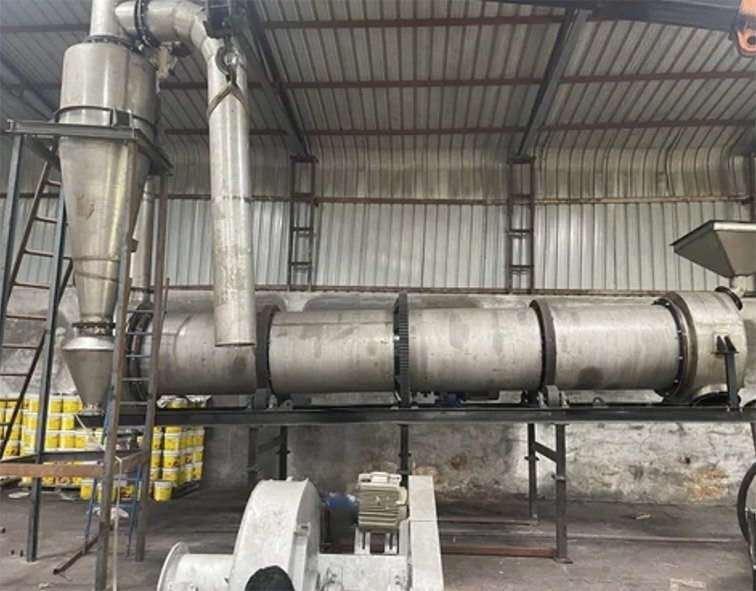
What is the difference between a belt dryer and a rotary dryer?
In a rotary dryer, wet solids move through a slightly inclined rotating cylinder. In direct-heat designs, lifting flights raise the solids and let them shower through the hot gas stream, so drying happens while the material cascades. In a belt dryer, the product lies in a bed on a moving perforated or mesh belt and passes through a series of zones where hot air is blown through the bed. In short, a rotary dryer moves and tumbles the product, while a belt dryer leaves it undisturbed on the belt.
A university study of rotary dryers in the Brazilian Journal of Chemical Engineering describes the cascading principle: solids are carried by flights and fall through the air stream, so good flight design is essential for gas-solid contact. GTI’s rotary drum dryer page lists co-current and counter-current airflow options and single-pass or multi-pass drums, and describes cascading of material through the hot air stream. GTI’s mesh belt dryer page describes product spread on a mesh belt with hot air circulating through the bed, with multi-zone temperature control. If a fluid bed dryer is also on your shortlist, our broader comparison of rotary, fluid bed and band dryers covers all three; this article goes deeper on belt versus rotary for granular and mineral solids, with a holdup calculation. See also our separate explanation of how a rotary drum dryer works.
How do belt and rotary dryers compare side by side?
| Question | Rotary drum dryer | Belt (band or mesh belt) dryer |
|---|---|---|
| How is product moved? | Rotation and flights lift and cascade it through the gas | Product rests on a moving belt, with no tumbling |
| Contact with air | Falling curtain of particles in the gas stream | Air passes through a stationary bed on the belt |
| Fragile granules or crystals | Repeated lifting and falling can cause breakage and fines | Gentler handling, suited to shape-sensitive pieces |
| Residence time control | Set by drum holdup, slope, speed, flights and airflow | Set directly by belt length and belt speed |
| Temperature profile | Mostly one drying environment, co-current or counter-current | Multiple zones with their own temperature and airflow |
| Feed that varies in size or moisture | Often tolerant, as tumbling mixes the load | Needs even spreading and a bed that air can penetrate |
| Sticky or pasty feed | May ball up or coat the shell unless back-mixed | Often needs preforming or a different dryer type |
| Dust in the exhaust | Cascading creates airborne fines, so dust collection is central | Lower agitation, but fines can fall through the mesh or leave in the exhaust |
| Typical raw material fit | Bulk solids such as minerals, sand, biomass, grains and fertiliser-type granules | Granules, flakes, extrudates, slices and chips that suit a permeable bed |
This table is general engineering guidance, not a guarantee for any product. Feed properties decide, so always confirm in a drying trial. Our guides to pilot plant testing and uneven moisture in belt dryers show what to test.
How is residence time set in each dryer?
On a belt dryer, residence time is the effective belt length divided by belt speed, which is variable by design. That makes it simple to extend or shorten drying time without changing anything else. See our guide to belt dryer sizing.
In a rotary dryer, residence time is the mass held in the drum (the holdup) divided by the solids feed rate. Holdup depends on the drum slope, rotation speed, number and shape of flights, and how the solids and gas flow. The Brazilian study above compared measured residence times with published prediction equations, which shows why designers verify rather than assume. The same paper cites a widely used design guide that the volume of solids carried by the flights should be about 10 to 15% of the drum volume.
Worked example (illustrative inputs, simplified): 2,000 kg/h of wet granular feed at 12% moisture (wet basis), dried to 2% (wet basis), with a trial showing 30 minutes of residence time is needed. Wet bulk density is taken as 800 kg/m³.
| Quantity | Calculation | Result |
|---|---|---|
| Dry solids | 2,000 × (1 − 0.12) | 1,760 kg/h |
| Dried product | 1,760 ÷ (1 − 0.02) | 1,796 kg/h |
| Water to evaporate | 2,000 − 1,796 | 204 kg/h |
| Material held in dryer | 2,000 × (30 ÷ 60) | 1,000 kg |
| Volume of that material | 1,000 ÷ 800 | 1.25 m³ |
For the rotary option, if that volume occupies about 12% of the drum (inside the 10 to 15% range cited above), drum volume is 1.25 ÷ 0.12 ≈ 10.4 m³. For the belt option, with a 0.10 m bed, bed loading is 800 × 0.10 = 80 kg/m² and effective belt area is 1,000 ÷ 80 = 12.5 m². These are two ways of holding the same 1,000 kg for 30 minutes, not a size comparison of finished machines. Real designs add allowances for shrinkage, changing density along the dryer, feed and discharge sections, and a margin that each supplier should state.
At about 2.26 MJ/kg for the latent heat of vaporisation of water near 100 °C (steam-table data such as the NIST Chemistry WebBook), evaporating 204 kg/h needs at least about 460 MJ/h, around 130 kW of thermal energy, before sensible heat and losses. That is thermal energy only. Fan, drum or belt drive and dust-collection power are electrical energy and must be counted separately. For the full method see how to calculate dryer capacity and evaporation load.
Which one causes less product breakage and dust?
Where product shape or size matters, such as granules with a crush strength specification or crystals sold by size, the belt dryer is usually the gentler choice because the bed is not disturbed. In a rotary dryer, particles are repeatedly lifted and dropped, which is how the drying contact is achieved. For hard, dense solids such as many minerals and sand, this is not a problem and is often an advantage. For friable granules it can generate fines.
Fines affect more than product quality. They load the exhaust dust collector, and for combustible dusts they raise the safety requirement. Our dryer fire and dust explosion checklist explains what to review. A belt dryer is not dust-free either: fine particles can sift through a mesh belt or be carried by the air, so mesh size and bed depth need checking in trials.
When does a rotary dryer fit better?
A rotary dryer is typically the better candidate when:
- the material is hard, free-flowing and not damaged by tumbling, such as many minerals, sand and bulk chemicals;
- tonnage is high and a continuous, robust, heavy-duty machine is preferred;
- feed size or moisture varies, and mixing through tumbling helps even out drying;
- a single drying environment is acceptable and product temperature limits are not tight.
GTI’s rotary dryer page lists grains, fertilisers, minerals, sand, wood chips, biomass, chemicals and industrial powders among suitable materials and mentions abrasion-resistant liners for mineral processing as an option. See also our rotary dryer maintenance checklist for the running-cost side.
When does a belt dryer fit better?
A belt dryer is typically the better candidate when:
- pieces are fragile or must keep their shape, such as extrudates, granules and flakes;
- different drying temperatures are needed along the process, for example gentle early drying followed by a hotter finish and cooling;
- drying must be slow and long to avoid case hardening or cracking;
- you want to set residence time directly with belt speed.
GTI’s mesh belt dryer page lists chemical salts and resins, specialty chemical granules, plastic flakes and recycled materials, and wood, pulp and biomass materials among its applications. If the feed is paste-like, it needs preforming first, as explained in our guide to preforming filter cake for belt drying. To understand the heat side, read about choosing the heat source for an industrial dryer. Some products need both: a hybrid line, such as a belt dryer followed by a cooler, or a multi-stage combination.
What should you tell a supplier before comparing the two?
- Material name, particle size distribution and shape, and whether it is friable, sticky or abrasive.
- Wet-feed capacity, initial and target moisture, stated on a wet basis, and whether the capacity means feed, product or evaporation.
- Maximum product temperature and any sensitivity to oxidation, colour change or melting.
- Required product form: size limits, crush strength, maximum fines.
- Dust, solvent and fire hazard information, including whether the dust is combustible.
- Available heat source and utilities, and installation space and height.
- Any drying trial or pilot test data you already have.
Frequently asked questions
Is a rotary dryer cheaper than a belt dryer?
It depends on duty, materials of construction and scope, so no general ranking is reliable. Compare quotations on the same basis. Our article on belt dryer cost drivers explains how to do that.
Which dryer is better for fertiliser granules?
Hard granules may suit a rotary dryer, while crush-sensitive or coated granules may suit a belt dryer. Check granule strength and fines limits and test before deciding.
Which is better for sticky material?
Neither handles very sticky feed without help. Back-mixing, preforming or a different dryer type may be needed. A drying trial is the way to find out.
Can I use the same dryer for several products?
Often yes, within limits. Check changeover cleaning, product-temperature limits and bed permeability for each product.
Does a belt dryer use less energy than a rotary dryer?
Neither is universally lower. Energy depends on heat source, air recirculation, insulation, exhaust humidity and moisture load. Our dryer energy audit guide shows how to measure and compare.
Discuss belt or rotary drying with GTI
For assistance with dryer selection, belt versus rotary comparison, processing requirements or a project-specific quotation, contact Genex Tech Industries LLP (GTI Group).
Email: mktg@gtidryers.com
Call or WhatsApp: +91-93300 77417
Website: https://gtidryers.com/
Please share your material, required wet-feed capacity, initial and target moisture, available heating source and installation location.