
Short answer: Industrial belt dryer cost is driven mainly by effective belt area, which comes from capacity and drying time, followed by materials of construction, heating system, number of zones and tiers, emission and safety equipment, and scope of supply. Operating cost is dominated by thermal energy per kg of water evaporated, then fan power and maintenance.
Last updated: 22 November 2026
Buyers often ask for “the price of a belt dryer” before the process is defined. Any number given at that stage is a rough screening figure, because two belt dryers with the same nameplate capacity can differ several times in size and specification. This guide explains what actually drives the capital and operating cost of belt, band, mesh belt and apron dryers for industrial materials such as chemicals, minerals, biomass and waste streams, how estimate accuracy improves as the project is defined, and how to compare quotations from different suppliers on a like-for-like basis. It is written for owners, procurement teams and project consultants in international projects. It does not give prices, because a price without a defined process basis would be misleading.
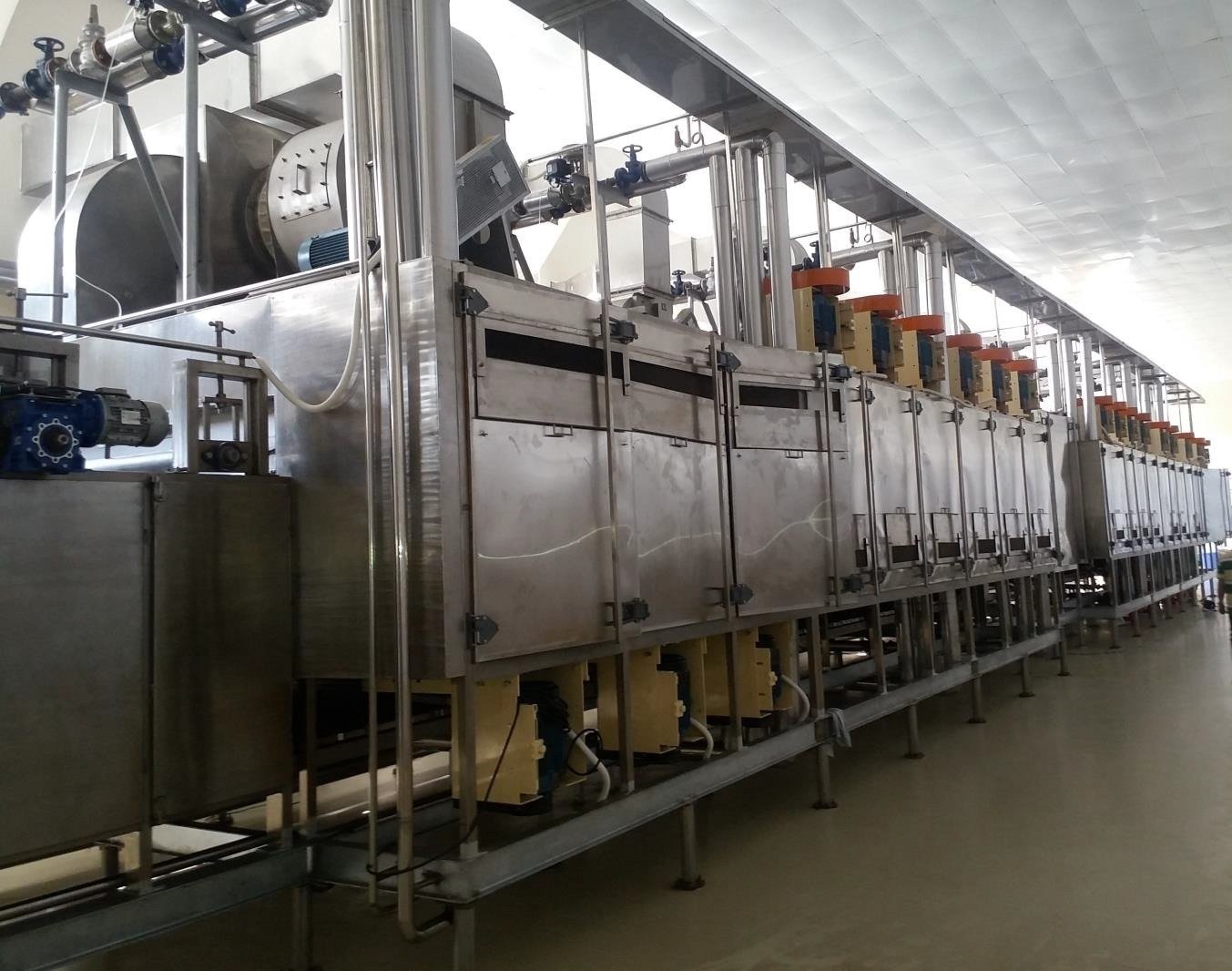
Why can’t a supplier quote a belt dryer price from capacity alone?
A belt dryer is sized by drying area, not by a catalogue capacity. The area depends on how much water has to be evaporated, how long the material needs on the belt and how deep a bed it tolerates. A material that needs 20 minutes at a deep bed can need a fraction of the belt area of a material that needs two hours at a shallow bed, even at the same feed rate. Our worked guide to belt dryer sizing shows how residence time, bed loading and evaporation translate into belt area.
That is why the first questions from any competent supplier are about the material, wet feed rate, inlet and target moisture, temperature limits and heat source, not about budget.
What drives the capital cost of a belt dryer?
The table below ranks the main cost drivers and the decisions behind them. The order is typical, not fixed; for some projects emission control or explosion protection outweighs everything else.
| Cost driver | What decides it | Questions to settle early |
|---|---|---|
| Effective belt area | Evaporation load, residence time, bed loading | Is the capacity basis wet feed, product or evaporation? Is there trial data? |
| Single-pass or multi-tier layout | Building length available, product handling | Can the product be dropped between tiers without damage? |
| Belt type | Particle size, temperature, abrasion, stickiness | Woven mesh, perforated plate or hinged apron? |
| Materials of construction | Corrosion, hygiene, product contamination limits | Mild steel, SS304 or SS316 for product-contact and air-path parts? |
| Number of zones and control | Need for different temperatures or humidity along the belt | How many independently controlled zones are really needed? |
| Heating system | Available utility and its temperature | Steam, thermic fluid, direct or indirect gas, biomass or waste heat? |
| Heat recovery | Energy price, exhaust temperature and humidity | Is recovery worth the extra equipment at your energy cost? |
| Dust, odour and emission control | Product, local permits | Cyclone, bag filter, scrubber, odour treatment? |
| Safety systems | Combustible dust, solvents, fire risk | Explosion venting, isolation, spark detection, inerting? |
| Feeding and discharge | Feed form and downstream process | Oscillating spreader, extruder, granulator, cooler, conveyors? |
| Scope and site work | Contract model and location | Erection, insulation, ducting, electrical, commissioning, freight? |
GTI’s band dryers are offered in MS, SS304 and SS316 construction with steam, thermic fluid, hot air generator or electric heating, and single or multi-zone arrangements, so these choices are made project by project rather than taken from a fixed price list.
Belt type and materials
Mesh belts suit granular, extruded and pelletised products that form a permeable bed. Perforated plate or hinged apron belts suit heavier, wetter or abrasive feeds, and some pastes that are first formed into strands. Upgrading product-contact parts from mild steel to stainless steel adds cost but may be essential for corrosive chemicals, fertiliser salts or products with contamination limits. Specifying SS316 everywhere “to be safe” is a common way to overspend; specify by zone and component instead.
Heat source
The heat source affects both capital cost and running cost. Steam coils or thermic fluid heaters are simple if the utility already exists on site. A dedicated hot air generator or biomass furnace adds equipment but may be cheaper to run where fuel is cheap. Waste heat can cut fuel cost but needs heat exchangers sized for low temperature differences. Our guide to dryer heat source selection compares these routes.
Safety and compliance
Combustible dusts such as dry biomass, some organic chemicals and pigments can create fire and explosion hazards. Protection measures such as venting, isolation and detection add cost and must be designed in from the start (OSHA combustible dust guidance). For equipment going to the European Union, equipment intended for use in potentially explosive atmospheres falls under the ATEX Directive 2014/34/EU, which affects design, documentation and cost. Our article on dryer fire and dust explosion prevention explains the main layers of protection.
What drives the operating cost of a belt dryer?
For most hot-air belt dryers, operating cost is dominated by heat. The theoretical minimum is the latent heat of the water evaporated, from about 2,260 kJ per kg at 100 °C to about 2,500 kJ per kg near 0 °C. Real dryers need more, because exhaust air leaves warm and humid, the product and solids are heated, and walls and leaks lose heat.
The main operating cost drivers are:
- Specific thermal energy (kJ per kg of water evaporated). Mostly set by exhaust air flow and temperature, air recirculation and heat recovery. The US DOE process heating sourcebook describes exhaust and wall losses and recovery options.
- Fan power. Air flow multiplied by pressure drop. Deep beds and fine filters raise pressure drop.
- Upstream dewatering. Every kg of water removed mechanically before the dryer is usually far cheaper than evaporating it.
- Maintenance and wear parts. Belts, bearings, seals, filter bags and drives. See our belt dryer maintenance checklist.
- Labour and cleaning. Product changeovers and cleaning time reduce available operating hours.
Track specific energy consumption once the dryer is running; our guide to a dryer energy audit explains how.
How accurate is a belt dryer budget estimate?
Estimate accuracy depends on how well the project is defined. The cost estimate classification published by AACE International (Recommended Practice 18R-97) gives typical accuracy ranges for the process industries, at about 80% confidence:
| Estimate class | Typical use | Typical accuracy range |
|---|---|---|
| Class 5 | Concept screening | −20% to −50% / +30% to +100% |
| Class 4 | Study or feasibility | −15% to −30% / +20% to +50% |
| Class 3 | Budget authorisation | −10% to −20% / +10% to +30% |
| Class 2 | Control or bid | −5% to −15% / +5% to +20% |
| Class 1 | Check estimate or bid | −3% to −10% / +3% to +15% |
A “price” given from capacity alone, before trials and a defined heat source, belongs at the screening end of this scale. Treat it as an order-of-magnitude figure, not a basis for investment approval.
How should you compare belt dryer quotations?
Quotations that look very different in price often differ in scope. Before comparing numbers, put every offer on the same basis.
- Confirm the design basis. Same wet feed, inlet and outlet moisture, product temperature limit, ambient conditions and heat source.
- Compare effective belt area and bed depth. A lower price with much less area may mean a shorter residence time assumption. Ask what it is based on.
- Compare guaranteed figures. Which figures are guaranteed (capacity, outlet moisture, specific energy) and under what test conditions?
- Check materials by component. Belt, frame, air path, heaters, ducting, insulation cladding.
- List exclusions. Civil work, structural steel, ducting to stack, emission control, electrical cabling, utilities, erection, commissioning.
- Check delivery terms. International quotations should state the Incoterms rule (for example FOB, CIF or DAP), which decides who pays freight, insurance and import costs.
- Ask for the energy basis. A dryer with lower capital cost and higher kJ per kg can cost more over its life.
- Check spares, training and service support. Especially for installations far from the supplier.
For projects where the buyer wants one party responsible for the whole line, compare the supply-only route with a turnkey or EPC contract; our partner site explains the trade-offs in EPC versus supply-only dehydration contracts, and GTI’s turnkey drying solutions guide describes the stages involved. For a general view of dryer pricing across technologies, see our industrial dryer cost guide.
How can you reduce belt dryer cost without losing performance?
- Run trials first. A measured residence time avoids paying for belt area “just in case”.
- Dewater mechanically as far as practical. Less water to evaporate means a smaller dryer and lower fuel cost.
- Specify materials by zone. Use stainless steel where corrosion or contamination requires it.
- Match zones to the drying curve. Extra zones add fans, heaters and controls; use only as many as the process needs.
- Evaluate heat recovery against your energy price. It pays where fuel is expensive and operating hours are long.
- Define the scope clearly. Late additions to scope cost more than items in the original enquiry.
Frequently asked questions
Is a multi-tier belt dryer cheaper than a single-pass one?
Not necessarily. It needs the same drying area but less floor length. It can save building cost but adds transfer points and access platforms.
Does stainless steel always increase belt dryer cost a lot?
It increases material and fabrication cost. The impact depends on how much of the dryer is upgraded, which is why specifying by component matters.
Why do two quotations for the same capacity differ so much?
Usually because of different belt area assumptions, materials, heat source, emission equipment or scope exclusions. Compare the design basis first.
What information gets the most accurate quotation?
Trial data or samples, the full design basis and a clear scope list. See the enquiry details below.
Can GTI supply a belt dryer for export projects?
GTI (Genex Tech Industries LLP) designs and manufactures belt and band dryers and supports international enquiries. Share your design basis for a project-specific offer.
Request a belt dryer quotation from GTI
For assistance with dryer selection, processing requirements or a project-specific quotation for a belt, band or mesh belt dryer, contact Genex Tech Industries LLP (GTI Group).
Email: mktg@gtidryers.com
Call or WhatsApp: +91-93300 77417
Website: https://gtidryers.com/
Please share your material, required wet-feed capacity, initial and target moisture, available heating source and installation location.