
Purchasing a dryer is not the same as delivering a working drying plant. Moisture targets, utilities, feeding, exhaust treatment, controls, installation quality and operator training all decide whether the line runs on specification — or becomes a permanent bottleneck.
Turnkey industrial drying solutions close that gap by placing process design, equipment selection, system engineering, supply, installation support and commissioning under a defined scope. This page explains what buyers should expect, which problems turnkey delivery solves, and how to structure a project so accountability stays clear.
Quick answer: A turnkey drying solution covers the path from process study and technology selection through detailed engineering, manufacturing, installation and commissioning to agreed performance basis. GTI Dryers supports end-to-end drying projects with process-data-led design and clear scope boundaries.
1. The Real Problem Turnkey Delivery Solves
| Fragmented supply problem | Turnkey response |
|---|---|
| Dryer sized without real moisture basis | Process study defines evaporation load first |
| Feeder, ducts and filters bought separately and mismatched | System engineering balances the line |
| “Erection by others” with unclear interfaces | Installation scope and responsibilities documented |
| Commissioning arguments over what was promised | Performance basis written into the contract assumptions |
| Operators untrained on recipes and cleaning | Commissioning includes operating guidance |
| After-sales orphaned across multiple vendors | Single process partner for the drying system |
Turnkey is not a marketing word. It is a scope and accountability model.
2. What “Turnkey Drying” Should Include (Buyer Map)
| Phase | Typical activities |
|---|---|
| 1. Process study | Feed form, moisture in/out, capacity, quality limits, utilities, constraints |
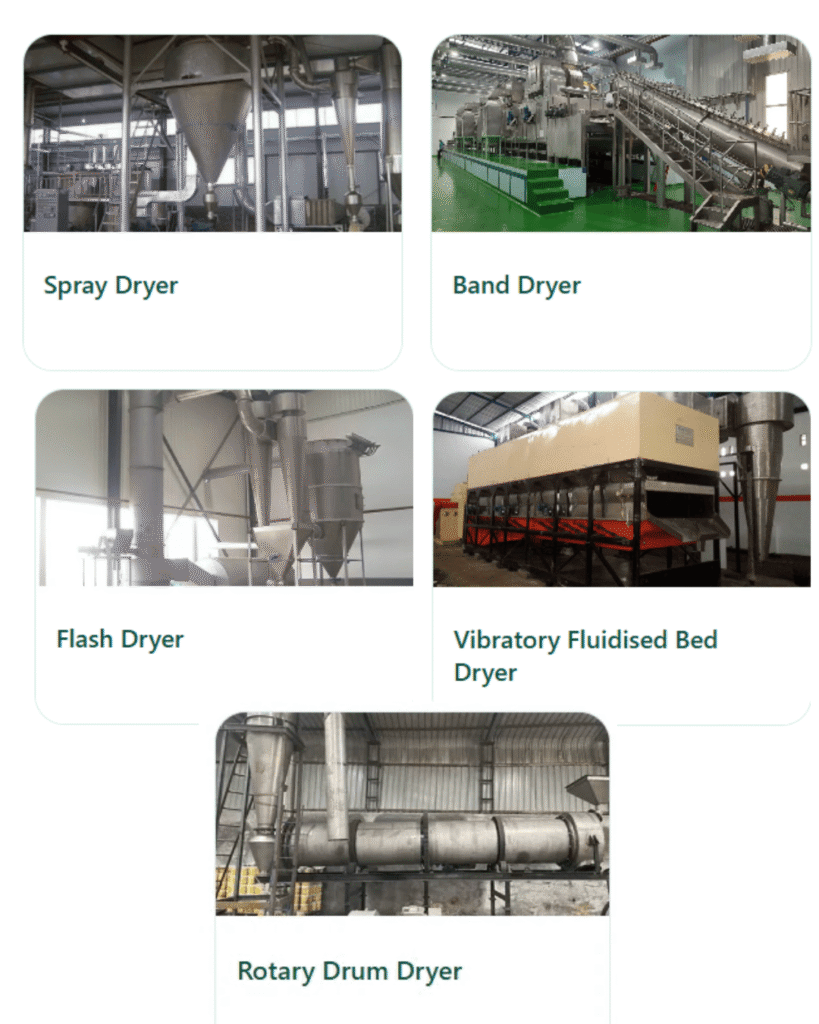
| 2. Technology selection | Band, fluid bed, rotary, flash/spin-flash, spray, contact, or hybrid multi-stage |
| 3. System engineering | P&ID-level thinking, heat & mass balance assumptions, layout, safety |
| 4. Detailed design & manufacturing | Equipment fabrication, materials, drives, instrumentation |
| 5. Automation & controls | Recipes, interlocks, basic or advanced PLC/SCADA as specified |
| 6. Installation & erection support | Mechanical/electrical interfaces, supervision or agreed installation package |
| 7. Commissioning | Cold/hot trials, moisture verification, operator familiarisation |
| 8. After-sales | Spares logic, service response, process support for optimisation |
Exact inclusions must be listed in the offer. “Turnkey” without a scope table is incomplete.
3. Phase-by-Phase: What Good Looks Like
Phase 1 — Process study
Buyer outcome: A shared design basis.
- Product identity and feed form
- Inlet and target residual moisture (method stated)
- Continuous and peak capacity
- Maximum product temperature / quality assays
- Heat source options and emission limits
- Hygiene, corrosion, containment needs
Without this, every later phase is guesswork.
Phase 2 — Equipment & line selection
Buyer outcome: Technology matched to feed form — not to a favourite catalogue item.
Examples:
- Pieces/flakes → continuous band / multi-zone belt
- Free-flowing granules → fluid bed / VFBD
- Robust bulk crystals → rotary
- Sticky cakes → spin-flash / contact
- Pumpable slurries → spray
- Hybrid lines when one stage cannot meet the full moisture path
Phase 3 — System engineering
Buyer outcome: The dryer works with its feed, exhaust, utilities and controls.
- Evaporation load and zone/stage balance
- Fan and duct pressure design
- Powder/dust recovery
- Condensate / odour / emission interfaces where relevant
- Layout for maintenance access and cleaning
- Defined battery limits (what GTI supplies vs client civil/utilities)
Phase 4–5 — Build and automation
Buyer outcome: Equipment and controls reflect the design basis.
- Materials of construction stated
- Instrumentation for temperature, and moisture strategy as agreed
- Recipe capability for multi-product plants
- Safety interlocks for over-temperature, fan failure, overload
Phase 6–7 — Installation and commissioning
Buyer outcome: Documented start-up against agreed tests.
- Installation quality checks
- No-load and load trials
- Residual moisture verification on real feed
- Punch-list closure
- Operator orientation on normal and upset operation
Phase 8 — After-sales
Buyer outcome: Continuity after handover.
- Critical spares list
- Service support path
- Process advice when feed moisture or product mix changes
4. Problem–Solution Map for Project Buyers
| Problem | Cause in non-turnkey buys | Turnkey discipline |
|---|---|---|
| Dryer never hits moisture | Wrong basis or missing after-dryer/cooler | Moisture path designed as a system |
| Chronic dust or emissions issues | Filters treated as optional extras | Recovery included in system design |
| Commissioning delays | Interfaces undefined | Battery limits and responsibilities written early |
| Energy higher than expected | Over-drying, leakage, poor dewatering upstream | Process study challenges feed moisture and targets |
| Quality complaints after start-up | Temperature profile not validated | Trial plan and product limits in design basis |
| Vendor blame circle | Split mechanical/electrical/process supply | Single drying-system accountability for agreed scope |
5. What Turnkey Is — and Is Not
Turnkey drying solutions typically cover the drying system within agreed battery limits: process design for the dryer line, equipment, key auxiliaries, controls as specified, installation support and commissioning of that system.
They do not automatically include (unless purchased):
- Civil buildings and foundations
- Upstream process plants (reactors, crystallisers, ETPs) beyond interface definition
- Plant-wide utilities generation (boilers, substations) beyond connection points
- Product registrations, environmental consents or legal waste classification
- Guaranteed plant OEE independent of client feed quality and operating discipline
Honest scope prevents disputes.
6. How to Structure a Turnkey RFQ
- Product and feed form
- Moisture in/out and analytical method
- Capacity continuous/peak
- Quality limits (temperature, PSD, colour, purity)
- Utilities available on site
- Required codes/standards and documentation
- Installation model (client erects with supervision vs broader package)
- Commissioning success criteria
- Training expectations
- Spares and service expectations
- Which auxiliaries are in scope (coolers, conveyors, cyclones, scrubbers)
Ask for a scope matrix: Included / Excluded / Client scope.
7. Performance Basis — Avoid Ambiguous Guarantees
Agree in writing:
- Feed moisture range used for design
- Product residual moisture target and test method
- Capacity definition (wet feed vs dry product)
- Utility conditions (steam pressure, gas CV, ambient design)
- What happens if client feed is outside the stated range
A turnkey partner should welcome clarity. Vague “guaranteed performance” without basis creates conflict.
8. Hybrid and Multi-Stage Turnkey Lines
Many modern projects are systems, not single dryers:
- Spray + fluid bed finish/cool
- Spin-flash + fluid bed
- Multi-zone band lines with cooling
- Sludge drying with vapour treatment packages
Turnkey value is highest here: intermediate moisture targets, transfer design and unified controls decide success.
9. How GTI Dryers Delivers End-to-End Drying Projects
GTI Dryers designs and manufactures continuous industrial drying systems and supports turnkey-oriented project delivery for drying lines:
| Stage | GTI focus |
|---|---|
| Process discussion | Feed form, moisture path, technology fit |
| Engineering | Equipment selection, system balance, layout inputs |
| Manufacturing | Band, fluid bed/VFBD, rotary, flash/spin-flash, spray-related and contact configurations as applicable |
| Controls | Process recipes and interlocks as specified |
| Installation support | Supervision / agreed erection support model |
| Commissioning | Trial plan against stated design basis |
| After-sales | Spares and process support |
Positioning: Engineered drying solutions from India for global industries — process-led, scope-clear, without overstating civil or non-dryer plant packages.
Geographic Note
Turnkey drying projects are executed for Indian plants and export installations. Local manufacturing shortens feedback loops during fabrication and service. For overseas sites, documentation, packing, installation supervision models and commissioning travel plans should be agreed in the project schedule at the offer stage.
Frequently Asked Questions
What is a turnkey industrial drying solution?
An end-to-end scope covering process design, equipment, system engineering and commissioning of the drying line within agreed battery limits — so the buyer receives a working system, not only a machine.
Does turnkey mean zero involvement from our team?
No. Clients still provide feed data, utilities, civil works (unless included) and operating ownership. Turnkey reduces interface risk; it does not replace plant responsibility.
Can GTI supply hybrid multi-stage lines on a turnkey basis?
Yes where process data justify multi-stage design — with intermediate targets and integrated controls defined up front.
How do we compare turnkey offers?
Compare scope matrices, design basis (moisture/capacity), exclusions and commissioning criteria — not headline price alone.
What should I send to start?
Product, feed form, moisture in/out, capacity, utilities, site constraints and whether installation is to be supervised or more fully packaged.
Next Step
If you need turnkey industrial drying solutions — from process design and engineering through installation support and commissioning — share your product and capacity data. GTI will propose a technology route and a clear scope boundary for a complete drying system discussion.
Request a turnkey drying project discussion with your process and site data.
Contact the GTI Technical Team:
Website: gtidryers.com
Email: mktg@gtidryers.com
Phone / WhatsApp: +91 9330077417