
A rotary drum dryer (rotary dryer) removes moisture from bulk solids by tumbling the material in a rotating cylindrical shell while contacting it with hot gas or with a heated surface. It is one of the most widely used continuous dryers for robust, free-flowing or moderately cohesive solids at industrial tonnages.
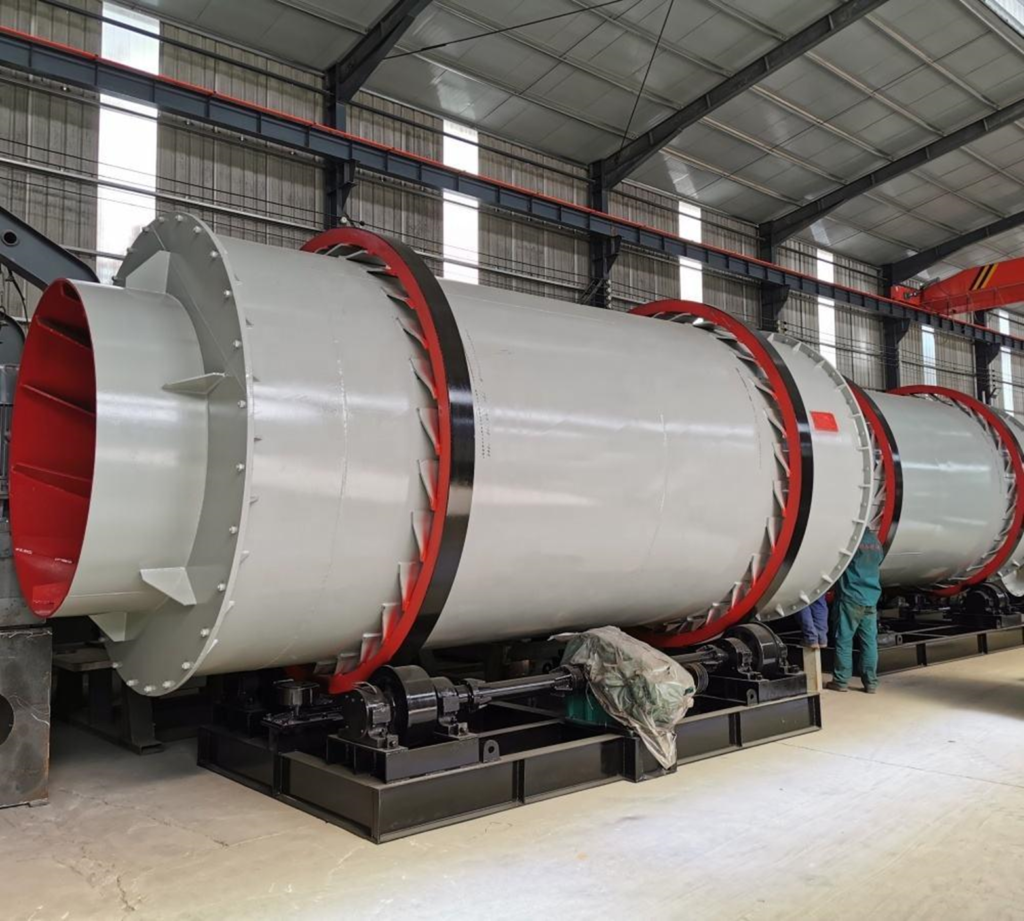
This page explains the engineering principles, the difference between direct and indirect designs, the main components, typical applications, and the practical limits buyers should understand before selecting a rotary dryer.
1. Working Principle in One Paragraph
Wet solid is fed into a slightly inclined, slowly rotating drum. Internal flights lift the material and cascade it through the drum cross-section. Hot gas flows co-currently or counter-currently (direct dryers), or heat is supplied through the shell or internal tubes (indirect dryers). Moisture evaporates; dry product discharges at the opposite end. Residence time is set by drum length, diameter, slope, speed and flight design; capacity is set by the balance of heat transfer, mass transfer and allowable product temperature.
2. Process Flow (Text Schematic)
text
[Wet feed] → [Feed chute / screw]
                    ↓
        [Rotating drum + flights]
         ↑                    ↓
[Hot gas in]              [Product out]
         ↓                    ↓
[Exhaust gas] → [Cyclone / bag filter] → [Fan / stack]
Indirect variant: Heat enters via jacket, shell, or internal tubes; process gas may be limited to sweep air rather than the main heat carrier.
(On the published page, place a labelled cutaway diagram: feed end, flights, cascading bed, gas flow direction, discharge end, drive and seals.)
3. Engineering Principles
Cascading and gas–solid contact
Flights (lifters) fixed to the inner shell wall pick up solids and shower them through the open cross-section. This increases the surface area exposed to the gas and renews the material surface. Flight shape, number and wear state strongly affect filling, cascade pattern and efficiency.
Residence time
Solids move from feed end to discharge under the combined effect of:
- Drum slope (typically a few degrees)
- Rotation speed (usually low, in the range of a few rpm — exact value is design-specific)
- Flight action and volumetric fill
Longer drums and lower effective transport rates increase residence time for harder-to-dry materials.
Heat transfer
- Direct dryers: Hot gas contacts the cascading solids; heat transfer is mainly convective. Inlet gas temperature can be high if the product tolerates it; exhaust carries both humidity and unused heat.
- Indirect dryers: Heat passes through a metal wall (shell or tubes). Product can be kept out of contact with combustion gases — important for contamination-sensitive or fine/dusty materials. Capacity often depends more on wall area and temperature difference than on gas volume.
Co-current vs counter-current (direct dryers)
| Arrangement | Behaviour | Typical use |
|---|---|---|
| Co-current | Hottest gas meets wettest solid; product temperature at discharge is closer to exhaust gas temperature | Heat-sensitive materials; reduces overheating of dry product |
| Counter-current | Hottest gas meets driest solid; higher thermal efficiency possible | Materials that tolerate higher discharge temperatures |
Mass balance
As with any dryer, evaporation load is fixed by feed rate and inlet/outlet moisture. The rotary dryer must supply enough heat transfer and residence time to meet that load without exceeding product temperature or dust limits.
4. Direct vs Indirect Rotary Dryers
| Aspect | Direct rotary dryer | Indirect rotary dryer |
|---|---|---|
| Heat source contact | Process gas contacts product | Heat through wall; minimal gas–product contact |
| Contamination risk | Combustion products may contact solids (unless clean heat exchanger gas) | Lower — preferred when product purity matters |
| Typical temperatures | Can use high inlet gas temperatures | Limited by wall metal temperature and product limits |
| Exhaust volume | Larger — carries evaporated water | Often smaller sweep-gas volume |
| Best suited to | Robust minerals, aggregates, biomass, many sludges | Finer chemicals, products needing isolation from flue gas |
Hybrid and specialised designs exist; the table covers the mainstream distinction buyers evaluate first.
5. Main Components
| Component | Role |
|---|---|
| Rotating shell | Containment and transport of solids |
| Flights / lifters | Cascade solids through the gas stream |
| Drive (motor, gearbox, girth gear or friction) | Controlled slow rotation |
| Support rollers / trunnions | Carry drum weight; allow thermal expansion |
| Seals (feed and discharge) | Limit air leakage and dust escape |
| Feed and discharge breeching | Connect stationary ducts to rotating shell |
| Burner or heat exchanger | Provide hot gas or wall heat |
| Cyclone / bag filter / scrubber | Dust recovery and emission control |
| Exhaust fan | System draft |
| Slope adjustment / design slope | Influences residence time |
6. Key Operating Variables
| Variable | Effect |
|---|---|
| Inlet gas temperature (direct) | Primary capacity driver; limited by product and materials |
| Gas flow rate | Heat supply and exhaust humidity; excess flow wastes energy |
| Drum speed | Cascading intensity and transport rate |
| Fill level | Too low → poor contact; too high → reduced cascade, possible overload |
| Feed rate and moisture | Set evaporation load; surges cause discharge moisture swings |
| Flight condition | Worn or missing flights cut efficiency and increase residual moisture variation |
7. Typical Industrial Applications
Rotary drum dryers are widely used when the solid is mechanically robust and high continuous throughput is required:
- Minerals, ores, sand, aggregates
- Fertilizers and bulk inorganic chemicals
- Biomass, wood chips, bagasse, agro residues
- Municipal and industrial sludge (with appropriate design for stickiness and odour)
- Some food and feed by-products where attrition and temperature profile are acceptable
- Bulk solids that do not require the gentle handling of a band dryer or the fine temperature profiling of multi-zone food dryers
Less suitable as first choice when:
- Product is fragile slices or flakes that must keep shape (onion, garlic, many premium spices) → prefer band/mesh-belt
- Feed is a pumpable liquid → spray dryer
- Feed is a sticky filter cake needing intense mechanical dispersion → spin-flash or contact dryers often fit better
- Very tight low-temperature colour/aroma limits with minimal attrition → evaluate band or specialised low-temperature systems
8. Common Operating Problems and Causes
| Symptom | Typical causes |
|---|---|
| High residual moisture | Insufficient heat, short residence time, worn flights, overload, wetter feed than design |
| Product overheating / degradation | Counter-current with sensitive product, excessive inlet temperature, low moisture late in drum |
| Dusting / high exhaust loading | High gas velocity, fine product, seal leakage, inadequate separation |
| Balling or sticking in drum | Sticky intermediate moisture, insufficient cascade, feed too wet for design |
| High fuel use | Excess air, poor seals, over-drying, no attention to exhaust temperature |
9. What Buyers Should Specify
- Material name and particle size range
- Inlet and target outlet moisture (state wet or dry basis)
- Continuous feed rate and peak rate
- Maximum product temperature or quality limits
- Preference for direct or indirect heating and available fuel/steam
- Dust, odour or emission constraints
- Abrasiveness or corrosiveness (affects shell, flights, seals)
- Layout limits (length, diameter, headroom)
Ask manufacturers to state the evaporation load and gas temperatures assumed in any capacity claim.
10. How GTI Dryers Approaches Rotary Drying
GTI Dryers designs and supplies rotary drying systems for bulk solids and selected industrial duties where cascading contact and high throughput are appropriate. Engineering review covers:
- Direct vs indirect selection against contamination and temperature needs
- Flight and residence-time concept for the stated moisture duty
- Integration with feed, discharge and dust collection
- Alternatives (band, fluid bed, spin-flash) when rotary attrition or temperature profile would harm product value
Rotary is recommended when process fit is clear — not as a default for every solid.
Geographic Note
Rotary dryers are installed globally in mineral, fertilizer, biomass and sludge plants. Fabrication in India is common for domestic and export projects; design must still match local fuel, emission rules and feed variability. The same principles — cascade contact, residence time, direct vs indirect — apply in every region.
Frequently Asked Questions
How does a rotary drum dryer work in simple terms?
A rotating drum tumbles wet solids through hot gas (or against a heated wall). Flights lift and cascade the material so moisture can evaporate; dry product exits the other end.
What is the difference between direct and indirect rotary dryers?
Direct: hot gas contacts the product. Indirect: heat passes through a wall so combustion gases need not touch the product.
Is a rotary dryer suitable for onion or garlic slices?
Usually not when shape and colour are commercial attributes. Band dryers are typically preferred for those products.
What controls residence time?
Drum length, diameter, slope, rotation speed and flight design — set at design stage and trimmed in operation within a limited range.
What data should I send for a rotary dryer assessment?
Material type, particle size, inlet and target moisture, capacity, heat source and any limits on temperature, dust or contamination.
Next Step
If you are evaluating a rotary drum dryer for a bulk solid, sludge or mineral duty — or comparing it with band, fluid-bed or flash options — share your material and moisture data. GTI can confirm whether rotary principles fit your application and outline a suitable configuration.
Request a rotary drum dryer suitability assessment with your process data.
Contact the GTI Technical Team:
Website: gtidryers.com
Email: mktg@gtidryers.com
Phone / WhatsApp: +91 9330077417