
Rotary dryers, fluid-bed dryers and band (belt/mesh-belt) dryers are three of the most widely used continuous drying technologies in industry. All three can remove moisture from solids at industrial scale, yet they move the product, control residence time and protect product quality in fundamentally different ways.
Selecting the wrong one produces uneven moisture, excessive fines, colour or flavour damage, high energy use or frequent operational problems. This guide gives process engineers and buyers a clear, practical framework for choosing between them.
1. Start with How the Material Moves
| Dryer | How the product moves | Typical residence-time control |
|---|---|---|
| Rotary dryer | Tumbling inside a rotating drum with internal flights | Drum speed, length, slope and gas flow |
| Fluid-bed dryer | Suspended / fluidised by upward air flow (vibration optional) | Bed length, air velocity, vibration and weir settings |
| Band / Belt dryer | Carried as a static or gently agitated layer on a moving perforated belt | Belt speed and number of passes / zones |
The movement mechanism largely determines which feeds succeed and which fail.
2. What Each Dryer Does Best
Rotary Dryer
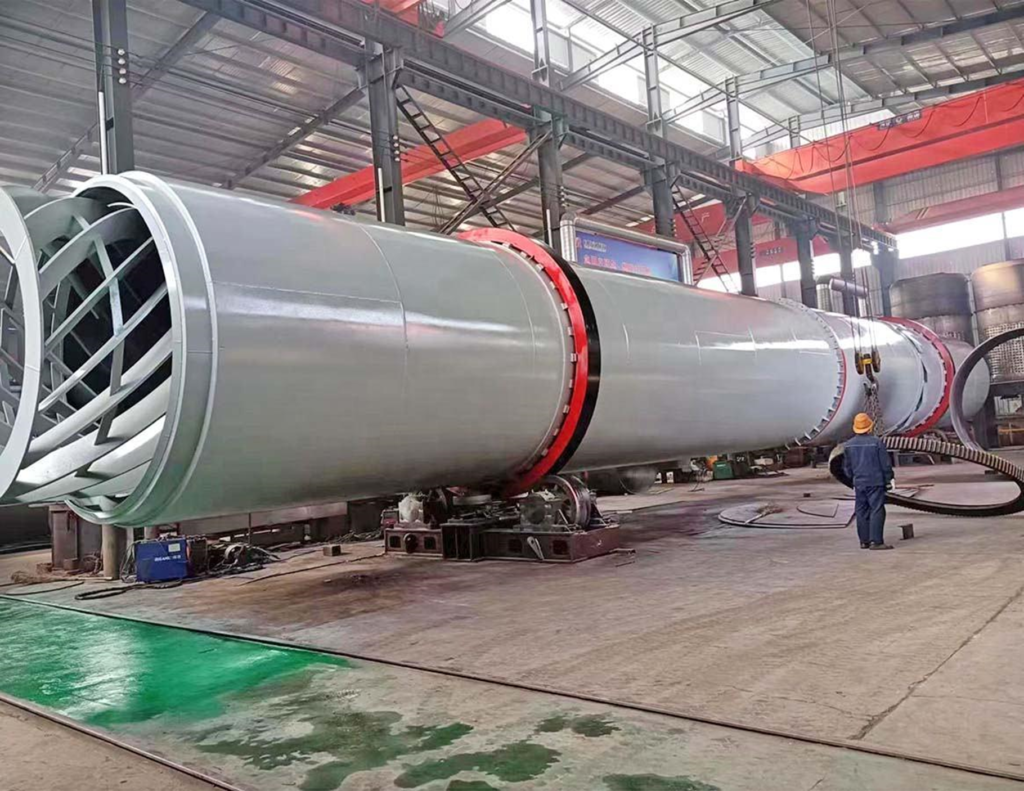
A rotating cylindrical drum fitted with lifting flights cascades the material through hot gas (direct) or over heated surfaces (indirect).
Strong candidates when
- Feed is robust, granular, fibrous or bulk solid
- High continuous throughput is required
- Material can tolerate mechanical tumbling
- Applications include minerals, sand, aggregates, certain biomass streams, salts, fertilizers and many chemical bulk solids
Limitations
- Higher attrition risk for fragile particles
- Less precise multi-zone temperature control than a band dryer
- Not ideal for thin slices, delicate food pieces or products that must retain exact shape
Fluid-Bed Dryer (including Vibratory Fluid Bed – VFBD)
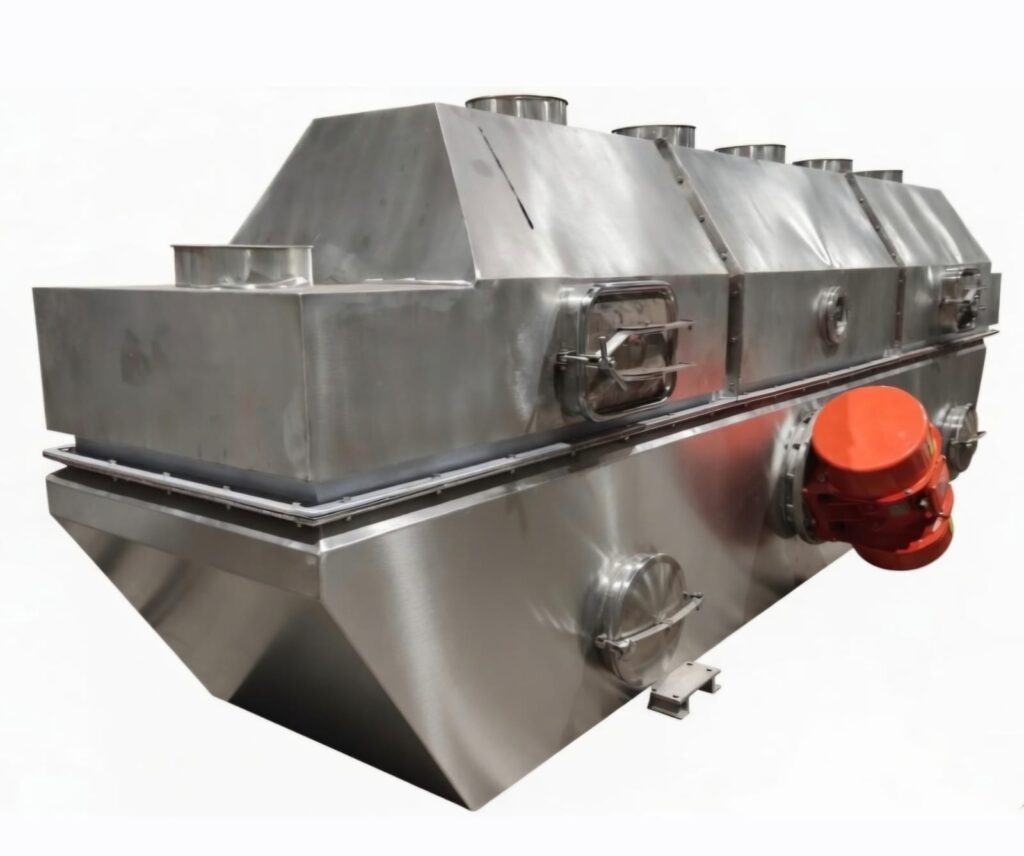
Hot air flows upward through a bed of particles, suspending them so that every particle is surrounded by drying gas. Vibration can be added to improve movement of moderately sticky or broad-size-distribution materials.
Strong candidates when
- Feed is free-flowing granules, crystals or particles that can be fluidised
- Uniform residual moisture and gentle handling are important
- Drying and cooling can be combined in one unit
- Applications include salts, sugar, starch, pharmaceutical granules, food granules, catalyst particles and many free-flowing chemical crystals
Limitations
- Cannot accept sticky cakes or large irregular pieces that will not fluidise
- Very fine cohesive powders may need special design or pre-conditioning
Band / Belt / Mesh-Belt Dryer
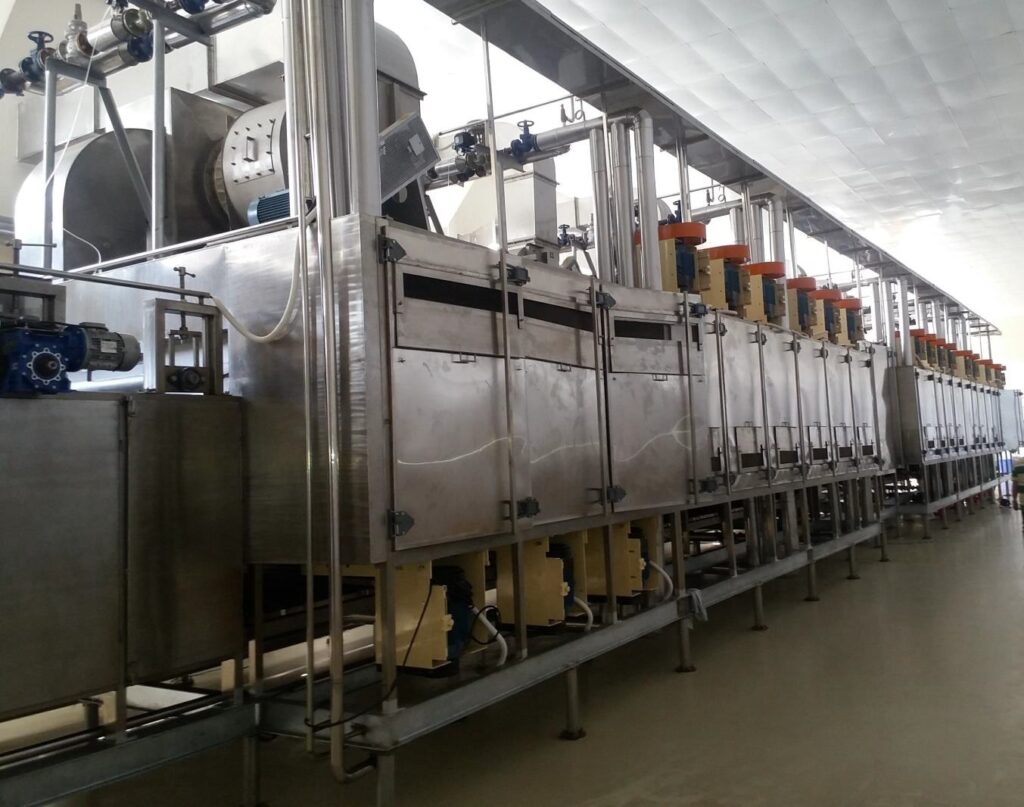
Material travels through controlled temperature and airflow zones on a perforated or mesh belt. Air can pass through the bed from above, below or both.
Strong candidates when
- Feed is sliced, diced, flaked or forms a permeable layer
- Gentle handling and precise residence-time control are required
- Multi-zone temperature profiling is needed to protect colour, flavour or activity
- Applications include onion, garlic, spices, herbs, fruits, vegetables, coconut products, pet-food pieces, certain biomass and many food ingredients
Limitations
- Lower bulk density or very high-throughput coarse minerals usually favour rotary systems
- Sticky cakes that cannot form a stable bed require pre-treatment or another technology
3. Side-by-Side Comparison
| Decision factor | Rotary Dryer | Fluid-Bed / VFBD | Band / Belt Dryer |
|---|---|---|---|
| Typical feed | Robust granules, crystals, fibrous bulk solids | Free-flowing particles and granules | Slices, flakes, pieces, permeable layers |
| Mechanical action | Cascading / tumbling | Fluidisation (+ optional vibration) | Gentle conveying on belt |
| Residence-time control | Good | Excellent | Excellent (belt speed) |
| Multi-zone temperature control | Moderate | Good | Excellent |
| Product integrity / attrition | Higher risk for fragile materials | Low to moderate | Very low |
| Integrated cooling | Usually separate cooler | Often possible in same unit | Possible |
| High bulk mineral throughput | Excellent | Good | Secondary choice |
| Heat-sensitive food / spice products | Application-dependent | Good for granules | Excellent for slices and pieces |
| Footprint | Long drum | Moderate | Long conveyor |
| Common failure mode | Over-attrition, uneven cascading | Channeling or inability to fluidise | Uneven bed loading, case-hardening |
4. Practical Decision Path
- Is the feed large, irregular pieces, slices or flakes that must keep their shape?
→ Start with a band / mesh-belt dryer. - Is the feed free-flowing granules or crystals that can be fluidised?
→ Evaluate fluid-bed or vibratory fluid-bed dryer (especially if drying + cooling is needed). - Is the feed a robust bulk solid, mineral, sand, aggregate or high-volume fibrous material that can tolerate tumbling?
→ Evaluate rotary dryer. - Does the process require both primary drying and precise finishing or multi-zone control?
→ Consider band dryer for layer products or fluid-bed for particulates; rotary may still be primary for bulk minerals. - Is the feed a sticky filter cake or paste?
→ None of these three is usually first choice; evaluate spin-flash, paddle or pre-conditioning first.
5. Common Selection Mistakes
- Installing a rotary dryer for delicate spice or vegetable slices and then fighting attrition and colour loss.
- Expecting a fluid-bed dryer to handle large irregular pieces or sticky cakes that never fluidise.
- Choosing a band dryer for high-volume coarse minerals where a rotary system would be more compact and cost-effective.
- Comparing only “kg water evaporated per hour” without checking particle integrity, residual-moisture uniformity or multi-zone needs.
- Ignoring the need for cooling after drying — fluid-bed systems often integrate it more easily.
6. India-Relevant Operating Notes
- Utilities and heat source (steam, thermic fluid, gas, biomass) influence operating cost and preferred configuration for all three technologies.
- Emission and dust norms require proper cyclone / bag-filter systems, especially for fine products from fluid-bed and rotary units.
- Space constraints in existing plants often favour the more compact fluid-bed layout over long band or rotary systems.
- Variable agricultural feeds (onion, garlic, spices, coconut) benefit from the multi-zone control of band dryers.
- High-volume mineral and salt plants continue to favour robust rotary or fluid-bed designs.
Pilot or representative-feed testing remains the most reliable way to confirm the final choice.
7. Data Required for a Correct Recommendation
- Exact material and physical form (slices, granules, crystals, bulk solid, etc.)
- Particle-size range and bulk density
- Inlet and target residual moisture
- Maximum allowable product temperature
- Required throughput (dry basis)
- Whether cooling or multi-zone profiling is needed
- Available heat source and utilities
- Dust, hygiene or emission constraints
- Downstream process (milling, packaging, storage)
How GTI Dryers Approaches the Choice
GTI Dryers designs and manufactures rotary dryers, fluid-bed and vibratory fluid-bed systems, and band/mesh-belt dryers for Indian and international industries. The engineering approach is:
- Begin with the physical state of the feed and the quality constraints of the product
- Compare the three continuous technologies against real process data
- Recommend the configuration that matches material behaviour, residence-time needs and product integrity
- Support process-data review and, where useful, trial evaluation
No single dryer is universally best. The correct system is the one that reliably converts your specific feed into the required product at acceptable operating cost and risk.
Frequently Asked Questions
Which dryer is gentlest on the product?
Band dryers are generally the gentlest for slices and pieces. Fluid-bed systems are gentle for fluidisable granules. Rotary dryers involve more mechanical action.
Can one dryer replace the other two?
Rarely. Each technology is optimised for different feed forms and movement requirements.
Is a fluid-bed dryer always more energy-efficient?
For free-flowing particulates it is often efficient. For bulk minerals or large pieces the comparison depends on the full system design and heat recovery.
When should I choose a band dryer over a rotary dryer?
When the product is heat-sensitive, must retain shape, or benefits from precise multi-zone temperature control (typical of many food, spice and vegetable applications).
What is the single most important selection question?
What is the physical form of the material as it enters the dryer, and what product properties must be protected?
Next Step
If you are evaluating rotary, fluid-bed or band drying for a new or existing plant, share your feed form, moisture figures, capacity and product requirements. GTI can review the data and recommend the most appropriate technology for technical discussion.
Request a dryer-selection assessment with your process data.
Contact the GTI Technical Team:
Website: gtidryers.com
Email: mktg@gtidryers.com
Phone / WhatsApp: +91 9330077417