
Short answer: In a vibratory fluid bed dryer, fluidisation sets the air volume: bed area multiplied by the chosen air velocity. Capacity is then limited either by the heat that air can carry in, or by the moisture it can carry out. In the worked example below, heat is the limit, so inlet temperature and bed area decide capacity.
Last updated: 23 November 2026
This guide is for process engineers and buyers comparing vibratory fluidised bed dryer (VFBD) quotations for chemical, mineral and fertiliser-type granules and crystals. It uses a worked heat and moisture balance to show how the air flow in a quotation connects to evaporation capacity, inlet temperature, exhaust humidity and energy use. It follows on from our guide to fluid bed dryer air velocity calculation, which explains how velocity and bed area are chosen. All numbers are illustrative inputs for a calculation method, not GTI performance data and not a design for any real plant.
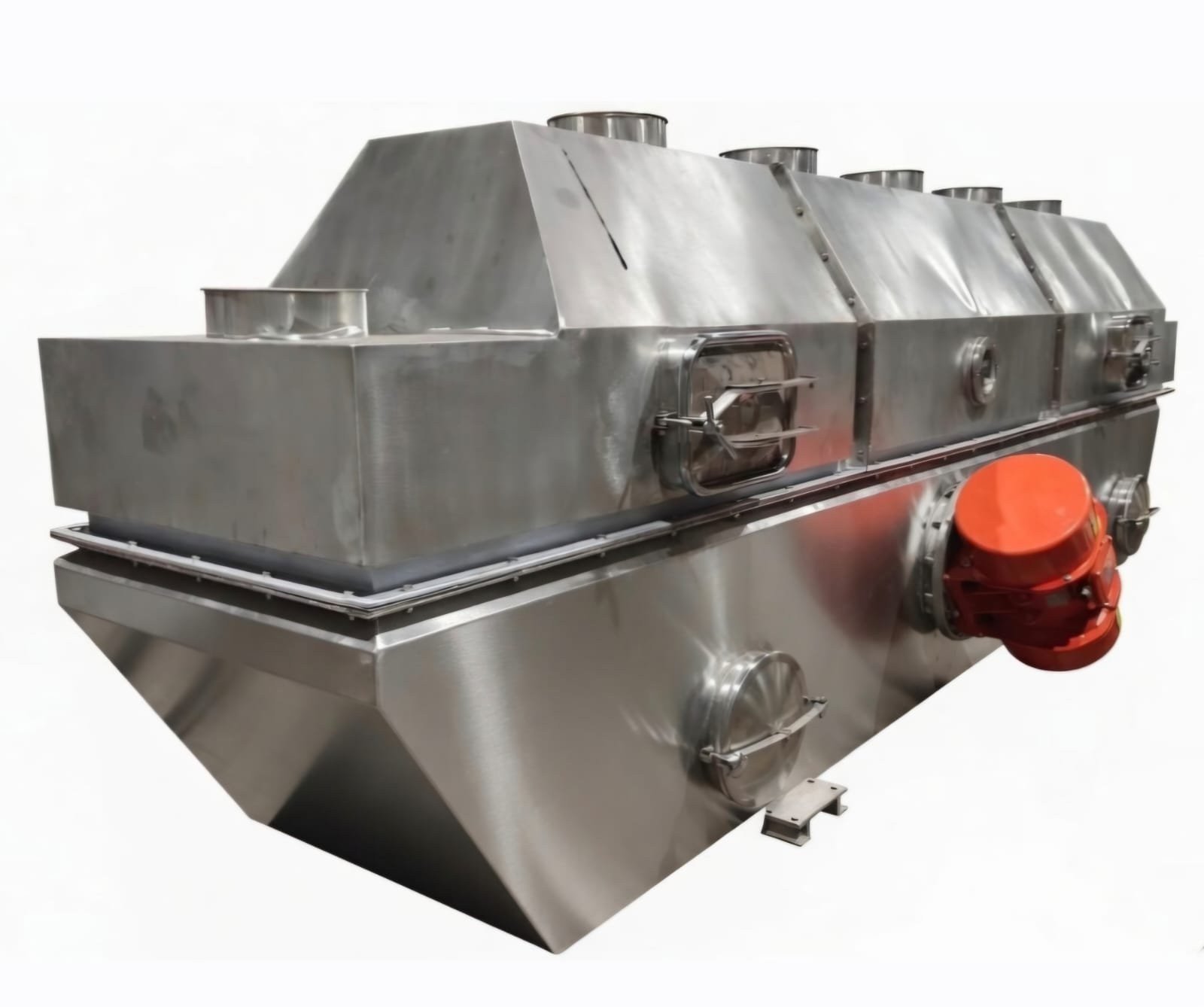
What sets the air flow in a vibratory fluid bed dryer?
The air has to lift the particles into a fluid-like state, so the air volume is fixed mainly by the bed area and the superficial velocity needed for fluidisation. Superficial velocity is the air volume flow divided by the bed cross-section. A fluidisation calculation sets the velocity range between the minimum needed to fluidise and the point where fine particles are carried out. Vibration helps move the product along the deck and supports fluidisation, and GTI’s vibratory fluidised bed dryer page lists adjustable vibration speed, airflow control and multi-zone temperature control among its design options. Because the fluidising air volume is largely fixed by the bed, the drying duty then depends on how much heat and moisture capacity that air carries.
In short, for a given bed, the air flow is a result of fluidisation, not a free setting. You can still change its temperature and humidity, and the number of zones.
Is capacity limited by heat or by humidity?
Two balances must both be satisfied.
- Heat balance: the heat given up by the air as it cools from inlet to exhaust temperature must cover the latent heat of the evaporated water, the sensible heat of the product and losses.
- Moisture balance: the exhaust air must stay below saturation, with margin, after picking up the evaporated water.
Whichever gives the lower evaporation limit is the one that governs. These are standard psychrometric methods, described in the Handbook of Industrial Drying. Water properties used below come from steam-table data such as the NIST Chemistry WebBook.
Worked example: how much heat and air does a VFBD need?
Illustrative inputs: wet feed 1,000 kg/h at 10% moisture (wet basis), dried to 1% (wet basis). Bed 0.8 m wide by 3.0 m long (2.4 m² area). Superficial air velocity 0.9 m/s at inlet conditions (assumed to come from the fluidisation calculation). Inlet air 80 °C, exhaust air 45 °C. Ambient air 30 °C at 55% relative humidity. Feed enters at 25 °C and product leaves at 45 °C.
Step 1: mass balance (wet feed, product and evaporation kept separate).
| Quantity | Calculation | Result |
|---|---|---|
| Dry solids | 1,000 × (1 − 0.10) | 900 kg/h |
| Dried product | 900 ÷ (1 − 0.01) | 909 kg/h |
| Water to evaporate | 1,000 − 909 | 91 kg/h |
Step 2: heat required. Latent heat of water at about 50 °C is about 2,382 kJ/kg (NIST steam-table data). Product sensible heat is taken with an assumed specific heat of 1.0 kJ/kg·K, and a 10% allowance is added for losses. This is thermal energy.
| Quantity | Calculation | Result |
|---|---|---|
| Latent heat | 91 × 2,382 ÷ 3,600 | 60 kW |
| Product sensible heat | 909 × 1.0 × (45 − 25) ÷ 3,600 | 5 kW |
| Total with 10% allowance | (60 + 5) × 1.10 | about 72 kW |
Step 3: air flow from fluidisation. Air volume = 2.4 m² × 0.9 m/s = 2.16 m³/s. At 80 °C the air density is about 1.0 kg/m³, so the dry air mass flow is about 2.16 kg/s, or about 7,770 kg/h.
Step 4: heat the air can supply. Heat given up = air mass flow × specific heat of humid air (taken as about 1.02 kJ/kg·K) × temperature drop. From 80 °C to 45 °C, that is 2.16 × 1.02 × 35 = about 77 kW, just above the 72 kW needed. In this example, the heat balance is only just satisfied.
Step 5: check the exhaust humidity. Ambient humidity ratio is about 0.0148 kg/kg dry air (from saturation pressure, with Antoine constants from NIST). Adding 91 kg/h to 7,770 kg/h of air raises it by about 0.0117 to about 0.0265 kg/kg. At 45 °C that is about 43% relative humidity, with a dew point of about 29 °C. The air is well short of saturation.
What does the example tell you?
| Inlet air temperature | Heat available (to 45 °C exhaust) | Approximate evaporation capacity |
|---|---|---|
| 80 °C | about 77 kW | about 98 kg/h |
| 70 °C | about 55 kW | about 68 kg/h |
| 60 °C | about 33 kW | about 38 kg/h |
The table keeps the same fluidising air flow and 45 °C exhaust, and applies the same product heating and 10% allowance. It shows that with this bed, a 70 °C inlet could not evaporate the required 91 kg/h, even though the exhaust air is far from saturated. The moisture balance alone would allow much more: at an 80% relative humidity exhaust at 45 °C, the same air could carry about 287 kg/h of water. In other words, the air is not limited by moisture capacity, it is limited by heat. Treat this as a method check, not a prediction, because real beds have air bypass, non-uniform temperature and different product heating.
How can you increase capacity when heat is the limit?
- Raise inlet temperature if the product tolerates it. The limit is product temperature, colour, melting or degradation, which only a trial can confirm.
- Increase bed area (a longer or wider deck). At the same velocity, more area means more air, and so more heat per hour.
- Use zones. GTI lists multi-zone temperature control; a hotter first zone with a cooler later zone can match the drying curve, since surface-wet product stays cooler than the air.
- Reduce the water load upstream, for example with better mechanical dewatering. See our guide to calculating dryer capacity and evaporation load.
- Cut losses with insulation and leak sealing, which also helps with condensation control.
You cannot normally cut the air flow to raise exhaust humidity, because that would reduce fluidisation. If the exhaust is far from saturation, partial recirculation of filtered exhaust air can recover heat, but it raises the inlet humidity and the dust and condensation risks, so check dew points and filter loading. Our guide to condensation in dryer exhaust ducts and bag filters covers the dew point checks, and our dryer energy audit guide shows how to measure the result.
What about electrical energy?
The fan is the main electrical load that scales with air flow. Fan shaft power is approximately air volume flow multiplied by total pressure rise, divided by fan efficiency. With the 2.16 m³/s example, an assumed 3 kPa total resistance (deck, bed, filter and ducts) and 65% efficiency, that is 2.16 × 3,000 ÷ 0.65 = about 10 kW, plus vibration drives and filter-cleaning air. Compare that with the roughly 72 kW of thermal energy: they are different energy types and must not be added without stating which is which. The US DOE Process Heating Sourcebook is a neutral general reference on process heating energy.
What should a VFBD quotation state about air and heat?
- Air volume, stated as volumetric (and at what temperature) or as mass flow.
- Inlet and exhaust temperatures for each zone.
- Thermal duty in kW and the heat source (steam, thermic fluid, hot air generator or electric heating).
- Evaporation rate and whether capacity is stated for feed, product or water evaporated.
- Bed area, bed depth and design superficial velocity.
- Fan power and total pressure, which is electrical load.
- Expected exhaust humidity and the dew-point margin for ducts and filters.
- Assumptions on product temperature, losses and recirculation.
Frequently asked questions
Why does a fluid bed dryer need so much air?
Because the air must lift and fluidise the particles, not only carry moisture. The fluidising air volume is often far more than moisture removal alone would need, which is why the exhaust can be well below saturation.
Is a VFBD heat-limited or moisture-limited?
It can be either. In the example here, with moderate inlet temperature, it is heat-limited. A very wet feed or a high-humidity ambient could change that, so run both balances.
Can I just raise the inlet temperature to dry faster?
Only within the product’s temperature limits, and you should check particle surface temperature and quality in trials. The vibratory design does not change the product’s thermal limits.
How much does exhaust humidity matter?
It affects dew-point margin, filter condition and recirculation options. Check it against duct and filter temperatures to avoid condensation.
Where can I get a VFBD sized for my product?
Send your material and capacity details to GTI. Sizing starts from your feed, target moisture and a drying trial.
Discuss VFBD air flow and heat balance with GTI
For assistance with dryer selection, vibratory fluid bed dryer sizing, processing requirements or a project-specific quotation, contact Genex Tech Industries LLP (GTI Group).
Email: mktg@gtidryers.com
Call or WhatsApp: +91-93300 77417
Website: https://gtidryers.com/
Please share your material, required wet-feed capacity, initial and target moisture, available heating source and installation location.