
Short answer: To size a belt dryer, run a mass balance to find the water to evaporate, take drying time from trials on your material, and divide the material held on the belt (feed rate × residence time) by the allowable bed loading in kg/m². That gives effective belt area. Width, length and speed follow; a heat balance sets air flow.
Last updated: 22 November 2026
This guide is for process engineers and procurement teams who need a first estimate of belt dryer size before requesting quotations. It uses a worked example on wet wood chips, a common biomass feed, and shows where trial data and engineering judgement come in. The same method works for chemical granules, extrudates and other materials that form a permeable layer on a belt. All example numbers are illustrative inputs, not GTI performance data or a design for any real plant.
What does “sizing a belt dryer” actually mean?
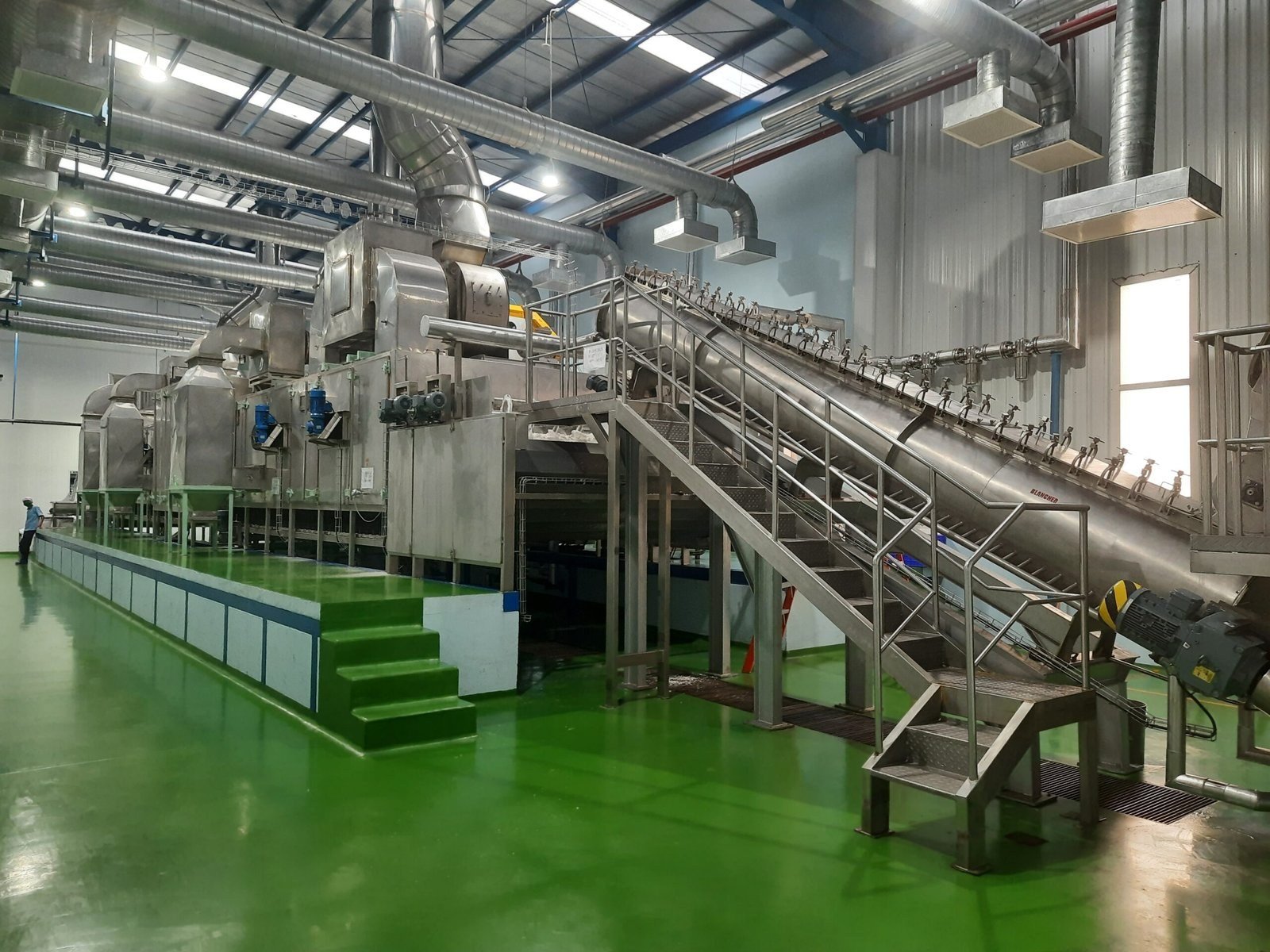
Sizing a belt dryer means fixing four things: the effective belt area, the belt width and length (and the number of tiers if the dryer is multi-pass), the belt speed that gives the required residence time, and the air flow and heat input that remove the water. In a through-circulation belt dryer, hot air passes through a permeable layer of product carried on a perforated or mesh belt, so bed depth and air velocity matter as much as temperature. GTI’s continuous band dryers and mesh belt dryers are both multi-zone machines where temperature, airflow and belt speed are set zone by zone, so the sizing figures below feed directly into the zone design.
Published design methods for conveyor-belt dryers follow the same logic: measure drying behaviour in the laboratory or pilot plant, model it, then scale up to belt area and zone conditions (see this design study in Drying Technology). Detailed treatment of conveyor dryer design is also given in the Handbook of Industrial Drying.
Step 1: How much water does the dryer have to remove?
Every sizing exercise starts with a mass balance on a wet basis. Keep three flows separate: wet feed, dried product and evaporation. Mixing them up is the most common source of undersized dryers. Our separate guide on calculating dryer capacity and evaporation load covers the theory. Here is the short version.
- Dry solids = wet feed × (1 − inlet moisture, wet basis)
- Dried product = dry solids ÷ (1 − outlet moisture, wet basis)
- Evaporation = wet feed − dried product
Worked example (illustrative inputs): 2,000 kg/h of wet wood chips at 50% moisture (wet basis) to be dried to 10% (wet basis).
| Quantity | Calculation | Result |
|---|---|---|
| Dry solids | 2,000 × (1 − 0.50) | 1,000 kg/h |
| Dried product | 1,000 ÷ (1 − 0.10) | 1,111 kg/h |
| Evaporation | 2,000 − 1,111 | 889 kg/h |
Note that “a 2 t/h dryer” could mean wet feed, product or water evaporated: three very different machines. State which one you mean in an enquiry.
Step 2: How long must the material stay on the belt?
For most real materials residence time cannot be calculated reliably from first principles. It depends on particle size and shape, bed depth, air temperature, air velocity, air humidity and how strongly the water is bound inside the material. The dependable route is a drying trial that records moisture against time at controlled conditions, ideally at the bed depth you intend to use. Our article on pilot plant testing for industrial dryers explains what a useful trial looks like.
Two points matter when you read trial results:
- Constant-rate versus falling-rate drying. Surface water evaporates quickly; water bound inside the particle is limited by internal diffusion. Higher air temperature shortens the first phase much more than the second.
- Bed depth effect. In a deep bed the air cools and picks up moisture as it passes through, so the top and bottom layers dry at different rates. A trial at 30 mm depth does not prove the same time at 150 mm.
Worked example (assumption): trials on the wood chips show that a 100 mm bed reaches 10% moisture in 40 minutes at the chosen air conditions. This figure is an assumed input for illustration only.
Step 3: How do you calculate belt area from bed loading?
Bed loading is the mass of wet material per square metre of belt. It is set by bed depth and the bulk density of the wet feed:
- Bed loading (kg/m²) = wet bulk density (kg/m³) × bed depth (m)
- Material held on the belt (kg) = wet feed rate (kg/h) × residence time (h)
- Effective belt area (m²) = material held on the belt ÷ bed loading
Worked example (illustrative inputs): wet bulk density 350 kg/m³, bed depth 0.10 m.
| Quantity | Calculation | Result |
|---|---|---|
| Bed loading | 350 × 0.10 | 35 kg/m² |
| Material on belt | 2,000 × (40 ÷ 60) | 1,333 kg |
| Effective belt area | 1,333 ÷ 35 | 38.1 m² |
This simple method assumes the bed keeps roughly the same volume as it dries, which is reasonable for wood chips but not for materials that shrink strongly. For shrinking products, designers often increase bed depth in later zones or use a multi-tier dryer where the product drops onto a lower belt, re-forming a deeper bed.
The effective area is the drying area only. Feed and discharge sections, transitions between zones and any cooling section add length. How much margin to add on top of the calculated area is a design judgement based on feed variability and trial confidence, so ask each supplier to state the margin they have used.
Step 4: How do belt width, length and speed follow from the area?
Once the effective area is known, width and length are a trade-off between building footprint, feed distribution and transport limits for shipping. For the example, a 2.5 m effective width gives:
- Effective length = 38.1 ÷ 2.5 = 15.2 m
- Belt speed = length ÷ residence time = 15.2 m ÷ 40 min ≈ 0.38 m/min
A wider belt shortens the machine but makes even spreading harder; a narrower belt needs more length or tiers. Uneven spreading is one of the main causes of moisture variation; see our belt dryer uneven moisture troubleshooting guide.
Belt speed is normally variable, so check that the speed range offered covers your worst-case feed, not just the design point.
Step 5: How much air and heat does the belt dryer need?
The air system is sized from a heat balance and a moisture balance. The heat needed is mainly the latent heat of the evaporated water plus sensible heat to warm the solids, the residual water and the water before it evaporates. Heat losses through walls and leaks are added separately.
Worked example (illustrative inputs): feed at 20 °C, product leaving at about 45 °C, specific heat of dry wood taken as 1.4 kJ/kg·K, latent heat of water about 2,382 kJ/kg at 50 °C (from steam-table data such as the NIST Chemistry WebBook).
| Heat duty | Calculation | Result |
|---|---|---|
| Evaporation | 889 kg/h × 2,382 kJ/kg | about 588 kW |
| Warming the water that evaporates | 889 × 4.18 × 25 | about 26 kW |
| Warming dry solids | 1,000 × 1.4 × 25 | about 10 kW |
| Warming residual water | 111 × 4.18 × 25 | about 3 kW |
| Total, before losses | about 627 kW |
If air enters at 90 °C and leaves at 50 °C (illustrative), with an inlet humidity of 0.010 kg water per kg dry air, the dry-air flow needed to carry this heat is:
- Dry air = 627 kW ÷ (1.024 kJ/kg·K × 40 K) ≈ 15.3 kg/s, or about 55,000 kg/h
The moisture balance then gives the exhaust humidity: 0.010 + 889 ÷ 55,000 ≈ 0.026 kg/kg. At 50 °C that is only about 33% relative humidity. In other words, a once-through design at these temperatures would throw away air that could still carry more water.
That is why practical belt dryers recirculate most of the air inside each zone and exhaust only part of it. This creates two separate air figures you should ask suppliers for:
- Circulating air flow through the bed, set by the air velocity the product can take without lifting or channelling, and by the drying rate.
- Exhaust air flow, set by the moisture balance. Less exhaust means higher exhaust humidity and lower heat losses, but the exhaust must stay safely above its dew point to avoid condensation in ducts. Our guide to dryer exhaust condensation covers that limit.
As a cross-check, 55,000 kg/h of air at 90 °C is about 16 m³/s. Spread over 38 m² of belt it gives a superficial velocity of about 0.42 m/s. Trials should confirm that this suits your material (no lifting of fines, acceptable bed pressure drop). The US Department of Energy process heating sourcebook is a useful reference for exhaust losses and heat recovery in hot-air systems.
What inputs should you send for a belt dryer sizing?
You can do a first estimate yourself, but a supplier needs the following to size a belt dryer properly:
- Material name, particle size range and shape, and whether it is sticky, dusty, fragile or combustible
- Wet feed rate, and whether this is an average or peak
- Inlet and target moisture, both stated as wet basis or dry basis
- Wet and dry bulk density
- Maximum product temperature and any quality limits (colour, odour, volatiles)
- Available heat source (steam, thermic fluid, gas, biomass or waste heat) and its temperature; see our heat source selection guide
- Site altitude and ambient conditions, and any emission or dust limits
- Existing trial data, or willingness to send samples for trials
For combustible dusts such as dry wood fines, explosion and fire protection also affect the design; see our article on dryer fire and dust explosion prevention.
Common mistakes in belt dryer sizing
- Using the wrong capacity basis. Wet feed, product and evaporation get confused.
- Scaling residence time from thin-layer tests. Bed depth changes drying time.
- Ignoring feed variability. A design based on average moisture will fail on wet days.
- Forgetting the exhaust dew point. Saving energy by cutting exhaust air can cause condensation.
Frequently asked questions
What is a typical bed depth on a belt dryer?
There is no single typical value. It depends on particle size, permeability, shrinkage and how much air pressure drop the fans can provide. Choose bed depth from trials at the intended depth rather than from another product.
Can I size a belt dryer from evaporation rate per square metre?
Yes, if you have a reliable evaporation rate per m² measured on your material at the same bed depth and air conditions. Dividing total evaporation by that rate gives belt area. Without that data, the residence-time method above is safer.
Does a multi-tier belt dryer need less area?
No. It needs the same effective drying area but stacks it on several belts to shorten the machine. Transfers between tiers also turn the product over.
Why is my calculated air flow so high?
Once-through air flow based only on a temperature drop is high because exhaust air leaves far from saturation. Practical dryers recirculate air and exhaust only what the moisture balance requires.
Is a belt dryer the right choice for my material?
Belt dryers suit materials that form a permeable bed and need gentle handling or long residence time. Fine powders that pass through the belt, or very sticky pastes, often suit other dryers. Our continuous band dryer selection guide and biomass drying systems page compare the options.
Request a belt dryer sizing from GTI
For assistance with dryer selection, belt dryer sizing, processing requirements or a project-specific quotation, contact Genex Tech Industries LLP (GTI Group).
Email: mktg@gtidryers.com
Call or WhatsApp: +91-93300 77417
Website: https://gtidryers.com/
Please share your material, required wet-feed capacity, initial and target moisture, available heating source and installation location.