
A continuous band dryer (also called a belt dryer or mesh belt dryer) dries solids on a moving perforated belt as heated air passes through the product bed. It is chosen when pieces, flakes, pellets or pre-formed cakes need gentle handling, uniform residual moisture and multi-zone temperature control.
This page explains how continuous band dryers work, where they fit, how buyers should size and specify them, and when another technology is better.
Quick answer: Wet product is spread evenly on a stainless mesh or perforated belt and moves through insulated zones. Hot air flows up or down through the bed, removing moisture while the product stays largely undisturbed. Ideal for fragile or shaped solids that must not tumble.
1. What Is a Continuous Band Dryer?
A continuous band dryer is a through-circulation convective dryer. Product rests on a conveying belt; drying air is forced through the layer. The chamber is typically divided into zones with independent temperature and airflow so the profile can be aggressive early and gentle at the end.
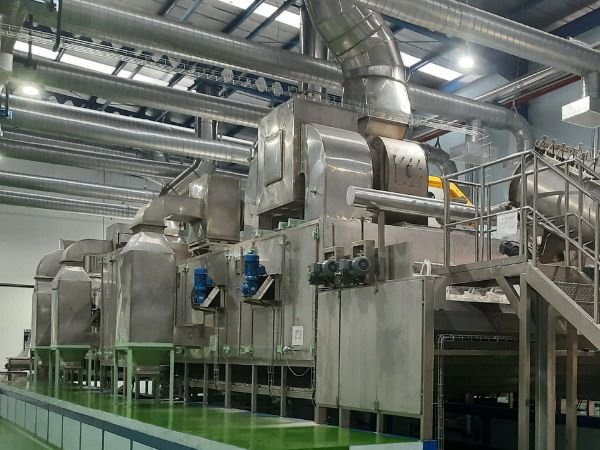
Also known as: belt dryer, mesh belt dryer, conveyor dryer, continuous belt dryer, multi-pass band dryer.
2. Working Principle (Step by Step)
- Feeding — Oscillating or specialised feeders set bed depth and width coverage
- Zone drying — Belt travels through sequential heated zones
- Through-air flow — Fans drive air through the product; direction may reverse between zones
- Exhaust & recirculation — Humid air is exhausted; part of the air may be recirculated to save energy
- Optional cooling zone — Product temperature reduced before discharge
- Continuous discharge — Steady residual moisture for packing or downstream process
Text
Wet feed → Even spreading on mesh belt
        ↓
Zone 1…n (controlled T and airflow through the bed)
        ↓
Optional cool zone → Dry product discharge
        ↓
Exhaust air → Cyclone / filter / stack
3. Why Buyers Choose Continuous Band Dryers
| Benefit | Practical meaning |
|---|---|
| Gentle product handling | Low breakage vs rotary tumbling |
| Multi-zone control | Colour, aroma and moisture uniformity |
| Continuous output | Fits industrial production lines |
| Flexible recipes | Speed, depth and zone temperatures adjustable |
| Hygiene options | SS contact parts, access doors, cleanable design |
| Formed sticky feeds | Pastes can be extruded then dried as strands |
4. Ideal Applications
- Vegetable and fruit pieces, onion/garlic flakes, herbs, spices
- Coconut chips/flakes, snack pellets, extruded foods
- Pharma/nutraceutical plant materials and granules (when belt-suitable)
- Chemical extrudates, catalysts, pigment forms
- Biomass pieces and formed sludge (after pre-forming)
- Tea and other leaf-type products in appropriate configurations
Common rule: If the product can form a permeable layer on a belt, band drying is a candidate.
5. When Not to Use a Band Dryer
| Situation | Better direction |
|---|---|
| True liquids / thin slurries | Spray dryer |
| Fine powders that fall through mesh | Fluid bed or prior granulation |
| Free-flowing uniform granules needing intense fluidization | Fluid bed / VFBD |
| Very high-tonnage robust bulk minerals | Rotary dryer often more economical |
| Impermeable sticky sheets without forming | Spin-flash / contact, or extrude first |
6. Single-Pass vs Multi-Pass
| Type | Advantage | Trade-off |
|---|---|---|
| Single-pass | Simple, gentle, easy access | Longer floor length for long residence |
| Multi-pass (multi-tier) | Long residence in less length | More complex transfer between tiers |
Choice depends on residence time needed, fragility and building layout.
7. Key Design Variables Buyers Must Define
| Variable | Effect |
|---|---|
| Belt width × effective length | Area available for evaporation |
| Bed depth | Throughput vs through-air resistance |
| Zone temperatures | Capacity and product quality |
| Airflow rate & direction | Moisture uniformity, energy use |
| Belt speed | Residence time |
| Mesh opening | Support vs airflow; fines loss |
| Heat source | Steam, thermic fluid, gas, biomass, heat pump |
8. How to Size a Continuous Band Dryer
Start from evaporation load (wet basis):W=F×100−MfMi−Mf
- W = kg water/h
- F = wet feed kg/h
- Mi = inlet moisture %
- Mf = target moisture %
Belt area then depends on the evaporation rate per m² your product achieves at the chosen bed depth and temperatures (from trial or experience factors). Always design for peak credible load.
Send for sizing: product form, Mi, Mf, capacity, max product temperature, bulk density, heat source, hygiene needs.
9. Band Dryer vs Fluid Bed vs Rotary
| Criterion | Continuous band | Fluid bed | Rotary |
|---|---|---|---|
| Product stress | Very low | Moderate | Higher tumbling stress |
| Best feeds | Pieces, flakes, extrudates | Free-flowing granules | Robust bulk solids |
| Zoning | Excellent multi-zone | Possible but different | Limited vs belt |
| Floor space | Longer (unless multi-pass) | Compact | Compact for tonnage |
| Sticky cake | Needs forming | Poor if not fluidisable | Variable |
10. Common Problems and Fixes
| Problem | Cause | Direction |
|---|---|---|
| Uneven residual moisture | Uneven loading, poor zone balance | Feeder tuning; airflow balancing |
| Product marks / mesh imprint | Soft product, wrong mesh | Mesh selection; lower bed pressure |
| Low capacity | Optimistic moisture basis | Recalculate peak evaporation |
| High energy use | Excess air, leakage, over-drying | Recirculation; moisture targets |
| Fines loss | Mesh too open / high velocity | Mesh and airflow review |
| Hygiene issues | Poor access | Cleanable design, SS, SOP |
11. Buyer Checklist Before Ordering
- Product form and whether pre-forming is needed
- Inlet and target moisture
- Maximum product temperature / quality limits
- Capacity continuous and peak
- Single-pass vs multi-pass preference
- Number of zones and cooling need
- Belt material (SS304/SS316) and mesh size
- Heat source and utilities
- Exhaust treatment requirements
- Hygiene / food-grade expectations
- Footprint limits
12. How GTI Dryers Builds Continuous Band Systems
GTI Dryers designs and manufactures continuous band / mesh-belt dryers for food, spice, chemical and agro applications.
Typical engineering scope includes:
- Belt width, length and pass configuration from evaporation load
- Multi-zone temperature and airflow control
- Feed systems for pieces, extrudates or formed cakes
- SS contact parts and cleanable access for food duties
- Heat source integration (steam, gas, thermic fluid, biomass, heat-pump options where suited)
- Optional cooling zone and exhaust filtration
Geographic Note
Continuous band dryers are used worldwide for food and industrial solids. In India they are common for spices, onion/garlic, coconut, herbs and formed agro products. Local manufacture supports faster service and spares; export projects need documented materials and capacity basis at stated moistures.
Frequently Asked Questions
What is a continuous band dryer?
A dryer that conveys product on a perforated belt through heated air zones while air passes through the product bed.
Is a band dryer the same as a mesh belt dryer?
Yes — the names are used interchangeably in industry.
Can sticky paste be dried on a band dryer?
Yes if formed into permeable strands, granules or layers that allow through-flow of air.
Band dryer or fluid bed dryer?
Band for pieces/flakes and gentle zoning; fluid bed for free-flowing granules that fluidise well.
How do I get a quotation from GTI?
Share product form, moisture in/out, capacity, max product temperature and heat source.
Next Step
If you are evaluating a continuous band dryer for food, spice, chemical or agro solids, share your process data. GTI will confirm technology fit and propose a multi-zone belt system sized on real evaporation load.
Request a continuous band dryer assessment with your process data.
Contact the GTI Technical Team:
Website: gtidryers.com
Email: mktg@gtidryers.com
Phone / WhatsApp: +91 9330077417