
Short answer: Most flash dryer problems trace back to unstable or poorly dispersed feed, too little air or heat for the actual evaporation load, sticky material passing through its sticky moisture range, or worn and blinded collection equipment. Check feed rate and moisture first, then air flow and temperatures, then deposits and collectors.
Last updated: 22 November 2026
This guide is for plant engineers, production managers and maintenance teams running pneumatic flash dryers on mineral powders, pigments, fillers, inorganic salts and specialty chemical filter cakes. It links each common symptom to its likely causes and the checks that separate one cause from another. It does not replace the operating manual or safety rules for your dryer, and any change to temperatures, air flow or feed arrangement on a running plant should go through your own management-of-change process.
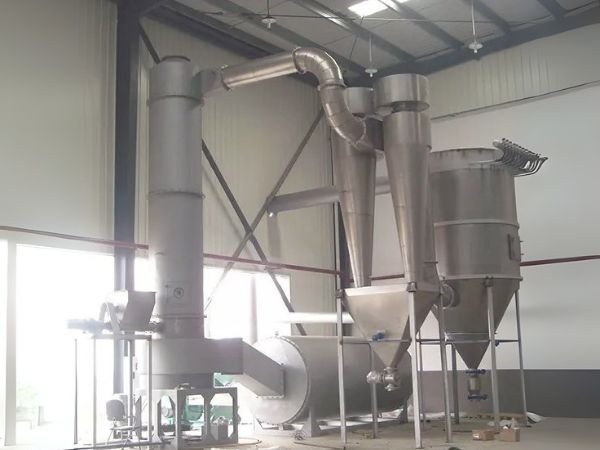
How does a flash dryer work, and why does that matter for troubleshooting?
A flash dryer disperses wet particles into a fast-moving stream of hot gas. The particles dry while being conveyed up a column or duct, typically within a few seconds, and are then separated from the gas in cyclones and a bag filter. GTI’s flash dryers handle powders, slurries, filter cakes and fibres, with applications including calcium carbonate, kaolin clay, metal oxides, pigments and fillers, inorganic salts and specialty chemical powders.
Because residence time is so short, a flash dryer mainly removes surface and loosely held moisture. It has little reserve: if a lump is not broken up or the gas is not hot enough at the feed point, there is no long residence time to recover. Feed preparation and dispersion are therefore as important as the heater. The Handbook of Industrial Drying describes how pasty or sticky materials are often pre-conditioned by mixing with dried product and then dispersed mechanically before entering the gas stream. For the related spin flash design with an agitated drying chamber, see our article on spin flash dryers.
Symptom and cause table
| Symptom | Likely causes | First checks |
|---|---|---|
| Product moisture too high | Feed moisture higher than design; feed rate surges; lumps not dispersed; air flow reduced; inlet temperature too low | Feed moisture and rate trend; fan current and damper position; filter differential pressure; inlet and outlet temperature trend |
| Product over-dried or discoloured | Outlet temperature too high; feed rate low for the heat input; product held up in deposits | Outlet temperature setpoint versus feed rate; deposits in column and bends |
| Wall deposits or build-up at feed point | Material sticky in a moisture range; poor dispersion; gas too cool at feed point; back-mix ratio too low | Inspect feed zone and first bends; check back-mix proportion and blended moisture |
| High product loss in exhaust | Cyclone wear or air leaks; damaged or wrongly fitted filter bags; air flow above design | Visual stack check; filter differential pressure; cyclone inlet and cone wear |
| Filter differential pressure rising | Bags blinding with fine or damp dust; cleaning system fault; condensation | Exhaust dew point versus outlet temperature; pulse cleaning operation |
| Outlet temperature swinging | Feed rate or moisture fluctuating; feeder slip or bridging; control loop tuning | Feeder speed versus actual mass flow; hopper level; control loop response |
| Smouldering, smoke or hot spots | Deposits overheating; combustible dust | Stop safely per procedure; inspect for deposits; review fire and explosion protection |
Why is the product still wet?
Wet product is the most common complaint. Work through the causes in this order, because the cheapest checks come first.
- Has the feed changed? A filter press or centrifuge that discharges wetter cake raises the evaporation load. For example, at the same dry-solids rate, a rise in feed moisture from 30% to 35% (wet basis) increases the water to evaporate by roughly a quarter. Use our evaporation load method to calculate the new duty.
- Is the feed steady? Screw feeders and rotary valves deliver volume, not mass. Bridging in the hopper or slip on a sticky cake causes surges that the temperature control cannot follow in a dryer with seconds of residence time.
- Is the feed dispersed? Lumps that enter the gas stream intact dry on the outside only. Check the disperser or mill, and the back-mix arrangement if one is used.
- Is the air flow what you think it is? A blinding bag filter, a partly closed damper or a leaking duct reduces air flow. Less air carries less heat.
- Is the heat input sufficient? Check the heater output against the duty, and look for fouled heat exchangers or burner problems.
A common reaction to wet product is to raise the inlet temperature. That can help if the dryer is genuinely short of heat, but if the cause is poor dispersion or a feed surge, it mainly raises the risk of overheating fines and deposits.
What causes wall deposits in a flash dryer, and how do you stop them?
Many materials pass through a sticky stage as they dry: wet enough to be cohesive, dry enough to smear onto hot surfaces. Deposits form where particles hit walls, such as the feed point, bends and the cyclone inlet.
Typical remedies, each to be confirmed by trial on your material:
- Back-mixing dry product with the wet feed to bring the blend below the sticky moisture range before it enters the gas. Calculate the blended moisture on a clear mass basis and remember that recycled product increases the solids load on the feeder, column and collectors.
- Improving dispersion so particles enter the hot gas individually rather than as a smeared paste.
- Ensuring hot gas at the feed point so the surface dries quickly.
- Regular inspection and cleaning of known build-up points, recorded in the maintenance plan.
Deposits are not only a quality problem. Material held in a hot duct can overheat and smoulder, which is a fire and explosion concern with combustible dusts.
Why are we losing product in the exhaust?
Collection losses usually come from the cyclone or the filter, not from the dryer itself.
- Cyclone: worn inlets and cones, air leakage at the discharge valve and operation far from design gas flow all reduce efficiency. An air leak at the cyclone bottom can re-entrain collected product.
- Bag filter: torn or poorly seated bags release dust; blinded bags raise pressure drop and reduce air flow. The US EPA guidance on fabric filter monitoring describes pressure drop and broken-bag detection as monitoring tools.
- Exhaust condensation: if the exhaust reaches its dew point in the filter, damp fines blind the bags. Our guide to dryer exhaust condensation explains how to check this.
What safety checks apply to flash dryer troubleshooting?
Flash dryers handle fine, dry, airborne powder at high temperature, so many organic chemicals, pigments and some mineral products can form combustible dust clouds. Any troubleshooting plan should respect the hazard analysis and protection already in place. Relevant references include OSHA’s combustible dust guidance and NFPA 652, Standard on the Fundamentals of Combustible Dust. Before opening equipment to inspect deposits, follow lockout and isolation procedures (OSHA control of hazardous energy).
Our article on dryer fire and dust explosion prevention and the partner checklist on dryer dust explosion protection cover protection measures in more detail.
Which trends should you record to diagnose problems faster?
A short list of trended values makes most problems easy to diagnose:
- Feed rate (as mass if possible) and feed moisture, by shift or batch
- Inlet and outlet gas temperatures
- Fan current or air flow
- Bag filter differential pressure
- Product moisture and, where relevant, particle size
- Cleaning and inspection records for deposit points
Comparing these against the values recorded at commissioning shows which part of the system has drifted. For energy performance, track kJ per kg of water evaporated as described in our dryer energy audit guide.
When is a flash dryer the wrong dryer?
Some recurring problems are not faults but a sign that the material does not suit flash drying. Examples include products with a long falling-rate period where moisture is held deep inside particles, very heat-sensitive materials that cannot tolerate the inlet gas temperature, or pastes that remain sticky even with back-mixing. In those cases a longer-residence dryer, such as a vibratory fluid bed dryer as a second stage or a paddle dryer for sticky pastes, may be more suitable. Our mineral and industrial drying systems and pigment dryers pages describe the options GTI offers for these sectors.
Frequently asked questions
Should I raise the inlet temperature when product is wet?
Only after checking feed rate, feed moisture, dispersion and air flow. If the dryer is short of heat, a higher inlet temperature may help; otherwise it raises the risk of overheating and deposits.
How often should a flash dryer be inspected for deposits?
Set the interval from experience on your product. Start with frequent checks of the feed zone, bends and cyclone inlet, then adjust based on what you find.
What is back-mixing in a flash dryer?
It is the blending of part of the dried product with wet feed to make a drier, more free-flowing blend that disperses more easily and is less sticky.
Why does the bag filter pressure drop keep rising?
Common causes are fine or damp dust blinding the bags, a faulty cleaning system or condensation from an exhaust too close to its dew point.
Can a flash dryer handle slurries?
GTI’s flash dryer page lists slurries among product forms. Slurries usually need conditioning, often by back-mixing, and trials should confirm the route.
Get flash dryer support from GTI
For assistance with dryer selection, flash dryer troubleshooting, processing requirements or a project-specific quotation, contact Genex Tech Industries LLP (GTI Group).
Email: mktg@gtidryers.com
Call or WhatsApp: +91-93300 77417
Website: https://gtidryers.com/
Please share your material, required wet-feed capacity, initial and target moisture, available heating source and installation location.