
A spin flash dryer is a continuous dryer designed to turn wet cakes, pastes and sticky filter cakes into a fine dry powder without first re-slurrying them into a pumpable liquid. It combines mechanical dispersion with rapid convective drying in a hot gas stream.
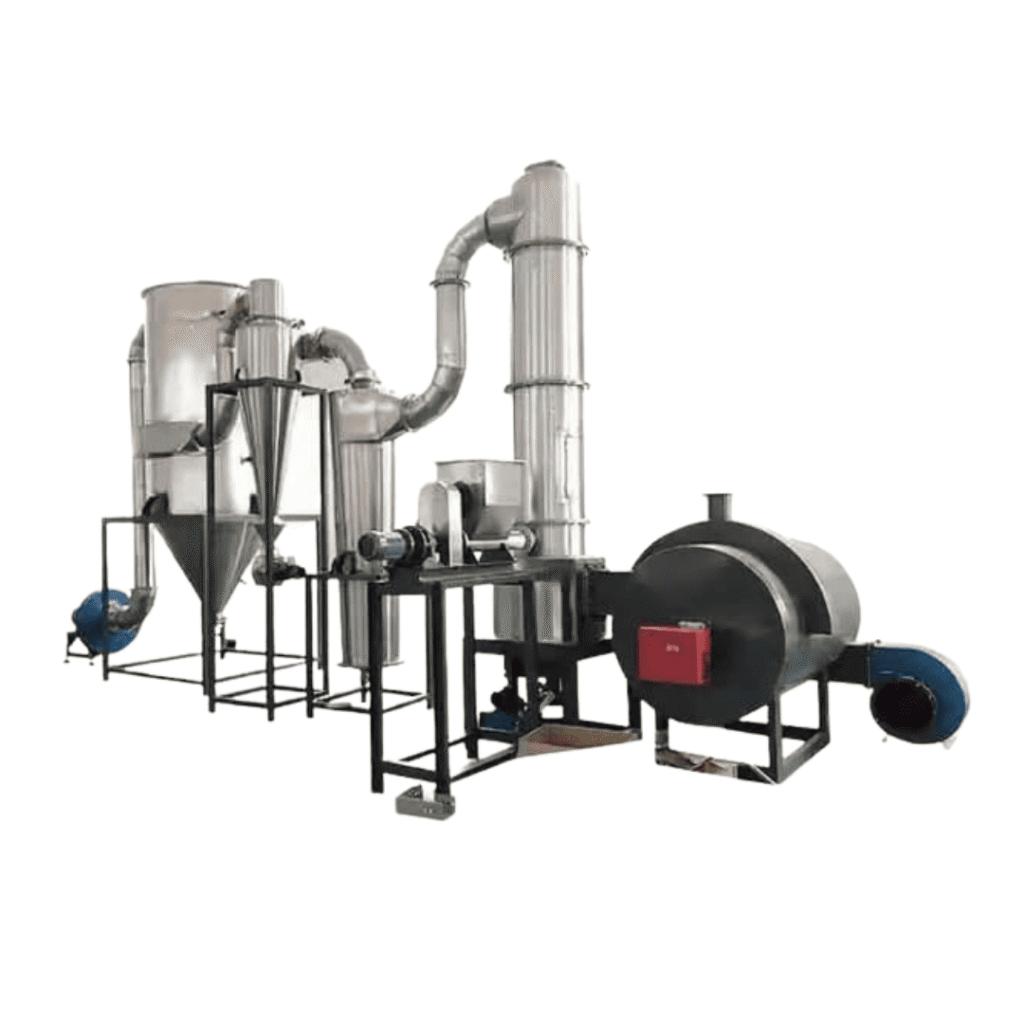
This guide explains what a spin flash dryer is, how it differs from a conventional flash dryer and a spray dryer, and when you should — and should not — use it.
1. What is a Spin Flash Dryer?
A spin flash dryer (also called a spin-flash or mechanical-dispersion flash dryer) feeds moist solid or semi-solid material into a vertical drying chamber where a high-speed agitator (rotor) breaks the feed into small particles. Those particles are picked up by a hot gas stream, dry in seconds while airborne, and are separated in cyclones and/or a bag filter.
Core idea:
Mechanical energy disperses the wet mass; thermal energy removes the moisture. Dispersion is the feature that allows sticky cakes to be dried as cake instead of being diluted back to a slurry.
2. How a Spin Flash Dryer Works (Process Outline)
text
[Wet cake / paste]
       ↓
[Feed system – screw / pump suitable for semi-solids]
       ↓
[Drying chamber + high-speed rotor / disperser]
       ↑
[Hot gas in] → particles dry in gas stream
       ↓
[Cyclone and/or bag filter] → [Dry powder]
       ↓
[Exhaust fan → stack]- Feed — Filter cake or paste is metered into the chamber (often with optional back-mixing of dry product to pass through the sticky moisture range more easily).
- Dispersion — The rotor shears and throws material into the hot gas so that agglomerates become small particles with high surface area.
- Drying — Moisture evaporates rapidly in the turbulent gas stream; particle temperature is moderated while free moisture remains.
- Separation — Powder is recovered in cyclone and bag filter; exhaust leaves through the fan.
- Discharge — Product goes to cooling, conveying or packing.
Residence time in the hot zone is short compared with rotary or band dryers — typically on the order of seconds, depending on design and duty.
3. Spin Flash vs Conventional Flash vs Spray Dryer
| Aspect | Spin flash dryer | Conventional flash dryer | Spray dryer |
|---|---|---|---|
| Typical feed | Wet cake, paste, sticky filter cake | Dispersible wet solids / granules that do not need intense mechanical breakup | Pumpable liquid or slurry |
| Dispersion | Dedicated high-speed rotor in the chamber | Relies more on gas velocity and feed preconditioning | Atomiser (wheel or nozzle) creates droplets |
| Re-slurry needed? | No — designed to accept cake | Usually no, but sticky cakes often fail | Yes — feed must be pumpable |
| Sticky-phase handling | Strong (with correct rotor and possible back-mix) | Weak if material plasticises or sticks | Sticky droplets cause wall deposits if conditions are wrong |
| Product form | Fine powder | Powder / fine granules | Powder (morphology from droplet drying) |
Practical rule:
- Cake or paste → evaluate spin flash (or contact dryers) first.
- Already pumpable slurry → evaluate spray.
- Free-flowing wet granules that fluidise → evaluate fluid bed.
- Slices and flakes → evaluate band / mesh-belt.
4. When You Should Use a Spin Flash Dryer
Use spin flash when most of the following are true:
- Feed is a wet cake or paste from filtration or centrifugation — not a stable low-viscosity liquid.
- Re-slurrying is undesirable (extra water, extra energy, extra effluent, or product quality harm).
- Product can be dispersed mechanically into particles that dry quickly in hot gas.
- Fine powder is an acceptable or required end form.
- Short drying time is compatible with quality (many inorganics, pigments, some organics and food intermediates).
Typical application areas include:
- Filter cakes from chemical and inorganic processes
- Pigments and dyes (where temperature and chemistry allow)
- Certain mineral and salt cakes
- Selected food or fermentation cakes after evaluation
- Other pastes that pass through a sticky phase but can be broken up by a rotor
Exact fit always depends on temperature limits, abrasion, corrosion and powder specifications.
5. When You Should Not Use a Spin Flash Dryer
Avoid forcing spin flash when:
| Situation | Better direction |
|---|---|
| Feed is a true solution or thin slurry | Spray dryer |
| Product must remain as large slices or flakes | Band / mesh-belt dryer |
| Particles are free-flowing granules that fluidise well | Fluid bed / VFBD |
| Material is extremely heat-sensitive even to short hot-gas contact | Low-temperature, vacuum or carefully profiled systems |
| Product must not be mechanically broken into fines | Gentler conveyor or contact dryers; re-evaluate specification |
| Feed is so elastic or fibrous that the rotor cannot disperse it | Pilot test other technologies; may need conditioning or different principle |
A pilot trial is strongly recommended when stickiness, fibre content or temperature sensitivity is uncertain.
6. Main Design and Operating Points Buyers Should Understand
| Topic | Why it matters |
|---|---|
| Rotor / disperser design | Determines whether the cake is actually broken up or only smeared |
| Back-mixing | Optional recycle of dry product to reduce stickiness of the wet feed — must be engineered, not improvised |
| Inlet gas temperature | Drives capacity; limited by product thermal stability |
| Residence time and chamber geometry | Must finish residual moisture without excessive wall buildup |
| Wear | Abrasive cakes require appropriate materials and maintenance planning |
| Explosion / dust safety | Fine dry powders need proper venting, grounding and housekeeping design |
| Exhaust and powder recovery | Cyclone + bag filter sizing affects both recovery and emissions |
7. Benefits When the Fit Is Correct
- No re-slurry — Avoids evaporating water you already removed in the filter
- Handles sticky intermediate moisture better than many static or simple pneumatic systems
- Continuous single-pass drying from cake to powder
- Compact footprint relative to long rotary or large band systems for the same evaporation load on suitable feeds
- Fast response for moisture control via gas temperature and feed rate
Benefits disappear if the feed cannot be dispersed or if quality requires a completely different thermal history.
8. Common Problems and What They Usually Mean
| Symptom | Typical implication |
|---|---|
| Chamber wall buildup | Feed too sticky for current temperature/back-mix/rotor settings; or wrong technology |
| Wet lumps in product | Incomplete dispersion or overload |
| Over-fine dusty product | Rotor intensity or product friability — adjust or accept with dust handling |
| Rapid rotor or liner wear | Abrasive feed — materials and maintenance plan needed |
| Moisture variation | Unstable feed rate or moisture; rotor or gas conditions outside window |
9. What to Provide for a Spin Flash Assessment
- Description of feed (filter cake, centrifuge cake, paste)
- Inlet moisture range and how it varies
- Target residual moisture
- Particle or cake characteristics (sticky, fibrous, abrasive, corrosive)
- Maximum product temperature
- Required capacity (feed or product basis)
- Heat source available
- Any preference to avoid re-slurrying
10. How GTI Dryers Approaches Spin Flash Applications
GTI Dryers evaluates spin-flash and related mechanical-dispersion drying when the feed is a wet cake or paste and re-slurrying is not the preferred route. The review covers:
- Whether dispersion drying is realistic for the specific cake
- Temperature and moisture targets
- Comparison with spray (if re-slurry is optional), fluid bed, band or contact alternatives
- Need for pilot testing when behaviour is uncertain
Spin flash is recommended only when process fit is clear — not as a universal dryer for every wet solid.
Geographic Note
Spin flash dryers are specified in chemical, mineral and selected food plants worldwide wherever filter cakes dominate. Indian manufacturers supply domestic and export projects; the decision logic — cake vs slurry vs granules — does not change with geography. Local energy cost makes avoiding re-slurry especially attractive where fuel is expensive.
Frequently Asked Questions
What is a spin flash dryer in simple terms?
A dryer that mechanically breaks up wet cake or paste into small particles and dries them quickly in hot air, without turning the cake back into a liquid first.
Is spin flash the same as a normal flash dryer?
No. Spin flash adds intense mechanical dispersion in the chamber. Conventional flash relies more on gas flow and already dispersible feed.
Can spin flash replace a spray dryer?
Only when the feed is (or can remain) a cake or paste. If the process already produces a stable slurry and powder morphology from spray drying is required, spray remains the usual choice.
Do I always need back-mixing?
No. It is a tool for feeds that pass through a difficult sticky range. It should be designed into the system when needed.
What data should I send GTI?
Feed form, inlet and target moisture, capacity, temperature limits and whether the material is sticky, abrasive or heat-sensitive.
Next Step
If your plant produces filter cake or paste and you want to avoid re-slurrying — or you are comparing spin flash with spray, flash and fluid bed options — share your feed and moisture data. GTI can assess whether a spin flash dryer is the right principle for your duty.
Request a spin flash dryer suitability assessment with your process data.
Contact the GTI Technical Team:
Website: gtidryers.com
Email: mktg@gtidryers.com
Phone / WhatsApp: +91 9330077417