
A tomato dehydration plant turns fresh tomatoes into dried pieces, flakes or tomato powder. Before choosing any machine, decide which of two process routes you need, because they use different equipment and give different products.
Quick answer: In the slice-and-mill route, prepared tomato pieces are dried on a continuous band (mesh-belt) dryer or in a heat pump dryer, then milled and sieved. In the paste-to-powder route, tomatoes are crushed, sieved to remove skins and seeds, and concentrated, and the concentrate is dried on a drum, refractance window or spray dryer. Paste, ketchup and sauce plants are separate wet-processing lines that stop before drying. Size the dryer on peak wet feed and water to be evaporated, not on fresh tomatoes bought or powder sold.
This guide is for buyers planning a tomato dehydration or tomato powder processing plant. It covers both routes, dryer selection, colour and stickiness control, capacity basis, hygiene, utilities, powder handling, and the information GTI needs to quote.
Which tomato product are you making?
| Product | Typical feed to the dryer | Usual drying route | What to watch |
|---|---|---|---|
| Dried tomato pieces or slices | Sorted, washed, cut ripe tomato | Multi-zone band or mesh-belt dryer; heat pump dryer for smaller or colour-critical batches | Uniform cut size, even bed loading, colour |
| “Tomato flakes” from fresh fruit | Diced or sliced tomato | Band or mesh-belt dryer, sometimes followed by sizing | Name used loosely: confirm the size and moisture your buyer means |
| Tomato flakes from paste | Concentrate spread as a thin film | Drum or refractance window dryer | Thin sheets that are milled or sized after drying |
| Tomato powder from dried pieces | Dried pieces | Mill and sieve after drying | Contains skin and seed unless removed; colour varies with fruit |
| Tomato powder from paste | Concentrate, sometimes diluted or with a carrier | Spray, drum, refractance window or vacuum drying, then milling or sieving | Finer, more uniform powder; stickiness during drying and storage |
| Paste, ketchup, sauce | Not dried | Evaporation, cooking and filling | A different plant, not a dehydration line |
If you are planning paste or sauce capacity, GTI Group’s Food Tech Projects site has a separate industrial tomato processing plant guide. This article covers drying, flakes and powder.
Process flow for each route
Route A: slice or dice, dry, then mill
- Receiving and short buffer storage, because ripe tomatoes deteriorate quickly.
- Sorting to remove green, rotten and damaged fruit.
- Washing.
- Stalk removal and cutting to a uniform size. FAO’s small-scale dried fruit guidance uses 3–5 mm tomato slices; industrial cut sizes should be set by trial.
- Optional pretreatment such as blanching or a dip, set by your recipe and the destination market’s additive rules.
- Even spreading onto the dryer belt.
- Multi-zone drying, with a cooling zone or separate cooler.
- Inspection and metal detection.
- Milling and sieving if powder is the product.
- Packing in a low-humidity room into moisture-barrier packs.
Route B: paste or concentrate to powder
- Receiving, sorting and washing.
- Crushing with a hot or cold break, depending on the product specification.
- Pulping and finishing to remove skins and seeds.
- Concentration in an evaporator. Evaporators generally remove water with less energy per kilogram than a convective dryer, which is why this route concentrates first.
- Drying the concentrate on a drum, refractance window, spray or vacuum dryer. Some routes need the feed diluted, or a carrier added, to dry properly.
- Cooling, milling or sieving, and packing in a dehumidified area.
The equipment overlap between the two routes is limited to intake, sorting and washing. Route B needs a pulper-finisher and evaporator before the dryer and is a much larger wet-processing investment.
Dryer selection for tomato
| Dryer | Suits | Strengths | Watch-outs |
|---|---|---|---|
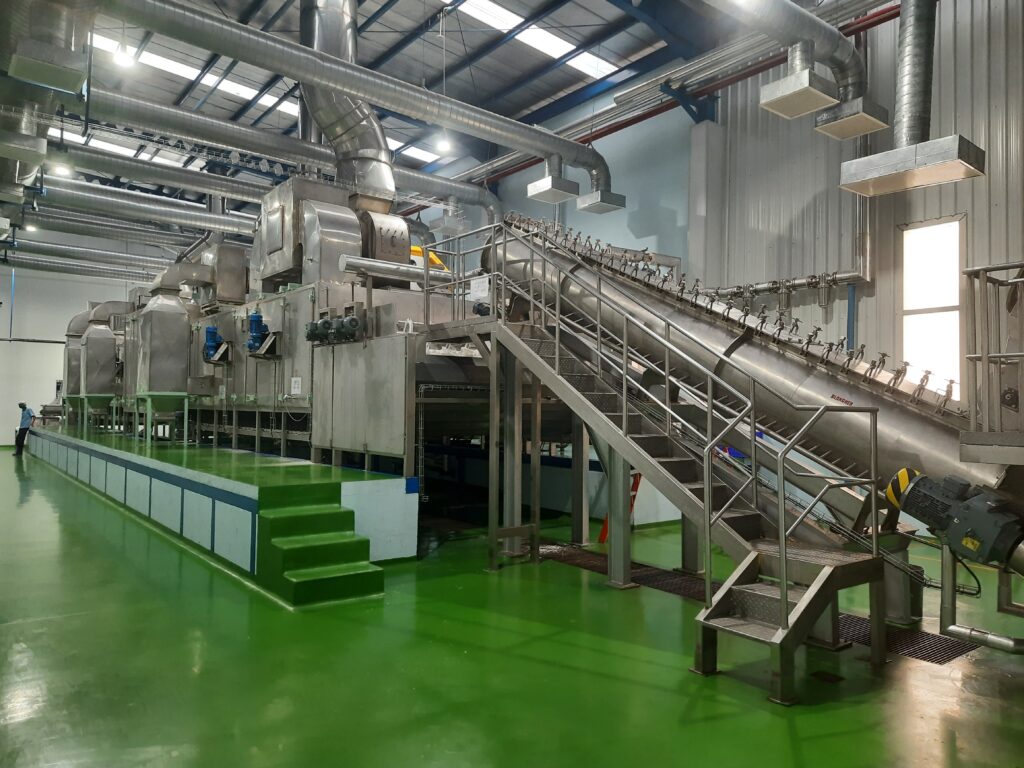
| Band dryer or mesh belt dryer | Pieces, slices, dice (route A) | Continuous; separate temperature and airflow zones; product rests on the belt | Uneven bed depth gives wet centres; soft pieces can stick to or mark on the belt; plan belt cleaning |
| Heat pump dryer | Smaller batches of pieces | Low, steady temperature with humidity control | Lower throughput; batch loading and unloading |
| Drum dryer | Paste or puree (route B) | Compact; dries a thin film directly on a steam-heated drum | Product touches a hot surface, which can darken colour and change flavour; sticky films can be hard to scrape |
| Refractance window dryer | Puree or concentrate (route B) | Thin film on a belt heated by circulating hot water | Feed viscosity and film thickness must suit the applicator |
| Spray dryer | Diluted concentrate (route B) | Fine, free-flowing powder possible | Tomato sugars make powder stick to chamber walls; carriers such as maltodextrin and dry inlet air are commonly used |
Evidence on product quality differs by dryer. A pilot study led by Wageningen researchers compared four conductive dryers on tomato puree. It found that the drying method clearly changed colour and the aroma and taste compounds. Refractance window and vacuum drum dryer powders kept more aroma-related markers than atmospheric drum drying. The same study had to dilute the puree before it would form an even film on the refractance window dryer. Run a trial with your own concentrate before fixing the dryer type. GTI’s comparison of spray, drum and refractance window drying for fruit powders covers the trade-offs in more detail.
Colour, flavour, stickiness and moisture
Colour and flavour. Tomato’s red colour and fresh aroma are heat-sensitive. In a band dryer, remove most of the water in the earlier zones and use a gentler finishing zone, rather than pushing one high temperature through the whole dryer. Avoid over-drying, which darkens the product without making it safer if the packaging fails.
Stickiness. Tomato solids are rich in sugars and organic acids. These soften when warm and moist, so dried tomato and tomato powder become sticky and cake. A review of spray-dried tomato powder explains this through the glass transition temperature, which falls as moisture rises. It cites a rule of thumb that stable powder should have a glass transition temperature about 20°C above the storage temperature. In practice:
- Cool the product before milling and packing.
- Mill, sieve and pack in a dehumidified area.
- Use moisture-barrier packaging and seal it promptly.
- On the spray route, agree any carrier with your buyer, because it changes the ingredient declaration.
GTI’s guide to powder caking after drying covers storage and handling fixes in more depth.
Moisture. Write the target residual moisture, or water activity, and the laboratory test method into the specification. Each product and buyer has its own limit, so take it from your buyer’s specification rather than from a generic figure.
Capacity: wet feed, evaporation and finished product
Most tomato dryer quotation errors come from mixing up three numbers:
- Wet feed: prepared tomato entering the dryer (kg/h).
- Evaporation: water the dryer must remove (kg/h). This sets the dryer’s size and heat demand.
- Finished product: dried output (kg/h).
Evaporation W = F × (Mi − Mf) ÷ (100 − Mf), where F is wet feed and Mi and Mf are the initial and final moisture in % wet basis.
Illustrative calculation only (assumed values, not a design): 1,000 kg/h of prepared tomato pieces at an assumed 94% moisture, dried to an assumed 6%.
- Water evaporated = 1,000 × (94 − 6) ÷ (100 − 6) ≈ 936 kg/h.
- Dried product ≈ 64 kg/h.
So a dryer described as “1 tonne per hour” on wet feed makes roughly 64 kg/h of dried tomato under these assumptions. To make 1 tonne per hour of dried product, it would need about 15.7 t/h of wet feed. Measure your own fruit’s moisture, because it varies by variety and season. Also allow for stalks, rejects and, in route B, skins and seeds, which make raw tomato intake higher than dryer feed.
Tomatoes are seasonal. Design on peak daily intake and real operating hours, and decide early whether the dryer will process other crops out of season. GTI’s article on onion and garlic powder line integration shows how a powder line is planned around one dryer.
Materials, cleaning and hygiene
- Product contact: Tomato is acidic, so product-contact parts are normally stainless steel. GTI’s mesh belt dryer page lists SS304 or SS316 construction options. Choose the grade with your supplier based on the product, cleaning chemicals and site conditions.
- Cleanability: Specify access doors, belt-washing arrangements, drainage and no hidden ledges where sticky fines can build up.
- Food safety: Build the line layout and cleaning schedule into your own food-safety plan and your destination market’s rules. The dryer supplier provides the equipment; certification of your plant is your responsibility.
Heat source and utilities
GTI’s dryer pages list steam, thermic fluid, gas and electric heating options, plus heat pump systems for low-temperature drying. The right choice depends on what your site has and on the dryer:
- Drum dryers are usually steam-heated.
- Refractance window dryers use circulating hot water.
- Spray dryers need hot air at a higher inlet temperature.
- Band dryers can work from several sources through heat exchangers or burners.
GTI’s dryer heat source selection guide compares the options. Also plan for wash water, effluent from washing and pulping, cleaning water, and electrical load for fans, mills and conveyors.
Dust collection and powder handling
Milling dried tomato creates fine dust, and the dust is sticky in humid air. Plan for:
- Cyclones and bag filters, with fines recovered or blended back where the specification allows.
- Sieving, with oversize returned to the mill.
- Enclosed conveying, plus a combustible-dust assessment for mills, filters and silos. See GTI’s guide to dryer fire and dust explosion prevention.
GTI Group’s Food Tech Projects site lists pulverizer systems with cyclones, dust collection and sieving for the milling stage.
What GTI supplies
GTI Dryers’ vegetable dehydration systems page lists tomato powder among its applications and refractance window drying for tomato puree powders. Its fruit drying systems page lists tomato among the fruits processed. GTI’s core delivery is the drying stage: band, mesh-belt, heat pump, drum, refractance window and spray dryers, with feeding, cooling and dust collection around the dryer.
For preparation and powder equipment, GTI Group’s Food Tech Projects site covers sorting, grading and washing machines, slicers and mills. Every quotation should state clearly whether it covers the dryer only or a complete line.
Information to send for a tomato dryer quotation
- Raw material (variety if known) and finished product: pieces, flakes or powder, and which route.
- Required capacity, stating the basis: fresh tomato intake, dryer wet feed or finished product (kg/h or t/day), plus operating hours and season length.
- Inlet moisture and target moisture or water activity, with the test method.
- Cut size, or concentrate solids if you already make paste.
- Available heat source: steam, thermic fluid, gas, electricity or biomass.
- Installation country and site, including climate and available space.
- Quality requirements: colour, flavour, particle size, carrier allowed or not, and packaging.
Frequently asked questions
What is the difference between a tomato dehydration plant and a tomato processing plant?
A tomato processing plant usually means paste, ketchup or sauce production, which stops at a wet, cooked product. A tomato dehydration plant removes water to make dried pieces, flakes or powder, and may start from fresh fruit or from paste.
Which dryer is best for tomato powder?
It depends on the route. For powder milled from dried pieces, a multi-zone band or mesh-belt dryer is the usual choice. For powder made from concentrate, compare drum, refractance window and spray drying through trials, because colour, flavour, stickiness and the need for a carrier differ between them.
Can tomato slices be spray-dried?
No. Spray drying needs a pumpable liquid. Slices and dice are dried on belts or trays; only concentrate or puree goes to a spray dryer.
Why does my tomato powder go hard in the bag?
Tomato powder absorbs moisture from the air, and its sugars become sticky as it does. Cool the powder, pack it in a dry room, use barrier packaging, and check that residual moisture meets your specification.
Is a paste line needed for tomato powder?
Only for the paste-to-powder route. The slice-and-mill route needs no evaporator, but gives a coarser powder containing skin and seed unless they are removed.
Discuss your tomato dehydration project with GTI
For assistance with tomato dryer selection, processing requirements or a project-specific quotation, contact Genex Tech Industries LLP (GTI Group).
Email: mktg@gtidryers.com
Call or WhatsApp: +91-93300 77417
Website: https://gtidryers.com/
Contact page: https://gtidryers.com/contact/
Please share your raw material and desired finished product, required feed or product capacity, inlet and target moisture, available heat source, installation country and product-quality requirements.
Sources
- FAO, Dried fruit: processing details and recipes (small-scale guidance, including tomato slice thickness and pretreatment).
- Wageningen University and University of Greenwich repository, systematic analysis of tomato powder quality from four conductive drying technologies (Innovative Food Science and Emerging Technologies, 2019).
- ASEAN Journal of Chemical Engineering, effect of carrier agents and operating parameters on spray-dried tomato powder: a review.