
Short answer: Black mass drying removes residual electrolyte solvents, and any process water, from shredded lithium-ion battery material before hydrometallurgical or pyrometallurgical recovery. It is usually done at low temperature in an inert or vacuum environment, with solvent vapour condensed and off-gas treated. Indirect, agitated dryers are the main candidates, but the design must follow trials and a hazard study.
Last updated: 22 November 2026
Lithium-ion battery recycling is growing quickly, driven by electric vehicles, energy storage and new regulation. Between shredding and metal recovery sits a drying step that is easy to underestimate. Wet or solvent-laden black mass is hazardous to handle, can release toxic and flammable vapours, and can upset downstream separation. This article explains what black mass drying has to achieve, which process conditions matter, how dryer types compare, and what an engineering team should define before asking for a dryer. It is written for recycling project developers, process engineers and investors evaluating plant designs. It draws on published research and regulation; it does not report GTI installations in this sector.
What is black mass and why does it need drying?
Black mass is the fine, dark powder recovered after end-of-life lithium-ion cells are discharged, shredded and screened. It contains cathode active material (compounds of lithium with nickel, manganese, cobalt or iron phosphate), anode graphite, and smaller amounts of copper, aluminium, binder and separator residues. Depending on the route, it can also carry electrolyte: organic carbonate solvents such as dimethyl carbonate and ethylene carbonate, and the lithium hexafluorophosphate (LiPF6) salt.
Drying matters for three reasons:
- Safety. Organic carbonate vapours are flammable. LiPF6 can decompose and, in contact with moisture, form hydrogen fluoride (HF) and other fluorine compounds. Fluoride gas emissions from lithium-ion battery fires were measured in a widely cited study in Scientific Reports (Larsson et al., 2017).
- Downstream processing. Removing solvents improves material handling and the efficiency of later separation and leaching steps.
- Solvent recovery and emissions. Condensing solvents instead of venting them reduces emissions and can allow recovery.
A recent study on thermal drying in battery recycling, published in Batteries (MDPI, 2025), describes a two-step thermal treatment: a lower-temperature drying step to remove and recover the solvents, followed where needed by a higher-temperature pyrolysis step to decompose binders. It notes that drying is performed under inert gas or vacuum, at temperatures kept low to avoid decomposing the conducting salt or melting the separator. It also found that ethylene carbonate, with its low volatility, is the limiting component, and that vacuum or enhanced carrier gas flow helps remove it at low temperature. A broader review of pre-processing and thermal safety in battery recycling is available in Energy & Fuels.
Why is black mass drying becoming a commercial priority?
Regulation is pushing recyclers toward higher recovery. The EU Batteries Regulation (EU) 2023/1542 sets material recovery targets of 50% for lithium and 90% for cobalt, copper, lead and nickel by 31 December 2027, rising to 80% and 95% by 31 December 2031, plus recycling efficiency targets of 65% by weight for lithium-based batteries by the end of 2025 and 70% by the end of 2030. In September 2026 the European Commission confirmed that these targets remain appropriate. In the United States, the EPA’s lithium-ion battery recycling guidance explains that most lithium-ion batteries are likely to be hazardous waste when discarded, because they can catch fire or explode if mishandled.
Higher recovery targets reward clean, well-conditioned black mass, and that puts more attention on the pre-treatment steps, including drying.
What process conditions matter in black mass drying?
| Parameter | Why it matters | What to define |
|---|---|---|
| Product temperature | Too high risks salt decomposition, separator melting and side reactions | Maximum product temperature from lab tests |
| Atmosphere | Air plus solvent vapour can be flammable; moisture promotes HF formation | Inert gas (usually nitrogen) or vacuum, oxygen limit |
| Pressure | Vacuum lowers boiling points and helps remove low-volatility solvents | Operating pressure range, if vacuum is used |
| Solvent composition | Volatile linear carbonates leave first; ethylene carbonate is slowest | Electrolyte content and composition of the feed |
| Feed form | Fine, dusty, abrasive, may contain foil pieces | Particle size distribution, metal fragments |
| Vapour handling | Solvents must be condensed; off-gas may contain HF and fines | Condenser, filter, scrubber, emission limits |
| Batch or continuous | Plant scale and integration with shredding | Throughput and operating pattern |
Many of these are site- and feed-specific. Cell chemistry, shredding method (wet or dry, inert or not) and storage time all change what reaches the dryer.
Which dryer types suit black mass?
Because the product is fine, dusty and potentially flammable, and the vapours must be contained and recovered, indirect (conduction) dryers are the usual starting point. Heat is supplied through a jacket or heated agitator rather than by blowing hot air through the product, so the vapour stream is small and can be condensed.
| Dryer type | How it works | Points to evaluate for black mass |
|---|---|---|
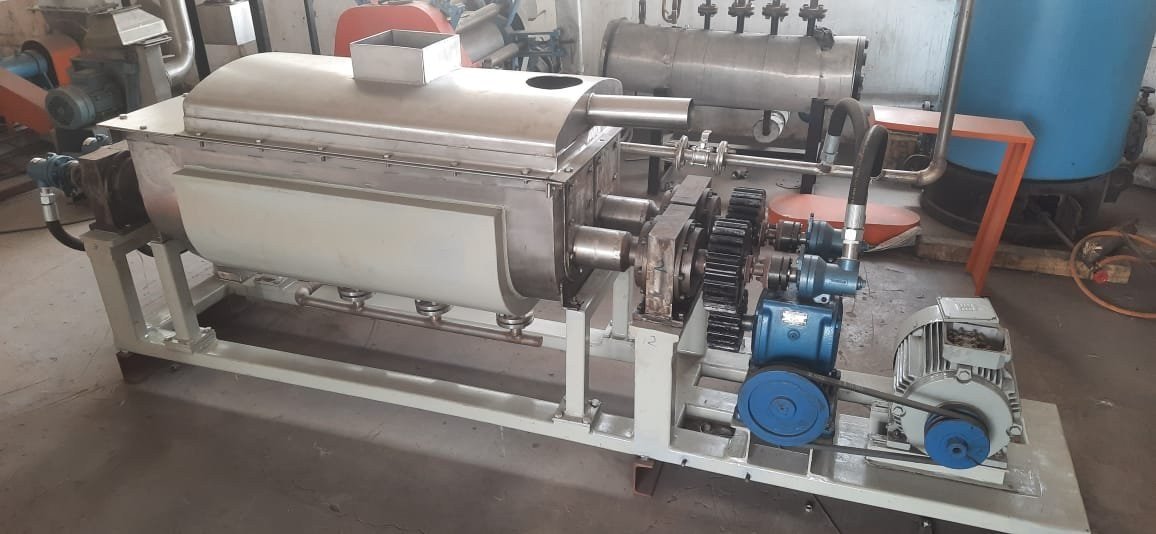
| Paddle dryer | Heated trough and hollow paddles mix and convey the product | Continuous or batch; can be sealed for inert gas; wear from abrasive powder; seal design |
| Tube bundle (rotary indirect) dryer | Rotating steam-heated tube bundle | Large heat-transfer area; sealing and dust handling must be checked |
| Rotary indirect dryer | Externally heated rotating drum | Suits higher temperatures; sealing for inert operation needs care |
| Direct hot-air dryers (fluid bed, flash) | Product in contact with hot gas | Large gas volume to treat; usually less suited where solvents must be recovered |
GTI’s paddle dryer page lists options such as nitrogen blanketing, explosion-safe design and vapour condensation systems, with construction in carbon steel, SS304, SS316 and special alloys. GTI also manufactures tube bundle dryers. Whether either fits a particular black mass stream, and whether vacuum operation is needed, depends on trials and a hazard study. Our comparison of paddle dryers and tube bundle dryers explains the general differences between the two.
How should a black mass drying system be engineered?
A dryer alone is not a drying system. A typical scope includes:
- Inerted feeding from the shredding and screening line, with level and oxygen monitoring.
- The dryer, with heating medium (steam, thermic fluid or hot water), agitator drive and seals suited to fine abrasive powder.
- Dust separation on the vapour line to keep fines out of the condenser.
- Condensation of solvent vapours, with recovered solvent collected for treatment or reuse.
- Off-gas treatment, such as scrubbing for acidic fluorine compounds, before discharge.
- Inert gas supply or vacuum system.
- Product cooling and discharge under controlled atmosphere into closed containers.
- Instrumentation and safety interlocks, based on a formal hazard study (such as HAZOP) and the combustible dust and flammable vapour rules that apply at the site.
Materials of construction need care, because HF and other fluorine compounds can attack many materials in the presence of moisture. This is a specialist selection to be made with the process licensor or recycler’s own chemistry team.
For projects that want one party responsible for the integrated line, a turnkey drying solution covers process design, equipment, installation and commissioning.
What should you test before buying a black mass dryer?
- Electrolyte content and composition of representative feed
- Drying curve at candidate temperatures and pressures, including residual ethylene carbonate
- Off-gas composition, including fluorine compounds
- Dust behaviour and minimum ignition data for the dry product, where required by your hazard study
- Abrasion and wear on candidate materials
- Effect of drying conditions on downstream leaching or separation
Our guide to pilot plant testing for industrial dryers explains how to plan useful trials.
How does this link to battery materials drying more broadly?
Black mass drying sits at the recycling end of the battery value chain. Cathode precursors, cathode materials and graphite also need drying in production, with different priorities such as purity and particle morphology. See our guides on battery materials dryers and the best dryer for battery materials, and the partner article on LFP cathode material dryers.
Frequently asked questions
Why not dry black mass with hot air?
Hot air brings oxygen into contact with flammable solvent vapour and produces a large gas volume to treat. Indirect drying under inert gas or vacuum keeps the vapour stream small and easier to condense.
What temperature is used for black mass drying?
It depends on the feed and the process route. Published work stresses keeping temperatures low enough to avoid decomposing the conducting salt or melting the separator. Set the limit from tests on your material.
Which solvent is hardest to remove?
Research identifies ethylene carbonate as the limiting component because of its low volatility. Vacuum or enhanced carrier gas flow helps remove it at low temperature.
Is drying the same as pyrolysis?
No. Drying removes solvents at lower temperature. Pyrolysis is a separate, higher-temperature step used in some routes to decompose binders.
Can GTI supply a black mass dryer?
GTI designs and manufactures paddle and tube bundle dryers and can review a black mass application on the basis of trial data and a defined process. Any offer would follow testing and engineering review.
Discuss your battery recycling dryer with GTI
For assistance with dryer selection, processing requirements or a project-specific quotation for black mass or battery materials drying, contact Genex Tech Industries LLP (GTI Group).
Email: mktg@gtidryers.com
Call or WhatsApp: +91-93300 77417
Website: https://gtidryers.com/
Please share your material, required wet-feed capacity, initial and target moisture, available heating source and installation location.