
Short answer: Case hardening happens when the surface of a fruit or vegetable piece dries much faster than its centre, so a stiff, dry crust forms and traps moisture inside. The usual causes are drying air that is too hot, too dry or too fast in the early stage, pieces that are too thick or uneven, and a drying profile that does not let internal moisture keep up with surface evaporation. The fixes are to moderate early-stage temperature and airflow, control humidity so the surface does not seal, slice evenly, and verify the result by measuring the centre of the piece rather than the surface. Case hardening is a process-design problem, not just a setpoint problem, so a trial on your own product is the only reliable way to set the profile.
This guide is for process engineers, quality managers and production heads at fruit, vegetable and mushroom drying plants who see leathery surfaces, wet centres, poor rehydration or mould complaints in finished product. Genex Tech Industries LLP (GTI Group) supplies continuous belt and heat pump dryers for these products. Figures below are from published studies or are labelled as hypothetical illustrations.
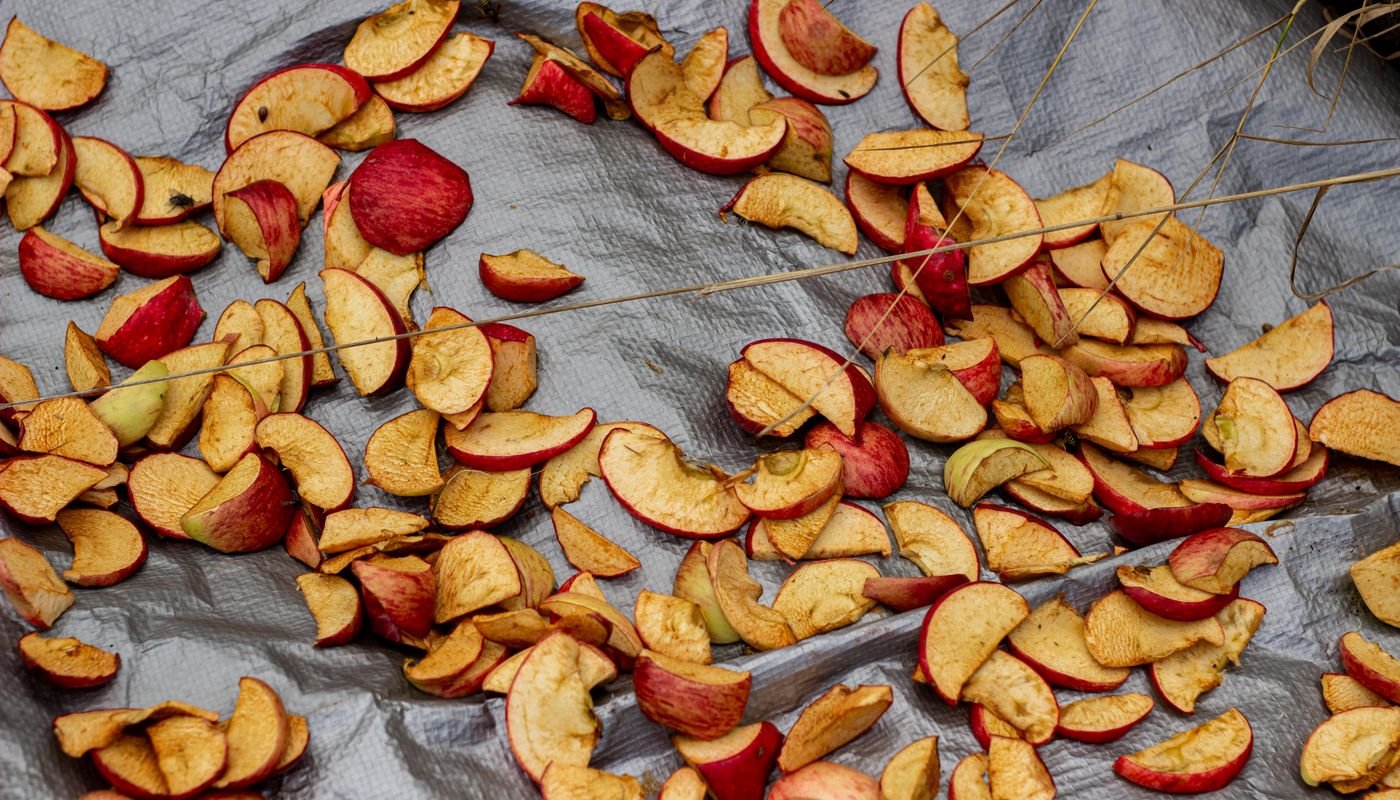
What case hardening is
During hot-air drying, water moves from the interior to the surface and then evaporates. If the surface loses water faster than the interior can supply it, the outer layer becomes dry, stiff and sometimes glassy. A mechanistic modelling study describes it this way: at high drying rates the surface dries faster than the core and forms a case-hardened layer, which causes early deviations in shrinkage, while at low drying rates deviations appear only at very low moisture (Mechanistic understanding of case-hardening and texture development). A review of shrinkage during drying also notes that case hardening strongly affects how much a material shrinks (Comprehensive Reviews in Food Science and Food Safety).
Case hardening has three practical consequences:
- Slower drying overall. The crust becomes a barrier to internal moisture, so the last stage takes longer.
- Uneven moisture. A dry surface and a wet centre can read as an acceptable average while the centre is still above the safe limit.
- Poor texture and rehydration. A review of relative humidity effects notes that a rigid crust fixes the product volume and that higher humidity in the early stage helps build a pore network that supports rehydration.
Warning signs on the line
- Pieces feel dry and hard outside but are soft, cool or damp when snapped or cut.
- Moisture readings drift upward after packing, because moisture redistributes from centre to surface.
- Slices curl, wrinkle deeply or form a glassy skin.
- Drying slows sharply in the final zones even though the temperature is unchanged.
- Rehydrated product is tough or has a dense outer skin.
- Mould appears in sealed packs despite a passing surface-moisture test.
If belt loading or airflow is also uneven, read our belt dryer uneven moisture troubleshooting guide alongside this one, because the two problems often overlap.
Causes and fixes
| Symptom or cause | Why it happens | What to test |
|---|---|---|
| Very high air temperature at the start | Surface dries before internal moisture can follow | Lower early-zone temperature, then raise it later |
| Very low air humidity in early zones | Low humidity increases the surface drying rate and can form a rigid crust | Step-down humidity profile: more humid early, drier later |
| High air velocity over thin, wet surfaces | Strong surface evaporation | Reduce velocity in the first zones |
| Thick or uneven pieces | Long internal diffusion path and uneven drying | Uniform slicing and a tighter thickness range |
| Dense skins or low porosity (for example whole, uncut fruit) | Moisture escapes slowly through the skin | Cut, pierce or pretreat to open the surface |
| Deep or uneven product bed | Moisture trapped in the pile, then a dry surface layer | Lower bed depth, better spreading |
| Over-drying the surface to hit an average moisture | The centre stays wet | Check centre moisture, not just the surface |
The relative humidity review concludes that applying high humidity in the initial drying stage and then lowering it can improve drying efficiency compared with continuous dehumidification, and that a step-down humidity strategy helps mitigate casehardening and promote a pore network. It also reports that the strategy suits certain materials and not others, which is why it must be tested for your product. Higher humidity also lowers the driving force for evaporation and, if overdone, can lengthen drying or encourage microbial growth in a product with free water at the surface. The profile is a balance, not a rule to maximise humidity.
How to confirm the problem: an equilibration check
A simple test separates a truly dry piece from a case-hardened one. This is a practical plant check, not a published standard.
- Take a sample of finished pieces straight from the dryer discharge.
- Measure moisture on one set immediately (surface-dominated reading).
- Seal a second set in an airtight bag for 12–24 hours so moisture redistributes.
- Measure again, and also cut a piece and compare the centre and the surface.
Hypothetical illustration: if the surface reads 6% wet basis and the centre reads 22% wet basis right after drying, the average of the whole piece may be about 14%, above a 10% limit. That product could mould in storage even though a quick surface check passed.
Remember to state moisture on a consistent basis. A wet-basis figure of 10% means 0.11 kg water per kg dry solids; dry-basis and wet-basis numbers must never be mixed in a specification.
Process changes that reduce case hardening
1. Slice and prepare for uniformity
Even thickness is the cheapest control. Foodtech Projects lists food slicer machines and a wider range of fruit and vegetable processing machinery for upstream preparation.
2. Use a temperature and humidity profile, not a single setpoint
A multi-zone continuous band dryer or mesh belt dryer can run different conditions in successive zones, so gentle early drying can be followed by a hotter, drier finishing stage. Ask any supplier how humidity is controlled per zone, through exhaust and recirculation dampers, and what the controls allow you to set.
3. Consider pretreatment
A laboratory study on cherry tomatoes found that osmotic dehydration before hot-air drying reduced total drying time by about 32%, and reduced hardness of the dried samples by about 88%, compared with air drying alone (Drying Technology). That is a single product study at stated conditions and should not be read as a general result. It does show that pretreatment can change how the tissue dries.
4. Use low-temperature, humidity-controlled drying where quality demands it
A heat pump dryer controls temperature and humidity in a closed or semi-closed air loop, which suits products that crust easily. Our heat pump versus hot air comparison covers when it fits. For mushrooms, see our mushroom dryer selection guide.
5. Match capacity to the evaporation load, not the wet-feed figure
Slowing the early stage to avoid a crust lengthens residence time. If the dryer was sized on an optimistic drying time, you cannot fix quality without losing throughput. Use our dryer capacity and evaporation load guide to size the machine for the real drying curve.
Quality links beyond the crust
Browning, flavour loss and colour change are separate degradation routes that share some causes with case hardening, mainly excess heat. Our guide to preventing product degradation and colour change during drying covers them. Related high-moisture feed issues are in handling high initial moisture feeds.
What to ask for in a drying trial
- Drying curves (moisture against time) at two or three temperatures and humidity levels.
- Centre and surface moisture after equilibration, not only an average.
- Shrinkage, colour and rehydration comparisons between profiles.
- The slice thickness range and bed depth used in the trial.
- The throughput the gentler profile implies, so the economics are clear.
Trial support and engineering review are described in our pilot testing guide. The range of dryers is listed on the GTI homepage and fruit and vegetable options on our vegetable dehydration systems page.
Frequently asked questions
What is case hardening in drying?
It is the formation of a dry, rigid outer layer on a food piece because the surface dries faster than moisture can move from the centre. The crust slows further drying and can leave a wet core.
Is case hardening always bad?
It can limit shrinkage, but it usually slows drying and worsens rehydration and texture, so most processors avoid it when the product is meant to be soft or rehydrated.
How do I prevent case hardening in a belt dryer?
Use moderate early-zone temperature and airflow, control humidity per zone, slice evenly and keep bed depth modest. Then verify with an equilibration check.
Does higher humidity always help?
No. Published work reports that a high-then-lower humidity profile can reduce crusting and improve efficiency for some materials, but high humidity also reduces the driving force and can raise microbial risk. Test for your product.
How can I tell if my dried product is case hardened?
Cut pieces and compare the centre with the surface, and re-measure moisture after sealed equilibration. A rise in moisture after packing is a strong sign.
Discuss your drying profile with GTI
For assistance with dryer selection, processing requirements or a project-specific quotation for fruit or vegetable drying, contact Genex Tech Industries LLP (GTI Group).
Email: mktg@gtidryers.com
Call or WhatsApp: +91-93300 77417
Website: https://gtidryers.com/
Please share your material, required wet-feed capacity, initial and target moisture, available heating source and installation location.