
A banana processing plant can make four very different products: dried banana slices or chips, fried banana chips, green banana flour and ripe banana powder. They start from fruit at different ripeness, use different thermal steps and need different machinery. The first job in any banana project is to decide which of the four you are making.
Quick answer: Dried (dehydrated) banana chips use ripe but firm fruit, slicing, an anti-browning step and a hot-air dryer such as a band, mesh-belt or heat pump dryer. Fried banana chips use a fryer. A dryer does not replace the fryer, though a fried-chip line may remove surface water before frying. Green banana flour uses unripe fruit dried at low temperature and then milled. Ripe banana powder is made from sugary ripe fruit or puree, and stickiness makes it the hardest of the four to dry.
This guide explains each route, how ripeness changes dryer selection, how to state capacity, and what GTI needs to quote a banana drying machine or a complete banana powder processing plant.
Four banana products, four different lines
| Product | Fruit condition | Main thermal step | Typical equipment sequence | Key quality issue |
|---|---|---|---|---|
| A. Dehydrated banana slices or chips | Ripe but firm | Hot-air drying | Peel, slice, anti-browning dip, dryer, cool, pack | Browning; chewy versus firm texture |
| B. Fried banana chips | Often unripe (green) for savoury chips | Frying in oil | Peel, slice, dewater, fry, de-oil, season, pack | Oil quality and rancidity; not a dehydration product |
| C. Green banana flour | Unripe, starchy | Low-temperature drying | Peel, slice or mash, anti-browning, dry, mill, sieve, pack | Whiteness; resistant starch loss if overheated |
| D. Ripe banana powder | Fully ripe, sugary | Drying of slices or puree | Peel, slice or pulp, dry (drum, refractance window or spray for puree), mill or sieve, pack | Stickiness, caking and browning |
IITA’s banana and plantain processing guide makes the same split: flour is made from unripe fruit and powder from ripe fruit. Green banana flour and ripe banana powder are not interchangeable products.
What “banana chips dryer” means
Buyers use “banana chips dryer” for two different machines:
- A dehydrator for dried banana chips (product A). This is a real drying machine: a continuous band or mesh-belt dryer, or a heat pump or tray dryer for smaller volumes. The product contains no frying oil.
- Surface-water removal before a fryer (product B). In a fried-chip line, slices are dewatered, often centrifugally, before frying. This short step is not a dehydration dryer and cannot replace the fryer.
If your market wants conventional fried banana chips, you need a frying line. GTI Group’s Food Tech Projects site describes chips cutter machines and chips-line scopes that include blanching and frying systems. If you want an oil-free dried chip, you need a dryer. The two products taste, look and keep differently.
Process routes in detail
A. Dehydrated banana slices or chips
- Ripeness grading. FAO’s small-scale dried fruit guidance calls for fruit that is “ripe and sweet, but not soft and brown”.
- Washing and peeling, which is often manual or knife-assisted.
- Slicing to a uniform thickness. The FAO guidance uses about 5 mm; set your own figure by trial.
- Anti-browning treatment straight after peeling and slicing, such as an acid dip, blanching or a sulphite dip where the destination market permits it and it is declared.
- Even loading onto a multi-zone dryer.
- Drying, then cooling.
- Inspection, metal detection and packing in moisture-barrier packs.
B. Fried banana chips
Peeling, slicing, dewatering, frying, de-oiling, seasoning, cooling and packing. The fryer and its oil management are the core equipment. Treat it as a snack line, not a dehydration plant.
C. Green banana flour
- Washing and peeling unripe fruit. Peeled green banana browns quickly, so it needs an anti-browning step straight away.
- Either slicing and drying the chips, or, at larger scale, wet-milling to a mash, pressing out water and flash drying. IITA describes both routes.
- Milling and sieving to the required fineness.
- Cooling and packing.
IITA states that this route needs 8–10 kg of raw green bananas to produce 1 kg of flour. Use that figure only as a planning check; your own peel ratio and moisture will differ.
D. Ripe banana powder
There are two options:
- Dry ripe slices, then mill. This needs simple equipment, but the dried slices are sticky and the milled powder picks up moisture quickly.
- Make a puree, then dry it. Puree can be dried on a drum, refractance window or spray dryer. Carriers such as maltodextrin are commonly used, especially in spray drying, and must be agreed with your buyer because they change the ingredient list.
How ripeness and sugar change process selection
| Factor | Green (unripe) banana | Ripe banana |
|---|---|---|
| Main solids | Mostly starch | Mostly sugars |
| Browning after peeling | Fast | Fast, and worsened by heat |
| Behaviour in the dryer | Firm pieces that dry to a brittle chip | Soft, sticky pieces that can stick to belts |
| Heat sensitivity | Resistant starch is lost if the starch gelatinises | Colour darkens and sugars caramelise |
| Milling | Mills to a fine flour | Sticky; needs cool, dry milling and packing |
| Typical product | Flour for bakery, pasta and gluten-free uses | Fruit powder ingredient, for example in drink mixes |
Ripeness inside a single lot matters too. Mixed ripeness gives uneven drying, uneven colour and, for flour, variable starch. Grade the fruit before peeling.
Dryer selection for banana
| Dryer | Best suited to | Strengths | Watch-outs |
|---|---|---|---|
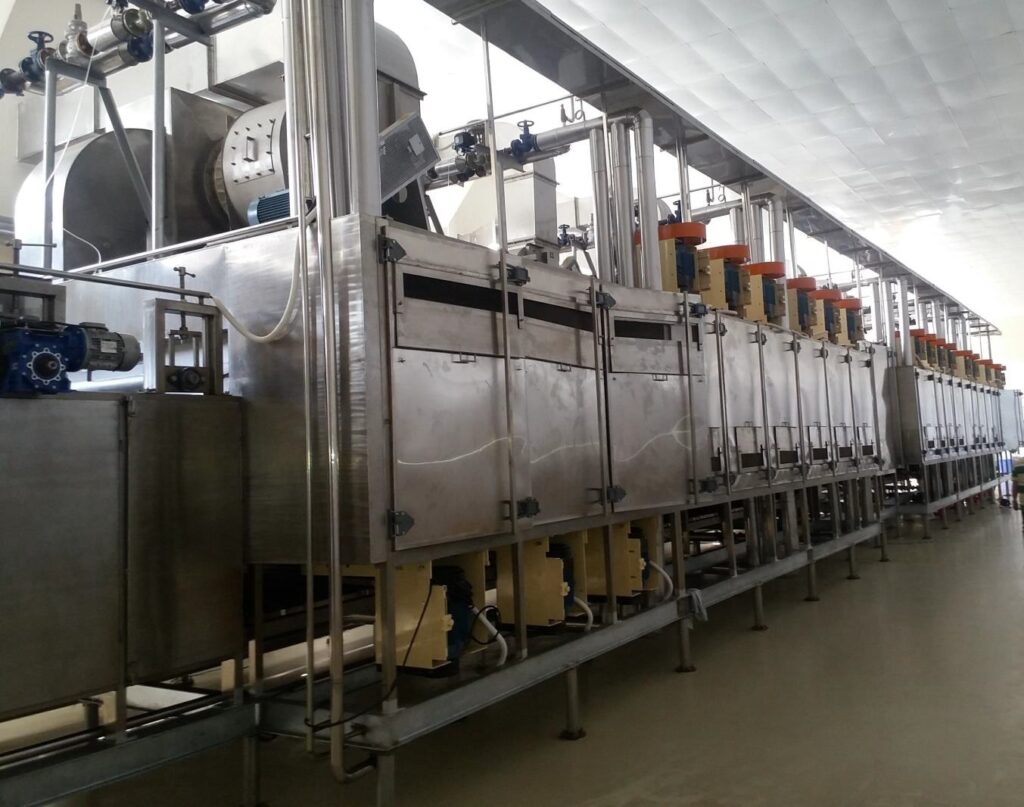
| Band dryer or mesh belt dryer | Dried slices (A); green chips for flour (C) | Continuous; temperature and airflow zones; gentle on slices | Ripe slices can stick to the belt; bed depth must be uniform |
| Heat pump dryer | Colour-critical slices and smaller batches | Low, steady temperature with humidity control | Lower throughput; batch handling |
| Flash dryer | Pressed green banana mash (C, large scale) | Short contact time for wet, dispersible solids | Needs dewatering first; not suitable for sticky ripe fruit |
| Drum dryer | Ripe banana puree (D) | Compact; makes flakes that mill easily once cool | Hot surface can darken the product; sticky film is hard to scrape without additives |
| Refractance window dryer | Ripe banana puree (D) | Thin film heated by circulating hot water | Feed viscosity and film thickness need trials |
| Spray dryer | Diluted ripe banana puree (D) | Fine powder | Sugars stick to the chamber; carriers are usually needed |
GTI’s fruit drying systems page lists banana chips under belt drying and banana powder under refractance window drying. GTI’s comparison of spray, drum and refractance window drying for fruit powders explains the puree-route trade-offs.
Browning, starch, stickiness and moisture
Browning. Bananas are low in acid and brown rapidly after peeling. Pretreat within minutes of peeling, keep the time from slicing to the dryer short, and avoid excessive heat in the final drying zones. Additive choice, including sulphites, depends on the rules of your destination market.
Resistant starch (green banana flour). A 2023 review of green banana flour technology recommends drying below the starch gelatinisation temperature, given as about 68°C, to protect resistant starch. It reports a study in which flour made in a rotary dryer lost more than 90% of its resistant starch compared with other methods. If resistant starch is part of your product claim, set product temperature limits with your buyer and confirm them with laboratory tests.
Stickiness (ripe banana powder). Ripe banana solids are sugar-rich. Research on banana flakes shows the glass transition temperature falls as moisture rises and that maltodextrin raises it, which is why carriers reduce stickiness. In practice:
- Cool the product before milling.
- Mill, sieve and pack in a dehumidified area.
- Use moisture-barrier packaging.
GTI’s guide to powder caking after drying covers the storage side.
Moisture. Write the target residual moisture, or water activity, and the test method into your specification. FAO’s small-scale recipe dries ripe banana slices at 60–75°C to about 12% moisture. Treat that as a starting point for trials, not a design figure for an industrial dryer or a substitute for your buyer’s specification.
Capacity: state the basis
Quotations go wrong when buyers and suppliers use different bases. Keep these separate:
- Fruit intake: bunches or fingers bought (t/day).
- Dryer wet feed: peeled, sliced or pulped material entering the dryer (kg/h).
- Evaporation: water removed in the dryer (kg/h). This sizes the dryer.
- Finished product: dried output (kg/h).
Evaporation W = F × (Mi − Mf) ÷ (100 − Mf), where F is wet feed and Mi and Mf are the initial and final moisture in % wet basis.
Illustrative calculation only (assumed values, not a design): 1,000 kg/h of peeled ripe banana slices at an assumed 75% moisture, dried to an assumed 12%.
- Water evaporated = 1,000 × (75 − 12) ÷ (100 − 12) ≈ 716 kg/h.
- Dried product ≈ 284 kg/h.
Fruit intake will be higher than wet feed because of peel and rejects. Measure your own peel ratio and moisture, which vary with variety and ripeness.
Materials, hygiene, heat source and milling
- Materials: Use stainless steel for product contact. GTI’s mesh belt dryer page lists SS304 or SS316 options and steam, thermic fluid, gas or electric heating. Choose with your supplier for your product and cleaning regime.
- Hygiene: Banana sap and sugary fines build up on belts and in ducts. Specify access doors, belt washing and drainage, and include cleaning in your food-safety plan. Certification of your plant is your responsibility.
- Heat source: Compare what your site has, using GTI’s dryer heat source selection guide.
- Milling and dust: Flour and powder lines need a mill, a sieve, cyclones or bag filters, and a combustible-dust assessment. GTI Group’s Food Tech Projects site lists hammer mills with dust collection and screening.
What GTI supplies
GTI Dryers designs and manufactures the drying stage: band, mesh-belt, heat pump, flash, drum, refractance window and spray dryers, with feeding, cooling and dust collection around the dryer. Preparation, frying and packing equipment is listed on GTI Group’s Food Tech Projects site. Every quotation should state whether it covers the dryer only or a complete line.
Information to send for a banana dryer quotation
- Raw material (variety, ripeness stage) and finished product: dried chips, green banana flour or ripe banana powder.
- Required capacity and its basis: fruit intake, dryer wet feed or finished product, plus operating hours.
- Inlet and target moisture or water activity, with the test method.
- Slice thickness, or puree solids if you already make puree.
- Available heat source.
- Installation country and site, including climate and space.
- Quality requirements: colour, texture, resistant starch if claimed, particle size, carrier allowed or not, and packaging.
Frequently asked questions
Can a dryer make banana chips like fried ones?
No. A dryer makes dehydrated banana chips, which have a different taste and texture and contain no frying oil. Conventional fried chips need a fryer.
Is banana flour the same as banana powder?
No. Banana flour is made from unripe, starchy fruit and is used like a flour. Banana powder is made from ripe, sugary fruit or puree and is used for flavour and sweetness. The two need different drying conditions.
What temperature should green banana flour be dried at?
The 2023 review cited above recommends staying below the starch gelatinisation temperature, given as about 68°C, to protect resistant starch. Confirm the limit for your variety and product claim with laboratory tests.
Why does ripe banana powder go sticky?
Its sugars absorb moisture and soften as they warm. Cool it before milling, pack it in a dry room, use barrier packaging and, on puree routes, consider a carrier agreed with your buyer.
Which dryer is best for dried banana chips?
For continuous production, a multi-zone band or mesh-belt dryer. For smaller, colour-critical batches, a heat pump dryer. Trials with your own fruit confirm the settings.
Discuss your banana processing project with GTI
For assistance with banana dryer selection, processing requirements or a project-specific quotation, contact Genex Tech Industries LLP (GTI Group).
Email: mktg@gtidryers.com
Call or WhatsApp: +91-93300 77417
Website: https://gtidryers.com/
Contact page: https://gtidryers.com/contact/
Please share your raw material and desired finished product, required feed or product capacity, inlet and target moisture, available heat source, installation country and product-quality requirements.
Sources
- IITA PROPAS, value-added processing of bananas and plantain.
- FAO, Dried fruit: processing details and recipes (small-scale guidance, including banana slice thickness and drying).
- Brazilian Archives of Biology and Technology, Green banana flour technology: from raw material to sensory acceptance (2023 review).
- Agriculture and Natural Resources, effect of maltodextrin on glass transition temperature and water activity of banana flake.