
Refractance Window (RW) drying is a thin-film drying technology used mainly for heat-sensitive liquid and semi-liquid foods — purees, juices, concentrates and similar pastes. Product is spread as a thin layer on a moving polymer film heated from below by circulating hot water. Drying is relatively fast while product temperatures remain moderate compared with many conventional hot-air or drum processes.
Interest has grown because processors want colour, flavour and nutrient retention closer to freeze-dried quality, without the full capital and energy burden of freeze drying. This guide explains what an RW dryer is, how it works, where it fits in food applications, and what limits buyers should understand.
1. What is a Refractance Window Dryer?
A Refractance Window dryer is a continuous contact dryer in which:
- Hot water (typically below boiling, often in a range around 90–95 °C at the water side in published descriptions) circulates under a thin infrared-transparent plastic film (commonly a polyester-type film such as Mylar in literature).
- Liquid or semi-liquid feed is applied as a thin, uniform layer on the upper surface of the film.
- Heat reaches the product mainly by conduction through the film, with contributions discussed in the literature from radiation and from air-side convection as moisture leaves.
- As the product dries, the thermal path changes; product temperature is often reported in a moderate range (commonly cited around 60–70 °C product-side in food studies), and drying times for thin layers are measured in minutes rather than hours.
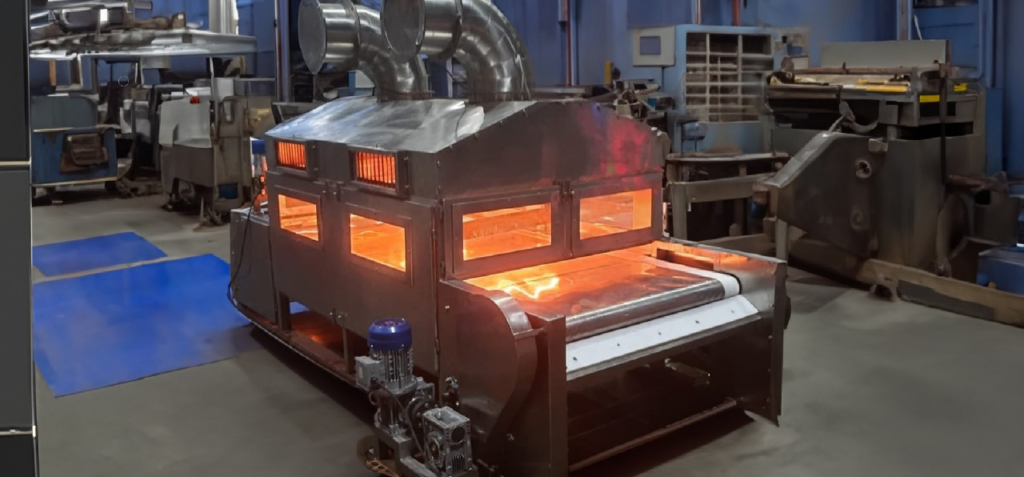
The name “Refractance Window” comes from the original description of a radiative “window” that is more open when the product is wet and closes as it dries. Later engineering studies have emphasised that conduction through the film is the dominant heat-transfer path, with radiation a smaller fraction — but the practical outcome remains: rapid thin-layer drying at moderated product temperature.
RW drying is sometimes grouped with other “fourth-generation” or novel food drying methods aimed at quality retention.
2. How the Process Works (Simple Flow)
text
[Hot water circulation under belt/film]
              ↑
[Thin polymer film] ← product spread in thin layer
              ↑
[Moisture evaporates to ambient or managed air above]
              ↓
[Dried sheet / flake / powder after removal from film]- Feed application — Puree or juice is metered and spread to a controlled thickness.
- Contact heating — Heat transfers from hot water through the film into the wet layer.
- Evaporation — Water leaves the free surface; residence time is set by belt speed and dryer length.
- Discharge — Dried product is released as a sheet, flakes or material that can be milled to powder.
- Water loop — Hot water is recirculated; managing this loop is central to energy use.
Uniform layer thickness is critical. Thick or uneven layers dry slowly in the centre and can hurt both capacity and quality.
3. Why Food Applications Are Growing
| Driver | What it means for processors |
|---|---|
| Heat-sensitive value | Fruit and vegetable purees, herbs, and bioactive-rich foods lose colour and nutrients in aggressive hot-air or high-temperature drum drying. |
| Quality vs freeze drying cost | Freeze drying often sets the quality benchmark but at high capital and energy cost. RW is widely discussed as offering much of the quality benefit at lower energy and equipment intensity for suitable thin-layer feeds. |
| Puree and viscous feeds | Spray drying needs a pumpable, atomisable feed and can be thermally harder on some products. RW accepts purees and thicker semi-liquids spread as a film. |
| Colour and bioactive retention | Published studies frequently report better retention of colour, carotenoids, vitamin C, anthocyanins and similar compounds versus conventional hot-air drying for many fruits and vegetables. |
| Shorter drying times for thin layers | Minutes-scale drying for thin spreads improves throughput per unit area versus tray drying of the same products. |
| Atmospheric operation | No vacuum system required (unlike freeze drying), which simplifies the plant in many cases. |
Growth is strongest where the product is high-value, heat-sensitive and can be applied as a thin, uniform layer.
4. Typical Food and Related Applications
- Fruit and vegetable purees → flakes, sheets or powders
- Juices and concentrates (within viscosity and spreading limits)
- Herbal and botanical purees or extracts suited to thin-film drying
- Some dairy- or protein-based formulations under evaluation in literature
- Fruit leathers and edible film-type products
- Selected nutraceutical and high-pigment materials (e.g. carotenoid-rich biomass) in published commercial and research use
Always confirm with product-specific trials: not every formulation spreads or releases cleanly from the film.
5. Comparison Snapshot (Buyer View)
| Criterion | Refractance Window | Hot-air / tray | Spray drying | Freeze drying |
|---|---|---|---|---|
| Typical feed | Thin layer of puree / semi-liquid | Pieces, trays, various forms | Pumpable liquid/slurry | Frozen pieces or liquids (as designed) |
| Product temperature | Moderate (often cited ~60–70 °C range in food RW literature) | Often higher in product | Depends on outlet conditions; can be stressful | Very low |
| Quality retention | Often high for colour & many bioactives | Variable; often lower for sensitive compounds | Good for many powders; formulation-dependent | Excellent |
| Energy / capital intensity | Generally lower than freeze drying for suitable duties | Moderate | Moderate–high depending on water load | High |
| Scale-up focus | Belt area, layer uniformity, film life | Tray/tunnel capacity | Chamber & atomiser | Vacuum, condenser, cycle time |
Figures such as “50% less energy than freeze drying” appear in industry and review literature for specific comparisons; treat them as context from published cases, not a guarantee for every product or plant.
6. Limitations and Practical Constraints
Buyers should plan for:
| Limitation | Implication |
|---|---|
| Thin-layer requirement | Capacity scales with belt area and allowable layer thickness; thick layers defeat the quality/speed advantage. |
| Feed must spread | Fibrous, lumpy or poorly dispersed feeds need preparation. |
| Film durability | Polymer film is a wear/consumable item; life and replacement affect operating cost. |
| Not a bulk-solid dryer | Wrong tool for wet filter cakes, granules or large slices (those point to spin-flash, fluid bed, band, rotary, etc.). |
| Scale-up engineering | Uniform spreading, edge effects and continuous discharge need careful design at industrial width and speed. |
| Hybrid interest | Research continues on RW combined with infrared, ultrasound, osmotic pre-treatment, etc.; industrial standardisation is still evolving. |
7. When to Put RW on the Shortlist — and When Not To
Consider RW when:
- Product is a puree, juice or similar semi-liquid
- Colour, flavour or bioactive retention is a commercial requirement
- Freeze drying is desired on quality grounds but is hard to justify on cost
- You can run a thin, uniform layer continuously
Look elsewhere when:
- Feed is a sticky filter cake → spin-flash or contact dryers
- Feed is free-flowing granules → fluid bed / VFBD
- Feed is slices/flakes of onion, garlic, coconut, etc. → multi-zone band dryer
- Feed is a thin solution already suited to spray drying and spray morphology is required
- Very large tonnage of robust bulk solids → rotary or other high-throughput systems
8. What Buyers Should Ask or Specify
- Exact feed form and solids content
- Target residual moisture and end form (sheet, flake, powder)
- Critical quality attributes (colour, vitamin/bioactive targets, microbes)
- Required continuous capacity
- Willingness to run pilot trials for layer thickness and film release
- Utilities (hot water generation, cleaning)
- Film replacement and hygiene procedures
9. How GTI Dryers Can Help You Decide
GTI Dryers focuses on engineered continuous drying systems such as band/mesh-belt, fluid-bed/VFBD, rotary, flash/spin-flash and spray configurations for food, spice, chemical and related industries.
Refractance Window drying is a specialised thin-film technology. GTI’s role for buyers exploring this space is to:
- Clarify whether your feed and quality goals truly suit thin-film RW drying
- Compare that route with technologies GTI designs (especially low-temperature multi-zone band systems for layered foods, and other heat-sensitive options)
- Support process-data review and, where appropriate, point you toward pilot evaluation before capital commitment
GTI does not treat RW as a default offering in place of proven belt, fluid-bed or dispersion dryers. Technology choice stays driven by feed form and specification.
Geographic Note
RW drying research and installations are discussed in North America, Europe, Asia and other food-tech markets. Adoption tracks high-value fruit, vegetable and nutraceutical processing. In India and similar regions, interest follows export quality standards and premium domestic products where colour and nutrient claims matter. Energy and water-loop design must still match local utilities.
Frequently Asked Questions
What is a Refractance Window dryer in simple terms?
A dryer that spreads puree or liquid in a thin layer on a plastic film heated by hot water underneath, so the product dries quickly at moderate temperature.
Is it the same as freeze drying?
No. It operates at atmospheric pressure with contact heat from hot water through a film. Quality can approach freeze-dried levels for some products, at typically lower energy and capital intensity, but results are product-specific.
Can it dry onion or garlic slices?
Those are usually better suited to multi-zone band dryers. RW is aimed at thin layers of purees and similar semi-liquids.
Why is it growing in food applications?
Demand for better retention of colour and sensitive compounds without full freeze-drying cost, plus suitability for purees that are awkward for simple hot-air or standard spray routes.
What should I send to discuss options with GTI?
Product form (puree, juice, pieces, cake), quality priorities, capacity and residual-moisture target — so the right technology family can be identified.
Next Step
If you are evaluating Refractance Window drying for a fruit, vegetable or high-value puree — or comparing it with band, spray or other systems — share your feed form and quality targets. GTI can help map the duty to a practical drying route and outline next engineering or trial steps.
Contact the GTI Technical Team:
Website: gtidryers.com
Email: mktg@gtidryers.com
Phone / WhatsApp: +91 9330077417