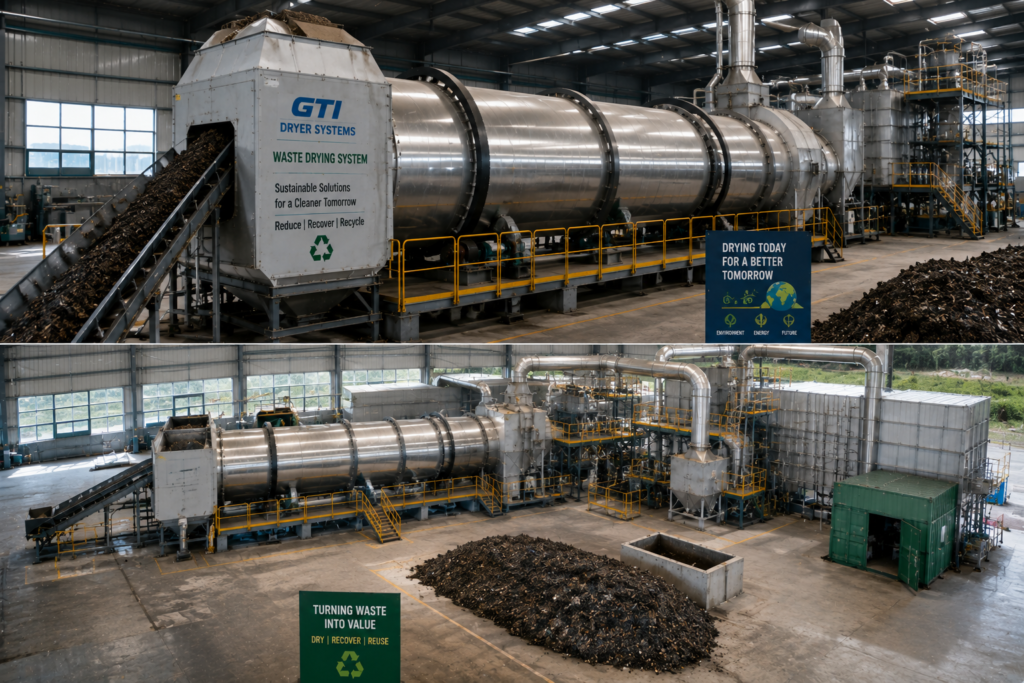
Waste Is No Longer a Problem—It Is a Valuable Resource
The world is facing one of its biggest environmental challenges in history. Rapid industrialization, urban expansion, increasing consumption, and population growth have resulted in enormous quantities of industrial waste, municipal sludge, wastewater, agricultural residues, and hazardous by-products.
According to global environmental reports, billions of tonnes of waste are generated every year, placing tremendous pressure on landfills, water resources, ecosystems, and public health. Governments and industries are now shifting from traditional waste disposal methods toward resource recovery and sustainable waste management.
One of the most important technologies driving this transformation is industrial drying.
Drying significantly reduces moisture content, decreases waste volume, lowers transportation costs, improves handling, eliminates odors, and converts waste into reusable products such as biofuels, fertilizers, construction materials, and energy resources.
At GTI Dryers, we develop advanced environmental drying solutions that help industries transform waste into value while improving operational efficiency and supporting long-term environmental sustainability.
Why Environmental Sustainability Has Become a Global Priority
The environment is no longer affected by pollution in one region—it is a global concern. Climate change, water scarcity, overflowing landfills, and industrial pollution are forcing governments and businesses to rethink how waste is managed.
Major environmental concerns include:
- Industrial sludge accumulation
- Municipal wastewater generation
- Landfill overflow
- Air pollution
- Water contamination
- Soil degradation
- Greenhouse gas emissions
- Plastic and industrial waste
- Food processing waste
- Hazardous industrial residues
Simply disposing of waste is no longer a sustainable solution. Modern industries now focus on reducing waste, recovering valuable resources, and minimizing environmental impact.
Advanced drying systems play a vital role in achieving these objectives by making waste easier to handle, transport, recycle, or convert into useful products.
The Growing Need for Sustainable Waste Processing
Every manufacturing sector produces waste during its operations. Without proper treatment, these waste streams can create environmental risks and increase operational costs.
Industries are increasingly adopting sustainable processing methods to:
- Reduce disposal costs
- Recover reusable materials
- Improve workplace hygiene
- Meet environmental regulations
- Lower carbon emissions
- Support circular economy initiatives
- Increase operational efficiency
- Protect natural resources
Environmental drying technologies have become an essential part of this transition by reducing moisture and preparing waste for reuse or safe disposal.
What Are Waste & Environmental Drying Systems?
Waste & Environmental Drying Systems are engineered technologies designed to remove moisture from industrial waste, sludge, wastewater treatment residues, biomass, organic waste, and other environmental by-products.
Instead of simply drying waste, these systems prepare materials for:
- Recycling
- Resource recovery
- Energy generation
- Composting
- Safe disposal
- Further industrial processing
Modern drying systems use carefully controlled temperature, airflow, and residence time to achieve efficient moisture removal while minimizing energy consumption and environmental impact.
Why Moisture Reduction Is Critical in Waste Management
Moisture is one of the biggest challenges in handling industrial and municipal waste.
High moisture content leads to:
- Heavy transportation loads
- Increased disposal costs
- Odor generation
- Difficult material handling
- Poor combustion efficiency
- Biological instability
- Larger landfill requirements
- Reduced recycling efficiency
By reducing moisture content, industries can:
- Decrease waste volume
- Lower transportation expenses
- Improve storage stability
- Increase calorific value for waste-to-energy applications
- Enhance recycling opportunities
- Reduce environmental risks
This makes industrial drying one of the most valuable investments in modern environmental management.
How Industrial Drying Supports the Circular Economy
The traditional “take, use, and dispose” model is rapidly being replaced by the circular economy, where waste materials are recovered, processed, and reused instead of being discarded.
Industrial drying supports this approach by converting waste into valuable resources such as:
- Alternative fuels
- Organic fertilizers
- Soil conditioners
- Biomass fuel
- Compost feedstock
- Recycled industrial materials
- Construction additives
Rather than treating waste as a liability, industries can generate new value while reducing their environmental footprint.
GTI Dryers: Supporting a Cleaner Future Through Engineering
At GTI Dryers, we believe that industrial growth and environmental responsibility should progress together.
Our environmental drying systems are engineered to help industries:
- Improve waste management efficiency
- Reduce landfill dependency
- Recover reusable resources
- Optimize wastewater treatment processes
- Lower operating costs
- Reduce greenhouse gas emissions
- Support sustainable manufacturing practices
- Meet international environmental standards
Every solution is customized to the customer’s waste characteristics, production requirements, and environmental objectives.
India’s Role in Sustainable Waste Management
India is among the fastest-growing economies in the world, but rapid urbanization and industrial development have also increased the need for advanced waste treatment technologies.
The country generates significant quantities of:
- Municipal solid waste
- Sewage sludge
- Industrial sludge
- Food processing waste
- Agricultural residues
- Textile waste
- Paper mill sludge
- Chemical waste
Government initiatives such as Swachh Bharat Mission, Namami Gange, Smart Cities Mission, AMRUT, and stricter environmental regulations have accelerated investments in modern waste management and wastewater treatment infrastructure.
GTI Dryers contributes to this transformation by providing reliable drying systems that help municipalities and industries reduce waste volumes, improve resource recovery, and meet environmental compliance requirements.
Industries That Require Environmental Drying Solutions
Environmental drying systems are widely used across numerous industries.
Municipal Wastewater Treatment
Applications include:
- Sewage Sludge
- Biosolids
- Municipal Residues
Industrial Wastewater Treatment
Suitable for:
- ETP Sludge
- STP Sludge
- WWTP Residues
- Process Sludge
Chemical Industry
Processing of:
- Chemical Sludge
- Catalyst Waste
- Process Residues
Food Processing Industry
Applications include:
- Organic Waste
- Food Residues
- Vegetable Waste
- Fruit Waste
Paper & Pulp Industry
Processing:
- Paper Sludge
- Fiber Residues
- Biomass Waste
Textile Industry
Suitable for:
- Dye Sludge
- Treatment Plant Residues
- Process Waste
Biomass & Renewable Energy
Applications include:
- Agricultural Waste
- Wood Chips
- Sawdust
- Biomass Residues
- Organic Feedstock
Why Environmental Drying Is an Investment, Not a Cost
Many industries initially view waste treatment as an unavoidable expense. However, modern environmental processing technologies have changed this perspective.
Efficient drying systems help organizations:
- Reduce disposal costs
- Recover valuable materials
- Improve operational efficiency
- Lower energy consumption
- Generate renewable energy feedstock
- Enhance environmental performance
- Improve corporate sustainability credentials
When designed correctly, environmental drying systems deliver long-term operational and financial benefits.
Why GTI Dryers Develops Customized Environmental Solutions
No two waste streams are identical. Factors such as moisture content, organic composition, abrasiveness, particle size, and thermal sensitivity vary significantly between industries.
GTI Dryers begins every project with a detailed engineering assessment, evaluating:
- Waste composition
- Initial and target moisture content
- Throughput requirements
- Available heat sources
- Plant layout
- Automation requirements
- Environmental regulations
- Future expansion needs
This customized approach ensures each drying system achieves maximum efficiency, reliable operation, and compliance with environmental standards.
The Science Behind Modern Environmental Drying
Environmental drying is much more than simply removing moisture from waste materials. It is a carefully engineered thermal process that transforms difficult-to-handle waste into stable, transportable, recyclable, or reusable resources.
Whether processing municipal sludge, industrial residues, chemical waste, food waste, biomass, or wastewater treatment solids, the objective remains the same—reduce moisture efficiently while preserving energy and minimizing environmental impact.
At GTI Dryers, every environmental drying solution is developed through detailed process engineering to achieve maximum drying efficiency, lower operating costs, and long-term operational reliability.
Understanding Moisture in Industrial Waste
Different waste materials contain different types of moisture. Removing each type requires a different amount of energy.
Surface Moisture
Water attached to the outer surface of particles.
This is generally the easiest moisture to remove.
Examples include:
- Fresh sludge
- Sand
- Biomass
- Industrial powders
Capillary Moisture
Water trapped inside small pores and capillaries.
Removing this moisture requires greater heat transfer and controlled residence time.
Bound Moisture
Water chemically attached to the material structure.
This is the most difficult moisture to remove and often determines the final drying stage.
Understanding these moisture characteristics allows engineers to select the most efficient drying technology.
The Environmental Drying Process
Although applications vary across industries, the drying process generally follows the same sequence.
Step 1 – Waste Collection
Materials originate from:
- Sewage Treatment Plants (STP)
- Effluent Treatment Plants (ETP)
- Wastewater Treatment Plants (WWTP)
- Chemical Industries
- Food Processing Plants
- Textile Mills
- Paper & Pulp Industries
- Municipal Waste Facilities
Step 2 – Dewatering
Mechanical equipment such as:
- Filter Presses
- Belt Presses
- Centrifuges
- Screw Presses
reduces free water before thermal drying begins.
Step 3 – Feeding System
The partially dewatered material is transferred into the drying equipment using:
- Screw Conveyors
- Belt Conveyors
- Feed Hoppers
- Rotary Feeders
Proper feeding ensures stable and continuous operation.
Step 4 – Thermal Drying
Heat energy removes remaining moisture through carefully controlled:
- Temperature
- Airflow
- Residence Time
- Material Movement
The drying system continuously monitors these parameters to ensure efficient moisture reduction.
Step 5 – Product Recovery
The dried product may be used for:
- Waste-to-Energy
- Cement Kilns
- Composting
- Fertilizer Production
- Biomass Fuel
- Resource Recovery
- Safe Disposal
Heat Transfer in Environmental Drying
Efficient heat transfer determines the performance of any drying system.
Three primary mechanisms are involved.
Conduction
Heat transfers through direct contact between the heated surface and the material.
Commonly used in:
- Paddle Dryers
- Vacuum Dryers
Advantages:
- High efficiency
- Precise temperature control
- Low dust generation
Convection
Heat transfers through moving hot air.
Used in:
- Belt Dryers
- Flash Dryers
- Rotary Dryers
- Fluid Bed Dryers
Benefits include:
- Continuous drying
- High capacity
- Uniform heat distribution
Radiation
Heat is transferred through thermal radiation.
Although less common in environmental drying, radiation assists overall heat transfer in high-temperature systems.
Direct Drying vs Indirect Drying
Selecting the correct heating method depends on the material characteristics.
Direct Drying
The heating air directly contacts the waste material.
Suitable for:
- Biomass
- Municipal Sludge
- Organic Waste
- Agricultural Waste
Advantages:
- Faster drying
- Lower capital investment
- High throughput
Indirect Drying
Heat passes through heated metal surfaces without contacting the product.
Suitable for:
- Hazardous Waste
- Chemical Sludge
- Solvent-Containing Materials
- Sensitive Industrial Waste
Advantages:
- Better emission control
- Cleaner operation
- Improved product quality
- Lower odor generation
GTI Dryers evaluates each application carefully before recommending the most suitable technology.
Dryer Technologies Used in Environmental Processing
Different waste materials require different drying systems.
Belt Dryers
Ideal for:
- Municipal Sludge
- Biomass
- Organic Waste
- Agricultural Residues
Advantages:
- Continuous production
- Uniform moisture reduction
- Gentle drying
- Excellent energy efficiency
Paddle Dryers
Suitable for:
- Sticky Sludge
- Filter Cakes
- Industrial Residues
- Hazardous Waste
Advantages:
- Indirect heating
- Closed operation
- Minimal dust
- High thermal efficiency
Rotary Dryers
Used for:
- Biomass
- Sand
- Ash
- Bulk Industrial Waste
Advantages:
- High production capacity
- Robust construction
- Reliable continuous operation
Flash Dryers
Ideal for:
- Fine Sludge
- Industrial Powders
- Chemical Residues
Advantages:
- Extremely rapid drying
- Compact installation
- Continuous operation
Fluid Bed Dryers
Applications include:
- Granular Materials
- Crystalline Products
- Free-Flowing Waste Materials
Benefits:
- Uniform drying
- Excellent heat transfer
- Precise moisture control
Vacuum Dryers
Suitable for:
- Heat-Sensitive Materials
- Hazardous Chemicals
- Solvent Recovery Applications
Advantages:
- Low-temperature drying
- Product protection
- Improved safety
Factors Affecting Drying Performance
Several process variables determine system efficiency.
Moisture Content
Higher moisture requires greater thermal energy.
Particle Size
Smaller particles generally dry faster than larger materials.
Bulk Density
Dense materials require different airflow characteristics.
Air Velocity
Proper airflow ensures efficient evaporation without excessive energy use.
Drying Temperature
Incorrect temperature may cause:
- Product degradation
- Energy losses
- Poor drying quality
GTI Dryers carefully balances temperature with product characteristics.
Residence Time
Each material requires an optimized drying duration to achieve the desired final moisture level without over-processing.
Energy Efficiency in Environmental Drying
Energy consumption is one of the largest operational expenses in waste processing.
GTI Dryers incorporates several energy-saving technologies:
- Waste Heat Recovery
- Air Recirculation Systems
- High-Efficiency Burners
- Optimized Airflow Design
- Premium Thermal Insulation
- Intelligent Temperature Control
- Variable Frequency Drives (VFDs)
These features reduce fuel consumption while maintaining stable drying performance.
Environmental Control Systems
Modern environmental drying facilities must also manage emissions and maintain workplace safety.
GTI Dryers integrates:
- Cyclone Separators
- Bag Filter Systems
- Wet Scrubbers
- Odor Control Units
- Dust Collection Systems
- Air Pollution Control Equipment
These systems help facilities comply with environmental regulations while improving operational cleanliness.
Smart Automation for Modern Waste Processing Plants
Automation improves productivity, consistency, and safety.
Typical automation features include:
- PLC-Based Process Control
- HMI Touchscreen Interfaces
- SCADA Monitoring
- Real-Time Moisture Monitoring
- Temperature Sensors
- Pressure Monitoring
- Automatic Alarm Systems
- Remote Diagnostics
- Production Data Logging
These technologies reduce manual intervention and improve long-term process reliability.
Common Challenges in Environmental Drying
Waste processing facilities often face operational challenges.
High Moisture Variations
Different waste batches may contain varying moisture levels.
Solution: Adaptive process controls and automatic temperature adjustment.
Sticky Materials
Certain sludges tend to adhere to equipment surfaces.
Solution: Customized internal designs, indirect heating, and self-cleaning mechanisms.
Odor Emissions
Organic waste may produce unpleasant odors during drying.
Solution: Closed-loop drying systems with integrated odor control.
Dust Generation
Fine materials can create airborne particles.
Solution: Advanced dust collection and enclosed conveying systems.
Rising Energy Costs
Fuel prices continue to increase worldwide.
Solution: Heat recovery systems, optimized insulation, and energy-efficient airflow design.
GTI Dryers’ Engineering Philosophy
Every environmental drying project begins with understanding the customer’s process rather than simply recommending equipment.
Our engineering workflow includes:
- Waste Material Analysis
- Laboratory Testing
- Moisture Profiling
- Heat & Mass Balance Calculations
- Dryer Selection
- Process Simulation
- Utility Optimization
- Automation Design
- Performance Validation
This engineering-first approach ensures each customer receives a drying system specifically designed for long-term efficiency, environmental compliance, and operational reliability.
Building a Cleaner Future Through Advanced Drying Technology
Across the world, industries are being challenged to produce more while consuming fewer natural resources and generating less waste. Governments, environmental agencies, and manufacturers are no longer measuring success only by production capacity—they are also evaluating sustainability, energy efficiency, emissions, and responsible waste management.
This global shift has transformed environmental drying from a supporting process into a strategic investment.
Today’s drying technologies not only reduce moisture but also enable industries to recover valuable materials, minimize landfill dependency, reduce greenhouse gas emissions, and contribute to a circular economy.
At GTI Dryers, we believe that environmental responsibility and industrial growth can progress together. Through innovative drying technologies, we help businesses convert waste into valuable resources while improving productivity and supporting global sustainability goals.
The Global Waste Challenge
Every year, industries and municipalities generate billions of tonnes of waste.
Some of the largest waste streams include:
- Municipal Sewage Sludge
- Industrial Sludge
- Food Processing Waste
- Agricultural Residues
- Chemical Process Waste
- Textile Sludge
- Paper Mill Sludge
- Mining Waste
- Biomass Residues
- Organic Industrial Waste
Without proper treatment, these materials create environmental risks including:
- Landfill Overflow
- Water Pollution
- Soil Contamination
- Methane Emissions
- Greenhouse Gas Production
- Public Health Risks
- High Transportation Costs
Modern drying systems significantly reduce these challenges by decreasing waste volume and making materials easier to recycle, reuse, or convert into useful products.
Waste Is Becoming a Valuable Resource
The traditional waste management model focused on disposal. Today, industries are embracing a resource recovery approach.
Instead of viewing sludge and industrial waste as liabilities, companies are recovering valuable materials that can be reused in production or converted into alternative energy sources.
Examples include:
- Biomass Fuel
- Refuse-Derived Fuel (RDF)
- Solid Recovered Fuel (SRF)
- Organic Fertilizers
- Compost Feedstock
- Construction Fillers
- Industrial Raw Materials
Drying is the critical step that makes these recovery processes technically and economically viable.
Circular Economy: The Future of Industrial Sustainability
The circular economy is changing how industries operate worldwide.
Instead of following the traditional “take, make, and dispose” model, companies now aim to:
- Reduce Waste Generation
- Extend Material Life
- Recover Valuable Resources
- Recycle Industrial By-products
- Minimize Environmental Impact
- Lower Carbon Emissions
Environmental drying systems support this transformation by reducing moisture content, improving material stability, and preparing waste for reuse across multiple industries.
Industries Benefiting from Environmental Drying
Municipal Wastewater Treatment
Cities worldwide generate increasing volumes of sewage sludge.
Drying helps:
- Reduce disposal costs
- Improve handling
- Produce biosolids
- Support waste-to-energy projects
Chemical Industry
Chemical manufacturers use drying systems to process:
- Process Sludge
- Catalyst Residues
- Filter Cakes
- Chemical Waste
Benefits include improved safety, reduced waste volume, and easier transportation.
Food Processing Industry
Food manufacturers recover value from:
- Fruit Waste
- Vegetable Waste
- Organic Residues
- Processing By-products
These materials can often be converted into compost, animal feed ingredients, or renewable energy sources after drying.
Paper & Pulp Industry
Drying technologies assist in managing:
- Paper Sludge
- Fiber Residues
- Biomass Waste
Recovered materials may be reused for energy generation or other industrial applications.
Textile Industry
Textile treatment plants generate sludge containing dyes and treatment chemicals.
Advanced drying reduces waste volume and simplifies downstream disposal or recovery.
Mining & Mineral Processing
Environmental drying is increasingly used for:
- Tailings Management
- Mineral Sludge
- Process Residues
- Wastewater Solids
This improves environmental compliance and reduces storage challenges.
Biomass & Renewable Energy
Drying supports the production of renewable fuels from:
- Sawdust
- Wood Chips
- Rice Husk
- Sugarcane Bagasse
- Agricultural Residues
- Coconut Waste
Lower moisture content significantly improves combustion efficiency and energy output.
Environmental Regulations Driving Modern Drying Technologies
Countries worldwide are implementing stricter environmental regulations to reduce pollution and encourage sustainable manufacturing.
Industries are increasingly required to:
- Reduce landfill disposal
- Improve wastewater treatment
- Lower emissions
- Recover valuable materials
- Improve energy efficiency
- Reduce greenhouse gas emissions
Investing in advanced drying systems helps businesses comply with these regulations while improving overall operational performance.
How GTI Dryers Supports Sustainable Industrial Growth
GTI Dryers develops drying systems that support both environmental responsibility and industrial productivity.
Our engineering philosophy focuses on:
- Energy-Efficient Thermal Design
- Process Optimization
- Customized Dryer Selection
- Intelligent Automation
- Low Emission Operation
- Resource Recovery
- Long Equipment Life
- Reduced Operating Costs
Every project is engineered according to the customer’s material properties, production goals, environmental requirements, and future expansion plans.
Global Markets Driving Demand for Environmental Drying
Demand for sustainable waste processing is increasing across multiple regions due to stricter environmental policies and expanding industrial infrastructure.
Key growth markets include:
Asia-Pacific
Rapid urbanization and manufacturing growth are driving investments in wastewater treatment, biomass utilization, and industrial sludge management.
Major countries include:
- India
- Indonesia
- Vietnam
- Thailand
- Malaysia
- Philippines
Europe
European industries continue to invest in:
- Circular Economy Projects
- Carbon Reduction
- Renewable Energy
- Waste-to-Energy
- Advanced Recycling Technologies
North America
Growing focus on:
- Industrial Sustainability
- Municipal Infrastructure
- Environmental Compliance
- Resource Recovery
Middle East & Africa
Increasing investments in:
- Water Reuse
- Wastewater Infrastructure
- Industrial Development
- Environmental Engineering
How Environmental Drying Solutions Are Known Around the World
Industrial buyers often search using localized technical terms depending on their country and industry. Including these terms naturally within your website improves international discoverability while maintaining an English-first content strategy.
| Country / Region | Common Industry Search Term |
| 🇮🇳 India | Industrial Sludge Drying Plant |
| 🇮🇩 Indonesia | Mesin Pengering Lumpur Industri (Industrial Sludge Drying Machine) |
| 🇲🇾 Malaysia | Wastewater Sludge Drying System |
| 🇻🇳 Vietnam | Máy sấy bùn công nghiệp |
| 🇹🇭 Thailand | เครื่องอบแห้งตะกอนอุตสาหกรรม |
| 🇩🇪 Germany | Klärschlammtrocknungsanlage |
| 🇫🇷 France | Système de séchage des boues industrielles |
| 🇪🇸 Spain | Sistema de secado de lodos industriales |
| 🇧🇷 Brazil | Sistema de secagem de lodo industrial |
| 🇺🇸 USA | Industrial Waste Drying Equipment |
| 🇨🇦 Canada | Municipal Sludge Drying Solutions |
| 🇦🇪 UAE | Wastewater Sludge Drying Plant |
| 🌍 Middle East | شركة تصنيع أنظمة تجفيف الحمأة |
Innovation Shaping the Future of Environmental Drying
The future of environmental processing will be driven by intelligent, sustainable, and data-driven technologies.
Emerging trends include:
- AI-Based Process Optimization
- Industry 4.0 Integration
- Smart Moisture Sensors
- Predictive Maintenance
- Waste Heat Recovery Systems
- Carbon Footprint Monitoring
- Digital Twin Technology
- Renewable Energy Integration
- Low-Emission Drying Systems
GTI Dryers continuously invests in engineering innovation to ensure customers benefit from efficient, future-ready drying solutions.
Why Industries Worldwide Choose GTI Dryers
GTI Dryers is more than an equipment manufacturer—we are a technology partner committed to sustainable industrial development.
Our customers choose us because we provide:
- Customized Engineering Solutions
- Energy-Efficient Drying Systems
- Turnkey Project Execution
- Reliable Automation
- Food & Industrial Grade Manufacturing
- Global Technical Support
- Long Equipment Life
- Low Maintenance Costs
- Process Optimization Expertise
- Strong Focus on Environmental Sustainability
Whether you are designing a municipal wastewater treatment facility, upgrading an industrial sludge processing plant, or implementing a waste-to-energy project, GTI Dryers delivers drying solutions tailored to your operational and environmental goals.
Engineering Better Waste Processing Through Intelligent Drying Technology
Every waste material behaves differently during drying. Municipal sludge, industrial sludge, food waste, biomass, chemical residues, paper sludge, and textile waste all have unique moisture characteristics, particle structures, thermal properties, and handling requirements.
For this reason, selecting the right drying technology is an engineering decision—not simply an equipment purchase.
A properly designed drying system improves:
- Waste volume reduction
- Process efficiency
- Energy consumption
- Product consistency
- Resource recovery
- Environmental compliance
- Operating costs
- Plant reliability
At GTI Dryers, every project begins with detailed engineering analysis to ensure the selected technology delivers maximum long-term value.
Engineering Parameters That Influence Dryer Selection
Before designing any environmental drying plant, engineers evaluate several critical factors.
1. Material Characteristics
Each waste stream behaves differently during thermal processing.
Key parameters include:
- Initial Moisture Content
- Final Moisture Requirement
- Bulk Density
- Particle Size
- Flowability
- Stickiness
- Abrasiveness
- Organic Content
- Thermal Sensitivity
- Calorific Value
Understanding these properties helps determine the most suitable drying technology.
2. Waste Source
Different industries generate different waste streams.
Examples include:
Municipal Sector
- Sewage Sludge
- Biosolids
Chemical Industry
- Process Sludge
- Catalyst Waste
- Filter Cake
Food Industry
- Fruit Waste
- Vegetable Waste
- Organic Residues
Paper Industry
- Fiber Sludge
- Paper Mill Residues
Textile Industry
- Dye Sludge
- Treatment Residues
Biomass Industry
- Agricultural Waste
- Sawdust
- Rice Husk
- Bagasse
Each application requires a customized engineering approach.
Industrial Dryers Used in Environmental Processing
No single dryer is suitable for every application. GTI Dryers offers a complete portfolio of drying technologies, each designed for specific material characteristics and production requirements.
Belt Dryer
Best for:
- Municipal Sludge
- Organic Waste
- Compost Feedstock
- Biomass
Advantages
- Continuous operation
- Uniform drying
- Gentle heat exposure
- Excellent energy efficiency
- Large production capacities
Paddle Dryer
Suitable for:
- Sticky Sludge
- Filter Cakes
- Hazardous Waste
- Chemical Residues
Benefits
- Indirect heating
- Closed-loop operation
- Low dust generation
- Excellent thermal efficiency
- Reduced odor emissions
Rotary Dryer
Common Applications
- Biomass
- Sand
- Ash
- Industrial Waste
- Mineral Residues
Features
- High throughput
- Rugged construction
- Continuous production
- Low maintenance
Flash Dryer
Ideal for
- Fine Sludge
- Powders
- Chemical Residues
- Lightweight Materials
Advantages
- Rapid drying
- Compact footprint
- Short residence time
- High productivity
Fluid Bed Dryer
Applications
- Granules
- Free-flowing solids
- Crystalline materials
Benefits
- Uniform moisture removal
- Excellent heat transfer
- Precise process control
Vacuum Dryer
Best for
- Heat-sensitive waste
- Solvent-containing materials
- Hazardous products
Advantages
- Low-temperature drying
- Product protection
- Improved safety
Direct vs. Indirect Drying Technologies
Selecting the correct heat transfer method is one of the most important engineering decisions.
Direct Drying
Hot air comes into direct contact with the material.
Advantages
- Fast drying
- Lower capital investment
- Suitable for bulk materials
Applications
- Biomass
- Municipal Sludge
- Organic Waste
Indirect Drying
Heat is transferred through heated surfaces without direct contact.
Advantages
- Cleaner operation
- Lower emissions
- Better odor control
- Ideal for hazardous materials
Applications
- Chemical Sludge
- Filter Cake
- Pharmaceutical Waste
- Hazardous Waste
GTI Dryers recommends the most suitable approach after evaluating the customer’s material and process requirements.
Process Optimization for Maximum Efficiency
Drying efficiency depends on balancing several interconnected process parameters.
Temperature Optimization
Excessive temperatures can waste energy or degrade materials.
Optimized temperatures improve:
- Product quality
- Fuel efficiency
- Equipment life
Residence Time
Each material requires an ideal drying duration.
Too short:
- High final moisture
Too long:
- Unnecessary energy consumption
Airflow Management
Proper airflow ensures:
- Uniform drying
- Reduced hot spots
- Lower fuel usage
Material Distribution
Uniform feeding prevents:
- Channeling
- Uneven moisture
- Production bottlenecks
Heat Recovery Systems
Energy costs represent one of the largest expenses in drying operations.
GTI Dryers integrates advanced heat recovery systems to improve efficiency.
Examples include:
- Exhaust Air Recovery
- Heat Exchangers
- Air Recirculation
- Waste Heat Utilization
- Multi-Stage Drying
These technologies significantly reduce operating costs while improving sustainability.
Automation for Environmental Drying Plants
Modern drying plants rely on intelligent automation to improve consistency and reduce manual intervention.
Typical systems include:
- PLC Control
- SCADA Monitoring
- HMI Interfaces
- Moisture Sensors
- Temperature Controllers
- Pressure Monitoring
- VFD Drives
- Alarm Systems
- Data Logging
- Remote Diagnostics
Automation improves process stability, product quality, and operational efficiency.
Air Pollution Control Systems
Environmental drying facilities must control dust, odors, and emissions.
GTI Dryers integrates:
- Cyclone Separators
- Bag Filters
- Wet Scrubbers
- Biofilters
- Activated Carbon Systems
- Odor Control Units
- Stack Monitoring Systems
These solutions help customers comply with environmental regulations while maintaining clean operations.
Sustainable Energy Sources for Drying
Modern plants increasingly utilize alternative heating sources.
Options include:
- Steam
- Thermal Oil
- Natural Gas
- LPG
- Biomass
- Electricity
- Waste Heat
- Biogas
Selecting the appropriate energy source improves both operating costs and environmental performance.
Common Operational Challenges & Engineering Solutions
Challenge: Sticky Sludge
Problem:
Material adheres to equipment surfaces.
Solution:
Customized paddle geometry, indirect heating, and optimized agitation.
Challenge: Variable Moisture Content
Problem:
Incoming material changes daily.
Solution:
Automatic moisture monitoring and adaptive process control.
Challenge: High Energy Consumption
Problem:
Excessive operating costs.
Solution:
Heat recovery, insulation, airflow optimization, and intelligent automation.
Challenge: Odor Generation
Problem:
Organic waste releases unpleasant gases.
Solution:
Closed-loop drying systems, biofilters, and odor treatment units.
Challenge: Dust Emissions
Problem:
Fine particles affect workplace safety.
Solution:
Cyclones, bag filters, enclosed conveyors, and dust suppression systems.
Maintenance Best Practices
A proactive maintenance strategy ensures long equipment life and consistent performance.
Recommended activities include:
Daily
- Inspect conveyors
- Check temperatures
- Monitor airflow
- Verify moisture readings
Weekly
- Clean filters
- Inspect seals
- Lubricate moving components
Monthly
- Inspect burners
- Check insulation
- Test automation systems
Annually
- Comprehensive equipment inspection
- Performance testing
- Calibration of sensors
- Preventive component replacement
Why Customized Engineering Delivers Better Results
Every waste processing facility has different operational requirements.
GTI Dryers customizes each project based on:
- Waste Characteristics
- Moisture Profile
- Utility Availability
- Plant Layout
- Environmental Regulations
- Capacity Requirements
- Expansion Plans
- Automation Preferences
This engineering-first methodology results in:
- Lower energy consumption
- Improved drying performance
- Reduced maintenance
- Higher productivity
- Better environmental compliance
- Greater return on investment
Future Trends in Environmental Drying Technology
The industry is evolving toward smarter, greener, and more connected systems.
Emerging technologies include:
- AI-Based Process Optimization
- Digital Twin Technology
- Predictive Maintenance
- Industry 4.0 Integration
- Smart Moisture Sensors
- IoT-Based Monitoring
- Carbon Footprint Analytics
- Renewable Energy Integration
- Zero-Emission Drying Technologies
GTI Dryers continuously invests in research and engineering innovation to provide future-ready solutions that meet evolving environmental and industrial requirements.
Why Industries Around the World Choose GTI Dryers
Investing in an environmental drying plant is more than purchasing equipment—it is a long-term investment in operational efficiency, environmental compliance, and sustainable growth. Industries require a technology partner who understands the complete process, from material testing to commissioning and after-sales support.
GTI Dryers provides complete engineered drying solutions tailored to each customer’s waste stream, production capacity, utility availability, and environmental objectives. Our systems are designed to deliver reliable performance, lower operating costs, and long service life while helping businesses comply with increasingly stringent environmental regulations.
Whether you are planning a municipal sludge drying plant, an industrial waste recycling facility, or a waste-to-energy project, GTI Dryers offers the engineering expertise to transform complex challenges into efficient and sustainable solutions.
Our Engineering-First Approach
Every project begins with understanding your process—not simply recommending a machine.
Our engineering workflow includes:
Material Evaluation
- Moisture analysis
- Particle size assessment
- Bulk density testing
- Thermal behavior evaluation
Process Design
- Heat and mass balance calculations
- Drying curve analysis
- Energy requirement estimation
- Airflow optimization
Equipment Selection
Based on process requirements, GTI Dryers recommends the most suitable drying technology, whether Belt Dryer, Paddle Dryer, Flash Dryer, Rotary Dryer, Fluid Bed Dryer, or a hybrid solution.
Plant Engineering
- 2D & 3D layouts
- Equipment integration
- Utility planning
- Structural design
- Instrumentation
Automation
- PLC control systems
- SCADA integration
- Remote monitoring
- Data logging
- Intelligent alarms
This engineering-driven methodology minimizes project risks and maximizes plant performance.
Complete Turnkey Environmental Drying Solutions
GTI Dryers provides end-to-end project execution, ensuring a smooth transition from concept to production.
Our turnkey scope includes:
- Process consultation
- Material testing
- Pilot trials
- Equipment manufacturing
- Factory Acceptance Testing (FAT)
- Packaging and dispatch
- Installation supervision
- Site Acceptance Testing (SAT)
- Commissioning
- Performance validation
- Operator training
- Preventive maintenance planning
- Long-term technical support
Customers benefit from a single point of responsibility throughout the project lifecycle.
Industries We Serve
Our environmental drying solutions are trusted across diverse sectors, including:
- Municipal Wastewater Treatment Plants (WWTP)
- Sewage Treatment Plants (STP)
- Effluent Treatment Plants (ETP)
- Chemical Manufacturing
- Petrochemical Industries
- Food & Beverage Processing
- Paper & Pulp Mills
- Textile Processing
- Mining & Mineral Processing
- Fertilizer Manufacturing
- Biomass & Bioenergy Plants
- Renewable Energy Projects
- Waste-to-Energy Facilities
- Environmental Engineering Companies
Each solution is customized to suit the specific characteristics of the material and the operational requirements of the plant.
Sustainable Engineering for a Greener Future
Environmental responsibility has become a competitive advantage for industries worldwide.
GTI Dryers helps organizations achieve sustainability goals by:
- Reducing waste volume
- Lowering landfill dependency
- Recovering reusable materials
- Improving energy efficiency
- Supporting circular economy initiatives
- Reducing greenhouse gas emissions
- Optimizing resource utilization
- Improving environmental compliance
Our engineering philosophy focuses on creating solutions that are economically viable while protecting natural resources.
International Markets We Serve
Demand for sustainable waste processing is expanding rapidly across the world.
GTI Dryers supports customers in:
Asia
- India
- Indonesia
- Vietnam
- Thailand
- Malaysia
- Philippines
- Bangladesh
- Sri Lanka
Middle East
- UAE
- Saudi Arabia
- Oman
- Qatar
- Kuwait
Africa
- Kenya
- South Africa
- Nigeria
- Egypt
Europe
- Germany
- France
- Spain
- Italy
- Netherlands
- Poland
North America
- United States
- Canada
- Mexico
South America
- Brazil
- Chile
- Colombia
Our systems are designed to meet international engineering practices and project requirements across multiple industries.
How to Choose the Right Environmental Drying System
Before investing in a drying plant, consider the following:
Material Properties
- Moisture content
- Particle size
- Stickiness
- Abrasiveness
- Thermal sensitivity
Capacity Requirements
- Daily throughput
- Future expansion
- Seasonal production variations
Utility Availability
- Steam
- Thermal oil
- Natural gas
- Biomass
- Electricity
- Waste heat
Environmental Compliance
- Dust emissions
- Odor control
- Air pollution regulations
- Wastewater discharge requirements
Automation Requirements
- Remote monitoring
- Production tracking
- Moisture control
- Predictive maintenance
Choosing the right technology improves efficiency and reduces lifecycle costs.
Why GTI Dryers Stands Apart
Customers choose GTI Dryers because we combine engineering expertise with practical industrial experience.
Our Strengths
- Customized Process Design
- Complete Turnkey Solutions
- Energy-Efficient Systems
- Advanced Automation
- High-Quality Manufacturing
- Reliable Technical Support
- Experienced Engineering Team
- Proven Industry Applications
- Sustainable Process Solutions
- Long-Term Customer Partnerships
Our focus extends beyond supplying equipment—we help customers build efficient, reliable, and future-ready processing facilities.
Frequently Asked Questions (FAQ)
1. What types of waste can GTI Dryers process?
Municipal sludge, industrial sludge, biomass, food waste, chemical residues, paper sludge, textile sludge, and many other materials.
2. Which drying technology is best for sludge?
The best solution depends on moisture content, material properties, capacity, and process requirements. GTI Dryers evaluates each application individually.
3. Can drying reduce transportation costs?
Yes. Lower moisture content significantly reduces weight and volume, lowering transportation and disposal expenses.
4. Are your systems energy efficient?
Yes. Our systems incorporate heat recovery, optimized airflow, advanced insulation, and intelligent automation to minimize energy consumption.
5. Do you provide turnkey projects?
Yes. We manage everything from process design and manufacturing to installation, commissioning, and after-sales support.
6. Can environmental drying support waste-to-energy projects?
Absolutely. Drying increases the calorific value of many waste streams, making them more suitable for energy recovery applications.
7. Do your systems comply with international environmental standards?
Our solutions are engineered to support compliance with applicable environmental and industrial regulations, depending on project requirements.
8. Do you offer customized solutions?
Yes. Every drying system is engineered specifically for the customer’s material, capacity, utilities, and production objectives.
Partner with GTI Dryers for Sustainable Waste Processing
The future of industrial growth depends on smarter resource utilization, cleaner production methods, and environmentally responsible engineering. Advanced drying technology plays a critical role in achieving these goals by reducing waste, recovering valuable materials, improving energy efficiency, and supporting a circular economy.
GTI Dryers combines process engineering expertise, customized system design, and turnkey project execution to deliver reliable environmental drying solutions for industries around the world. From municipal wastewater treatment and industrial sludge management to biomass utilization and resource recovery, our solutions are designed to improve productivity while reducing environmental impact.
Whether your objective is to optimize an existing facility or build a new sustainable processing plant, GTI Dryers is ready to be your trusted engineering partner—delivering innovative, efficient, and future-ready drying technologies that create long-term value for both your business and the environment.