
Many industrial materials leave upstream processes as free-flowing granules, crystals or particulate solids that still contain surface or residual moisture. When these materials must be dried continuously to a tight moisture specification while preserving particle integrity, a conventional fluidized-bed dryer is often considered. In practice, however, certain products do not fluidize uniformly, generate excessive attrition, form channels or dead zones, or require more controlled residence time than pure pneumatic fluidization provides.
A Vibratory Fluidized Bed Dryer (VFBD) addresses this class of problems by combining upward fluidizing air with controlled mechanical vibration. The vibration assists product transport through the drying chamber, improves bed mobility and can reduce the air velocity needed for effective contact. The result is continuous drying with more predictable movement for materials that sit between freely fluidizable powders and sticky or fragile solids.
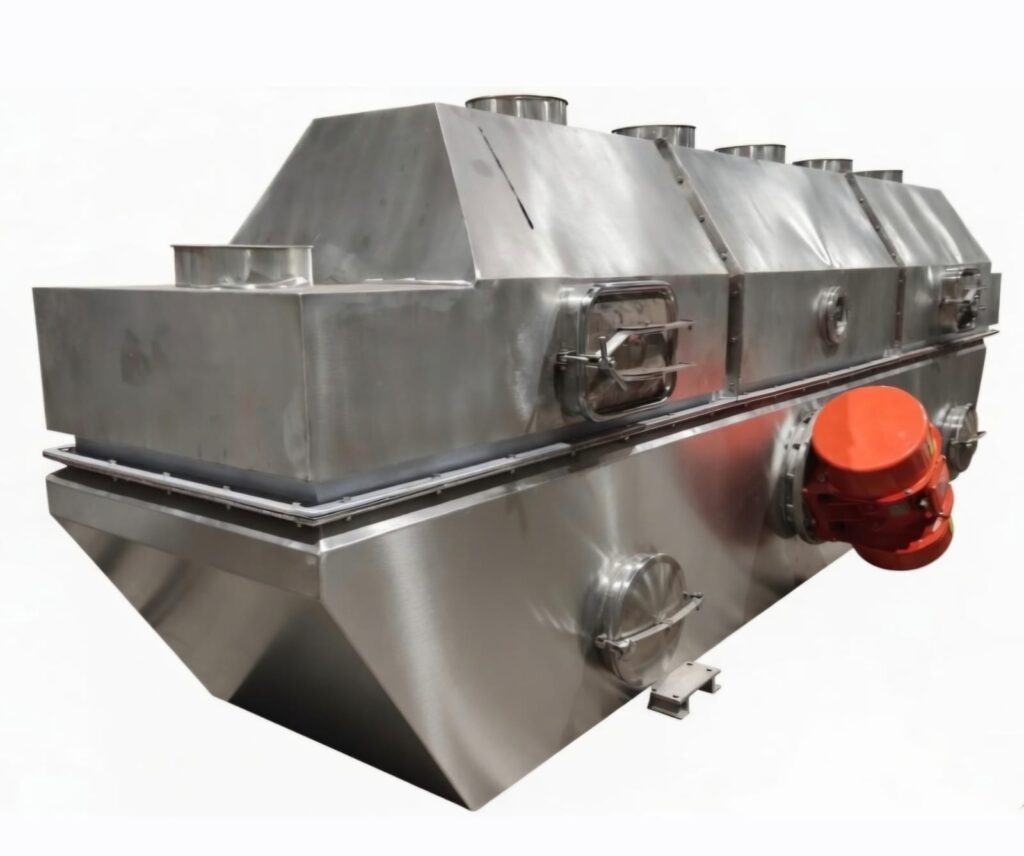
This page is written for process engineers and technical buyers who need to decide whether VFBD technology is appropriate, how it differs from a standard fluid bed, and what data are required for reliable selection.
The Core Process Problem VFBD Technology Solves
A conventional fluidized-bed dryer relies primarily on airflow to suspend and transport particles. This works well when:
- Particles are relatively uniform in size and density
- The material fluidizes cleanly across the full bed
- Attrition is acceptable
- Residence time can be managed by bed length and gas velocity alone
Problems appear when the feed is:
- Fragile or attrition-sensitive
- Broad in particle-size distribution
- Moderately cohesive or sticky at intermediate moisture
- Difficult to fluidize consistently (channeling or dead zones)
- Required to move continuously through a defined thermal profile
In these cases the buyer’s real requirement is not simply “a fluid bed.” It is a continuous drying system that maintains intimate gas–solid contact while providing controlled, gentle product movement and uniform final moisture.
How a Vibratory Fluidized Bed Dryer Works
A VFBD consists of a vibrating perforated deck or trough through which heated air (or another suitable gas) is forced upward. Mechanical vibration (typically from unbalanced motors or exciters) conveys the material along the length of the dryer while the air fluidizes the particles.
Simplified process sequence:
Wet or moist particulate feed → Controlled feeding → Vibrating fluidized bed → Upward heated air → Moisture evaporation → Exhaust air removal → Continuous discharge of dried product
Key controllable variables include:
- Vibration frequency and amplitude
- Airflow rate and distribution
- Inlet and zone temperatures
- Bed depth / feed rate
- Residence time (length + vibration + feed rate)
- Exhaust and dust-collection design
Because vibration assists transport, the superficial gas velocity required for effective fluidization can often be lower than in a purely pneumatic fluid bed for the same material. This can reduce entrainment of fines and fan energy demand, depending on the product.
When a VFBD Is the Appropriate Choice
| Material / Process Characteristic | VFBD Suitability | Notes |
|---|---|---|
| Free-flowing granules or crystals | Strong | Continuous drying + cooling possible |
| Fragile or attrition-sensitive particles | Strong | Vibration can reduce reliance on high air velocity |
| Moderately sticky or cohesive at intermediate moisture | Good candidate | Vibration helps break liquid bridges and improve mobility |
| Broad particle-size distribution | Good candidate | Better bed movement than pure fluidization alone |
| Pharmaceutical granules / excipients (where continuous is acceptable) | Evaluate carefully | Design, cleaning, materials and documentation must match process requirements |
| Food ingredients, salt, sugar, starch, seasoning granules | Strong | Continuous, uniform moisture control |
| Chemical crystals, catalysts, pigments (particulate form) | Strong | Material of construction and dust control critical |
| Wet filter cakes or pastes that cannot form a permeable bed | Weak | Consider spin-flash, paddle or other technology first |
| Very fine cohesive powders (Geldart C) | Application-dependent | May still require special design or pre-conditioning |
Common Problems and Engineering Responses
| Observed Problem | Typical Causes | Practical Response |
|---|---|---|
| Channeling or dead zones | Uneven air distribution, blocked distributor, excessive bed depth, sticky feed | Improve distributor design; reduce bed depth; increase vibration amplitude; verify air balance |
| Uneven final moisture | Non-uniform feed, poor vibration synchronization, temperature variation along length | Improve feeder uniformity; check motor synchronization and spring condition; multi-zone temperature control |
| Excessive attrition or fines generation | Excessively high air velocity or aggressive vibration | Lower gas velocity (vibration assists movement); optimize frequency/amplitude; review particle strength |
| Material buildup on distributor plate | Condensation, sticky intermediate moisture, insufficient vibration | Insulate inlet ducting; adjust temperature profile; increase vibration; consider surface coatings or cleaning devices |
| Discharge rate too fast or too slow | Vibration angle/force imbalance, air-velocity gradient along bed | Adjust eccentric weights or vibration parameters; balance inlet and exhaust air |
| High product temperature or quality loss | Excessive inlet air temperature or long residence time | Distinguish product temperature from gas temperature; multi-zone profile; shorter residence or lower peak temperature |
| Dust carry-over / filter loading | High gas velocity, fine particle generation | Reduce velocity; improve cyclone/bag-filter design; possible fines recycle |
Pilot testing with the actual feed remains the most reliable method to confirm fluidization behaviour, vibration settings and final product quality.
VFBD vs Conventional Fluid Bed vs Other Continuous Options
| Requirement | Conventional Fluid Bed | Vibratory Fluidized Bed (VFBD) | Band / Belt Dryer |
|---|---|---|---|
| Purely fluidizable uniform particles | Excellent | Excellent | Good |
| Fragile or attrition-sensitive granules | Moderate | Strong | Strong (gentle conveying) |
| Difficult-to-fluidize or moderately sticky particles | Limited | Stronger candidate | Strong if bed can be formed |
| Precise continuous residence-time control | Good | Excellent (vibration + length) | Excellent (belt speed) |
| Integration of drying + cooling | Strong | Strong | Possible |
| Large irregular pieces or slices | Limited | Limited | Strong |
| Very high bulk mineral throughput | Possible | Possible | Secondary to rotary in many cases |
There is no universal winner. Selection follows the physical state of the feed and the quality constraints of the product.
Key Data Required for Technical Evaluation
Provide the following information when requesting a VFBD assessment:
- Exact material and particle-size distribution
- Bulk density and flow characteristics
- Incoming moisture and target residual moisture
- Required throughput (dry solids basis)
- Maximum allowable product temperature or heat-sensitivity limits
- Attrition or breakage sensitivity
- Preferred heating medium and available utilities
- Construction / hygiene / cleaning requirements
- Dust emission or containment needs
- Integration with upstream feeding and downstream cooling/conveying/packing
Illustrative mass-balance thinking (example only, not a design guarantee):
If 1 000 kg/h of moist granules at 15 % moisture must reach 0.5 % residual moisture, approximately 145 kg/h of water must be evaporated. Actual dryer length, airflow, vibration settings and energy demand depend on drying rate, bed behaviour and heat losses — all material-specific.
How GTI Dryers Approaches VFBD Engineering
GTI Dryers designs and manufactures continuous vibratory fluidized-bed drying systems for particulate materials across food, chemical, pharmaceutical and related industries. Systems are engineered around the product’s fluidization and vibration behaviour rather than a single standard machine.
Evaluation typically covers:
- Feed characteristics and moisture profile
- Required residence time and temperature limits
- Air distribution and vibration parameters
- Dust collection and product recovery
- Construction materials and cleanability
- Automation and process monitoring
- Integration with feeding, heating, cooling and conveying
Pilot or representative-feed testing is recommended when material behaviour is uncertain. GTI positions the technology as one option within a broader range of industrial dryers (fluid bed, band, spin-flash, rotary, etc.), selected according to process data.
Contact the GTI Technical Team:
Website: gtidryers.com
Email: mktg@gtidryers.com
Phone / WhatsApp: +91 9330077417