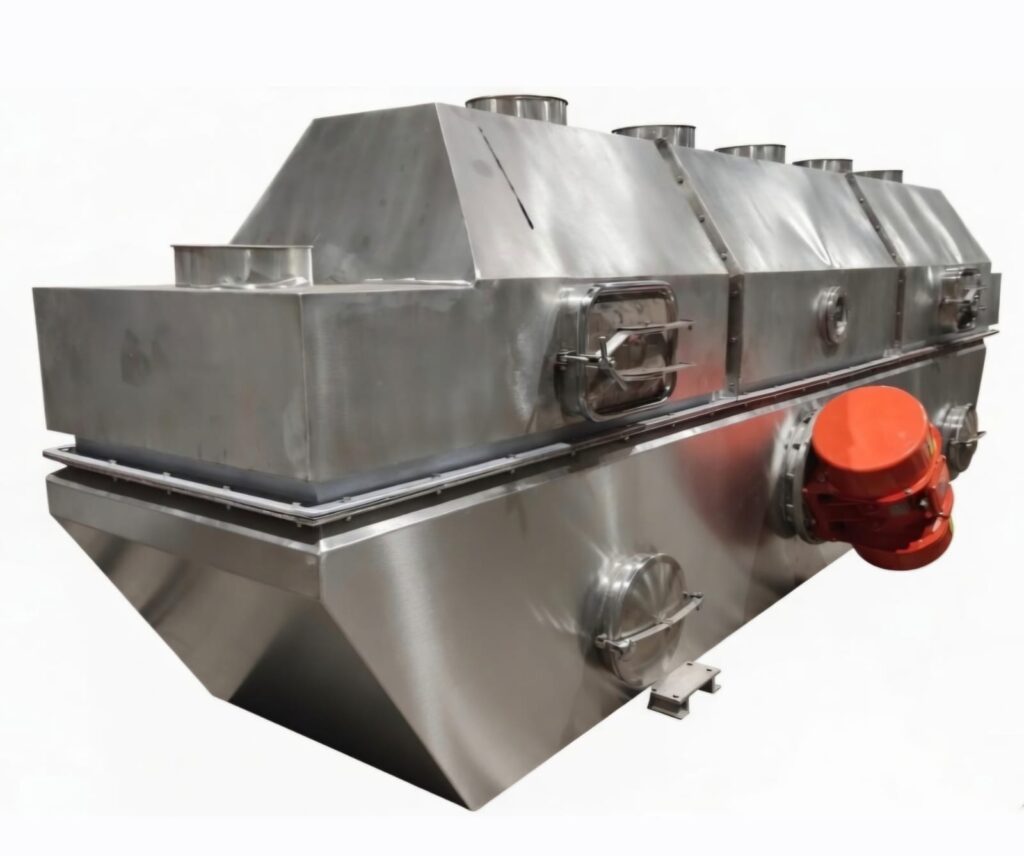
Vibratory Fluidized Bed Dryer USA: Advanced Continuous Drying for High-Value Industrial Materials
The U.S. industrial drying market includes demanding applications across pharmaceuticals, food ingredients, dairy, specialty chemicals, polymers, minerals and other bulk solids. These industries often require more than simply removing moisture—they need uniform drying, controlled residence time, consistent final moisture, gentle product handling and repeatable operation.
This is where a Vibratory Fluidized Bed Dryer (VFBD) can provide an important advantage.
A VFBD combines fluidization with controlled mechanical vibration. Instead of relying entirely on airflow to move and fluidize the product, vibration assists material transport through the drying chamber.
This configuration can be particularly useful for products that are:
- Fragile or prone to attrition
- Granular or crystalline
- Unevenly sized
- Difficult to fluidize consistently
- Moderately sticky
- Sensitive to excessive mechanical handling
- Required to move continuously through a controlled drying zone
For U.S. manufacturers, the objective is not simply a “fluid bed dryer.” The real requirement is often a continuous drying system engineered around product characteristics, production rate, moisture removal and quality specifications.
Why Is VFBD Technology Relevant to the U.S. Market?
U.S. manufacturers operate in industries where product consistency, process control, equipment reliability and operating economics are critical.
In pharmaceutical manufacturing, for example, equipment must be appropriate for its intended use, facilitate cleaning and maintenance, and avoid contact surfaces that could adversely affect product quality. FDA guidance also emphasizes appropriate equipment design and documented cleaning and maintenance practices.
That makes equipment design an important part of the process—not an afterthought.
A properly engineered VFBD can offer:
Continuous Operation → Controlled Airflow → Controlled Vibration → Uniform Product Movement → Efficient Heat & Mass Transfer → Consistent Final Moisture
This makes the technology relevant to U.S. facilities seeking higher levels of process control without unnecessarily aggressive product handling.
Where Are Vibratory Fluidized Bed Dryers Used in the USA?
The strongest opportunities are concentrated in industries where continuous drying and careful solids handling are important.
1. Pharmaceutical Manufacturing
Pharmaceutical production is one of the most specification-driven applications for industrial drying equipment.
Potential VFBD applications include suitable:
- Pharmaceutical granules
- Crystalline products
- API intermediates
- Excipients
- Formulated granules
- Nutraceutical ingredients
- Heat-sensitive particulate materials
For pharmaceutical applications, the dryer design should be evaluated around:
Product temperature + residence time + moisture specification + material compatibility + cleaning requirements + containment + automation
FDA cGMP requirements do not prescribe a single approved dryer type. Instead, manufacturers are responsible for selecting equipment appropriate for its intended use and capable of meeting applicable requirements.
For API manufacturing, FDA’s ICH Q7 guidance also emphasizes suitable equipment design, cleaning, maintenance, operating ranges and qualification activities such as DQ, IQ, OQ and PQ where applicable.
What does this mean for a U.S. pharmaceutical buyer?
The important question is not:
“Is this a VFBD?”
It is:
“Can this VFBD be engineered, documented, qualified and operated for my specific pharmaceutical process?”
That distinction is critical when evaluating an international dryer manufacturer.
2. Food & Specialty Food Ingredients
The U.S. food industry processes large volumes of ingredients where moisture control directly affects:
- Shelf life
- Flowability
- Storage stability
- Powder quality
- Caking tendency
- Bulk density
- Downstream packaging
- Product consistency
Potential applications include:
Dairy ingredients | Food granules | Salt | Sugar | Instant beverage ingredients | Starch-based products | Seasoning materials | Nutraceutical ingredients
VFBD technology can be particularly attractive when the product needs continuous drying with relatively gentle conveying and controlled residence time.
Dairy and food-ingredient manufacturers often require consistent moisture removal while maintaining the physical characteristics of the product.
Depending on the material, VFBD systems can be evaluated for:
- Dairy granules
- Crystalline ingredients
- Food additives
- Powder agglomerates
- Nutritional ingredients
- Specialty food intermediates
The final equipment configuration should be determined through product testing because fluidization behavior varies significantly between materials.
4. Specialty Chemicals
The U.S. specialty chemical sector represents another important application area.
VFBD systems may be considered for suitable:
- Chemical crystals
- Granules
- Catalysts
- Inorganic salts
- Pigments
- Specialty chemical intermediates
- Process solids
For chemical applications, manufacturers may prioritize:
Controlled temperature + corrosion-resistant construction + dust containment + uniform drying + continuous operation
Material compatibility is particularly important when selecting construction materials, seals, heating systems and filtration equipment.
Plastic and polymer processing can involve materials requiring controlled moisture reduction before downstream operations.
Potential applications may include suitable:
- Polymer granules
- Plastic additives
- Resins
- Compounded materials
- Specialty polymer intermediates
The appropriate dryer configuration depends on particle size, thermal sensitivity, bulk density and required moisture level.
Why Choose a Vibratory Fluidized Bed Dryer Instead of a Conventional Fluid Bed Dryer?
A conventional fluidized bed dryer primarily uses airflow to suspend and transport particles.
A Vibratory Fluidized Bed Dryer adds mechanical vibration to assist material movement.
This can provide advantages for certain materials where conventional fluidization alone may be less effective.
Key potential advantages include:
Gentle material movement
Vibration can help move the product through the dryer while reducing dependence on aggressive pneumatic transport.
Improved handling of difficult particles
Certain uneven, fragile or less easily fluidized materials can benefit from mechanical assistance.
Continuous drying
The system can be configured for continuous feed and discharge.
Controlled residence time
Drying time can be influenced through dryer length, vibration characteristics, feed rate and operating conditions.
Efficient heat and mass transfer
Fluidization provides strong contact between the drying medium and product.
Potential fan-energy optimization
Because mechanical vibration assists transport, the airflow requirement may be optimized depending on the product and process design.
What Makes a VFBD Suitable for U.S. Industrial Applications?
A U.S. buyer typically needs to evaluate much more than basic drying capacity.
Important engineering parameters include:
Product Characteristics
- Initial moisture
- Final moisture
- Particle size
- Particle-size distribution
- Bulk density
- Flowability
- Stickiness
- Thermal sensitivity
- Attrition sensitivity
Process Requirements
- Feed rate
- Water evaporation rate
- Residence time
- Drying temperature
- Product temperature
- Required throughput
- Continuous or batch operation
Equipment Requirements
- Product-contact material
- Surface finish
- Dust collection
- Air filtration
- Heating system
- Vibration system
- Instrumentation
- Automation
- Cleaning accessibility
The final dryer should therefore be process-engineered rather than selected solely from a catalogue capacity chart.
Energy Efficiency: An Important U.S. Buyer Consideration
Industrial drying can be energy-intensive because the process must supply sufficient heat to evaporate moisture.
For this reason, U.S. manufacturers increasingly evaluate the total operating cost of drying equipment rather than only the purchase price.
Energy optimization can involve:
- Optimized airflow
- Variable-frequency drives
- Heat recovery
- Proper thermal insulation
- Multi-zone temperature control
- Optimized residence time
- Exhaust-air management
- Efficient heating systems
- Process-specific air recirculation
Depending on the project, heating may be designed around:
Steam | Thermal oil | Natural gas | LPG | Electric heating | Hot water | Waste heat
The optimum configuration depends on the plant’s existing utilities and energy economics.
VFBD Automation for Modern U.S. Manufacturing
Modern industrial drying systems can incorporate automation to improve process consistency and operator visibility.
A customized VFBD may include:
PLC → HMI → VFD → Temperature Sensors → Pressure Monitoring → Airflow Control → Vibration Control → Alarm System → Data Monitoring
Important parameters can include:
- Inlet air temperature
- Outlet air temperature
- Product temperature
- Feed rate
- Vibration frequency
- Airflow
- Differential pressure
- Residence time
- Exhaust conditions
- Final product moisture
For pharmaceutical projects, documentation and equipment qualification requirements may also become important. FDA guidance recognizes qualification activities including Design Qualification, Installation Qualification, Operational Qualification and Performance Qualification where appropriate.
What Should U.S. Buyers Ask Before Purchasing a VFBD?
Before selecting a Vibratory Fluidized Bed Dryer manufacturer, buyers should ask:
1. Can the manufacturer test my product?
Drying behavior differs dramatically between materials.
A product trial can help establish:
- Drying time
- Temperature requirements
- Airflow
- Product movement
- Moisture reduction
- Product quality
2. What materials are available for product-contact parts?
For demanding applications, the buyer should clearly define the required material grade and surface finish.
3. How is the dryer cleaned?
This is especially important for pharmaceutical and food applications.
FDA requirements emphasize equipment cleaning and maintenance to prevent contamination and protect product quality.
4. What documentation is available?
Depending on the project, buyers may require:
- GA drawings
- P&ID
- Equipment specifications
- Material certificates
- Electrical documentation
- Operating manuals
- Maintenance manuals
- Inspection documentation
- FAT support
- Qualification documentation where applicable
5. Can the system integrate with the existing plant?
The dryer may need to connect with:
Feeding → Heating → Drying → Dust Collection → Cooling → Conveying → Packaging
A supplier capable of handling these interfaces can simplify project execution.
Why Consider an Indian VFBD Manufacturer for the U.S. Market?
For U.S. companies, purchasing from India should not be positioned simply as a low-cost alternative.
The stronger proposition is:
Advanced Process Engineering + Competitive Manufacturing + Customized Industrial Drying
India has a large engineering and machinery-manufacturing ecosystem, allowing manufacturers to combine:
- Mechanical engineering
- Process engineering
- Fabrication
- Automation
- Thermal engineering
- Custom equipment design
This can provide U.S. buyers with a potentially attractive total project cost while allowing the dryer to be engineered around their specific process requirements.
For an international project, the buyer should evaluate the supplier based on technical capability, materials, documentation, testing, automation, quality systems, export experience and after-sales support—not country of origin alone.
Why GTI Dryers Can Be a Potential VFBD Partner for U.S. Projects
GTI Dryers can position its Vibratory Fluidized Bed Dryer solutions around application-specific engineering rather than one-size-fits-all equipment.
Depending on the product and process, GTI can evaluate:
Process Engineering
The dryer can be developed around:
Feed Moisture → Target Moisture → Throughput → Evaporation Load → Product Temperature → Residence Time
Customized Construction
Depending on application requirements, equipment can be engineered with appropriate stainless-steel construction and product-contact specifications.
Automation
Possible systems include:
PLC + HMI + VFD + Instrumentation + Temperature Control + Airflow Control
Complete Drying Systems
A project can be evaluated as an integrated process rather than only as a dryer:
Feeding System
↓
Heating System
↓
VFBD
↓
Dust Collection
↓
Cooling
↓
Conveying / Packaging
This approach can reduce interface issues between multiple equipment suppliers.
GTI Dryers: Engineering from India for Global Industrial Applications
For U.S. buyers, the key question is not whether the equipment is manufactured in India, Europe, China or elsewhere.
The important questions are:
Can the manufacturer understand the process?
Can the dryer achieve the required moisture specification?
Can the equipment be built to the required material and construction standards?
Can the supplier provide appropriate engineering documentation?
Can the system integrate with the customer’s plant?
Can the manufacturer support testing, commissioning and after-sales requirements?
This is where an export-oriented Indian engineering company can create value.
GTI Dryers can position itself as an industrial drying technology partner from India serving international process industries, with customized solutions for pharmaceuticals, food ingredients, chemicals, polymers and other bulk-solid applications.
Frequently Asked Questions About VFBD Dryers in the USA
What is a Vibratory Fluidized Bed Dryer?
A Vibratory Fluidized Bed Dryer is a continuous industrial dryer that combines fluidized-air drying with mechanical vibration to move and dry particulate materials.
What industries use VFBD dryers?
VFBD technology can be considered for pharmaceuticals, food ingredients, dairy, chemicals, polymers, minerals and other granular or crystalline materials.
What is the difference between VFBD and a conventional fluid bed dryer?
A VFBD combines airflow with mechanical vibration. The vibration assists product movement and can be advantageous for certain fragile, uneven or difficult-to-fluidize materials.
Are VFBD dryers suitable for pharmaceutical applications?
They can be, provided the complete system is appropriately engineered for the specific pharmaceutical process, materials, cleaning requirements, containment needs and applicable GMP expectations. FDA does not approve a specific dryer type; manufacturers are responsible for selecting suitable equipment for their processes.
Can GTI Dryers customize a VFBD for a U.S. application?
A customized system can be evaluated based on product characteristics, throughput, moisture content, final moisture, temperature sensitivity, residence time and plant utilities.
How much does a Vibratory Fluidized Bed Dryer cost in the USA?
There is no reliable single price because VFBD cost depends on throughput, evaporation capacity, construction material, heating system, automation, dust collection, instrumentation and project-specific requirements. A technical specification is normally required before preparing a meaningful quotation.
How is VFBD capacity calculated?
Preliminary sizing generally considers:
Feed Rate + Initial Moisture + Final Moisture + Water Evaporation + Drying Temperature + Residence Time + Airflow
Pilot testing is recommended when product behavior is uncertain.
Conclusion: The U.S. Opportunity for Vibratory Fluidized Bed Dryers
The U.S. market presents strong application opportunities for continuous, controlled and energy-conscious industrial drying, particularly in pharmaceuticals, food ingredients, specialty chemicals, dairy and polymers.
VFBD technology becomes especially relevant when manufacturers need to combine:
Continuous Production + Gentle Product Handling + Uniform Drying + Controlled Residence Time + Process Automation
For U.S. manufacturers evaluating a new drying line, the best approach is to begin with the material and process requirement, then determine whether VFBD technology is the appropriate solution.
Looking for a Vibratory Fluidized Bed Dryer for a U.S. Industrial Application?
GTI Dryers can evaluate your product, feed rate, moisture content, target moisture, thermal sensitivity and required throughput to develop a suitable industrial drying configuration.
Share your product details and drying requirement with GTI Dryers for a preliminary technical evaluation.