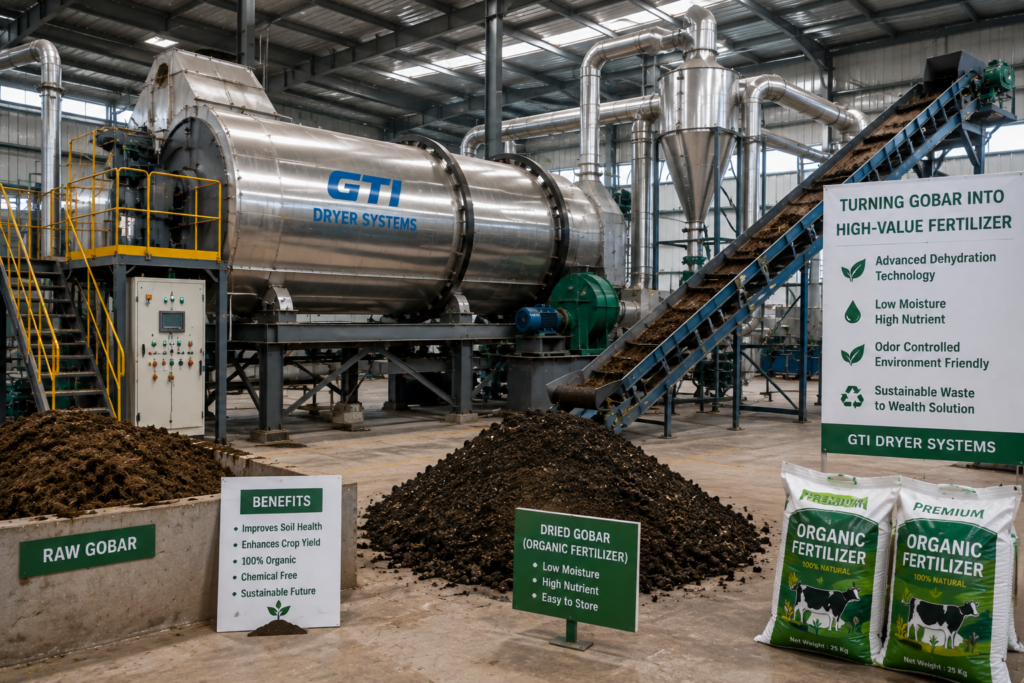
Turning Gobar (cow dung) into fertilizer stands at the absolute forefront of India’s visionary GOBARdhan (Galvanizing Organic Bio-Agro Resources Dhan) scheme—now turbo-charged by the national structural push toward a circular bioeconomy. As commercial biogas and Compressed Biogas (CBG) plants scale up nationwide, converting raw cattle waste and organic slurry into nutrient-dense, marketable organic manure has evolved from a manual farm chore into a sophisticated, high-capacity industrial process.
While traditional composting and vermicomposting work well for small-scale operations, commercial bioenergy plants require automated, high-efficiency dehydration solutions. GTIDryers delivers world-class industrial drying technology, converting wet digestate into premium Fermented Organic Manure (FOM), Liquid Fermented Organic Manure (LFOM), and Phosphate-Rich Organic Manure (PROM).
1. The GOBARdhan Biogas & Digestate Processing Value Chain
Under the industrial GOBARdhan framework, converting cattle dung and organic residues into clean energy and rich fertilizer involves a systematic mechanical and thermal chain:
- Feedstock Slurry Preparation: Fresh cow dung is blended with organic waste and water (typically a 1:1 ratio) to create a consistent slurry.
- Anaerobic Digestion: Slurry enters airtight digesters where microbes break down organic matter over 30 to 55 days, yielding:
- Biogas / CBG: Clean-burning fuel for transport and industrial use.
- Raw Digestate / Bio-Slurry: The nutrient-rich byproduct containing vital macro and micronutrients.
- Solid-Liquid Separation: Using mechanical screw presses or decanter centrifuges, the slurry is split.
- Thermal Dehydration & Stabilization: The solid fraction exits separators at a high moisture content of 80% to 85%. In this wet state, it is heavy, prone to pathogen growth, and expensive to transport. Advanced industrial dryers reduce moisture down to 10% to 12%, converting a heavy environmental liability into a lightweight, stable, high-value commercial asset.
- Value Addition & MDA Compliance: Enriched with rock phosphate and beneficial microbes (producing PROM) or granulated for easy bagging, the fertilizer qualifies seamlessly for government support, including the Market Development Assistance (MDA) scheme (₹1,500 per tonne).
2. Advanced Industrial Drying Technology by GTIDryers
Processing sticky, high-moisture organic residues requires purpose-built thermal systems. GTIDryers engineers a specialized portfolio of industrial dehydration plants optimized for bioenergy and organic fertilizer production:
Band Dryer (Mesh Belt Dryer)
- How it works: Utilizes a multi-pass conveyor belt system where wet organic pellets or dewatered cake are carried through a controlled, multi-zone heated chamber.
- Why it fits Gobar processing: Perfect for utilizing low-grade waste heat or thermal energy from CHP (Combined Heat and Power) engine jacket water (70^\circ\text{C} to 90^\circ\text{C}). It ensures gentle, uniform drying without crushing fragile granules or volatizing essential nitrogen compounds.
Mesh Belt Dryer
- How it works: Features a continuous perforated stainless-steel mesh belt that allows hot air to pass evenly through a deep bed of organic fertilizer.
- Why it fits Gobar processing: Offers exceptional throughput stability for high-volume CBG plants. It prevents caking and provides precise residence-time control, ensuring consistent final moisture levels across every batch of FOM.
VFB Dryer (Vibratory Fluidised Bed Dryer)
- How it works: Combines mechanical vibration with upward-flowing heated air, suspending the fertilizer particles in a fluid-like state for rapid, intense heat and mass transfer.
- Why it fits Gobar processing: Ideal for achieving rapid moisture flashing and uniform granulation of organic fertilizers, producing free-flowing, dust-free powder or granules ready for immediate bagging and retail distribution.
3. Key Benefits of Industrial Gobar-Based Fertilizers
- Soil Rejuvenation: Restores organic carbon, improves soil structure, enhances water-holding capacity, and stimulates native soil microbiology.
- Nutrient Profile: Supplies slow-release nitrogen, phosphorus, potassium, and vital trace minerals without the chemical shock associated with synthetic fertilizers.
- Massive Logistical Savings: Drying the digestate reduces gross mass by over 80%, slashing freight costs and expanding the commercial distribution radius far beyond local farm boundaries.
- Pathogen-Free Quality: Controlled thermal processing guarantees sanitary compliance, eliminating weed seeds and harmful bacteria to yield safe, high-grade organic manure.
Partner with GTIDryers for Your Turnkey Bioenergy Project
As the global push for carbon neutrality accelerates, maximizing plant efficiency and extracting maximum revenue from organic waste is essential for project profitability. Whether you are engineering a new greenfield CBG plant or upgrading an existing waste-to-wealth facility, GTIDryers provides the robust thermal engineering you need.
Transform your bio-slurry liabilities into high-margin organic fertilizer. Contact our technical specialists today through the official GTIDryers Portal to discuss custom band dryers, mesh belt dryers, and vibratory fluidized bed systems tailored to your plant capacity.
Contact us :- +91-9330077417 mktg@gtidryers.com