
India’s Turmeric Processing Industry and Market Opportunity
Turmeric is one of India’s most important spice crops and a major raw material for the global food, seasoning, nutraceutical, pharmaceutical and natural-ingredient industries.
But producing high-quality dried turmeric is not simply a matter of removing water.
For a commercial turmeric processor, the real challenge is to achieve controlled moisture reduction, consistent drying, good colour, efficient energy use, hygienic processing and repeatable product quality at the required production capacity.
This is where an industrial turmeric drying system becomes an important part of the processing line.
GTI Dryers designs and manufactures customized industrial drying systems for spices and food products, including turmeric, ginger, chilli, coriander and cumin.
This guide explains how industrial turmeric drying works, how to select a suitable turmeric dryer, what problems the dryer should solve, how turmeric processing differs by product form, and what information a buyer should provide before requesting a technical quotation.
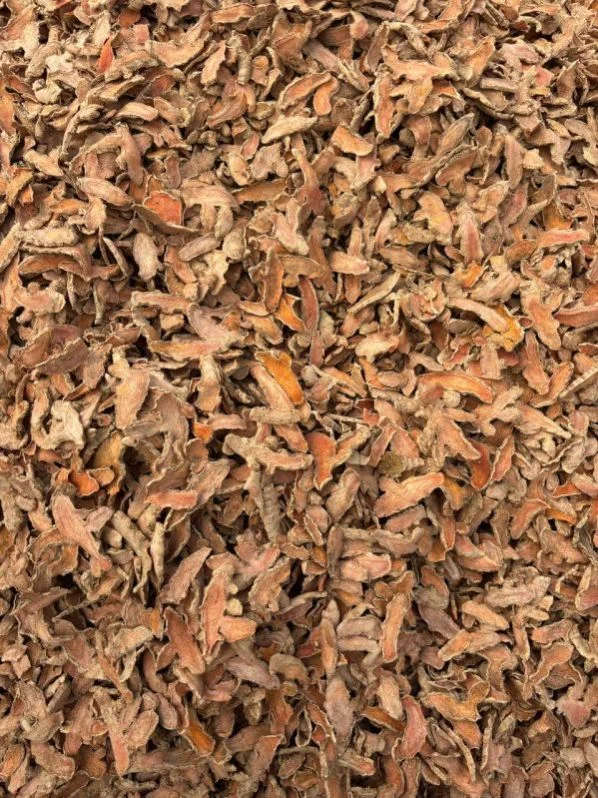
What Is an Industrial Turmeric Drying System?
An industrial turmeric drying system is equipment designed to remove moisture from processed turmeric under controlled conditions.
Depending on the plant configuration, turmeric processing may broadly follow:
Fresh Turmeric Rhizomes → Washing → Cleaning → Curing/Boiling → Slicing or Preparation → Drying → Polishing → Grinding → Sieving → Packaging
Not every factory follows exactly the same process.
The appropriate sequence depends on whether the manufacturer is producing:
- Dried turmeric fingers
- Turmeric slices
- Turmeric pieces
- Turmeric flakes
- Turmeric granules
- Turmeric powder
- Turmeric ingredients
- Turmeric-based food or botanical products
Therefore, a turmeric dryer should be designed around the actual feed material and final product specification.
Turmeric Dryer Machine for Industrial Turmeric Processing
An industrial turmeric dryer machine is designed to remove moisture from prepared turmeric rhizomes, slices, pieces, flakes or other processed forms under controlled drying conditions. The appropriate dryer depends on the turmeric feed form, production capacity, initial and final moisture, product sensitivity, residence time and required product quality.
For commercial turmeric processing, different dryer technologies can be considered depending on the production requirement.
1. Rotary Dryer for Turmeric Rhizomes
A rotary dryer is an established mechanical drying option for whole or prepared turmeric rhizomes, particularly where batch or large-volume drying of robust material is required.
In a rotary dryer, turmeric moves through a rotating cylindrical chamber while controlled hot air passes through the product. The continuous movement promotes contact between the product and drying air and helps remove moisture.
Rotary dryers can be considered for:
- Whole or boiled turmeric rhizomes
- Large-volume turmeric processing
- Agricultural and food-processing applications
- Batch or continuous drying requirements
- Processing environments where robust mechanical handling is required
Research and agricultural technology demonstrations have also evaluated rotary drying for turmeric rhizomes after boiling.
2. Continuous Belt or Band Dryer for Turmeric Slices
For industrial processors producing dried turmeric slices, pieces or flakes, a continuous belt dryer or band dryer can be evaluated when consistent throughput and controlled drying are important.
The prepared turmeric is distributed on a perforated or mesh conveying surface and transported through controlled hot-air drying zones. Different zones can be configured to provide controlled airflow and drying conditions.
A continuous belt/band turmeric dryer can be suitable for:
- Turmeric slices
- Turmeric pieces
- Turmeric flakes
- Large-scale continuous production
- Automated feeding and discharge
- Controlled residence time
- Consistent moisture reduction
This type of system can be particularly useful when a turmeric processor wants to move from batch drying toward a more continuous production process.
3. Tray Dryer for Batch Turmeric Processing
A tray dryer uses perforated trays or drying trays to hold turmeric while heated air circulates through the drying chamber.
Tray dryers can be considered for:
- Small and medium-scale production
- Batch processing
- Product trials
- Multiple turmeric product formats
- Process development and flexible production
The drying temperature, airflow and residence time can be adjusted according to the product and desired final moisture.
4. Cabinet Dryer for Turmeric
A cabinet dryer is another batch-type hot-air drying system that can be used for turmeric and other agricultural products.
It is generally considered where processors require a relatively compact system with controlled hot-air circulation rather than open-air or uncontrolled sun drying.
Cabinet drying can be evaluated for:
- Turmeric slices
- Small-batch production
- Pilot processing
- Food and spice dehydration
- Controlled hot-air drying
5. Fluidized Bed Dryer for Suitable Turmeric Particles
A fluidized bed dryer can be considered when the turmeric feed is in a suitable free-flowing particulate form. It is generally not the first choice for large whole rhizomes.
The process uses upward-flowing hot air to suspend and dry suitable particles, providing efficient heat and mass transfer.
It may be evaluated for suitable:
- Granules
- Small particles
- Free-flowing processed turmeric materials
- Powder-related intermediate products
Which Turmeric Dryer Should You Choose?
There is no single dryer that is suitable for every turmeric-processing plant. The selection should begin with the product form and process requirement.
| Turmeric Feed Form | Dryer Technology to Evaluate | Typical Processing Approach |
|---|---|---|
| Whole/boiled rhizomes | Rotary Dryer | Robust mechanical drying |
| Turmeric slices | Belt/Band Dryer | Continuous hot-air drying |
| Turmeric pieces/flakes | Belt/Band or Tray Dryer | Batch or continuous drying |
| Small batches | Tray/Cabinet Dryer | Batch processing |
| Suitable free-flowing particles | Fluidized Bed Dryer | Intensive particulate drying |
| Large-scale continuous production | Belt/Band / Customized Continuous Dryer | Automated continuous processing |
The final dryer selection should be based on turmeric variety, feed form, initial moisture, required final moisture, throughput, slice thickness, heat sensitivity, residence time, available energy source and plant layout.
GTI Dryers — Customized Turmeric Drying Systems
GTI Dryers designs and manufactures customized industrial drying systems for food, spice and agricultural processing applications. Depending on the turmeric product form and production requirement, GTI can evaluate suitable rotary, tray, belt/band, continuous hot-air and other customized drying technologies.
For a turmeric dryer project, provide:
- Turmeric product form
- Fresh/boiled/sliced/processed condition
- Initial moisture
- Required final moisture
- Production capacity
- Slice or piece dimensions
- Desired operating hours
- Available heating source
- Plant location
- Final product application
Based on these parameters, the appropriate turmeric drying configuration can be evaluated for the required production process.
Why Turmeric Drying Is Critical in Commercial Processing
Turmeric contains substantial moisture when harvested.
If the objective is to convert fresh rhizomes into a stable dried product, moisture must be reduced sufficiently for the intended downstream process and storage conditions.
Traditional sun drying can work for certain small-scale applications, but it introduces dependence on:
- Weather
- Solar radiation
- Ambient humidity
- Drying area
- Labour
- Drying duration
- Product handling
- Environmental contamination
ICAR has documented turmeric-processing systems where harvested rhizomes are boiled and then sun-dried before polishing.
For commercial processors, controlled mechanical drying can provide a more predictable processing environment.
A properly engineered industrial dryer can help with:
Moisture Control → Drying Uniformity → Process Consistency → Storage Stability → Grinding Performance → Product Standardization
India: A Major Market for Industrial Turmeric Drying Systems
India is particularly important for turmeric-processing equipment because turmeric is deeply connected to the country’s agricultural, spice-processing and export ecosystem.
The Spices Board states that India is the world’s leading producer, consumer and exporter of turmeric and its value-added products. During 2024–25, India exported 176,325 tonnes of turmeric valued at US$341.54 million.
The Spices Board’s 2024–25 export statistics also recorded turmeric export value at approximately ₹3,535.76 crore.
This creates a substantial ecosystem involving:
- Turmeric farmers
- Farmer Producer Organisations
- Agricultural traders
- Collection centres
- Turmeric processors
- Spice manufacturers
- Dehydration plants
- Grinding units
- Seasoning manufacturers
- Food ingredient companies
- Oleoresin producers
- Nutraceutical manufacturers
- Exporters
For an Indian dryer manufacturer, the opportunity therefore extends beyond selling a machine to a single turmeric factory.
The larger opportunity is providing industrial drying technology for the turmeric value chain.
Where Is Turmeric Processing Important in India?
Turmeric is cultivated and processed across several Indian states.
Important turmeric-processing and production regions include:
Telangana
Telangana is an important turmeric-producing region and a major location for turmeric trading and processing activity.
Andhra Pradesh
Andhra Pradesh has established turmeric-growing and agricultural-processing areas.
ICAR has also documented turmeric processing activities in Andhra Pradesh involving boiling, sun drying and polishing.
Maharashtra
Turmeric production and processing are important in parts of Maharashtra, creating opportunities for agricultural processing equipment.
Tamil Nadu
Tamil Nadu has established turmeric cultivation and processing activity, particularly around agricultural and spice-processing clusters.
Karnataka
Karnataka is another relevant market for turmeric and broader spice-processing machinery.
Madhya Pradesh
Turmeric, chilli and other agricultural commodities create opportunities for integrated dehydration and processing facilities.
Odisha and West Bengal
Eastern India also presents opportunities for turmeric processing, especially where agricultural products are being converted into dried and value-added ingredients.
Northeast India
The Northeast presents a particularly interesting post-harvest opportunity.
ICAR has reported that in Meghalaya’s Lakadong turmeric-growing areas, limited processing and value addition remain challenges, with much production sold as dry flakes or fresh rhizomes and only a smaller portion as powder. ICAR identifies scope for improved processing infrastructure and mechanisation.
This makes industrial turmeric drying and value-addition equipment relevant not only to large factories but also to regional processors, FPOs and emerging agro-processing enterprises.
Turmeric Dryer Machine: The Problem It Actually Needs to Solve
A buyer may initially search for:
“Turmeric dryer machine price”
But price should not be the first engineering question.
The more important questions are:
- How much fresh turmeric needs to be processed?
- What is the initial moisture?
- What is the final moisture target?
- Is the turmeric whole, sliced or otherwise prepared?
- What is the required throughput?
- What heating source is available?
- How sensitive is the product to thermal exposure?
- What final product is required?
- How many operating hours are planned?
- What are the plant conditions?
These parameters determine the actual dryer requirement.
How Does an Industrial Turmeric Dryer Work?
A typical controlled hot-air drying system operates by bringing heated air into contact with the prepared turmeric material.
1. Feeding
Prepared turmeric is introduced into the dryer at a controlled rate.
2. Product Distribution
The material is distributed over the drying surface or conveying system.
Uniform product distribution is important because excessive bed depth can affect drying uniformity.
3. Controlled Hot Air
Heated air is circulated through or across the turmeric.
4. Moisture Evaporation
Heat transfers energy to the product, allowing moisture to migrate toward the surface and evaporate.
5. Moisture-Laden Air Removal
The humid air is exhausted from the dryer.
6. Multi-Zone Drying
For continuous systems, different zones can be designed to provide different drying conditions where required.
7. Discharge and Cooling
Once the required moisture condition is achieved, the dried turmeric can be discharged and cooled before subsequent processing.
The actual drying profile must be established from the product and process requirements rather than using a universal temperature or residence time.
Turmeric Processing Flow: From Fresh Rhizome to Powder
For a powder-oriented processing plant, the overall value chain may look like:
Fresh Turmeric
↓
Washing & Cleaning
↓
Curing / Boiling
↓
Drying
↓
Polishing
↓
Grinding
↓
Sieving
↓
Turmeric Powder
↓
Packaging
Drying is therefore not an isolated operation.
It directly connects agricultural raw material to downstream grinding and value addition.
If the dried material has inconsistent moisture, the downstream milling operation may also experience variations in grinding behaviour, feed consistency and final product characteristics.
Turmeric Drying for Different Product Forms
A turmeric dryer should be selected according to the physical form entering the dryer.
Whole or Large Turmeric Rhizomes
Large pieces can have a longer moisture-diffusion path.
The drying system therefore needs to account for product size and loading.
Turmeric Slices
Sliced turmeric generally provides a larger exposed surface area.
However, slice thickness and uniformity significantly influence drying behaviour.
Turmeric Pieces
Piece size, shape and loading density can affect residence time and airflow requirements.
Turmeric Flakes
Flake production requires controlled handling to avoid excessive breakage.
Turmeric Granules
Granular material can have different flow and heat-transfer characteristics compared with larger pieces.
Turmeric Powder
Powder processing is fundamentally different from drying whole or sliced rhizomes.
For a powder plant, the overall system should be considered as:
Drying → Grinding → Classification → Packaging
rather than selecting a dryer independently.
What Type of Dryer Is Suitable for Turmeric?
There is no single dryer that is automatically suitable for every turmeric application.
Depending on the product form, throughput and process requirement, technologies that may be evaluated include:
- Tray dryers
- Cabinet dryers
- Tray-type belt dryers
- Band dryers
- Mesh belt dryers
- Continuous hot-air dryers
- Multi-zone drying systems
- Heat-pump drying systems
- Customized food dehydration systems
GTI’s spice-drying portfolio specifically includes turmeric and describes tray-type belt drying as an option for continuous processing of suitable sliced, chopped, grated or pre-processed agricultural materials.
For smaller or batch-oriented operations, a batch dryer may be more appropriate.
For larger continuous operations, a continuous conveyor or belt-based system can be evaluated.
The correct selection should be made after evaluating the feed characteristics, water evaporation requirement and final product specification.
Turmeric Dryer Selection: The 10 Parameters You Must Know
Before requesting a quotation, prepare these details.
1. Product
Fresh turmeric, cured turmeric, sliced turmeric, flakes or another form.
2. Feed Form
Whole / sliced / chopped / pieces / other.
3. Initial Moisture
The actual moisture content of the material entering the dryer.
4. Required Final Moisture
The target moisture after drying.
5. Capacity
For example:
kg/hour or tonnes/day
6. Slice Thickness
Important when processing sliced turmeric.
7. Operating Hours
Hours per day and number of production days.
8. Heating Source
Potential options include:
- Steam
- Thermic fluid
- Gas
- LPG
- Electricity
- Biomass
- Waste heat
9. Final Product
Dried turmeric / flakes / powder / ingredient.
10. Plant Location
Location influences ambient conditions, utilities, installation and plant integration.
Turmeric Drying Temperature: Why One Number Is Not Enough
One of the most common online searches is:
“What is the best temperature for drying turmeric?”
There is no single temperature that should be applied to every industrial turmeric-drying project.
The appropriate drying profile depends on:
- Initial moisture
- Product form
- Slice thickness
- Air velocity
- Product loading
- Residence time
- Final moisture
- Heat sensitivity
- Dryer configuration
- Desired product characteristics
Instead of designing a machine around a generic temperature, the drying system should be developed around the complete heat and mass-transfer requirement.
This is particularly important for commercial processors concerned with colour, aroma, curcuminoid-related quality parameters and downstream product performance.
ICAR’s post-harvest research indicates that turmeric’s essential oil, oleoresin and curcumin characteristics are relevant considerations in storage and processing.
Turmeric Dryer Capacity: Don’t Confuse Feed Capacity With Water Evaporation
A dryer rated at a particular feed capacity does not automatically tell you how much water it must remove.
For example, two plants may both process:
1,000 kg/hour of fresh turmeric
but require different dryer configurations if their incoming moisture and final moisture specifications differ.
The fundamental engineering calculation is based on the water that needs to be removed.
Conceptually:
Water Evaporation = Water in Feed − Water Remaining in Final Product
The complete calculation also needs to consider:
- Operating hours
- Product loading
- Drying efficiency
- Heat losses
- Air conditions
- Residence time
Therefore, GTI should not size a commercial turmeric dryer from feed tonnage alone.
Continuous Turmeric Dryer for Large-Scale Processing
For industrial processors requiring continuous operation, a continuous belt or band-style drying system can provide:
- Controlled residence time
- Continuous feeding
- Continuous discharge
- Multiple drying zones
- Adjustable conveyor speed
- Controlled airflow
- Scalable capacity
- Automated process control
GTI’s industrial spice-drying technology describes tray-type belt dryers as suitable for continuous drying of appropriate agricultural and spice products, including turmeric.
This type of system can be particularly relevant for:
- Large spice processors
- Export-oriented turmeric factories
- Dehydrated ingredient manufacturers
- Continuous food-processing plants
- Integrated spice-processing facilities
Batch Turmeric Dryer vs Continuous Turmeric Dryer
| Factor | Batch Dryer | Continuous Dryer |
| Production style | Batch | Continuous |
| Typical flexibility | High | High for compatible products |
| Automation | Can be automated | Highly suitable |
| Large throughput | Depends on design | Often suitable |
| Product changeover | Potentially easier | Requires process planning |
| Residence-time control | Batch-based | Conveyor/speed based |
| Factory integration | Moderate | Strong for continuous lines |
Neither configuration is universally better.
The right choice depends on:
Production Capacity + Product Form + Operating Pattern + Plant Layout + Product Mix
Energy Efficiency in Turmeric Drying
Turmeric drying requires significant energy because moisture must be removed from the product.
An efficient system therefore needs to consider the entire thermal process.
Potential energy-efficiency measures include:
- Proper dryer insulation
- Optimized airflow
- Controlled exhaust
- Heat recovery
- Efficient heating equipment
- Variable-speed drives
- Multi-zone temperature control
- Appropriate residence time
- Correct product loading
- Moisture endpoint control
The actual energy requirement should be calculated from the specific project.
It can vary significantly according to:
Feed Moisture + Final Moisture + Throughput + Ambient Conditions + Heat Source + Dryer Design
A supplier that provides a single universal energy-consumption number without knowing these parameters is not providing a complete process evaluation.
Hygienic Turmeric Drying Equipment
Turmeric is a food and spice product, so hygiene and cleanability are important considerations.
Depending on the application, an industrial turmeric dryer can be engineered with:
- Stainless-steel product-contact surfaces
- Suitable food-grade construction
- Cleanable surfaces
- Accessible inspection areas
- Controlled airflow
- Appropriate filtration
- Dust management
- Temperature monitoring
- Hygienic feeding
- Hygienic discharge
- Suitable exhaust arrangements
The precise material grade and hygienic design should be selected according to the product, cleaning method, applicable regulations and customer specification.
Automation and Control for Turmeric Drying Systems
A modern industrial turmeric dryer can incorporate automation to improve repeatability.
Depending on the project, automation may include:
- PLC
- HMI
- Temperature sensors
- Airflow control
- VFDs
- Conveyor-speed control
- Heating control
- Exhaust control
- Alarm systems
- Data monitoring
- Recipe management
- SCADA integration
The objective is to maintain consistent process conditions while reducing dependence on manual adjustments.
GTI’s industrial dryer solutions can be configured with process automation and monitoring according to project requirements.
Turmeric Drying Challenges in Indian Processing Regions
Indian turmeric processors can face very different drying conditions depending on location.
For example:
High-Rainfall Areas
Natural sun drying can become difficult when humidity and rainfall interfere with outdoor drying.
ICAR has demonstrated a solar-biomass hybrid dryer for turmeric and ginger specifically in the high-rainfall and hilly Northeast, highlighting the challenge of weather-dependent drying in those environments.
Large Processing Clusters
Large processors may require higher throughput and continuous operation.
FPO and Rural Processing Units
Smaller processors may require modular or batch systems that can be expanded as production grows.
Export-Oriented Plants
Exporters may require greater consistency, traceability and hygienic process control.
Therefore, one turmeric dryer configuration should not be copied across every Indian location.
Turmeric Drying and Value Addition
The biggest commercial opportunity may not be selling dried turmeric alone.
A processor can potentially move further along the value chain:
Fresh Turmeric
↓
Cured Turmeric
↓
Dried Turmeric
↓
Polished Turmeric
↓
Turmeric Powder
↓
Specialty / Functional Ingredients
↓
Packaged / Export Product
This transition from raw agricultural material to value-added product can increase the importance of controlled drying.
ICAR has specifically identified lack of processing and value addition as a constraint in certain turmeric-growing areas and highlighted improved washing, slicing and drying technologies as opportunities for mechanisation.
Turmeric Dryer Applications Across Industries
Industrial turmeric drying systems can support several downstream industries.
Spice Industry
For dried turmeric and turmeric powder.
Food Processing
For seasoning, sauces, prepared foods and ingredient formulations.
Seasoning Industry
For spice blends and seasoning powders.
Nutraceutical Industry
For turmeric-based ingredient processing.
Herbal Products
For dried botanical raw material.
Ingredient Manufacturing
For standardized dried ingredients used in further processing.
Export Processing
For processors supplying dried turmeric and turmeric-derived products to international markets.
Indian Turmeric Dryer Opportunities
For GTI’s website, the main national page should target:
Turmeric Dryer Machine Manufacturer in India
Supporting pages can target genuine regional and application-specific searches.
State-Level Keywords
- Turmeric Dryer Machine in Telangana
- Industrial Turmeric Dryer in Andhra Pradesh
- Turmeric Drying System in Maharashtra
- Turmeric Dryer Manufacturer in Tamil Nadu
- Turmeric Dryer Machine in Karnataka
- Turmeric Dehydration Machine in Madhya Pradesh
- Turmeric Drying System in Odisha
- Turmeric Dryer in West Bengal
- Turmeric Processing Dryer in Meghalaya
City / Processing-Cluster Searches
Where supported by actual business demand, additional pages can target locations such as:
- Nizamabad
- Erode
- Sangli
- Kadapa
- Guntur
- Warangal
- Salem
- Hyderabad
- Rajahmundry
- Bhopal
- Kolkata
These pages should contain real local processing information, applications, project considerations and relevant case/project information, rather than simply replacing the city name in the same article.
Indian Language Search Terms for Turmeric Dryer
India’s multilingual search behaviour creates another opportunity for GTI.
India does not have a single constitutionally designated national language, so it is better for SEO to target relevant Indian languages rather than call one language the “national language.”
Useful Hindi search terminology can include:
- हल्दी सुखाने की मशीन — turmeric drying machine
- हल्दी ड्रायर मशीन — turmeric dryer machine
- औद्योगिक हल्दी ड्रायर — industrial turmeric dryer
- हल्दी सुखाने की मशीन निर्माता — turmeric drying machine manufacturer
- हल्दी डिहाइड्रेशन मशीन — turmeric dehydration machine
Regional-language keyword clusters can also be developed where GTI has genuine market demand, such as Telugu, Tamil, Kannada, Bengali and other relevant languages.
Global Turmeric Drying Equipment Market Opportunities
Although India should remain the primary GEO focus, turmeric processing is not limited to India.
Potential international markets include:
Asia
- Bangladesh
- Sri Lanka
- Indonesia
- Vietnam
- Thailand
- Nepal
- China
Africa
- Nigeria
- Ethiopia
- Ghana
- Tanzania
- Kenya
Middle East
- UAE
- Saudi Arabia
- Oman
- Qatar
Europe
- Germany
- Netherlands
- United Kingdom
- France
North America
- USA
- Canada
- Mexico
For international buyers, the same engineering principle applies:
Product → Feed Form → Moisture → Capacity → Drying Profile → Energy Source → Final Product
The difference is that plant utilities, regulations, ambient conditions and downstream requirements must be evaluated for the destination market.
Common Turmeric Drying Problems and Solutions
Problem 1: Uneven Moisture
Possible Causes
- Uneven product distribution
- Variable slice thickness
- Excessive bed depth
- Uneven airflow
Engineering Approach
Evaluate product loading, airflow distribution, feed uniformity and residence time.
Problem 2: Turmeric Takes Too Long to Dry
Possible Causes
- High initial moisture
- Low effective airflow
- Excessive product loading
- Incorrect dryer sizing
- Unsuitable drying profile
Engineering Approach
Calculate the actual water evaporation requirement and review the complete drying system.
Problem 3: Colour Variation
Possible Causes
- Excessive thermal exposure
- Uneven drying
- Raw-material variation
- Inconsistent process conditions
Engineering Approach
Review the drying profile, residence time, airflow and raw-material preparation.
Problem 4: Final Moisture Is Inconsistent
Possible Causes
- Variable feed moisture
- Variable feed thickness
- Inconsistent loading
- Insufficient process monitoring
Engineering Approach
Improve feeding consistency and control critical drying parameters.
Problem 5: Sun Drying Cannot Meet Production Requirements
Possible Causes
- Rain
- Humidity
- Limited drying area
- Labour constraints
- Long drying time
Engineering Approach
Evaluate controlled mechanical drying, batch drying or continuous dehydration depending on the production requirement.
Problem 6: Dryer Capacity Does Not Match Actual Production
Possible Cause
The dryer was selected based only on fresh-product capacity without properly calculating moisture removal.
Engineering Approach
Determine:
Feed Rate + Initial Moisture + Final Moisture + Operating Hours + Water Evaporation
before final equipment sizing.
How to Calculate a Turmeric Drying Requirement
A preliminary project evaluation should establish:
Fresh Feed Capacity
↓
Initial Moisture
↓
Target Final Moisture
↓
Water to Be Removed
↓
Required Drying Capacity
↓
Heat Requirement
↓
Dryer Configuration
↓
Energy Source
↓
Automation
This approach is more reliable than selecting equipment solely by searching for:
“500 kg turmeric dryer”
or
“1 ton turmeric dryer.”
A commercial dryer should be sized according to the actual process requirement.
How Much Does a Turmeric Dryer Machine Cost?
The cost of an industrial turmeric dryer cannot be accurately determined from capacity alone.
Major cost factors include:
- Dryer type
- Capacity
- Construction material
- Number of drying zones
- Heating system
- Heat source
- Automation level
- Feeding system
- Discharge system
- Exhaust system
- Dust control
- Cooling section
- Installation requirements
- Plant layout
- Customization
- Transportation
- Commissioning
Therefore, a serious project enquiry should begin with process data rather than asking only for the machine price.
For a customized quotation, GTI can evaluate the process requirement and determine an appropriate equipment configuration.
Why Choose GTI Dryers for Turmeric Drying Systems?
GTI Dryers approaches industrial drying as a process-engineering problem.
Rather than assuming that one standard machine will work for every turmeric processor, the equipment can be evaluated around:
Product → Feed Form → Initial Moisture → Final Moisture → Throughput → Drying Profile → Residence Time → Heat Source → Plant Layout
GTI’s food-drying portfolio includes turmeric among its spice-drying applications, and its spice-drying systems are positioned for products including turmeric, ginger, chilli, coriander and cumin.
Depending on the application, GTI can evaluate configurations involving:
- Tray-type belt dryers
- Band dryers
- Mesh belt dryers
- Continuous food dryers
- Batch drying systems
- Heat-pump drying
- Customized industrial dehydration systems
The final technology selection should be based on actual product testing and process requirements where necessary.
Why Buy a Turmeric Dryer From an Indian Manufacturer?
For Indian turmeric processors, an India-based engineering and manufacturing partner can provide closer alignment with:
- Indian agricultural products
- Indian spice-processing conditions
- Local heating systems
- Indian plant layouts
- Domestic installation requirements
- Local engineering support
- Spare-parts requirements
- Process customization
For international buyers, Indian manufacturing can also provide access to customized industrial drying equipment while supporting projects outside India.
GTI’s positioning can therefore extend from:
Turmeric Dryer Manufacturer in India
to:
Industrial Turmeric Drying System Manufacturer for Global Spice Processing
Turmeric Drying System: Project Enquiry Checklist
Before contacting GTI Dryers, prepare the following information:
Product:
Fresh turmeric / cured turmeric / slices / pieces / flakes / other
Feed Rate:
_____ kg/hour
Initial Moisture:
_____ %
Required Final Moisture:
_____ %
Product Size / Slice Thickness:
_____ mm
Operating Hours:
_____ hours/day
Heating Source:
Steam / thermic fluid / gas / LPG / electric / biomass / other
Final Product:
Dried turmeric / flakes / powder / ingredient
Plant Location:
City / State / Country
New Plant or Existing Plant:
Required Installation Date:
This information allows the engineering team to evaluate:
Water Evaporation → Dryer Size → Heat Requirement → Drying Profile → Energy Requirement → Equipment Configuration
Frequently Asked Questions About Turmeric Drying Systems
Which dryer is best for turmeric?
There is no universal best dryer. The appropriate system depends on the turmeric’s physical form, moisture content, required capacity, final moisture, drying profile and downstream application.
Can turmeric be dried continuously?
Yes. Continuous systems can be evaluated for suitable turmeric pieces, slices and other prepared forms when the required production volume and process conditions justify continuous operation.
Can one dryer process turmeric and ginger?
Potentially, yes. A multi-product dryer can be considered when the products have compatible processing requirements. However, different drying profiles, hygiene requirements and cleaning procedures must be evaluated.
Can a turmeric dryer be used for turmeric powder?
The processing route should be evaluated carefully. Powder has different handling and drying characteristics from whole or sliced turmeric. In many applications, turmeric is dried first and then ground.
What moisture should dried turmeric have?
The required final moisture should be specified according to the intended product, storage conditions, downstream processing and applicable quality requirements. It should not be assumed that one moisture target is suitable for every turmeric product.
What is the capacity of an industrial turmeric dryer?
Capacity can range from small batch systems to large continuous industrial systems. Actual sizing depends on feed rate, moisture removal, product form, operating hours and drying conditions.
How much does an industrial turmeric dryer cost?
There is no single standard price. Dryer type, capacity, material, heating system, automation and customization all affect project cost.
Does GTI Dryers manufacture turmeric dryers in India?
GTI Dryers designs and manufactures industrial drying systems for food and spice applications, including turmeric. Its systems can be customized according to product, capacity and process requirements.
From Haldi to High-Value Turmeric Products
Turmeric processing is moving beyond simply producing dried rhizomes.
The broader opportunity is:
Agricultural Raw Material
↓
Scientific Post-Harvest Processing
↓
Controlled Drying
↓
Polishing
↓
Grinding
↓
Turmeric Powder
↓
Value-Added Ingredients
↓
Domestic & Export Markets
India’s strong turmeric production and export ecosystem makes efficient post-harvest processing particularly relevant.
At the same time, ICAR’s work in turmeric-growing regions shows that improved processing and value addition can address real gaps between agricultural production and higher-value products.
Get a Customized Industrial Turmeric Drying System From GTI Dryers
If you are planning a:
- Turmeric processing plant
- Turmeric dehydration unit
- Industrial turmeric dryer
- Turmeric powder manufacturing plant
- Spice-processing plant
- Turmeric export-processing facility
- FPO or agro-processing unit
- Existing dryer replacement or expansion
- Multi-product spice drying plant
GTI Dryers can evaluate your application based on the actual process requirement.
Send Your Turmeric Processing Details
Product: Fresh / cured / sliced / pieces
Capacity: _____ kg/hour
Initial Moisture: _____ %
Final Moisture: _____ %
Slice Thickness: _____ mm
Operating Hours: _____ hours/day
Heating Source: _____
Final Product: Dried turmeric / powder / other
Plant Location: _____
GTI Dryers
Industrial Turmeric Dryer & Dehydration System Manufacturer in India
Engineered in India. Designed for the World.
Whether you are looking for a turmeric dryer machine in India, an industrial turmeric dehydration system, a continuous spice dryer or a customized drying solution for an international processing plant, the correct starting point is the product and process data.
Tell GTI what you need to dry, how much you need to process and what final product you require—and the drying system can be engineered around your process.