
Rwanda Tea Drying: From Export-Grade CTC to Specialty Tea
Rwanda’s tea industry is entering an important phase of expansion and product diversification.
Tea is already one of Rwanda’s major agricultural export commodities. According to Rwanda’s National Agricultural Export Development Board (NAEB), tea production reached approximately 40,003 tonnes of made tea by June 2024, while 38,467.7 tonnes of made tea generated about US$114.8 million in export sales during 2023/24. More than 50,000 tea farmers are organized through cooperatives and out-grower structures.
But Rwanda’s opportunity is not limited to producing more conventional black tea.
NAEB identifies Black CTC as the predominant tea type, while Green Tea, White Tea, Orthodox Tea and Organic Tea are also produced in Rwanda.
This creates three distinct drying requirements for Rwanda’s tea-processing industry:
CTC Tea → VFBD
Orthodox Tea → Combination Fluid Bed Dryer
Green Tea → Combination Fluid Bed Dryer
For a new tea factory, capacity expansion project or modernization program, the correct drying system depends on the product, feed characteristics, required final moisture, throughput and process conditions.
GTI Dryers designs industrial tea drying systems around these requirements rather than treating every tea product as the same drying application.
Rwanda Tea Industry: Why Drying Technology Matters
Rwanda’s tea industry has developed around high-altitude tea-growing regions and an export-oriented processing model.
NAEB reports more than 33,000 hectares planted with tea across Rwanda’s Northern, Western and Southern provinces, while tea is processed through a network of factories serving farmers and industrial plantations.
The country’s tea industry is also becoming increasingly focused on:
- Production expansion
- Quality improvement
- Export competitiveness
- Specialty tea
- Orthodox tea
- Green tea
- Organic tea
- Value-added products
- Direct international markets
- Tea blending
- Processing modernization
The direction of investment is significant. FAO’s current Rwanda investment programme identifies expansion of tea cultivation, new tea factories, research and a tea blending facility for value-added domestic and export production as part of the sector’s development plans.
This means tea-processing machinery in Rwanda increasingly needs to support both high-volume conventional tea and higher-value differentiated tea products.
Rwanda Tea in Numbers: Production, Exports and Expansion
The scale of Rwanda’s tea industry provides an important foundation for industrial dryer demand.
Current tea production
Rwanda reached approximately:
40,003 MT of made tea in 2023/24
Export revenue
Approximately:
US$114.8 million from tea exports in 2023/24
Export volume
Approximately:
38,467.7 MT of made tea exported
Farmer base
More than:
50,000 tea farmers
Export orientation
NAEB reports that approximately 97.3% of Rwanda’s tea exports were exported in raw form, with about 80% sold through auctions, 17.3% directly and 2.7% locally in 2023/24.
This is one of the most important commercial signals for future tea-processing equipment.
If more Rwandan tea is processed, blended, packaged and sold as value-added tea instead of primarily as bulk/raw made tea, the requirements for drying, processing, quality control and downstream handling can also expand.
Rwanda’s Tea Export Markets: Where Does Rwandan Tea Go?
Rwanda is not dependent on a single geographical tea market.
NAEB’s 2023/24 annual report identifies the leading destinations for Rwandan made tea as:
| Market | Share of Rwanda tea exports, 2023/24 |
| Pakistan | 23.90% |
| United Kingdom | 14.81% |
| Egypt | 11.13% |
| Kazakhstan | 10.43% |
| Ireland | 8.77% |
| UAE | 3.52% |
| Russia | 3.34% |
| Sudan | 3.03% |
| Turkey | 2.72% |
Pakistan and the UK were the leading importing countries, while Egypt and Sudan were among the leading African destinations. NAEB also notes that black CTC teas accounted for more than 90% of made teas in this export profile, with the remainder including blends and specialty teas.
This export structure matters when designing a tea drying plant.
A Rwanda tea factory may need to optimize its production for:
high-volume CTC export markets + specialty tea markets + future value-added products.
Rwanda’s National Language & Tea Terminology
Rwanda’s national language is Kinyarwanda, while Kinyarwanda, English and French are official languages.
Useful Kinyarwanda tea terminology
| English | Kinyarwanda | SEO Usage |
| Tea | Icyayi | Icyayi / Tea |
| Green Tea | Icyayi cy’icyatsi | Green Tea / Icyayi cy’icyatsi |
| Black Tea | Mukaru | Black Tea / Mukaru |
| CTC Tea | CTC Tea | CTC Tea / Black CTC |
| Orthodox Tea | Orthodox Tea | Orthodox Tea / Orthodox Tea Rwanda |
| Tea Factory | Uruganda rw’icyayi | Tea Factory Rwanda |
| Tea Processing | Gutunganya icyayi | Tea Processing Rwanda |
| Tea Dryer | Imashini yumisha icyayi | Tea Dryer / Industrial Tea Dryer |
The word icyayi is documented as the Kinyarwanda word for tea, while an African Development Bank Kinyarwanda vocabulary resource lists Icyayi cy’icyatsi for green tea and Mukaru for black tea.
Important B2B strategy
Do not translate all technical machinery terms.
A Rwandan industrial buyer is much more likely to search combinations such as:
CTC Tea Dryer Rwanda
VFBD Tea Dryer Rwanda
Orthodox Tea Dryer Rwanda
Green Tea Dryer Rwanda
Tea Processing Equipment Rwanda
Therefore, use Kinyarwanda terms as supporting GEO keywords, while keeping the internationally recognized industrial terminology.
The Three Tea Drying Technologies Rwanda’s Industry Can Use
Rwanda’s tea sector is particularly interesting because the country already produces all three relevant categories.
NAEB states that while black CTC is the most common type, Rwanda also processes green, white and orthodox tea.
This allows the pillar page to target three separate commercial search intents without creating three disconnected pages.
CTC Tea Dryer Machine in Rwanda – VFBD Technology
For Rwanda’s High-Volume Black Tea Processing
CTC remains the foundation of Rwanda’s tea industry.
NAEB describes black CTC as the predominant tea produced in Rwanda, while its 2023/24 export report states that black CTC made up more than 90% of made tea in the reported export profile.
This makes CTC Tea Dryer Machine and VFBD Tea Dryer highly relevant keywords for Rwanda’s established tea factories.
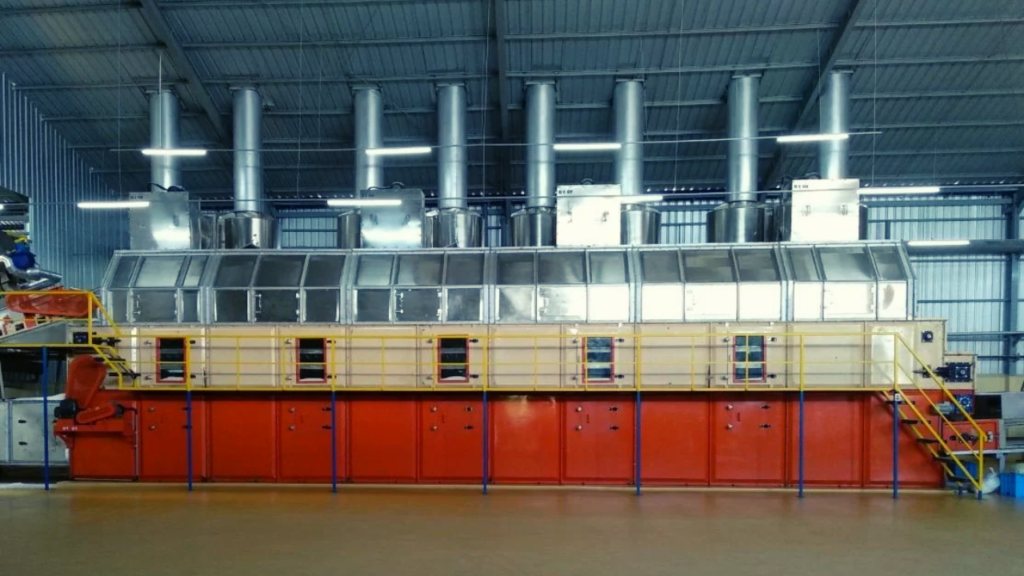
A Vibratory Fluidised Bed Dryer is designed for continuous drying applications where controlled airflow, vibration and residence time are important.
How a VFBD works
The processed tea enters the vibrating fluidized bed.
Controlled hot air passes upward through the perforated bed, creating fluidization and increasing contact between the drying air and tea particles.
At the same time, controlled vibration moves the product through the dryer.
Moisture is transferred from the tea into the drying air and discharged through the exhaust system.
GTI’s VFBD technology combines vibration and fluidized hot air to achieve controlled drying, uniform moisture removal and continuous product movement.
Why VFBD can be considered for Rwandan CTC tea
A customized VFBD system can provide:
- Continuous operation
- Controlled airflow
- Temperature-zone control
- Uniform moisture reduction
- Adjustable residence time
- Efficient heat and mass transfer
- Controlled final moisture
- PLC-based automation
- SCADA integration where required
- Integration with upstream and downstream tea equipment
For a Rwandan factory handling significant CTC production, the dryer should be engineered around actual:
feed moisture + production rate + particle characteristics + final moisture + heating source.
There is no universal VFBD specification suitable for every tea factory.
Rwanda keywords
CTC Tea Dryer Rwanda
CTC Tea Dryer Machine Manufacturer Rwanda
VFBD Tea Dryer Rwanda
Vibratory Fluid Bed Dryer Rwanda
Black CTC Tea Processing Machine Rwanda
Icyayi CTC Rwanda
Orthodox Tea Dryer Machine in Rwanda – Combination Fluid Bed Dryer
Supporting Rwanda’s Specialty Tea Strategy
Orthodox tea has a different processing philosophy from CTC tea.
Instead of producing small CTC particles, orthodox processing is intended to retain a more recognizable leaf structure.
Rwanda already has an established orthodox-tea segment.
NAEB confirms that Orthodox Tea is produced in Rwanda, while current Rwanda Mountain Tea operations include certified organic orthodox black and green tea production at Rutsiro.
Recent investment also demonstrates the direction of the market.
In May 2026, Mulindi Tea Factory completed a reported US$3 million modernization project, adding a new orthodox production capability alongside upgraded withering and CTC processing equipment. The project was reported as doubling annual made-tea capacity from 3,500 to 7,000 tonnes.
This is a strong signal for equipment manufacturers:
Rwanda’s tea industry is not only expanding conventional CTC processing; some factories are adding specialty and Orthodox capabilities.
Why Combination Fluid Bed Drying?
A customized Combination Fluid Bed Dryer can be configured for multi-stage drying where process conditions can be adjusted across different zones.
Potential features include:
- Multi-stage drying
- Controlled temperature zones
- Adjustable airflow
- Controlled residence time
- Uniform moisture reduction
- Gentle product movement
- Automated process control
- Flexible heating configuration
- Integration with existing tea-processing equipment
The exact dryer design should be established through product and process data.
For Orthodox tea, the engineering objective is to provide controlled drying while respecting the characteristics of the processed leaf.
Rwanda keywords
Orthodox Tea Dryer Rwanda
Orthodox Tea Dryer Machine Manufacturer Rwanda
Orthodox Tea Processing Equipment Rwanda
Combination Fluid Bed Dryer Rwanda
Orthodox Tea Machine Rwanda
Orthodox Tea Factory Equipment Rwanda
Green Tea Dryer in Rwanda – Combination Fluid Bed Dryer
A Smaller Category With Strategic Value-Addition Potential
Green tea is not the dominant tea category in Rwanda.
However, that does not make green tea irrelevant.
Rwandan tea producers already manufacture green tea, and Rwanda Mountain Tea’s Rutsiro operation, for example, produces certified organic orthodox black and green tea.
NAEB also recognizes Green Tea as one of the tea products processed in Rwanda and lists a mandatory national specification for green tea, RS 118, alongside the black-tea specification RS 31.
Green tea therefore represents a legitimate processing and product-diversification segment.
Why controlled drying matters
Green tea requires careful process control because the final product characteristics depend on the drying conditions applied to the leaf.
A customized Combination Fluid Bed Dryer can be engineered around:
- Controlled temperature
- Controlled airflow
- Multi-stage drying
- Residence-time management
- Moisture reduction
- Product movement
- Automation
- Energy management
The objective is not simply to “dry green tea.”
It is to create a repeatable drying process suited to the specific green-tea product.
Rwanda’s green-tea opportunity
A green-tea drying system may be relevant for:
- Specialty tea manufacturers
- Organic tea processors
- Export-oriented factories
- Tea diversification projects
- Premium loose-leaf tea producers
- Tea-blending businesses
- Value-added tea manufacturers
Rwanda keywords
Green Tea Dryer Rwanda
Green Tea Dryer Machine Manufacturer Rwanda
Green Tea Processing Equipment Rwanda
Combination Fluid Bed Dryer for Green Tea Rwanda
Icyayi cy’icyatsi Rwanda
Green Tea Processing Machine Rwanda
Rwanda’s Tea Industry Is Moving Toward Product Diversification
The opportunity becomes clearer when the three tea categories are considered together.
| Tea Product | Rwanda Market Position | Suitable Dryer Technology | Commercial Objective |
| Black CTC Tea | Dominant | VFBD | High-volume continuous production |
| Orthodox Tea | Specialty / expanding | Combination Fluid Bed Dryer | Higher-value differentiated tea |
| Green Tea | Smaller but established | Combination Fluid Bed Dryer | Product diversification |
| Organic Tea | Specialty segment | Depends on product | Premium/export positioning |
| Blended / Value-Added Tea | Development opportunity | Process-dependent | Domestic & export value addition |
This three-technology approach is more suitable for a Rwanda-focused pillar page because it mirrors the country’s actual tea-processing structure.
Rwanda’s Value-Addition Opportunity: Why Dryer Upgrades Matter
One of the most important facts for industrial machinery suppliers is that Rwanda is actively discussing greater value addition in its tea sector.
FAO’s Rwanda investment programme includes a planned tea blending facility intended to support value-added tea production for domestic consumption and export. The programme also includes expansion of tea cultivation and additional tea factories.
NAEB’s 2025 tea-sector strategy initiative likewise focuses on production, quality, processing and export competitiveness. NAEB describes tea as one of Rwanda’s top-performing export commodities, generating nearly US$700 million over 2017–2024.
For machinery suppliers, this creates several possible project categories:
Factory modernization
Replacing older drying equipment with a more controlled continuous system.
Capacity expansion
Increasing production capacity while maintaining process control.
Orthodox production line
Adding specialty Orthodox tea to an existing CTC factory.
Green tea line
Developing green or specialty tea production.
Value-added tea
Supporting downstream blending and differentiated tea products.
New tea factory
Designing a complete drying section for a new processing plant.
Rwanda Tea-Producing Regions: GEO Opportunities for Tea Machinery
For local SEO, the page should not stop at “Rwanda.”
Rwanda’s tea industry extends across important growing and factory regions.
NAEB identifies tea cultivation across the Northern, Western and Southern provinces, while its factory listings include locations such as:
- Rubaya
- Nyabihu
- Kitabi
- Mata
- Nshili-Kivu
- Gisakura
- Rutsiro
- Gatare
- Gisovu
- Pfunda
- Rugabano
- Karongi
- Muganza-Kivu
- Mulindi
- Shagasha
- Sorwathe
- Cyato
- Mushubi
- Kibeho
These locations appear in NAEB’s tea-factory stakeholder information.
Local GEO keyword opportunities
Instead of repeating “tea dryer Rwanda” throughout the page, create natural regional variations such as:
- Tea Dryer Manufacturer in Kigali
- Tea Processing Equipment Rwanda
- CTC Tea Dryer in Western Rwanda
- VFBD Tea Dryer for Rwanda Tea Factory
- Orthodox Tea Dryer in Rutsiro
- Green Tea Processing Equipment Rwanda
- Tea Factory Machinery in Nyabihu
- Tea Dryer for Karongi Tea Factory
- Tea Processing Machinery in Southern Rwanda
- Industrial Tea Dryer Supplier Rwanda
These variations help search engines understand the geographic and industrial context of the page without keyword stuffing.
What Should a Rwanda Tea Factory Consider Before Selecting a Dryer?
Choosing between VFBD and Combination Fluid Bed Dryer should begin with the process, not simply the product name.
1. Tea type
CTC, Orthodox, Green, Organic or specialty tea.
2. Production capacity
Required throughput in kg/hour or tonnes/day.
3. Feed moisture
Moisture entering the dryer determines the required drying duty.
4. Final moisture
The desired final moisture must be defined according to the specific product and quality requirements.
5. Particle or leaf characteristics
CTC particles and Orthodox leaves behave differently during drying.
6. Heating system
The available energy source may include steam, thermic fluid, hot-air generation, electricity or other suitable systems.
7. Automation
Manual, semi-automatic, PLC or SCADA-based control.
8. Factory layout
The dryer needs to integrate with existing tea-processing equipment.
9. Air handling and dust collection
Proper exhaust and dust-management systems should be considered as part of the overall installation.
10. Future product expansion
A factory planning to add Orthodox, Green or specialty tea should consider future process requirements during the initial engineering stage.
GTI Dryers: Tea Drying Systems Engineered for Rwanda
GTI Dryers designs and manufactures industrial tea drying systems for different tea-processing applications.
For Rwanda, the technology pathway can be structured around:
CTC Tea
Vibratory Fluidised Bed Dryer
For continuous drying applications requiring controlled airflow, vibration and moisture management.
Orthodox Tea
Combination Fluid Bed Dryer
For controlled, multi-stage drying of specialty and leaf-style tea.
Green Tea
Combination Fluid Bed Dryer
For controlled drying of green-tea products according to product-specific requirements.
GTI’s tea-drying scope includes process design and engineering, equipment manufacturing, installation and commissioning, automation integration, operator training and after-sales support. The company’s tea systems focus on controlling temperature, airflow, moisture content, drying time and residence time.
Why Work With an Industrial Tea Dryer Manufacturer From India?
For a Rwandan tea factory, buying a dryer should not be treated as purchasing an isolated machine.
The dryer needs to work as part of the processing line.
An experienced engineering supplier can support:
Process Data → Technology Selection → Dryer Design → Manufacturing → Installation → Commissioning → Automation → Training → Support
This approach is particularly important for Rwanda because factories may have different:
- Tea varieties
- Capacities
- Existing machinery
- Heating systems
- Product specifications
- Export requirements
- Automation levels
- Expansion plans
GTI’s approach is therefore based on customization rather than applying one standard dryer configuration to every project.
Who Should Consider a Tea Dryer Project in Rwanda?
This Rwanda-focused solution can be relevant to:
- Tea factories
- Tea estates
- Tea cooperatives
- Tea processors
- Tea exporters
- CTC tea manufacturers
- Orthodox tea producers
- Green tea manufacturers
- Organic tea processors
- Specialty tea companies
- Tea-blending companies
- Value-added tea manufacturers
- EPC companies
- Process engineering companies
- Investors developing new tea factories
- Existing factories planning modernization
Whether the requirement is a CTC Tea VFBD, Orthodox Tea Combination Fluid Bed Dryer or Green Tea Combination Fluid Bed Dryer, the system should be engineered around the actual process data.
Frequently Asked Questions About Tea Dryers in Rwanda
Which tea dryer is suitable for CTC tea in Rwanda?
A Vibratory Fluidised Bed Dryer (VFBD) can be considered for continuous CTC tea drying. It combines controlled hot-air flow with vibration to support product movement and drying. The final design depends on production capacity, moisture and product characteristics.
Is CTC tea important in Rwanda?
Yes. NAEB identifies black CTC tea as the predominant type of tea produced in Rwanda, and its 2023/24 export report states that black CTC represented more than 90% of made teas in the reported export profile.
Does Rwanda produce Orthodox tea?
Yes. NAEB states that Orthodox tea is among the tea types processed in Rwanda. Current Rwandan producers also operate Orthodox tea lines, including Rutsiro and the recently modernized Mulindi factory.
Which dryer can be used for Orthodox tea?
A customized Combination Fluid Bed Dryer can be considered where controlled, multi-stage drying is required. The actual configuration should be based on the tea characteristics and process requirements.
Does Rwanda produce green tea?
Yes. Green tea is among the tea products processed in Rwanda, and Rwandan producers such as Rutsiro produce green tea alongside other specialty products.
What is green tea called in Kinyarwanda?
Icyayi cy’icyatsi is a documented Kinyarwanda term for green tea.
What is tea called in Kinyarwanda?
Tea is Icyayi in Kinyarwanda.
What is black tea called in Kinyarwanda?
A Kinyarwanda vocabulary source gives Mukaru for black tea. For industrial SEO, however, it is better to retain Black Tea / Black CTC Tea alongside the local terminology because Rwanda’s tea industry itself uses CTC as the technical category.
What are Rwanda’s main tea export markets?
Rwanda’s 2023/24 leading tea destinations included Pakistan, the United Kingdom, Egypt, Kazakhstan and Ireland, followed by markets including the UAE, Russia, Sudan and Turkey.
Is Rwanda expanding its tea-processing industry?
Yes. Current sector plans include tea-area expansion, new factories, research and a tea-blending facility intended to support value-added production for domestic and export markets.
Request a Customized Tea Drying System for Rwanda
Rwanda already has an established tea-processing industry, a strong export orientation and a growing focus on diversification and value addition.
For the conventional CTC segment, VFBD technology can support continuous industrial drying.
For Orthodox tea, a Combination Fluid Bed Dryer can be engineered around controlled multi-stage drying.
For Green Tea, a Combination Fluid Bed Dryer can provide a controlled drying platform designed around the specific product.
The right solution begins with your process data:
Tea Type + Capacity + Feed Moisture + Final Moisture + Leaf/Particle Characteristics + Heating Source + Automation + Plant Layout
Talk to GTI Dryers About Your Rwanda Tea Project
If you are planning:
- A new CTC tea factory
- A CTC dryer upgrade
- A VFBD installation
- An Orthodox tea production line
- A Green Tea processing line
- A specialty tea project
- A tea factory modernization
- A value-added tea-processing plant
GTI Dryers can develop a customized industrial drying solution based on your project requirements.
GTI Dryers — Engineered Drying Solutions from India for Global Tea Industries.