
Industrial Tea Drying in Cameroon: Building More Consistent and Export-Ready Tea Processing
Cameroon has a long-established tea-growing and processing industry, with tea estates and processing operations associated with areas including Tole, Ndu, Djuttitsa and Ndawara. Cameroon Tea Estates reports operations across four plantations and an annual production capacity of approximately 5,000 tonnes, illustrating the presence of an established industrial tea-processing base in the country.
For tea factories, estates and processors, drying is more than simply removing moisture.
The drying stage influences:
- final moisture content
- tea stability during storage
- aroma and flavour retention
- product consistency
- handling and packaging performance
- energy consumption
- production throughput
- suitability for different tea products
This makes the selection of an industrial tea dryer an important part of tea-processing plant design.
GTI Dryers designs and manufactures customized industrial drying systems for tea-processing applications, including:
- CTC Tea Dryer Machine – Vibratory Fluid Bed Dryer (VFBD)
- Orthodox Tea Dryer Machine – Combination Fluid Bed Dryer
- Green Tea Dryer – Combination Fluid Bed Dryer
The appropriate configuration depends on the tea variety, particle characteristics, feed moisture, desired final moisture, production capacity, heat sensitivity and overall process layout.
Cameroon Tea Industry: Why Drying Technology Matters
Cameroon’s tea industry has developed around both highland and other suitable tea-growing regions. Tole is located in the South-West, while Ndu and Ndawara are associated with the North-West and Djuttitsa with the West region. Cameroon Tea Estates describes its plantations as covering more than 10,000 hectares across four plantations.
The country therefore has an existing industrial foundation on which tea-processing modernization can build.
At the same time, trade data illustrates an important opportunity for processors.
According to World Bank WITS data, Cameroon exported 245,577 kg of tea valued at approximately US$1.29 million in 2023, with almost the entire recorded export volume going to Chad.
Cameroon also imported more than 10.17 million kg of tea from China in 2023, while smaller quantities came from India and other suppliers.
These figures should not be interpreted as a complete measure of domestic tea consumption or total production, but they highlight a potentially important distinction between tea production capacity, domestic market requirements and internationally traded finished tea.
For processors, this creates several areas where modern drying technology can support development:
- improving consistency of finished tea
- increasing process control
- supporting higher-value tea products
- reducing moisture-related quality variation
- developing differentiated tea products
- strengthening export-oriented processing
- improving energy management
- preparing factories for future capacity expansion
One Country, Three Tea-Drying Requirements
A major advantage of designing a modern tea-processing plant is that the drying system can be selected around the product rather than forcing every tea type through the same technology.
For Cameroon, three important technology routes can be considered:
| Tea Application | Recommended GTI Technology | Main Processing Objective |
| CTC Tea | Vibratory Fluid Bed Dryer (VFBD) | Rapid and uniform drying of granular tea |
| Orthodox Tea | Combination Fluid Bed Dryer | Controlled multi-stage drying and quality preservation |
| Green Tea | Combination Fluid Bed Dryer | Gentle controlled drying after enzyme deactivation |
This three-technology approach allows tea producers to evaluate drying equipment according to their current product portfolio and future diversification plans.
1. CTC Tea Dryer Machine Manufacturer in Cameroon – VFBD
Why VFBD Technology Fits CTC Tea Processing
CTC stands for Crush, Tear and Curl, a processing method widely associated with granular black tea production.
After CTC processing and oxidation/fermentation, the tea must be dried rapidly and uniformly to stabilize the product.
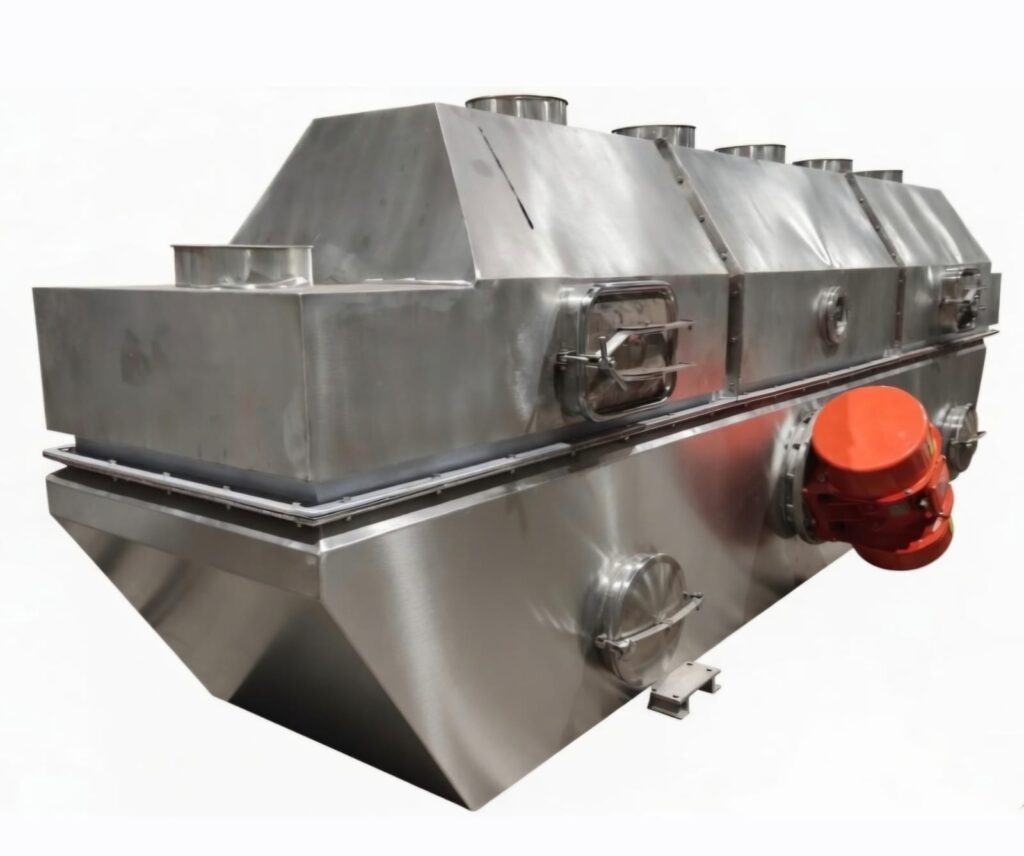
A Vibratory Fluid Bed Dryer (VFBD) combines controlled vibration with upward-flowing heated air. The product travels over a perforated vibrating bed while heated air fluidizes the particles.
This combination provides:
- uniform heat transfer
- controlled product movement
- efficient moisture removal
- consistent residence time
- controlled final moisture
- continuous operation
- gentle product handling
GTI’s VFBD technology is designed for continuous drying of free-flowing particles and provides controlled airflow, vibration and residence time.
How a CTC Tea VFBD Works
The general process can be represented as:
Fermented/Oxidized CTC Tea → Controlled Feeding → Vibratory Fluid Bed → Heated Air Contact → Moisture Removal → Cooling/Discharge → Grading & Packaging
The wet CTC tea enters through a controlled feeding system.
Inside the dryer, heated air passes through the perforated distribution plate. The airflow fluidizes the tea particles while controlled vibration transports them through the drying chamber.
As the tea travels through the system, moisture is progressively removed until the required process specification is reached.
The dried tea can then move toward cooling, grading, blending or packaging.
Why Cameroon CTC Tea Processors May Consider VFBD
For industrial CTC production, the main requirements are generally:
- continuous throughput
- uniform drying
- controlled moisture
- stable product movement
- efficient heat transfer
- automation
- repeatable operation
A VFBD can be engineered around these requirements.
2. Orthodox Tea Dryer Machine Manufacturer in Cameroon – Combination Fluid Bed Dryer
Not every tea-processing requirement is identical to CTC production.
Orthodox tea uses a different leaf-processing approach and can require greater attention to controlled handling and drying conditions.
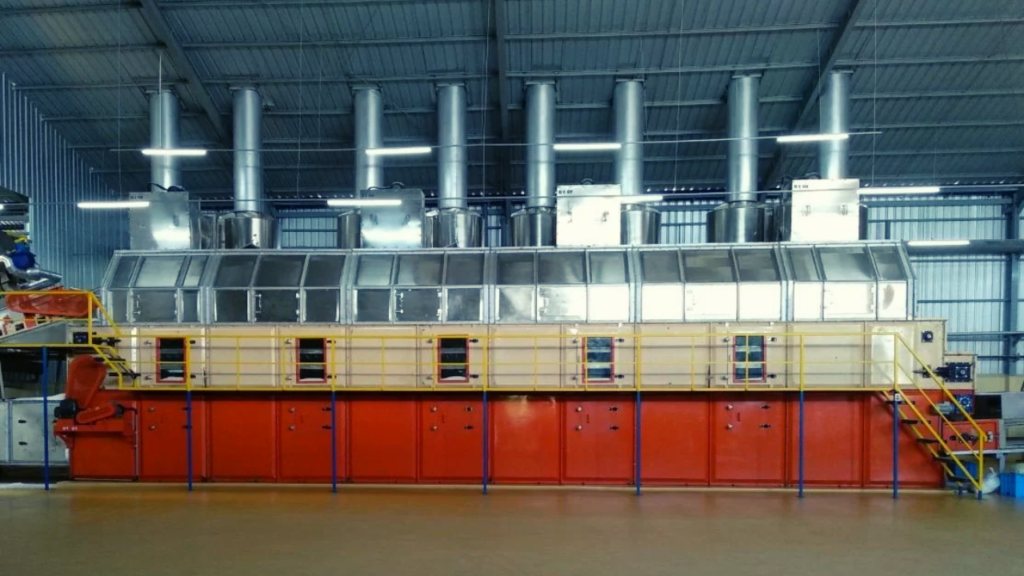
A Combination Fluid Bed Dryer can integrate multiple drying stages or controlled drying zones to manage moisture removal progressively.
Instead of treating the entire drying process as one uniform operation, the system can be engineered around different stages of moisture removal.
Typical Concept
Wet Processed Tea → Controlled Feeding → Initial Drying → Intermediate Drying → Final Moisture Control → Cooling → Finished Tea
The exact temperature profile, airflow and residence time must be established from product and process trials rather than using one universal setting.
Why Combination Drying Can Be Useful for Orthodox Tea
A multi-stage configuration can provide:
- improved moisture control
- controlled drying conditions
- flexible residence time
- uniform heat distribution
- better process repeatability
- energy optimization opportunities
- integration with automated plant controls
For Cameroon processors interested in producing differentiated or specialty tea products, a flexible drying system can also provide greater process adaptability.
3. Green Tea Dryer in Cameroon – Combination Fluid Bed Dryer
Green tea requires a different drying strategy because the objective is to prevent unwanted oxidation and preserve characteristics such as colour, aroma and desirable compounds.
GTI’s green tea drying systems describe controlled drying after enzyme deactivation and identify Combination Dryers as an option for multi-stage drying, moisture control and large-scale green tea production.
A Combination Fluid Bed Dryer can therefore be considered where a producer requires:
- controlled drying conditions
- staged moisture reduction
- uniform drying
- energy optimization
- controlled product temperature
- continuous industrial operation
Green Tea Processing Concept
Fresh Tea Leaves → Enzyme Deactivation → Rolling/Forming → Controlled Drying → Cooling → Sorting/Grading → Packaging
The drying parameters should be established according to:
- leaf condition
- feed moisture
- desired final moisture
- product temperature limits
- particle/leaf size
- production capacity
- required sensory characteristics
This is particularly important because green tea should not simply be treated as black tea with a different final colour.
CTC vs Orthodox vs Green Tea: Which Dryer Does a Cameroon Factory Need?
The correct dryer depends on what the factory is producing.
CTC Tea
Technology: VFBD
Main requirement: Efficient and uniform drying of granular tea.
Suitable where the factory requires:
- continuous production
- high throughput
- controlled moisture
- efficient heat transfer
- automated operation
Orthodox Tea
Technology: Combination Fluid Bed Dryer
Main requirement: Controlled, multi-stage drying of processed tea.
Suitable where the processor focuses on:
- product quality
- controlled drying
- differentiated tea products
- flexible process conditions
- consistent final moisture
Green Tea
Technology: Combination Fluid Bed Dryer
Main requirement: Controlled drying after enzyme deactivation.
Suitable where the producer needs:
- controlled temperature
- staged drying
- colour preservation
- uniform moisture removal
- premium or differentiated tea production
Cameroon Tea Processing Locations: Where Industrial Dryer Demand Can Develop
A Cameroon-focused tea equipment strategy should not target the country as a single generic market.
The geography of existing tea production creates more specific industrial SEO and sales opportunities.
Tole – South-West Cameroon
Tole is one of Cameroon’s historically established tea-growing and processing locations.
For businesses searching for equipment around the South-West tea-processing cluster, relevant searches can include:
- Tole tea dryer
- tea processing equipment in Tole
- industrial tea dryer South-West Cameroon
- CTC tea dryer Cameroon
- tea factory machinery Cameroon
Ndu – North-West Cameroon
Ndu is another historically important tea-growing and processing area.
Potential commercial search terms include:
- Ndu tea processing equipment
- Ndu tea dryer
- VFBD tea dryer Cameroon
- industrial tea drying machine North-West Cameroon
- tea factory equipment Ndu
Ndawara – North-West Cameroon
Ndawara represents another important tea-growing location and can be targeted through highly localized B2B content.
Potential searches include:
- Ndawara tea processing equipment
- Ndawara tea dryer
- tea drying system North-West Cameroon
- CTC tea processing machinery Cameroon
Djuttitsa – West Cameroon
Djuttitsa provides another geographic opportunity for tea-processing equipment searches.
Potential keywords include:
- Djuttitsa tea dryer
- tea processing equipment West Cameroon
- industrial tea dryer West Region Cameroon
- tea factory machinery Cameroon
This location-based structure can help a website move beyond the broad keyword “tea dryer Cameroon” and capture more specific industrial-intent searches.
Cameroon Tea-Processing Market
Cameroon has English and French as official languages, with both holding the same official status.
Useful French Search Terminology
Tea: Thé
Tea factory: Usine de thé
Tea processing: Transformation du thé
Tea drying: Séchage du thé
Tea dryer: Séchoir à thé
Industrial tea dryer: Séchoir industriel à thé
Tea processing equipment: Équipement de transformation du thé
Tea processing machinery: Machines de transformation du thé
CTC tea: Thé CTC
CTC tea dryer: Séchoir à thé CTC
Fluid bed dryer: Séchoir à lit fluidisé
Vibratory fluid bed dryer: Séchoir à lit fluidisé vibrant
Green tea: Thé vert
Green tea drying: Séchage du thé vert
Orthodox tea: Thé orthodoxe
These terms can be used naturally rather than repeatedly inserting translated keywords into every paragraph.
For example:
Industrial Tea Dryer in Cameroon – Séchoir industriel à thé pour les usines de transformation du thé
This approach allows the page to communicate with both English- and French-speaking industrial buyers without creating unnatural keyword stuffing.
Cameroon Tea Dryer Market: Where the Opportunity Lies
The available trade data suggests that Cameroon has a tea production base but relatively limited recorded tea exports compared with larger African tea-exporting countries.
FAOSTAT-derived data reported by Helgi indicates Cameroon produced approximately 24,684 tonnes of tea in 2024, its highest recorded level in that dataset.
By contrast, WITS records only 245,577 kg of tea exports in 2023.
The difference between production and recorded exports should be treated carefully because production and trade statistics measure different things and can reflect different classifications, reporting periods and market channels.
Nevertheless, it creates an important industrial question:
How can Cameroon tea processors improve processing, product differentiation and market utilization of locally produced tea?
Drying technology can contribute to that objective by providing:
1. Better Process Consistency
Automated control of airflow, temperature, vibration and residence time can reduce variation between production runs.
2. Higher Production Control
Continuous dryers can be integrated with upstream and downstream processing equipment to support industrial-scale production.
3. Product Diversification
Flexible drying systems can support different tea-processing configurations, allowing manufacturers to investigate CTC, Orthodox, green and specialty tea opportunities.
4. Improved Moisture Management
Uniform final moisture is essential for stable storage, packaging and consistent product performance.
5. Energy Optimization
Properly engineered airflow, heating and drying zones can improve thermal efficiency compared with poorly controlled drying systems.
6. Export-Oriented Manufacturing
Consistent processing can help manufacturers establish repeatable specifications for customers and export markets.
Why Choose an Indian Tea Dryer Manufacturer for a Cameroon Project?
For a Cameroon tea factory, purchasing a dryer should not be treated as simply buying a machine.
The equipment needs to match the complete process.
GTI Dryers approaches tea drying as an engineering and process-design requirement, with systems customized around product characteristics, capacity and operating conditions.
GTI’s published tea-drying solutions include fluid bed, conveyor/band, vibro fluid bed and other industrial drying technologies, with customization based on capacity and processing requirements.
For Cameroon projects, the engineering discussion can cover:
- tea variety
- production capacity
- feed moisture
- required final moisture
- particle size
- leaf characteristics
- drying temperature limitations
- available heating source
- plant layout
- automation requirements
- energy efficiency
- future production expansion
GTI Dryers: Tea Drying Solutions for Cameroon
GTI Dryers designs and manufactures industrial drying systems for tea-processing applications.
For Cameroon tea processors, the technology portfolio can be configured around three principal applications:
CTC Tea – VFBD
Designed for continuous and uniform drying of granular CTC tea with controlled airflow, vibration and residence time.
Orthodox Tea – Combination Fluid Bed Dryer
Designed for controlled multi-stage drying where product handling and moisture control are important.
Green Tea – Combination Fluid Bed Dryer
Designed for controlled drying after enzyme deactivation, with emphasis on moisture uniformity and product-quality preservation.
The final configuration should always be determined from actual product and process data.
What Information Is Required to Design a Tea Dryer for Cameroon?
Before requesting a quotation, tea factories should provide as much of the following information as possible:
| Parameter | Required Information |
| Tea type | CTC / Orthodox / Green / Specialty |
| Feed capacity | kg/hr or tonnes/hr |
| Initial moisture | % |
| Desired final moisture | % |
| Product form | Leaf / Granule / Cut Tea |
| Particle size | mm or relevant grading |
| Operating hours | Hours/day |
| Heating source | Steam / Gas / Biomass / Thermic Fluid / Electric |
| Plant location | City / Region |
| Available space | Approximate layout |
| Automation | Manual / PLC / SCADA |
| Cooling requirement | Yes / No |
| Dust collection | Required / Existing |
| Future expansion | Required / Not required |
Providing this information allows the dryer manufacturer to evaluate the application instead of supplying an undersized or oversized standard machine.
Typical Tea Drying System Configuration
A complete industrial tea drying line can include:
Tea Feeding System
↓
Controlled Feed Distribution
↓
Drying Chamber / VFBD / Combination Dryer
↓
Hot Air Generation System
↓
Air Handling & Blower System
↓
Exhaust & Dust Collection
↓
Cooling Section
↓
Finished Tea Discharge
↓
Grading / Blending / Packaging
Depending on the plant, the system can also be integrated with upstream tea-processing equipment and downstream packaging or material-handling systems.
GTI’s published tea-drying systems identify process design, manufacturing, installation and commissioning, automation integration, operator training and after-sales support as part of the potential project scope.
Technical Parameters That Matter More Than a Standard Machine Size
There is no single “Cameroon tea dryer size” that is suitable for every factory.
Dryer design depends on actual process data.
Important parameters include:
Feed Rate
The dryer must be designed according to the actual wet-feed capacity.
Moisture Removal
The difference between feed moisture and target moisture determines the thermal load.
Product Characteristics
Leaf size, particle density, flowability and sensitivity influence the drying configuration.
Airflow
Fluidized systems require carefully controlled air velocity and distribution.
Residence Time
The product must remain inside the dryer long enough to reach the required moisture without unnecessary over-drying.
Heating System
The available energy source influences heat-exchanger, burner and air-heating design.
Plant Layout
Equipment dimensions and auxiliary systems must fit the available factory space.
GTI’s VFBD design methodology considers parameters such as air velocity, inlet air temperature, bed depth, vibration intensity, residence time and feed moisture.
Cameroon Tea Dryer Search Landscape
For an industrial manufacturer product + technology + country + location + application + language.
Core Commercial Keywords
- Tea Dryer Machine Manufacturer in Cameroon
- Industrial Tea Dryer Cameroon
- Tea Drying Machine Cameroon
- Tea Processing Equipment Cameroon
- Tea Dryer Manufacturer India for Cameroon
CTC Keywords
- CTC Tea Dryer Cameroon
- CTC Tea Dryer Machine Manufacturer Cameroon
- VFBD Tea Dryer Cameroon
- Vibratory Fluid Bed Dryer Cameroon
- CTC Tea Processing Equipment Cameroon
Orthodox Keywords
- Orthodox Tea Dryer Cameroon
- Orthodox Tea Dryer Machine Manufacturer
- Combination Fluid Bed Dryer Cameroon
- Orthodox Tea Processing Equipment Cameroon
Green Tea Keywords
- Green Tea Dryer Cameroon
- Green Tea Drying System Cameroon
- Green Tea Processing Equipment Cameroon
- Combination Dryer for Green Tea Cameroon
Location Keywords
- Tole Tea Dryer
- Ndu Tea Dryer
- Ndawara Tea Dryer
- Djuttitsa Tea Dryer
- South-West Cameroon Tea Processing Equipment
- North-West Cameroon Tea Processing Equipment
- West Cameroon Tea Processing Equipment
French Keywords
- Séchoir industriel à thé Cameroun
- Séchoir à thé CTC Cameroun
- Séchoir à lit fluidisé Cameroun
- Séchoir à lit fluidisé vibrant Cameroun
- Équipement de transformation du thé Cameroun
- Machine de séchage du thé Cameroun
- Séchage du thé vert Cameroun
- Équipement de transformation du thé au Cameroun
Frequently Asked Questions – Tea Dryer Machine in Cameroon
What type of dryer is suitable for CTC tea in Cameroon?
A Vibratory Fluid Bed Dryer (VFBD) can be suitable for continuous drying of granular CTC tea because it combines controlled vibration with fluidized hot air for uniform moisture removal.
What dryer is suitable for Orthodox tea?
A Combination Fluid Bed Dryer can be engineered for controlled, multi-stage drying of Orthodox tea. The final design depends on the leaf characteristics, capacity and required product specifications.
Can GTI supply a green tea dryer to Cameroon?
Yes. GTI Dryers designs customized green tea drying systems, including Combination Dryer configurations, based on production capacity, feed moisture, product characteristics and drying requirements.
Does GTI manufacture tea dryers in India for export to Cameroon?
GTI Dryers designs and manufactures industrial drying systems in India and can engineer systems for international tea-processing projects.
Can the dryer be customized for a Cameroon tea factory?
Yes. Dryer design can be customized according to tea type, capacity, moisture reduction, heating source, plant layout, automation requirements and other process parameters.
What is “séchoir à thé” in English?
Séchoir à thé means tea dryer in French.
What is “séchage du thé” in English?
Séchage du thé means tea drying.
What is “séchoir à lit fluidisé vibrant”?
It refers to a Vibratory Fluid Bed Dryer (VFBD), a drying system that combines fluidized hot air with controlled mechanical vibration.
Can one drying system handle both CTC and green tea?
It depends on the process and product requirements. Different tea types have different drying conditions, so a project should be evaluated by product and process data rather than assuming one configuration will be optimal for all products.
Request a Customized Tea Dryer Proposal for Cameroon
If you are planning a new tea-processing plant, factory expansion, dryer replacement or process modernization project in Cameroon, GTI Dryers can evaluate the application based on your actual production requirements.
Send the following details to start the technical discussion:
Tea Type: CTC / Orthodox / Green Tea
Capacity: ___ kg/hr or TPH
Feed Moisture: ___ %
Final Moisture: ___ %
Heating Source: ___
Factory Location: Tole / Ndu / Ndawara / Djuttitsa / Other
Automation Requirement: ___
Project Status: New Plant / Expansion / Replacement
GTI Dryers – Industrial Tea Drying Solutions
CTC Tea → VFBD
Orthodox Tea → Combination Fluid Bed Dryer
Green Tea → Combination Fluid Bed Dryer
Engineered in India. Designed for the World.
For a Cameroon tea-drying project, request a customized technical evaluation rather than selecting a dryer based only on nominal capacity.
Suggested CTA:
Request Tea Dryer Quotation for Cameroon | Get Technical Consultation | Discuss Your Tea Processing Project