
Conventional spray drying is an effective way to convert liquids, solutions, emulsions and slurries into dry powders. But what if the required product is not a fine powder?
Many industrial processes need something different:
- Dense granules instead of lightweight powder
- Better flowability
- Reduced dust generation
- Controlled particle size
- Improved handling and conveying
- Better dissolution or dispersibility
- Higher bulk density
- Controlled moisture
- Granules suitable for downstream processing
This is where a Spray Fluidizer or Spray Granulation Dryer can become a more suitable process concept.
The technology combines the principles of spray drying, fluidized-bed drying and granulation to transform a liquid feed into controlled granular material.
GTI Dryers designs industrial drying and particle-processing solutions around the product, feed characteristics, required particle properties, production capacity and downstream process.
What Is a Spray Fluidizer?
A Spray Fluidizer is an industrial drying and granulation system in which a pumpable liquid feed—such as a solution, suspension, slurry or suitable melt—is atomized into a fluidized bed of particles.
Instead of simply producing individual fine powder particles, the process encourages particle layering, agglomeration and controlled growth.
The result can be a:
- Dense granule
- Free-flowing product
- Lower-dust material
- Controlled particle-size distribution
- Product with specified bulk density
- Granule with controlled residual moisture
The exact configuration depends on the product and desired particle characteristics.
A spray-fluidizer process can therefore sit between conventional spray drying and conventional fluid-bed granulation, combining elements of both technologies.
Why Choose Spray Granulation Instead of Conventional Spray Drying?
This is one of the most important questions for a plant designer.
A conventional spray dryer is generally selected when the objective is to convert a liquid feed into a powder.
But some applications require engineered granules rather than fine powder.
For example:
| Requirement | Conventional Spray Dryer | Spray Fluidizer / Granulation Dryer |
| Liquid-to-solid conversion | ✓ | ✓ |
| Fine powder production | ✓ | Possible |
| Granule production | Limited/configuration dependent | ✓ |
| Higher bulk density | Application dependent | Often a key objective |
| Dust reduction | Application dependent | Strong design objective |
| Particle growth | Limited | ✓ |
| Layering/agglomeration | Configuration dependent | ✓ |
| Controlled granule size | Application dependent | ✓ |
| Continuous processing | ✓ | ✓ depending on configuration |
The important point is that the equipment should be selected according to the desired final product, not simply the initial moisture-removal requirement.
If the customer needs a free-flowing powder, conventional spray drying may be sufficient.
If the customer needs a dense, controlled granule from a liquid feed, a spray granulation approach may provide a better process route.
How Does a Spray Fluidizer Work?
The process can be understood in several stages.
1. Liquid Feed Preparation
The process begins with a suitable feed such as:
- Solution
- Suspension
- Slurry
- Concentrated liquid
- Melt
Feed concentration, viscosity, temperature, solids content and rheology are important because they influence atomization and granule formation.
2. Atomization
The liquid feed is delivered through an appropriate atomization system.
Depending on the process, this may involve:
- Pressure nozzles
- Two-fluid nozzles
- Other application-specific atomization arrangements
The objective is to create droplets with the required characteristics for drying and particle growth.
3. Spray Drying
The atomized droplets encounter heated drying gas.
A significant portion of the moisture is removed during this initial stage.
The partially dried particles then participate in the granulation process.
4. Fluidization
The product is maintained in a fluidized state using controlled process air or gas.
The fluidized bed creates intensive contact between the drying medium and particles.
This supports:
- Heat transfer
- Mass transfer
- Particle movement
- Drying
- Granule growth
- Moisture equalization
5. Granule Formation
This is where the technology becomes different from a basic spray dryer.
Liquid droplets interact with existing particles or partially dried material.
Depending on the process, particle growth can occur through:
Layering → Wetting → Drying → Particle Growth → Further Drying
The objective is to develop granules with the required:
- Size
- Density
- Moisture
- Strength
- Flowability
- Surface characteristics
6. Screening and Product Classification
The dried product can then be screened according to the required particle-size range.
Depending on the plant design:
- Oversized particles may be milled
- Undersized particles/fines may be recovered
- Suitable granules may be discharged as final product
- Recycle streams may be incorporated into the granulation process
This creates an opportunity for tighter control over the final particle-size distribution.
Spray Fluidizer vs Spray Dryer vs Fluid Bed Granulator
Choosing between these technologies can be confusing.
Conventional Spray Dryer
Best considered when the objective is:
Liquid → Fine Dry Powder
Typical applications include:
- Dairy powders
- Food ingredients
- Pharmaceutical powders
- Chemical powders
- Extracts
- Proteins
- Specialty ingredients
Best suited when the feed is already in particulate form:
Wet Granules / Crystals / Particles → Dry Granules
Fluid-bed technology is widely used for drying and cooling powders, agglomerates, granules and pellets.
Spray Fluidizer / Spray Granulation Dryer
The process becomes particularly interesting when the requirement is:
Liquid Feed → Controlled Granules
The liquid is atomized while particles are fluidized, allowing drying and particle growth to occur as part of an integrated process.
This can eliminate the need for some separate intermediate processing steps, depending on the product and plant configuration.
What Problems Can a Spray Granulation Dryer Solve?
A buyer should not start by asking:
“Which dryer should I purchase?”
The better question is:
“What problem do I have with my final product?”
Problem 1: Powder Is Too Dusty
Very fine powders can create:
- Dust handling problems
- Product losses
- Workplace exposure concerns
- Filtration load
- Difficult conveying
Granulation can increase particle size and potentially reduce dust generation.
Problem 2: Powder Has Poor Flowability
Fine or irregular powders can bridge, cake or behave poorly during:
- Bag filling
- Conveying
- Feeding
- Packaging
- Blending
Granule engineering can improve flow characteristics where the formulation permits.
Problem 3: Bulk Density Is Too Low
A conventional spray-dried powder may have a bulk density that is unsuitable for a particular application.
Granulation can be used to target a denser product structure.
However, final density is highly product-dependent and should be established through trials rather than assumed.
Problem 4: Customer Requires Specific Particle Size
Different industries may require different particle-size ranges.
For example, the requirement could be:
- Fine granules
- Coarse granules
- Narrow particle-size distribution
- Dust-free granules
- Fast-dissolving agglomerates
The atomization, fluidization, recycle and classification strategy must therefore be designed together.
Problem 5: Liquid Feed Needs to Become a Granular Product
This is one of the strongest applications for spray granulation.
Instead of:
Liquid → Powder → Separate Granulation
a suitable integrated process can potentially move toward:
Liquid → Spray Drying + Granulation → Final Granules
This can simplify the process for selected products.
Industries Using Spray Fluidizer & Spray Granulation Technology
1. Fertilizer Industry
Potential applications include fertilizer solutions, suspensions and other granular formulations where controlled particle size, flowability and handling are important.
The exact granulation route depends on:
- Fertilizer chemistry
- Feed concentration
- Solids content
- Granule size
- Moisture specification
- Product strength
- Recycle requirements
Related GTI cluster: Fertilizer Dryer → Fluid Bed Dryer → Spray Dryer → Spray Granulation Dryer
2. Chemical Industry
Chemical processing is one of the important application areas for spray-fluidizer technology.
Potential products can include:
- Inorganic salts
- Organic salts
- Chemical intermediates
- Specialty chemicals
- Chemical formulations
- Crystalline materials
- High-value specialty products
For chemicals, process containment, corrosion resistance, material selection, dust control and product recovery become particularly important.
3. Detergent Industry
Detergent and cleaning-product manufacturing may require controlled powder or granule characteristics.
A spray-based process can be considered where liquid formulations need to be converted into a dry particulate product.
Important design considerations include:
- Feed composition
- Surfactant characteristics
- Bulk density
- Particle size
- Moisture
- Solubility
- Dust formation
- Fragrance or heat-sensitive components
4. Pharmaceutical Industry
Pharmaceutical applications require considerably tighter process control.
Depending on the formulation, spray granulation can be considered for:
- Pharmaceutical ingredients
- Granulated formulations
- Excipients
- Active ingredients
- Controlled-release formulations
- Specialty pharmaceutical powders
For pharmaceutical systems, the equipment design may need to address:
- GMP requirements
- Containment
- Cleaning
- Product recovery
- Validation
- Traceability
- Temperature control
- Cross-contamination prevention
The correct process route must always be established from the formulation and regulatory requirements.
5. Food Ingredients
Spray-fluidized and multi-stage spray drying concepts can be useful where the customer wants improved powder properties such as:
- Better flowability
- Improved dispersibility
- Reduced dust
- Controlled particle size
- Agglomerated particles
- Specific bulk density
Food and dairy processing may use spray and fluid-bed stages together to create coarse, free-flowing and easily handled powders.
6. Specialty Chemicals
Specialty chemical manufacturers often need more than simple moisture removal.
They may require specific:
- Particle morphology
- Granule strength
- Bulk density
- Solubility
- Flowability
- Particle-size distribution
- Residual moisture
This makes spray granulation a process-development decision rather than simply an equipment-selection decision.
Spray Fluidizer for High-Density Granules
One of the major reasons industries consider spray-fluidizer technology is the ability to engineer granule structure.
The objective may be to transform a liquid feed into particles that are:
Dense + Free-flowing + Low-dust + Controlled in Size + Easy to Handle
However, density is not determined by the dryer alone.
It depends on variables such as:
- Feed solids concentration
- Droplet size
- Atomization conditions
- Drying rate
- Bed conditions
- Spray rate
- Recycle ratio
- Residence time
- Granule growth mechanism
- Product temperature
- Binder or formulation characteristics
Therefore, a manufacturer should not promise a particular bulk density without product trials and process data.
Spray Granulation for Controlled Particle Size
Particle size is one of the most important design parameters.
The final distribution can be influenced by:
Feed Properties
- Solids concentration
- Viscosity
- Surface tension
- Temperature
- Particle content
Atomization
- Nozzle type
- Nozzle pressure
- Droplet size
- Spray rate
Fluid Bed
- Air velocity
- Air temperature
- Bed depth
- Residence time
- Fluidization characteristics
Classification
- Screen size
- Recycle arrangement
- Fines recovery
- Oversize treatment
The complete process therefore needs to be considered as a particle-engineering system, not simply as a dryer.
What About Heat-Sensitive Products?
Not every heat-sensitive product is automatically suitable for spray granulation.
The actual product temperature depends on the drying conditions, moisture evaporation, formulation and residence time.
For sensitive materials, process development should evaluate:
- Inlet temperature
- Outlet/product temperature
- Moisture trajectory
- Residence time
- Thermal exposure
- Oxygen sensitivity
- Solvent characteristics
- Product degradation
For pharmaceutical, food and specialty chemical applications, pilot testing can be particularly valuable before committing to full-scale equipment.
Can Spray Fluidizer Work With Slurries and Suspensions?
Yes, suitable solutions, suspensions and slurries can be considered, but feed rheology is critical.
The manufacturer needs to understand:
- Total solids
- Particle size
- Viscosity
- Pumpability
- Sedimentation tendency
- Abrasiveness
- Feed temperature
- Solvent/water content
- Surface tension
- Desired final granule size
A feed that appears pumpable in a laboratory may behave differently at industrial scale.
That is why feed characterization should be part of the engineering process.
Spray Fluidizer System Components
A complete industrial system can include several integrated sections.
Feed System
- Feed tank
- Agitation
- Feed pump
- Filters/strainers
- Feed heating or cooling where required
Atomization System
- Spray nozzles
- Pressure system
- Two-fluid atomization where applicable
Drying Section
- Air handling system
- Heater
- Air distributor
- Drying chamber
- Fluidized bed
Granulation Section
- Fluidized product zone
- Controlled spray addition
- Particle-growth zone
- Residence-time control
Product Recovery
- Cyclone where applicable
- Bag filter
- Fines recovery
- Screening
- Product discharge
Recycle System
- Oversize recycle
- Fines recycle
- Controlled product return
Cooling
A separate cooling stage may be incorporated when the final product needs controlled discharge temperature.
Direct Air vs Indirect Heating
The heating system should be selected according to the product and plant requirements.
Possible heat sources can include:
- Steam
- Thermic fluid
- Hot water
- Gas-fired heating
- Electric heating
- Other site-specific heat sources
The final configuration depends on:
- Product sensitivity
- Available utilities
- Plant location
- Energy cost
- Emission requirements
- Air quality requirements
- Explosion/fire risk
- Process temperature
A properly designed heat-recovery arrangement can also reduce energy demand in suitable applications.
Spray Fluidizer Energy Efficiency
Energy efficiency should not be evaluated only by heater efficiency.
A complete assessment should consider:
Feed Solids → Evaporation Load → Drying Air → Heat Recovery → Exhaust Losses → Product Moisture
Important factors include:
- Feed concentration
- Final moisture
- Air temperature
- Exhaust temperature
- Heat recovery
- Insulation
- Air leakage
- Recirculation
- Residence time
- Product load
Increasing feed solids before drying, where product rheology permits, can reduce the amount of water that must be evaporated.
However, the correct operating point must be established without compromising atomization or granule quality.
Spray Fluidizer vs Fluid Bed Dryer
These technologies are related but solve different problems.
Fluid Bed Dryer
Usually starts with a particulate feed:
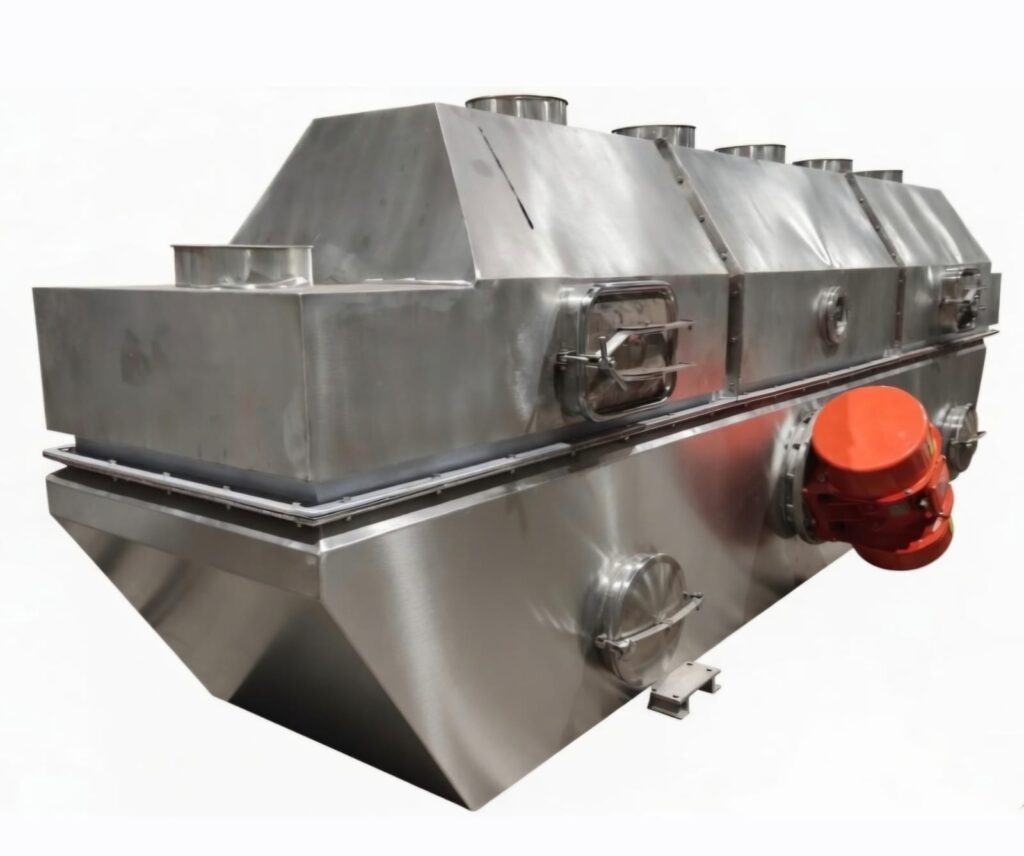
Wet Granules / Crystals → Dry Granules
Spray Fluidizer
Can start with a liquid feed:
Solution / Suspension / Slurry → Granulated Product
This distinction is extremely important when selecting equipment.
If your material is already a free-flowing wet particulate, a fluid bed dryer may be the more appropriate starting point.
If your feed is a liquid and your target is a controlled granule, spray granulation may deserve evaluation.
Spray Fluidizer vs Conventional Spray Dryer
Choose a conventional spray dryer when:
- Fine powder is acceptable
- High-volume liquid-to-powder conversion is required
- Particle size requirements can be achieved by spray drying
- A separate granulation step is unnecessary
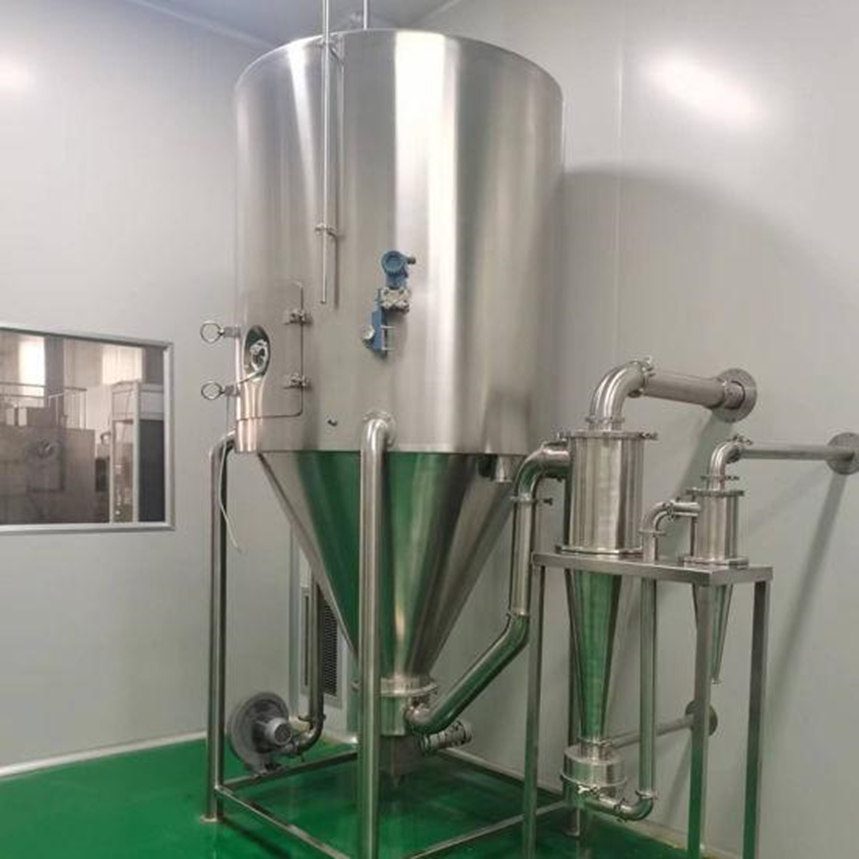
Consider a spray-fluidizer configuration when:
- Granules are preferred over fine powder
- Higher density is required
- Dust reduction is important
- Controlled particle growth is required
- Liquid feed needs to become a granular product
- Downstream handling requires improved flowability
Modern multi-stage spray systems can also combine spray drying and fluid-bed drying in one process, with separate stages for drying, agglomeration and cooling depending on the product requirements.
When Spray Fluidizer May NOT Be the Right Choice
A credible dryer manufacturer should also explain when not to use the technology.
Spray granulation may not be the best option when:
- The product must remain as an extremely fine powder
- The feed cannot be reliably atomized
- The desired product is already a dry free-flowing particulate
- Granulation is unnecessary
- The formulation cannot tolerate the required thermal exposure
- Product growth characteristics are unsuitable
- The required particle properties are better achieved by another granulation technology
Depending on the application, alternatives may include:
- Conventional Spray Dryer
- Fluid Bed Dryer
- Fluid Bed Granulator
- High-Shear Granulator + Fluid Bed Dryer
- Flash Dryer
- Ring Dryer
- Rotary Dryer
- Vacuum Dryer
- Other customized drying systems
The correct choice should come from the feed-to-product transformation required.
Common Spray Granulation Problems and Solutions
Problem: Excessive Fines
Possible causes:
- Excessive atomization
- Incorrect spray rate
- Poor recycle control
- Insufficient particle growth
- Inappropriate fluidization
Possible solutions:
- Optimize droplet size
- Adjust spray rate
- Modify recycle ratio
- Review bed conditions
- Reassess formulation
Problem: Oversized Granules
Possible causes:
- Excessive wetting
- Agglomeration beyond the target
- Inadequate classification
- Incorrect spray distribution
Possible solutions:
- Optimize spray rate
- Improve distribution
- Adjust fluidization
- Review recycle/classification
Problem: Granules Are Too Weak
Possible causes:
- Insufficient drying
- Inadequate particle growth
- Poor binder/formulation characteristics
- Excessive mechanical stress
Possible solutions:
- Review moisture profile
- Adjust drying conditions
- Evaluate formulation
- Optimize residence time
Problem: Product Sticking
Possible causes:
- Product passing through a sticky moisture range
- Excessive feed temperature
- Incorrect spray location
- Insufficient drying gas conditions
- Product-specific stickiness
Possible solutions:
- Review feed concentration
- Optimize atomization
- Adjust drying conditions
- Modify spray position
- Consider surface/material selection
How GTI Dryers Approaches Spray Granulation Projects
A spray granulation system should not be selected only from catalogue capacity.
At GTI Dryers, the engineering approach should begin with the material and final product requirement.
The project evaluation can consider:
Feed Information
- Feed type
- Feed rate
- Solids concentration
- Initial moisture
- Temperature
- Viscosity
- Density
- Particle characteristics
- pH
- Corrosiveness
- Solvent composition
Final Product Requirement
- Final moisture
- Particle-size range
- Bulk density
- Flowability
- Granule strength
- Solubility/dispersibility
- Product temperature
- Dust specification
Plant Conditions
- Available heat source
- Electrical supply
- Available floor height
- Installation space
- Utility availability
- Exhaust requirements
- Environmental controls
- Automation requirements
This information allows the drying and granulation process to be engineered around the actual application.
Pilot Testing: Why It Matters
Spray granulation is highly product-specific.
Two liquids with the same moisture content may behave completely differently during atomization and granule growth.
Pilot or laboratory trials can help determine:
- Atomization behaviour
- Drying kinetics
- Particle growth
- Granule density
- Final moisture
- Particle-size distribution
- Product temperature
- Stickiness
- Recycle requirements
- Energy demand
For high-value pharmaceutical, specialty chemical and food applications, process trials can significantly reduce scale-up uncertainty.
What Information Should You Send a Spray Granulation Dryer Manufacturer?
For a technically meaningful quotation, provide as much of the following as possible:
- Product name
- Feed type
- Feed flow rate
- Initial moisture or solids %
- Desired final moisture
- Feed temperature
- Feed viscosity
- Desired granule size
- Desired bulk density
- Required production capacity
- Operating hours per day
- Available heat source
- Product sensitivity
- Solvent/water composition
- Material compatibility requirements
- Dust/explosion safety requirements
- Pharmaceutical/GMP requirements, if applicable
- Installation location
- Space restrictions
- Existing upstream/downstream equipment
The more complete the process data, the more meaningful the equipment recommendation.
Spray Fluidizer for Global Industrial Applications
Spray granulation is relevant across multiple industrial markets where manufacturers need controlled transformation of liquid feeds into dry particulate products.
GTI Dryers can evaluate requirements for industries including:
- India
- Southeast Asia
- Middle East
- Africa
- Europe
- North America
- South America
- Other international markets
The engineering principle remains the same:
Understand the feed → Define the final product → Select the process → Validate the process → Engineer the equipment → Integrate the complete system
Recommended Internal Linking for GTI Dryers
This article should become a central page in the spray drying + fluid-bed + granulation cluster.
Add contextual internal links to:
1. Spray Dryer
Anchor examples:
- Industrial Spray Dryer
- Spray Dryer Manufacturer India
- Customized Spray Drying System
2. Fluid Bed Dryer
Anchor examples:
- Fluid Bed Dryer
- Industrial Fluidized Bed Dryer
- Fluid Bed Drying System
3. Vibratory Fluidized Bed Dryer
Anchor examples:
- Vibratory Fluidized Bed Dryer
- VFBD Manufacturer India
- Continuous Fluid Bed Dryer
4. Fertilizer Dryer
Anchor examples:
- Fertilizer Drying System
- Fertilizer Dryer Manufacturer
- Industrial Fertilizer Dryer
5. Chemical Dryer
Anchor examples:
- Chemical Dryer
- Industrial Chemical Drying System
- Chemical Powder Dryer
This creates a logical topical cluster instead of isolated SEO pages.
Google also recommends descriptive, relevant anchor text because links help both users and search engines understand the destination page.
Why Choose GTI Dryers for Spray Granulation Projects?
GTI Dryers approaches industrial drying as a process-engineering requirement rather than a one-size-fits-all equipment purchase.
The objective is to develop a system around:
- Feed characteristics
- Product requirements
- Drying kinetics
- Granulation behaviour
- Capacity
- Energy requirements
- Material compatibility
- Automation
- Safety
- Downstream handling
Depending on the project, the solution can be evaluated as a standalone dryer, integrated spray-fluidized system or part of a larger process line.
Engineered in India. Designed for industrial applications worldwide.
Frequently Asked Questions
What is a Spray Fluidizer?
A Spray Fluidizer combines liquid atomization with fluidized-bed processing to dry and grow particles into controlled granules.
What is a Spray Granulation Dryer?
A Spray Granulation Dryer is a drying system designed to convert suitable liquid feeds such as solutions or suspensions into dry granulated products through spray drying and controlled particle growth.
What is the difference between a spray dryer and spray granulator?
A conventional spray dryer primarily converts liquid into powder. A spray granulation system additionally focuses on particle growth, agglomeration, density and granule-size control.
Can a Spray Fluidizer process slurry?
Suitable slurries can be processed, provided their viscosity, solids content, particle characteristics and atomization behaviour are compatible with the selected process.
Can Spray Fluidizers be used for fertilizers?
Yes, suitable fertilizer solutions or suspensions can be evaluated for spray granulation when the required product is a controlled granular material.
Can Spray Granulation be used for chemicals?
Yes. Chemical applications can include suitable salts, specialty chemicals, intermediates and other formulations where controlled granule properties are required.
Is Spray Granulation suitable for pharmaceuticals?
It can be suitable for selected pharmaceutical formulations, subject to formulation behaviour, containment, GMP, cleaning and regulatory requirements.
Can spray granulation reduce dust?
Granulation can produce larger, more easily handled particles and may reduce dust compared with very fine powders. The actual result depends on the formulation and process design.
Can Spray Fluidizers produce high-density granules?
They can be engineered toward higher-density granules, but the achievable density depends on feed solids, atomization, particle-growth mechanism, drying conditions and formulation.
Should I choose a Spray Dryer or Spray Fluidizer?
Choose according to the desired final product. If the target is primarily fine powder, a conventional spray dryer may be suitable. If the target is controlled granules with specific density, flowability or particle size, spray granulation should be evaluated.
Get a Spray Granulation Dryer Designed Around Your Product
If you are converting a solution, suspension, slurry or suitable liquid feed into a controlled granular product, the right drying technology depends on much more than evaporation capacity.
Share your:
Feed → Solids % → Feed rate → Final moisture → Desired granule size → Bulk density → Heat source → Application
with GTI Dryers.
Our process-engineering team can evaluate whether a Spray Fluidizer, Spray Granulation Dryer, Spray Dryer, Fluid Bed Dryer or another drying technology is the right fit for your application.
GTI Dryers — Engineered Drying & Particle Processing Solutions from India for Global Industries.