Spray Dryer France: Where Dairy, Pharmaceuticals, Cosmetics & Specialty Ingredients Meet Advanced Drying Technology
France has a highly developed dairy, food, pharmaceutical, cosmetics and specialty-ingredient manufacturing sector, creating strong demand for advanced powder-processing technologies.
Among these technologies, spray drying plays an important role wherever manufacturers need to transform liquids, emulsions, extracts or slurries into stable powders with controlled moisture, particle size, density and flowability.
For French manufacturers, the requirement is not simply to remove water. A modern industrial spray dryer in France must balance:
Product quality + energy efficiency + hygienic design + powder recovery + particle engineering + process control
This is particularly important for applications involving whey, milk powder, dairy ingredients, flavors, cosmetic ingredients, pharmaceutical formulations and specialty chemicals.
Why the French Market Is Important for Spray Drying
The French market presents several high-value applications for spray drying.
Dairy & Milk Powder
France has a significant dairy-processing industry, making milk powder, whey powder and other dairy ingredients important spray-drying applications.
Industrial spray dryers can process suitable liquid dairy streams into powders with controlled:
- Moisture
- Particle size
- Bulk density
- Solubility
- Flowability
- Powder recovery
For dairy manufacturers, the objective is to achieve consistent powder quality while maintaining efficient thermal performance.
High-intent searches:
spray dryer France, dairy spray dryer France, milk powder spray dryer France, whey spray dryer France.
Whey & Dairy Ingredient Spray Drying
Whey processing is a particularly relevant application for French dairy processors.
Suitable whey streams can be concentrated and spray dried to produce powders used in:
- Food ingredients
- Sports nutrition
- Bakery products
- Dairy formulations
- Nutritional products
- Beverage formulations
The dryer configuration should be selected according to feed solids, concentration, heat sensitivity, required powder moisture and final particle characteristics.
A properly designed system can integrate spray drying with secondary drying or fluid-bed conditioning where required.
Pharmaceutical Spray Dryers in France
France has an established pharmaceutical and life-sciences ecosystem, creating demand for high-control drying systems.
Spray drying can be evaluated for suitable:
- Pharmaceutical intermediates
- APIs and formulations
- Excipients
- Nutraceutical ingredients
- Enzymes
- Biological materials
- Specialty pharmaceutical powders
For pharmaceutical applications, equipment selection needs to consider:
Hygienic construction → Containment → Temperature control → Powder recovery → Automation → Cleaning requirements
Depending on the application, the system may require specialized filtration, containment and controlled processing conditions.
For manufacturers searching for a pharmaceutical spray dryer France, process validation and product testing should form part of the equipment-selection process.
Cosmetics & Flavor Encapsulation: A High-Value Application
France’s global reputation in cosmetics, fragrances, perfumes and specialty ingredients creates another important opportunity for spray drying.
Spray drying can be used for suitable formulations involving:
- Flavors
- Fragrance ingredients
- Essential oils
- Cosmetic actives
- Botanical extracts
- Functional ingredients
- Encapsulated ingredients
Why spray drying?
Encapsulation can help transform selected liquid ingredients into easier-to-handle powders while protecting sensitive components from environmental exposure.
For these applications, controlling droplet size, inlet/outlet temperature, feed composition and powder morphology becomes particularly important.
This makes flavor encapsulation spray dryer France and cosmetic spray drying equipment France valuable long-tail search opportunities.
Spray Dryers for Specialty Chemicals
French chemical manufacturers also require drying technologies for suitable liquid and slurry-based products.
Potential applications include:
- Specialty chemicals
- Pigments
- Ceramic slurries
- Detergent ingredients
- Catalysts
- Functional additives
- Chemical intermediates
The correct spray dryer depends on feed rheology, solids content, thermal sensitivity, particle-size requirements and desired final moisture.
For hazardous or solvent-based products, specialized configurations such as closed-loop spray drying may be evaluated where appropriate.
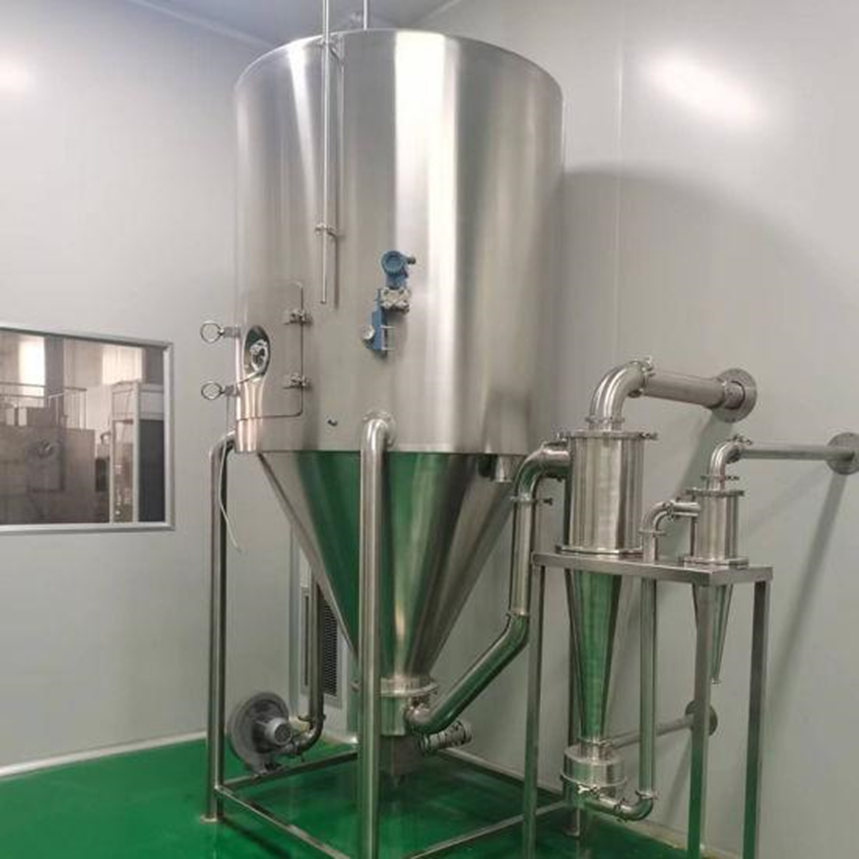
How Does an Industrial Spray Dryer Work?
A simplified spray-drying process is:
Liquid / Slurry Feed
↓
Atomization
↓
Hot-Air Contact
↓
Rapid Moisture Evaporation
↓
Powder Separation
↓
Cyclone / Filter Recovery
↓
Final Powder
The liquid feed is atomized into small droplets. The large surface area of these droplets allows rapid moisture evaporation when they contact the heated drying air.
The final powder characteristics are influenced by:
- Feed concentration
- Feed temperature
- Viscosity
- Atomization method
- Droplet size
- Inlet temperature
- Outlet temperature
- Airflow
- Residence time
- Product properties
Therefore, spray dryer design should be based on the material and required powder characteristics rather than capacity alone.
Which Spray Dryer Is Right for French Industries?
Different French industries require different drying configurations.
Dairy & Whey
Focus on:
High evaporation capacity + hygienic construction + powder recovery + moisture control
Pharmaceuticals
Focus on:
Containment + controlled temperature + hygiene + automation + reproducibility
Cosmetics & Flavors
Focus on:
Gentle drying + encapsulation performance + particle characteristics + active retention
Specialty Chemicals
Focus on:
Feed chemistry + particle size + thermal stability + material compatibility
Food Ingredients
Focus on:
Solubility + bulk density + flowability + hygroscopicity + moisture control
Spray Dryer Energy Efficiency in France
Energy efficiency is increasingly important when evaluating industrial drying equipment.
A spray dryer should therefore be engineered around the complete thermal system rather than simply maximizing heater capacity.
Potential energy-saving strategies include:
Heat Recovery
Recovering usable thermal energy from exhaust air where technically feasible.
Optimized Airflow
Matching airflow to the actual evaporation requirement.
Efficient Atomization
Producing an appropriate droplet size to achieve efficient moisture removal.
Multi-Stage Drying
Combining spray drying with secondary drying or fluid-bed conditioning when appropriate.
Thermal Insulation
Reducing heat loss from the drying chamber, ducts and heated surfaces.
VFD-Based Control
Optimizing fan and pump operation according to actual production conditions.
The actual energy performance must be established through material-specific drying calculations and process conditions.
How Much Does a Spray Dryer Cost in France?
There is no reliable single price for an industrial spray dryer in France.
The investment depends on:
- Feed capacity
- Water evaporation rate
- Product characteristics
- Dryer configuration
- Atomizer
- Drying chamber dimensions
- Material of construction
- Powder recovery system
- Air filtration
- Heating system
- Automation
- CIP requirements
- Installation
- Open or closed-loop operation
Therefore, French buyers should compare total process cost and lifecycle performance, not simply the initial equipment price.
A technically suitable dryer can provide better long-term economics through improved powder recovery, energy efficiency and production consistency.
How to Calculate Spray Dryer Capacity
A preliminary drying calculation can be structured as:
Feed Rate → Feed Solids → Initial Moisture → Target Moisture → Water Evaporation → Heat Duty → Airflow → Dryer Capacity
Important inputs include:
- Feed flow rate
- Feed solids
- Initial moisture
- Final moisture
- Inlet air temperature
- Outlet air temperature
- Ambient conditions
- Specific heat
- Heat losses
- Production hours
For complex materials, pilot spray drying can help validate the expected process performance before commercial-scale equipment is finalized.
Spray Dryer vs Other Industrial Dryers
Spray drying is particularly suitable when the feed is a liquid, emulsion, solution or pumpable slurry and the desired product is a powder.
| Dryer | Typical Feed | Common Application |
| Spray Dryer | Liquid/slurry | Dairy, food, pharma, chemicals |
| Fluid Bed Dryer | Granules/powders | Granules, crystals, pharmaceuticals |
| Rotary Dryer | Bulk solids | Minerals, biomass, fertilizers |
| Band Dryer | Wet solids | Food, herbs, biomass |
| Flash Dryer | Dispersible wet solids | Chemicals, starches |
| Refractance Window Dryer | Liquid/puree | Fruit, botanical and heat-sensitive products |
This comparison can help French buyers identify whether spray drying is actually the appropriate technology for their material.
Key French Industrial Regions to Target
Paris / Île-de-France
Relevant for:
- Pharmaceuticals
- Cosmetics
- Specialty chemicals
- Food ingredients
- R&D and engineering organizations
Lyon
Strong potential across:
- Pharmaceuticals
- Chemicals
- Biotechnology
- Food processing
Toulouse
Relevant to:
- Biotechnology
- Pharmaceuticals
- Advanced manufacturing
- Specialty materials
Lille & Northern France
Potential applications include:
- Food processing
- Dairy
- Chemicals
- Industrial manufacturing
Brittany & Normandy
Particularly relevant to:
- Dairy processing
- Food ingredients
- Agricultural processing
Rhône-Alpes / Auvergne-Rhône-Alpes
Potential demand from:
- Pharmaceuticals
- Chemicals
- Food ingredients
- Specialty manufacturing
search examples:
- spray dryer manufacturer France
- spray dryer supplier Lyon
- industrial spray dryer Paris
- dairy spray dryer France
- whey spray dryer France
- pharmaceutical spray dryer Lyon
- cosmetic spray drying equipment France
- spray drying equipment manufacturer Europe
Why GTI Dryers for Spray Drying Projects in France?
For an international market such as France, the buying decision should be based on engineering capability, process validation and lifecycle economics.
GTI Dryers can approach spray-drying projects through:
Material Evaluation
Understanding:
Feed properties → Solids → Moisture → Viscosity → Thermal sensitivity → Target powder
Drying Calculations
Evaluating:
Water evaporation → Heat requirement → Airflow → Dryer capacity → Energy requirement
Pilot Testing
Testing the actual material to assess:
- Drying behavior
- Powder moisture
- Particle characteristics
- Recovery
- Product quality
- Energy requirements
Customized Engineering
The system can be developed around:
- Production capacity
- Product specifications
- Available utilities
- Heating source
- Automation
- Hygienic requirements
- Plant conditions
FAQ: Spray Dryer France
What is a spray dryer used for in France?
Spray dryers are used for suitable dairy products, whey, food ingredients, pharmaceutical materials, cosmetic ingredients, flavors, specialty chemicals and other liquid-to-powder applications.
What is the best spray dryer for whey powder?
The appropriate system depends on whey solids, feed concentration, required powder moisture, production capacity and powder characteristics. A two-stage or multi-stage configuration may be considered where secondary drying or powder conditioning is beneficial.
Can spray dryers be used for cosmetic ingredients?
Yes, suitable cosmetic ingredients, botanical extracts, flavors and fragrance-related formulations can be spray dried or encapsulated, depending on their formulation and thermal properties.
How much does an industrial spray dryer cost in France?
Cost depends on evaporation capacity, feed properties, construction materials, atomization, powder recovery, heating system, automation and other process requirements. A technical quotation should therefore be based on the actual material and production requirement.
How can I select a spray dryer supplier in France?
Prioritize a supplier capable of providing material testing, drying calculations, customized engineering, powder recovery design, energy analysis and technical support, rather than comparing equipment only on purchase price.
The Opportunity for Spray Dryer Technology in France
France’s combination of dairy production, whey processing, pharmaceuticals, cosmetics, flavor technology and specialty chemicals creates several high-value applications for industrial spray drying.
The strongest opportunities are not limited to large-volume powder production. Specialized applications such as flavor encapsulation, cosmetic ingredients, pharmaceutical formulations and high-value functional powders can require considerably more sophisticated drying control.
For French manufacturers, the ideal spray drying project should therefore connect:
Product Requirements + Process Engineering + Energy Efficiency + Powder Quality + Scale-Up Validation
Looking for a Spray Dryer in France?
Whether your French plant is processing milk, whey, dairy ingredients, pharmaceutical formulations, flavors, cosmetic ingredients, botanical extracts or specialty chemical slurries, GTI Dryers can evaluate the material and develop a suitable spray-drying approach.
Send your feed rate, solids/moisture content, target powder moisture and required production capacity to GTI Dryers for a preliminary drying calculation and pilot-testing discussion.
Request a Spray Dryer Calculation for Your French Plant → Talk to GTI Dryers
Recommended internal links for the GTI page:
Spray Dryer → Fluid Bed Dryer → Refractance Window Dryer → Pharmaceutical Dryers → Food Dryers → Dairy Dryers → Pilot Testing → Drying Calculation → Contact GTI Dryers.