Spray Dryer Brazil: Why Demand Is Growing Across Food, Coffee, Dairy & Chemical Processing
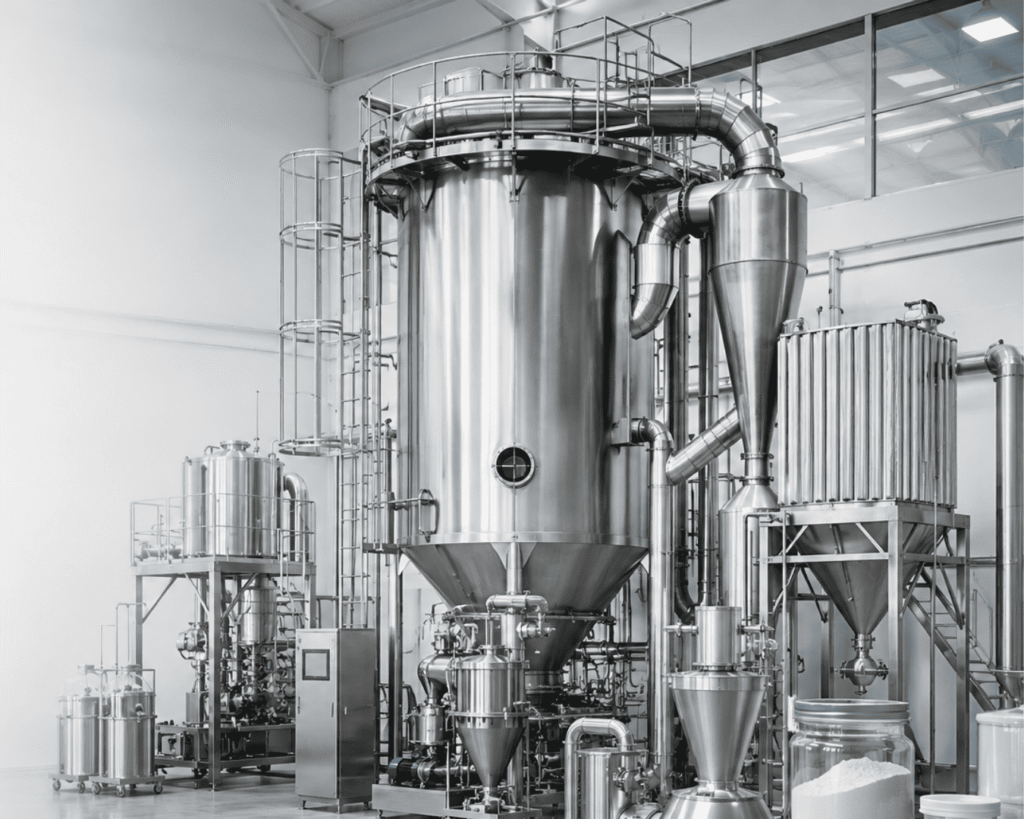
Brazil is one of the world’s major agricultural and food-processing economies, creating strong opportunities for technologies that convert liquid and slurry feedstocks into stable, transportable powders.
The spray dryer market in Brazil is particularly relevant to food processing, dairy, instant coffee, beverages, pharmaceuticals, biotechnology, specialty chemicals and agrochemical formulations. Current market research identifies food and dairy processing as a major demand segment, while Brazilian applications also extend into coffee, pharmaceutical products, chemicals and other specialized powders.
For manufacturers, the objective is no longer simply to “dry a liquid.” A modern industrial spray dryer in Brazil must deliver:
Consistent powder quality → Controlled moisture → Desired particle size → Good flowability → Efficient energy use → Reliable continuous production
This makes spray dryer selection an important process-engineering decision.
Why Brazil Is an Attractive Market for Industrial Spray Dryers
Brazil combines a huge agricultural base with sophisticated food, beverage, chemical and pharmaceutical manufacturing.
Several applications create particularly strong opportunities for spray drying:
Instant Coffee & Coffee Extracts
Brazil’s enormous coffee industry creates a natural market for advanced powder-processing technologies.
In soluble coffee production, coffee extract can be atomized into a drying chamber where hot air rapidly removes moisture and produces dry coffee particles. Brazilian coffee processors already use spray drying for soluble coffee production.
A properly engineered spray dryer for coffee in Brazil can help manufacturers control:
- Moisture content
- Particle size
- Bulk density
- Solubility
- Powder flowability
- Aroma and flavor retention
- Product consistency
This makes spray dryer coffee Brazil an important commercial search and application opportunity.
Dairy & Milk Powder Processing
Brazil’s dairy-processing sector is another important application area.
Spray drying is widely used to transform liquid dairy streams into powders such as:
- Skim milk powder
- Whole milk powder
- Whey powder
- Dairy ingredients
- Protein ingredients
- Nutritional formulations
The broader spray-drying equipment market is strongly supported by demand for milk powders, nutritional ingredients and other powdered food products.
For Brazilian dairy processors, the dryer must be designed around feed concentration, heat sensitivity, desired powder characteristics and production capacity rather than simply selecting a dryer by nominal evaporation rate.
Spray Dryers for Brazilian Food & Beverage Manufacturers
Brazil’s food industry creates opportunities beyond coffee and dairy.
Potential spray-drying applications include:
- Fruit juice powders
- Fruit extracts
- Beverage powders
- Cocoa-based formulations
- Plant-based ingredients
- Flavor powders
- Nutritional ingredients
- Functional food ingredients
- Food additives
- Instant beverage formulations
Brazilian research has also demonstrated spray drying for products such as cupuassu-based beverage powders, showing the technology’s relevance to tropical fruit and regional ingredient processing.
For food manufacturers, the advantage is the conversion of a liquid or slurry into a more stable, easier-to-store and easier-to-transport powder.
Pharmaceutical & Biotechnology Spray Dryers in Brazil
The pharmaceutical and biotechnology sectors represent another high-value application for spray drying.
Depending on the formulation and process requirements, spray drying can be used for:
- Pharmaceutical intermediates
- Enzymes
- Nutraceutical ingredients
- Biological materials
- Specialty formulations
- Functional ingredients
- Controlled-release formulations
Brazil’s spray-drying demand also includes pharmaceutical and biotechnology applications, particularly where controlled powder characteristics and processing of sensitive materials are important.
For these applications, equipment design may require greater emphasis on:
Hygienic construction → Controlled temperature → Containment → CIP considerations → Filtration → Automation → Reproducible powder quality
The exact configuration should be determined from the product and regulatory requirements.
Agrochemical & Specialty Chemical Spray Drying
Brazil’s large agricultural economy also creates opportunities for agrochemical formulation and specialty chemical powder production.
Spray drying may be considered for suitable liquid formulations, suspensions and chemical slurries where the required product is a controlled dry powder.
Potential applications include:
- Agrochemical formulations
- Specialty chemicals
- Pigments
- Detergent powders
- Catalysts
- Chemical intermediates
- Ceramic materials
- Functional additives
The spray dryer configuration can be customized around feed properties, particle-size requirements, solvent characteristics and thermal sensitivity.
For hazardous or solvent-containing materials, specialized closed-loop spray drying systems may be evaluated. Closed-cycle systems are increasingly relevant for pharmaceutical and specialty chemical applications where inert-gas operation and solvent recovery are required.
How an Industrial Spray Dryer Works
The basic spray drying process can be summarized as:
Liquid Feed
↓
Atomization
↓
Hot Air Contact
↓
Rapid Moisture Evaporation
↓
Powder Separation
↓
Collection & Packaging
The feed is atomized into small droplets. Because the droplets have a high surface-area-to-volume ratio, moisture can evaporate rapidly when they contact the drying air.
The final powder characteristics depend on several interconnected parameters:
- Feed concentration
- Feed viscosity
- Atomizer type
- Droplet size
- Inlet temperature
- Outlet temperature
- Airflow
- Residence time
- Product properties
- Drying chamber design
Brazilian technical literature similarly identifies atomization, hot-air contact, evaporation and powder separation as fundamental stages of spray drying.
Choosing the Right Spray Dryer for Brazil
There is no single spray dryer configuration suitable for every Brazilian application.
For Instant Coffee
Prioritize:
Particle characteristics + solubility + aroma/flavor preservation + moisture control
For Dairy Powder
Focus on:
Evaporation capacity + hygienic design + powder recovery + particle size + energy efficiency
For Pharmaceuticals
Evaluate:
Containment + temperature control + hygiene + automation + product recovery
For Agrochemicals
Consider:
Feed chemistry + particle size + containment + thermal stability + solvent characteristics
For Specialty Food Ingredients
Consider:
Powder morphology + hygroscopicity + solubility + bulk density + thermal sensitivity
This is why pilot testing and drying calculations are valuable before final equipment selection.
Spray Dryer Technology Options for Brazilian Industries
Depending on the application, GTI Dryers can evaluate different configurations, including:
Single-Stage Spray Dryer
Suitable for applications requiring straightforward liquid-to-powder conversion.
Two-Stage Spray Dryer
Combines spray drying with secondary fluidized-bed drying or conditioning to improve powder properties and energy utilization.
Multi-Stage Spray Drying
Useful where tighter control over powder moisture, particle characteristics and energy efficiency is required.
Open-Cycle Spray Dryer
Commonly considered for water-based food and industrial applications.
Closed-Loop Spray Dryer
Can be evaluated for suitable solvent-based, flammable or sensitive materials where inert-gas operation and solvent recovery are important.
Brazil’s Key Industrial Regions for Spray Dryer Demand
São Paulo
Important for:
- Pharmaceuticals
- Food processing
- Chemicals
- Specialty ingredients
- Beverage manufacturing
Search intent: spray dryer manufacturer São Paulo, industrial spray dryer São Paulo, spray drying equipment Brazil
Minas Gerais
Particularly relevant to:
- Coffee
- Dairy
- Food ingredients
- Mining-related processing
- Specialty manufacturing
Search intent: spray dryer Minas Gerais, coffee spray dryer Brazil, industrial drying equipment Minas Gerais
Paraná
Strong opportunities across:
- Dairy
- Food processing
- Agriculture
- Animal nutrition
- Agro-industrial processing
Santa Catarina
Relevant to:
- Dairy
- Food processing
- Meat and food ingredients
- Specialty manufacturing
Rio Grande do Sul
Important for:
- Dairy
- Food ingredients
- Agricultural processing
- Chemical manufacturing
Espírito Santo
Particularly relevant to Brazil’s coffee-processing ecosystem.
These regional terms can help GTI Dryers capture location-specific B2B search intent rather than competing only for the extremely broad keyword “spray dryer Brazil.”
Why Brazilian Manufacturers Need Energy-Efficient Spray Dryers
Spray drying is a thermal process, making energy consumption an important part of total operating cost.
A modern system should therefore consider:
Heat Recovery
Recovering usable heat from exhaust air where technically feasible.
Optimized Airflow
Matching air volume and velocity to the drying requirement.
Efficient Atomization
Producing the appropriate droplet size for the desired drying profile.
Insulated Drying Equipment
Reducing unnecessary heat losses.
VFD-Based Control
Controlling fans, pumps and other equipment according to actual operating requirements.
Automated Temperature Control
Maintaining stable inlet and outlet conditions to improve product consistency.
The goal is not simply to install a larger heater—it is to optimize the complete heat and mass-transfer system.
How Much Does a Spray Dryer Cost in Brazil?
The cost of an industrial spray dryer in Brazil cannot be accurately determined from the dryer name alone.
The investment depends on:
- Feed rate
- Water evaporation capacity
- Product type
- Initial and final moisture
- Atomizer type
- Drying chamber size
- Material of construction
- Automation level
- Powder recovery system
- Air filtration
- Heating system
- CIP requirements
- Open or closed-loop configuration
- Installation and auxiliary equipment
For this reason, buyers should request a process-based quotation rather than comparing equipment only by headline price.
A lower initial purchase price does not necessarily mean a lower total cost of ownership.
How to Calculate Spray Dryer Capacity
A preliminary capacity calculation begins with the moisture balance.
For example:
Feed Rate → Initial Moisture → Final Moisture → Water Evaporation → Thermal Duty → Required Dryer Capacity
The engineering team should evaluate:
- Feed flow rate
- Feed solids percentage
- Target powder moisture
- Water evaporation rate
- Inlet air temperature
- Outlet air temperature
- Specific heat
- Ambient conditions
- Heat losses
- Required production hours
Pilot testing can then be used to validate the process before scaling to commercial production.
Spray Dryer Energy Consumption: How to Reduce Operating Costs
For Brazilian plants, energy efficiency should be considered during the initial equipment design—not after installation.
Potential strategies include:
- Heat recovery
- Optimized inlet/outlet temperatures
- Efficient atomization
- Proper insulation
- VFD-controlled fans
- Optimized airflow
- Multi-stage drying
- Efficient heat-source selection
- Automated process control
The actual savings depend heavily on feed properties, operating conditions and system configuration, so site-specific engineering calculations are essential.
Why GTI Dryers for the Brazilian Market?
GTI Dryers can approach Brazilian spray-drying projects as process-engineering projects rather than simple equipment sales.
Our approach can include:
1. Material Evaluation
Understanding the liquid feed, solids concentration, viscosity, thermal sensitivity and target powder characteristics.
2. Drying Calculations
Estimating:
Feed Rate → Water Evaporation → Heat Duty → Airflow → Dryer Size → Energy Requirement
3. Pilot Testing
Testing the actual material can help evaluate:
- Drying behavior
- Powder recovery
- Moisture
- Particle characteristics
- Product quality
- Energy requirements
4. Customized Engineering
The final configuration can be developed around the Brazilian plant’s:
- Production capacity
- Available utilities
- Heat source
- Product requirements
- Automation requirements
- Installation conditions
5. International Project Support
For Brazilian buyers evaluating imported industrial drying equipment, clear technical documentation, engineering communication, logistics planning and commissioning support are important parts of the purchasing decision.
FAQ: Spray Dryer Brazil
What is a spray dryer used for in Brazil?
Spray dryers can be used for instant coffee, dairy powders, beverages, food ingredients, pharmaceuticals, biotechnology products, specialty chemicals and agrochemical formulations, depending on the feed and process requirements.
What is the best spray dryer for instant coffee in Brazil?
The appropriate system depends on coffee extract concentration, required powder properties, production capacity, aroma requirements and desired particle characteristics. Brazilian soluble-coffee production already uses spray drying technology.
Can a spray dryer produce fruit powder?
Yes. Suitable fruit juices, pulps and extracts can be spray dried when the formulation and feed properties are appropriate. Brazilian research has demonstrated spray drying of fruit-based products, including cupuassu formulations.
Is spray drying suitable for pharmaceuticals?
Spray drying can be used for suitable pharmaceutical and biotechnology formulations, but equipment configuration must be determined according to the specific product, containment, hygiene, thermal and regulatory requirements.
How do I select a spray dryer supplier in Brazil?
Look for a supplier that can provide material testing, drying calculations, customized engineering, powder recovery, energy analysis, automation and technical support, rather than selecting equipment only on price.
Final Takeaway: Brazil Is a High-Potential Market for Spray Drying Technology
Brazil’s combination of coffee production, dairy processing, food manufacturing, agricultural value addition, pharmaceuticals, specialty chemicals and agrochemical formulation creates multiple industrial applications for spray drying.
For manufacturers, the opportunity is particularly strong where liquid raw materials need to become stable, transportable, free-flowing powders with controlled moisture and particle characteristics.
The right spray dryer should therefore be selected through:
Material Characterization + Drying Calculations + Pilot Testing + Energy Analysis + Customized Engineering
GTI Dryers aims to support Brazilian manufacturers looking for reliable industrial spray drying equipment in Brazil, from initial process evaluation through customized system engineering.
Looking for a Spray Dryer in Brazil?
Whether you are processing coffee extract, milk, whey, fruit pulp, beverage concentrate, pharmaceutical formulation, specialty chemical slurry or agrochemical feed, GTI Dryers can evaluate your material and recommend a suitable spray drying configuration.
Send your feed rate, initial moisture/solids, target powder moisture and required production capacity to GTI Dryers for a preliminary drying assessment and pilot-testing discussion.
Recommended CTA:
Get a Spray Dryer Calculation for Your Brazilian Plant → Request a Technical Consultation