Industrial Spice Drying Systems for Ginger, Turmeric, Onion & Garlic
Spices and dehydrated food ingredients are essential raw materials for the global food, beverage, nutraceutical, seasoning and ingredient industries. From ginger and turmeric to onion and garlic, commercial processors require reliable drying systems to reduce moisture, improve shelf life and prepare agricultural products for grinding, powdering, extraction, packaging and export.
However, industrial spice drying is not simply about removing water.
A commercial drying system must balance:
Moisture Removal + Product Quality + Color Retention + Aroma Preservation + Hygiene + Energy Efficiency + Throughput
This makes the selection of the right industrial spice drying system particularly important for processors handling large quantities of agricultural raw materials.
For continuous production, a Tray-Type Belt Dryer can provide controlled residence time, multiple drying zones and adjustable temperature and airflow conditions, making it suitable for a wide range of sliced, chopped, grated or pre-processed spice and vegetable materials.
Why Industrial Spice Drying Is Becoming More Important
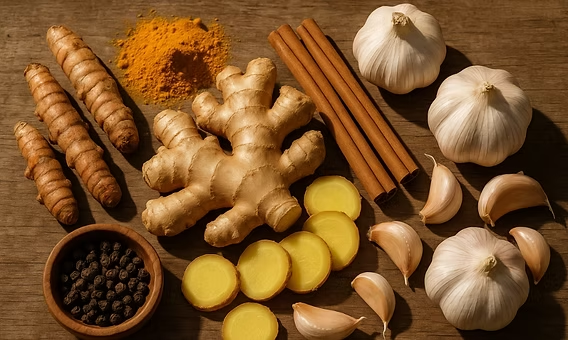
Fresh ginger, turmeric, onion and garlic contain significant amounts of moisture. Without appropriate dehydration, these materials can deteriorate quickly during storage and transportation.
Industrial drying helps processors:
- Reduce moisture content
- Increase shelf life
- Reduce transportation weight
- Improve storage stability
- Prepare products for grinding
- Produce consistent dried ingredients
- Reduce microbial and spoilage risks when appropriately controlled
- Support year-round processing
- Create higher-value powdered and processed products
The importance of modern spice processing is particularly visible in India.
According to the Spices Board of India, India exported 17.34 lakh tonnes of spices and spice products worth approximately US$4.43 billion during 2025–26. Major export destinations included the USA, China, UAE, Bangladesh, Saudi Arabia, the UK, Germany, Canada and Australia.
This creates significant opportunities for advanced spice dehydration and drying equipment.
Which Countries Have Strong Demand for Spice Drying Systems?
Spice drying is a global requirement, but certain countries are particularly important because of their large agricultural production, spice-processing industries and export-oriented food sectors.
Major Target Markets for Industrial Spice Dryers
| Region | Major Processing Opportunities |
| India | Ginger, turmeric, garlic, onion, chilli, cumin, coriander and spice powders |
| China | Ginger, garlic, chilli, onion and processed spice ingredients |
| Vietnam | Ginger, pepper, cinnamon, chilli and botanical ingredients |
| Indonesia | Ginger, turmeric, nutmeg, cloves and other tropical spices |
| Bangladesh | Ginger, turmeric, garlic, onion and processed food ingredients |
| Sri Lanka | Cinnamon, ginger, turmeric and botanical ingredients |
| Nigeria | Ginger, chilli, turmeric and agricultural ingredients |
| United States | Imported and domestically processed spice ingredients and powders |
| Europe | Clean-label spices, botanical ingredients, seasoning powders and food ingredients |
| Middle East | Dried onion, garlic, ginger, turmeric and spice blends |
India is particularly significant because of its combination of large domestic consumption, extensive spice cultivation, processing infrastructure and global exports. Government information describes India as the world’s largest producer, consumer and exporter of spices, with more than 225 spice products exported globally.
1. India: A Major Market for Industrial Spice Drying Equipment
India should be one of the highest-priority markets for an industrial spice dryer manufacturer.
The country’s spice-processing ecosystem includes farmers, aggregators, processors, exporters, seasoning manufacturers, oleoresin producers, food manufacturers and ingredient companies.
The Indian spice industry covers products including:
Ginger | Turmeric | Garlic | Onion | Chilli | Cumin | Coriander | Pepper | Cardamom | Fennel | Fenugreek
The Spices Board reported that turmeric contributed around 7% of India’s spice export basket by value during 2025–26, while ginger and pepper each contributed around 3%.
Key Indian Spice-Processing Regions
- Kerala – ginger, pepper and cardamom
- Meghalaya & Assam – ginger
- Madhya Pradesh – turmeric, garlic and chilli
- Rajasthan – cumin, coriander and other seed spices
- Gujarat – cumin, spices and food ingredients
- Andhra Pradesh – chilli and turmeric
- Telangana – turmeric and agricultural processing
- Karnataka – spices and dehydrated agricultural products
- Tamil Nadu – turmeric, chilli and food processing
- Maharashtra – onion and agricultural processing
- West Bengal – ginger, turmeric and food ingredients
The Government of India has also established crop-specific Spices Parks, including facilities associated with garlic and chilli in Chhindwara, coriander in Guna and Jodhpur, and cardamom and pepper in Puttady.
This creates a strong geographic opportunity for suppliers of industrial spice drying equipment.
Ginger Drying System
Ginger is one of the most important raw materials for dried spice, powder, extract and functional ingredient production.
Depending on the final product, fresh ginger can be processed into:
Fresh Ginger → Washing → Slicing → Drying → Grinding → Ginger Powder
or:
Fresh Ginger → Washing → Slicing → Drying → Further Processing / Extraction
Industrial ginger drying requires controlled conditions because excessive thermal exposure can negatively affect product characteristics.
A Tray-Type Belt Dryer can provide:
- Controlled drying temperature
- Adjustable residence time
- Multi-zone drying
- Continuous material movement
- Controlled airflow
- Uniform exposure
- Scalable production capacity
India is especially important for ginger processing. Recent research using FAOSTAT-based data identifies India as a leading global ginger producer, with China, Nepal, Indonesia and Thailand also among major producers.
Turmeric Drying System
Turmeric is another major opportunity for industrial dehydration systems.
Commercial turmeric processing may involve:
Fresh Turmeric → Cleaning → Boiling/Curing → Slicing → Drying → Polishing → Grinding → Turmeric Powder
Drying is an important stage because the product must reach a suitable moisture level before subsequent processing and storage.
An industrial turmeric dryer can be engineered around:
- Feed moisture
- Slice thickness
- Product loading
- Desired final moisture
- Drying temperature
- Residence time
- Airflow
- Production capacity
For export-oriented turmeric processors, maintaining consistent product quality is particularly important.
Onion Drying System
Onion dehydration is a major industrial food-processing application.
Dried onion can be produced in forms such as:
- Onion flakes
- Onion slices
- Onion granules
- Onion powder
- Dehydrated onion ingredients
A typical process can follow:
Fresh Onion → Sorting → Peeling → Washing → Slicing → Drying → Cooling → Grinding/Flaking → Packaging
For sliced onion, a continuous belt drying configuration can provide controlled residence time and airflow while allowing processors to scale production.
India’s large agricultural-processing base makes onion dehydration an important opportunity for industrial dryer manufacturers.
Garlic Drying System
Garlic is widely processed into:
- Garlic flakes
- Garlic slices
- Garlic granules
- Garlic powder
- Garlic-based seasoning ingredients
The drying process can be integrated as:
Fresh Garlic → Cleaning → Peeling → Slicing → Drying → Cooling → Grinding → Sieving → Packaging
The dryer must be selected according to the feed form and required final product.
For example, garlic slices and flakes require different handling characteristics from finely processed garlic particles.
A Tray-Type Belt Dryer can be engineered with suitable belt loading, airflow distribution and drying-zone control to achieve consistent moisture reduction.
Why Use a Tray-Type Belt Dryer for Spices?
For commercial spice processing, the objective is not merely maximum temperature.
The objective is controlled moisture removal without unnecessarily damaging product quality.
A Tray-Type Belt Dryer can be configured with multiple drying zones.
Typical Process Concept
Wet Spice Feed
↓
Feeding & Distribution
↓
Pre-Drying Zone
↓
Main Drying Zone
↓
Final Drying Zone
↓
Cooling / Conditioning
↓
Dried Spice
↓
Grinding / Flaking / Powdering
↓
Packaging
The exact process depends on the material, feed preparation and final product specification.
Key Advantages of a Continuous Tray-Type Belt Dryer
1. Continuous Processing
Unlike batch tray drying, continuous belt systems can support large-volume production.
2. Multi-Zone Temperature Control
Different drying stages can operate under different thermal conditions.
3. Adjustable Residence Time
Belt speed can be adjusted according to the required drying profile.
4. Controlled Airflow
Hot air can be distributed through different zones according to the material’s drying characteristics.
5. Better Production Scalability
The dryer can be engineered around the required feed rate and evaporation load.
6. Suitable for Different Feed Forms
Depending on the design, the system can handle:
- Slices
- Chopped material
- Flakes
- Granules
- Certain grated materials
- Other prepared agricultural products
How Does a Spice Dryer Improve Processing Economics?
For a spice processor, the value of an industrial dryer goes beyond the machine itself.
A properly engineered drying system can help improve:
Raw Material Utilization
↓
Moisture Control
↓
Shelf Stability
↓
Processing Consistency
↓
Grinding Performance
↓
Packaging Stability
↓
Export Readiness
The actual economics depend on feed moisture, final moisture, throughput, energy source, operating hours, product characteristics and local energy costs.
How to Select the Right Spice Drying System
There is no single dryer configuration that is automatically suitable for every spice.
Before selecting a machine, the processor should evaluate:
Feed Characteristics
- Initial moisture
- Particle/slice size
- Bulk density
- Stickiness
- Product temperature sensitivity
- Feed uniformity
Production Requirements
- kg/hour or tonnes/day
- Operating hours
- Continuous or batch production
- Seasonal or year-round operation
Final Product Requirements
- Final moisture
- Desired color
- Aroma requirements
- Powdering requirements
- Storage conditions
- Packaging requirements
Energy Availability
Possible heat sources can include:
- Steam
- Thermal oil
- Natural gas
- LPG
- Electricity
- Biomass
- Waste heat
The most suitable configuration should be determined through process calculations and, where necessary, product testing.
Energy Efficiency in Industrial Spice Drying
Because drying involves the evaporation of water, energy consumption is one of the most important factors in system design.
A modern industrial spice dryer can be evaluated for:
Optimized Airflow
Efficient airflow distribution helps deliver heat where it is required.
Multi-Zone Drying
Different temperature and airflow conditions can be used during different stages.
Heat Recovery
Where practical, exhaust heat can potentially be recovered for preheating.
Thermal Insulation
Proper insulation helps minimize heat losses.
VFD Control
Variable-frequency drives can help regulate fans, conveyors and feed systems.
Heat Source Optimization
The appropriate heating system can be selected according to local fuel availability and operating economics.
Food Hygiene & Quality Considerations for Spice Drying
Spices are food ingredients, so dryer design should consider hygienic operation and cleaning requirements.
Depending on the application, manufacturers may consider:
- Stainless-steel product-contact surfaces
- Suitable SS304/SS316 construction
- Accessible inspection areas
- Cleanable product-contact components
- Controlled airflow
- Dust management
- Appropriate filtration
- Temperature monitoring
- Moisture consistency
- Food-processing requirements
For export-oriented processors, equipment design should be aligned with the applicable food-safety and quality requirements of the target market.
The Spices Board emphasizes quality and hygiene as important elements of India’s spice-sector development and export strategy.
From Whole Spice to High-Value Ingredient: Where Drying Creates Value
Modern spice processing is increasingly moving beyond simply selling dried raw materials.
Drying can become part of a broader value-addition chain:
Fresh Ginger
→ Dried Ginger
→ Ginger Powder
→ Ginger Extract
→ Functional Ingredient
Similarly:
Fresh Turmeric
→ Dried Turmeric
→ Turmeric Powder
→ Curcumin Processing
And:
Fresh Onion / Garlic
→ Dehydrated Slices
→ Flakes
→ Granules
→ Powder
This creates opportunities for food ingredient manufacturers, seasoning companies, nutraceutical producers and exporters.
Global Spice Drying Opportunities for GTI Dryers
The opportunity is not limited to India.
China
China is a major producer and processor of ginger, garlic, chilli and other agricultural ingredients. Continuous drying systems can support large-scale food processing operations.
Vietnam
Vietnam is important for pepper, cinnamon, ginger and other agricultural products. Export-oriented processors require controlled dehydration systems for value-added ingredients.
Indonesia
Indonesia’s tropical spice industry includes ginger, turmeric, nutmeg, cloves and other products requiring drying and processing.
Bangladesh
Ginger, turmeric, garlic, onion and other agricultural ingredients create opportunities for decentralized and industrial-scale dehydration.
Sri Lanka
Cinnamon, pepper, ginger and other high-value spices form an important processing opportunity.
Nigeria & West Africa
Nigeria and other African markets offer opportunities for ginger, turmeric, chilli and agricultural dehydration as food processing infrastructure expands.
Europe & North America
These markets present opportunities primarily on the downstream processing side, including spice powders, seasoning ingredients, botanical ingredients, clean-label foods and specialty food ingredients.
Why GTI Dryers for Industrial Spice Drying?
GTI Dryers can approach spice drying as a process-engineering requirement rather than simply supplying a standard machine.
The appropriate dryer configuration can be developed according to:
Product → Feed Form → Initial Moisture → Required Final Moisture → Throughput → Heat Sensitivity → Residence Time → Energy Source
GTI can evaluate Tray-Type Belt Dryer configurations for applications involving:
Ginger | Turmeric | Onion | Garlic | Chilli | Herbs | Agricultural Ingredients | Botanical Materials | Food Ingredients
Depending on the application, a system can be engineered with:
- Stainless-steel construction
- Multiple drying zones
- Controlled hot-air circulation
- Adjustable conveyor speed
- Temperature monitoring
- VFD-based control
- PLC/HMI automation
- Heating-system integration
- Exhaust-air management
- Dust-control equipment
- Cooling sections
- Feeding and conveying systems
The final configuration should be determined from actual product and process data.
Why Choose an Indian Spice Dryer Manufacturer?
India offers a particularly relevant manufacturing base for spice-processing equipment because the country’s engineering and spice industries operate within the same broader agricultural-processing ecosystem.
The country exported 17.34 lakh tonnes of spices and spice products in 2025–26, with the USA, China, UAE and several European and Asian markets among the major destinations.
For international buyers, an Indian manufacturer can offer:
Process Engineering + Equipment Manufacturing + Customization + Competitive Project Economics
This can be particularly useful for processors looking for customized drying capacities rather than off-the-shelf equipment.
Spice Drying System FAQ
What is the best dryer for ginger?
The appropriate dryer depends on whether the ginger is processed as slices, pieces, granules or another form. For continuous industrial dehydration of prepared ginger pieces or slices, a Tray-Type Belt Dryer can be evaluated.
What dryer is used for turmeric?
Turmeric can be dried using several industrial technologies depending on its form and processing stage. A Tray-Type Belt Dryer can be considered for controlled continuous drying of prepared turmeric material.
Can a belt dryer dry onion?
Yes. Continuous belt drying systems can be engineered for onion slices, flakes and other prepared forms, subject to feed characteristics and required moisture reduction.
Can garlic be dried in an industrial belt dryer?
Yes. Industrial belt dryers can be designed for garlic slices, flakes and similar prepared products. Airflow, temperature, belt loading and residence time should be selected according to the product.
What is a Tray-Type Belt Dryer?
A Tray-Type Belt Dryer is a continuous industrial drying system in which product is conveyed through controlled drying zones while heated air is circulated over or through the material.
How do I calculate spice dryer capacity?
Preliminary capacity depends on:
Feed Rate + Initial Moisture + Final Moisture + Water Evaporation + Drying Time + Heat Requirement
A detailed process calculation should be completed before selecting the dryer size.
How much energy does a spice dryer consume?
Energy consumption varies significantly according to feed moisture, final moisture, ambient conditions, dryer efficiency, heat source, airflow, product loading and operating conditions. A manufacturer should calculate the thermal requirement for the specific product rather than provide a generic number.
Frequently Targeted Spice-Drying Applications
For search visibility and commercial intent, an industrial dryer manufacturer can create dedicated application pages around:
- Ginger Drying Machine
- Industrial Ginger Dryer
- Turmeric Drying Machine
- Industrial Turmeric Dryer
- Onion Drying Machine
- Dehydrated Onion Dryer
- Garlic Drying Machine
- Garlic Dehydration System
- Spice Drying Machine
- Industrial Spice Dryer
- Continuous Spice Dryer
- Belt Dryer for Spices
- Tray-Type Belt Dryer for Food
- Industrial Food Dehydration System
- Spice Powder Drying System
These application-specific pages can then internally link back to the main Spice Drying System pillar page.
The Future of Industrial Spice Drying
The global spice industry is increasingly moving toward value-added processing, controlled dehydration, improved hygiene, consistent quality and export-oriented production.
For countries such as India, China, Vietnam, Indonesia, Bangladesh and Nigeria, industrial drying can help convert agricultural products into stable, transportable and higher-value ingredients.
For processors, the question is no longer simply:
“How can we dry our spices?”
The more important question is:
“How can we dry our spices consistently, efficiently and at the required commercial scale while protecting product quality?”
That is where a properly engineered Tray-Type Belt Dryer can become an important part of a modern spice-processing line.
Need an Industrial Spice Drying System?
GTI Dryers provides industrial drying solutions designed around the specific characteristics of the product, required capacity and final moisture target.
For ginger, turmeric, onion, garlic and other agricultural or spice products, GTI can evaluate a suitable Tray-Type Belt Dryer configuration based on:
Feed Moisture → Product Form → Throughput → Water Evaporation → Drying Temperature → Residence Time → Final Moisture → Energy Source
Whether you are establishing a new spice processing plant, expanding an existing dehydration line or looking for a continuous replacement for conventional batch drying, process-specific engineering is the starting point.
Talk to GTI Dryers about your spice drying requirement and receive a preliminary technical recommendation based on your product, capacity and moisture specifications.