
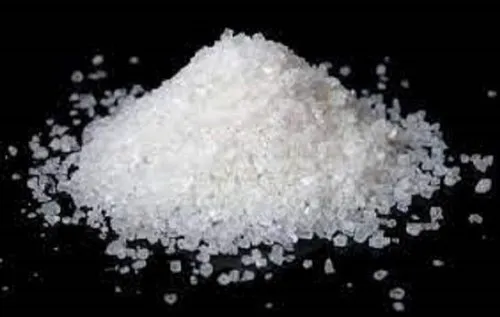
Sodium chloride (NaCl) — whether produced as sea salt, rock salt, vacuum/PVD salt or refined industrial grade — almost always requires a controlled drying step after washing, refining, iodisation or crystallisation. Residual surface moisture left after centrifuging causes caking in storage, poor flow in packaging lines, reduced free-flowing behaviour and, in iodised grades, potential stability issues.
Drying is therefore not an isolated operation. It is the final moisture-control stage in a process chain that typically includes:
Raw salt / brine → Washing & refining → (Iodisation) → Evaporation / crystallisation → Centrifuging / dewatering → Thermal drying → Cooling → Screening / packing
This page explains the engineering decisions that determine successful sodium chloride drying for both food-grade and industrial-grade products, with fluid-bed and rotary technologies as the primary options.
Why Salt Drying Is a Critical Process Step
Even after efficient centrifuging, salt crystals typically retain 2–8 % surface moisture (exact value depends on crystal size, centrifuge performance and preceding washing). If this moisture is not reduced to the target residual level (often ≤0.1–0.5 % for many food and industrial grades), the following problems appear:
- Caking during storage or transport
- Poor flowability in packing and dosing equipment
- Inconsistent bulk density
- Dusting or crystal breakage if the dryer is too aggressive
- Quality variation in iodised salt
- Customer complaints about free-flowing performance
The dryer must remove surface moisture efficiently while preserving crystal integrity and, where required, meeting food-grade hygiene and corrosion-resistance standards.
Salt Types and Their Drying Implications
| Salt type | Typical origin | Key drying considerations |
|---|---|---|
| Sea salt | Solar evaporation + washing | Variable crystal size, residual brine, possible organic traces |
| Rock salt | Mining + crushing + washing | Coarser fractions possible, higher capacity systems common |
| Vacuum / PVD salt | Evaporative crystallisation | Uniform crystals, often higher purity, tighter moisture specs |
| Iodised salt | Refined salt + iodine addition | Moisture control important for iodine stability and free flow |
| IP / industrial grade | Various routes | Focus on residual moisture, flow and corrosion-resistant construction |
Primary Dryer Technologies for Sodium Chloride
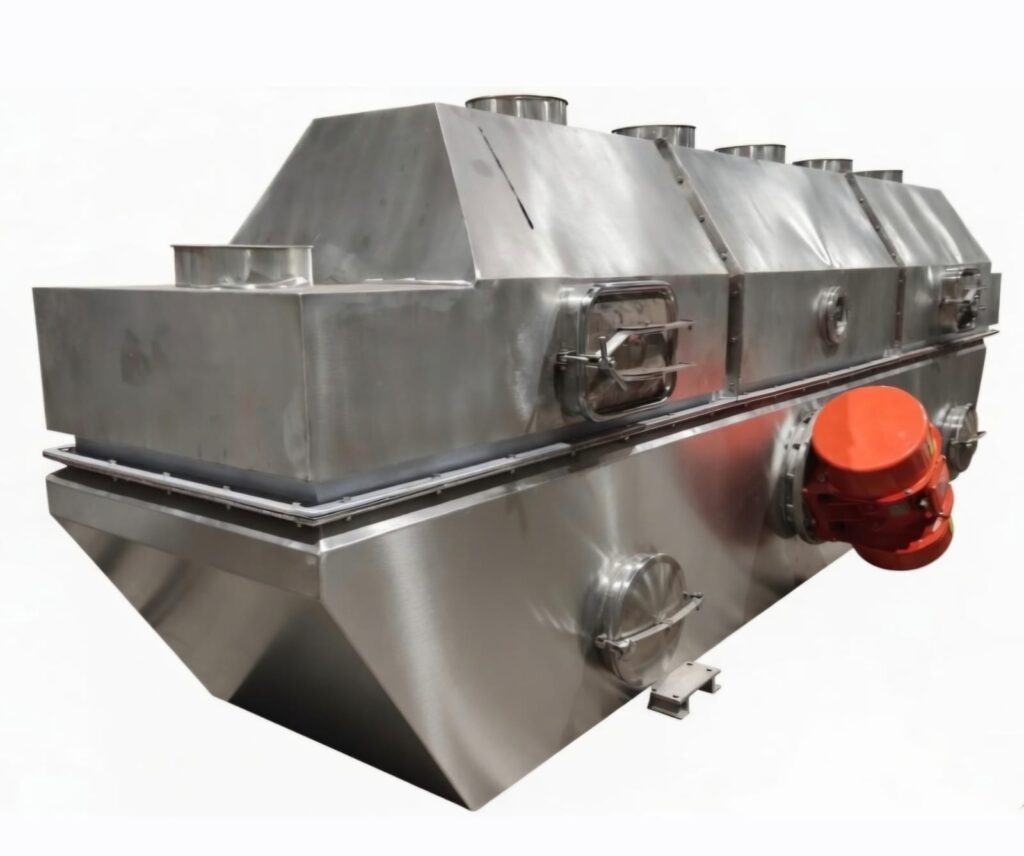
1. Fluid-Bed Dryer (including Vibratory / Shaking Fluid Bed)
Fluid-bed drying is widely used for crystalline salts. Hot air passes upward through a perforated distributor and fluidises the salt particles, giving intimate gas–solid contact and rapid surface-moisture removal. Vibration or shaking assists product transport and can reduce the air velocity needed for fluidisation.
Strengths for salt
- Excellent moisture uniformity
- Gentle handling that helps preserve crystal shape
- Easy integration of a cooling zone in the same machine
- Continuous operation and good capacity range
- Proven for sea salt, vacuum salt, rock salt and refined grades
Design notes
- Corrosion-resistant construction (typically SS316 or higher) is essential because of chloride.
- Bed depth, air velocity and residence time must be matched to crystal size distribution.
- Dust recovery (cyclone + bag filter) is required.
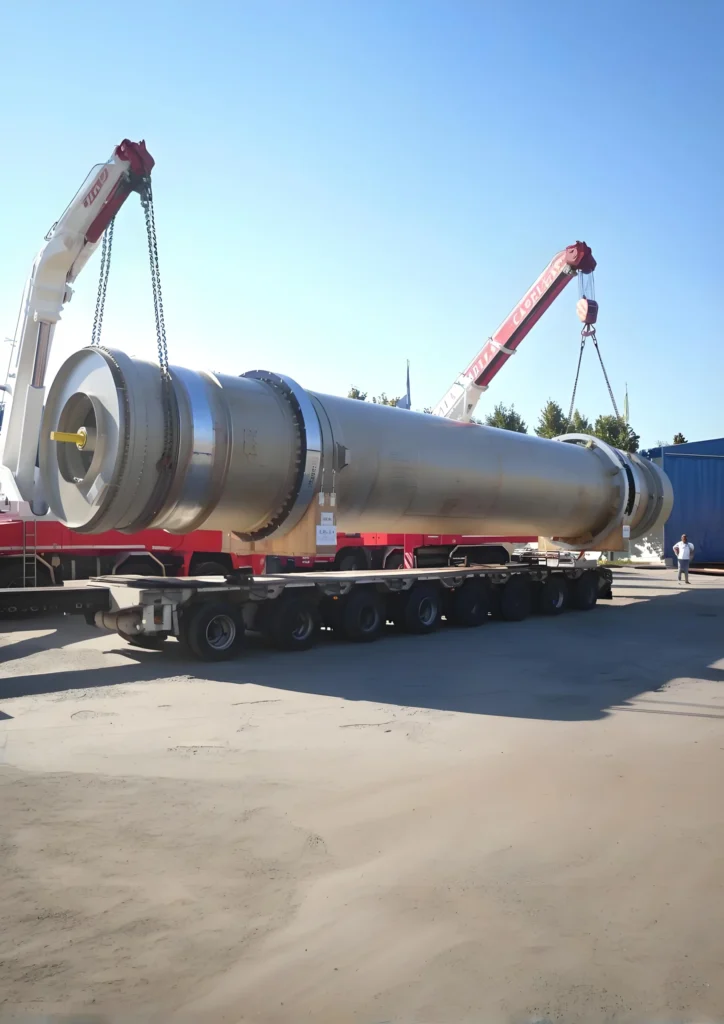
2. Rotary Dryer
A rotary dryer is evaluated for higher-throughput or coarser salt streams, or when a robust tumbling action is preferred. Material tumbles inside a rotating drum while contacting hot gas.
Strengths
- High continuous capacity
- Robust mechanical design
- Suitable for coarser rock-salt fractions or mixed particle sizes
Limitations
- Greater risk of crystal attrition compared with well-designed fluid beds
- Higher process-air volume in direct systems
- Cooling usually requires a separate unit
Technology selection starting point
| Requirement | Fluid-bed / VFBD | Rotary dryer |
|---|---|---|
| Crystal integrity / low fines | Strong | Moderate |
| Integrated drying + cooling | Strong | Separate cooler usually needed |
| High continuous throughput | Excellent | Excellent |
| Coarse rock-salt fractions | Good | Strong |
| Food-grade / iodised salt | Strong (with proper materials) | Possible |
| Corrosion resistance priority | Critical for both | Critical for both |
Final selection always depends on actual crystal size, feed moisture, capacity and product specification.
Common Process Problems and Engineering Responses
| Problem | Typical causes | Practical response |
|---|---|---|
| Residual moisture above target | Insufficient residence time or air temperature, uneven bed | Recalculate evaporation duty; improve feed distribution; verify air flow and temperature profile |
| Caking after drying | Product discharged too hot or residual moisture still high | Add or enlarge cooling zone; confirm final moisture |
| Excessive fines / dust | High air velocity or aggressive mechanical action | Optimise fluidisation velocity or rotary speed; improve dust collection |
| Corrosion | Chloride attack on carbon steel or inadequate grade of stainless | Specify appropriate stainless (SS316 / higher) or specialised alloys for contact parts |
| Uneven moisture | Poor feed distribution or channeling | Improve feeder design; ensure uniform bed depth |
| Crystal breakage | Overly aggressive tumbling or vibration | Adjust operating parameters; evaluate gentler fluid-bed configuration |
Key Data Required for Technical Assessment
- Salt type and grade (sea, rock, vacuum, iodised, IP, etc.)
- Crystal size distribution
- Feed moisture after centrifuging (%)
- Target residual moisture (%)
- Required throughput (t/h dry basis)
- Whether cooling is required before packing
- Food-grade or industrial-grade hygiene requirements
- Available heat source
- Corrosion or material-of-construction preferences
Illustrative mass-balance example (not a design guarantee):
10 t/h salt at 5 % moisture to 0.2 % residual moisture requires evaporation of approximately 480 kg/h of water. Actual dryer size, air flow and energy demand depend on heat-transfer rate, residence time and system efficiency.
Geographic Considerations & How GTI Evaluates Markets
Salt production and refining are global. Local conditions influence technology emphasis:
- India — Large sea-salt and refined-salt industry; focus on continuous fluid-bed and rotary systems matched to local utilities, coastal corrosion conditions and food-grade requirements.
- Europe & North America — Emphasis on energy efficiency, integrated drying-cooling, strict hygiene for food grades and robust emission control.
- Middle East & North Africa — High solar-salt volumes; drying systems sized for large continuous capacities and harsh ambient conditions.
- Southeast Asia & Latin America — Growing refined and iodised salt demand; evaluation of capacity, energy source and packaging-line integration.
GTI evaluates every project from the actual feed characteristics, residual-moisture target and site constraints rather than applying a single standard machine.
How GTI Dryers Approaches Sodium Chloride Drying
GTI Dryers designs industrial drying systems for bulk inorganic salts, including sodium chloride applications. Technology evaluation follows the salt’s physical form and quality requirements:
- Fluid-bed and vibratory fluid-bed systems for crystalline, free-flowing grades that benefit from gentle handling and integrated cooling
- Rotary dryers for suitable high-throughput or coarser streams
- Corrosion-resistant construction appropriate to chloride service
- Integration of feeding, dust recovery, cooling and product handling
GTI’s bulk inorganic chemical and salt drying portfolio already covers related crystalline salts and provides the engineering framework for NaCl projects.
Frequently Asked Questions
What residual moisture is typically required for salt?
Many food and industrial grades target ≤0.1–0.5 %. Exact specification depends on the end use and packaging requirements.
Why is cooling often combined with drying?
Salt discharged hot can still cake as it cools in silos or bags. An integrated or downstream cooling zone brings the product below its critical caking temperature.
Is fluid-bed better than rotary for salt?
Fluid-bed systems generally offer gentler crystal handling and easier integration of cooling. Rotary dryers remain strong for very high capacities or coarser rock-salt fractions. Selection depends on the specific product and plant constraints.
What material of construction is recommended?
Chloride service normally requires stainless steel (commonly SS316 or higher) for product-contact parts. Final selection depends on temperature, chloride concentration and hygiene requirements.
Can GTI handle both food-grade and industrial-grade salt?
Yes. Systems can be engineered with the appropriate materials, surface finishes and hygiene features for food-grade (including iodised) salt or robust industrial service.
Contact the GTI Technical Team:
Website: gtidryers.com
Email: mktg@gtidryers.com
Phone / WhatsApp: +91 9330077417