Rotary Dryer UK: High-Performance Industrial Rotary Drum Drying Systems
UK industries across biomass, recycling, minerals, chemicals, fertilizers, food processing, agriculture, animal feed and waste management require reliable technologies for continuous moisture removal.
For high-capacity bulk materials, an industrial rotary dryer can provide continuous operation, robust material handling and controlled moisture reduction.
GTI Dryers designs and manufactures custom rotary drum dryers according to material characteristics, initial moisture, required final moisture, production capacity, heat source and process conditions. GTI’s rotary-dryer range includes direct and indirect systems, single- and multi-pass configurations, and application-specific solutions for biomass, minerals, fertilizers, chemicals, food and sludge.
The objective is not simply to supply a drum. It is to develop a drying system matched to the customer’s actual process.
Why Are Rotary Dryers Important for UK Industry?
For industrial manufacturers, moisture affects:
- Product quality
- Storage stability
- Transportation costs
- Combustion performance
- Downstream processing
- Production efficiency
- Overall operating costs
A properly engineered rotary dryer can provide continuous, high-throughput drying for suitable granular, free-flowing and bulk materials.
GTI rotary dryers can be engineered for applications ranging from biomass and minerals to fertilizers, chemicals, agricultural products and industrial waste.
How Does a Rotary Drum Dryer Work?
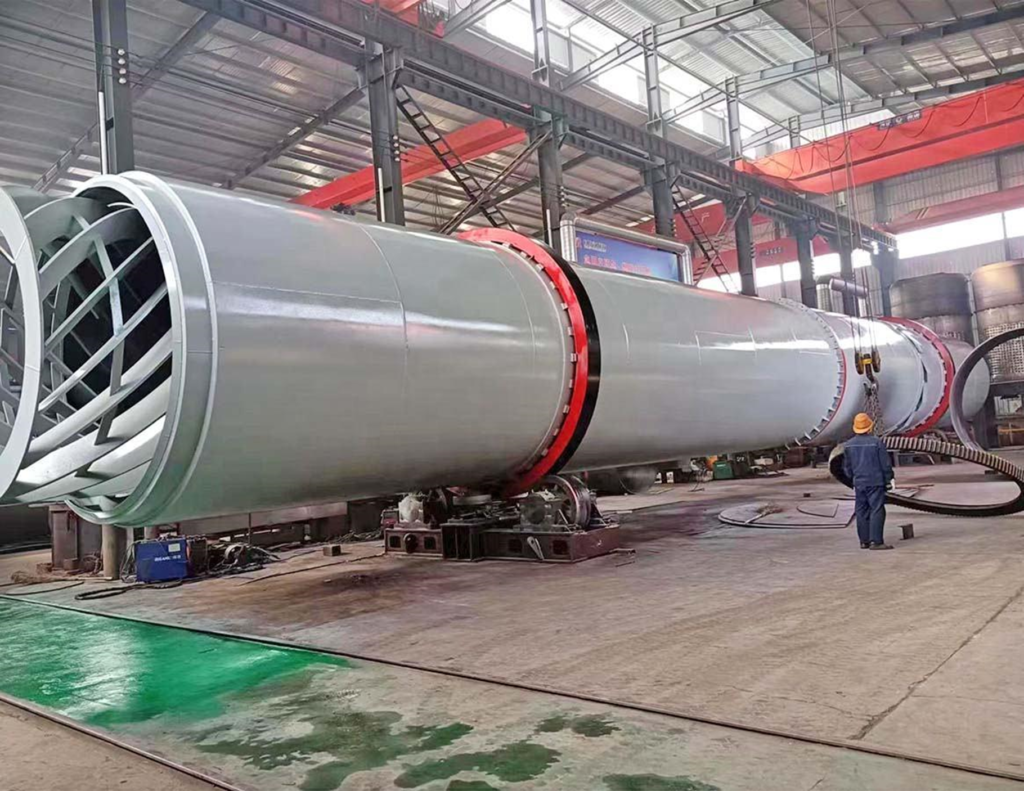
A Rotary Drum Dryer uses a rotating cylindrical drum to move wet material through a controlled drying environment.
Inside the drum, lifting flights raise and cascade the material through heated air, increasing contact between the product and drying medium.
Typical process:
Wet Material → Feeding System → Rotary Drum → Lifting Flights → Hot Air Contact → Moisture Evaporation → Dust Collection → Dried Product
Drying performance depends on:
- Initial moisture
- Final moisture
- Feed rate
- Material properties
- Airflow
- Temperature
- Residence time
- Drum dimensions
- Available heat source
This is why rotary dryer sizing should be based on process calculations rather than capacity alone. GTI’s rotary systems are designed around these process variables.
Rotary Dryer Applications in the UK
1. Biomass & Renewable Energy
Rotary dryers are suitable for high-throughput biomass applications such as:
- Wood chips
- Sawdust
- Wood shavings
- Agricultural residues
- Straw
- Biomass fuels
- RDF
- Biomass feedstocks
Reducing moisture can improve biomass handling and its suitability for downstream fuel, pellet or energy applications.
2. Minerals, Sand & Industrial Minerals
Rotary dryers can be used for suitable:
- Silica sand
- Quartz
- Limestone
- Gypsum
- Kaolin
- Bentonite
- Dolomite
- Mineral concentrates
- Industrial minerals
Moisture control can improve screening, storage, transportation and downstream processing.
3. Chemicals & Fertilizers
UK chemical and fertilizer processors can consider rotary drying for suitable:
- Chemical granules
- Industrial salts
- Fertilizers
- Organic fertilizers
- NPK materials
- Mineral chemicals
- Pigments
- Process intermediates
The appropriate dryer configuration depends on thermal sensitivity, particle characteristics and final moisture requirements.
4. Food, Agriculture & Animal Feed
For robust bulk materials requiring continuous processing, rotary dryers can be considered for:
- Grains
- Corn
- Rice
- Pulses
- Agricultural by-products
- Animal feed ingredients
- Food-processing residues
For highly heat-sensitive products, belt dryers, band dryers or low-temperature drying systems may be more suitable.
5. Recycling, Sludge & Waste Processing
Rotary drying can also be evaluated for:
- Industrial sludge
- Paper sludge
- Filter cakes
- Waste-derived materials
- Recycling feed stocks
- Industrial residues
The design must consider moisture, stickiness, dust, odour and exhaust-treatment requirements.
Energy-Efficient Rotary Dryers for UK Plants
Energy consumption is a major consideration when selecting industrial drying equipment.
GTI rotary dryer systems can incorporate:
- Optimized airflow
- Heat recovery where feasible
- Thermal insulation
- Variable-frequency drives
- Automated temperature control
- Efficient burner systems
- Residence-time optimization
- Dust collection
- Process monitoring
Possible heat sources include:
Natural Gas | LPG | Biomass | Steam | Thermal Oil | Electricity | Waste Heat
Actual energy consumption should be calculated from the material’s evaporation load, capacity and operating conditions rather than using a generic savings percentage.
How Much Does a Rotary Dryer Cost in the UK?
There is no single price for an industrial rotary dryer.
The cost depends on:
- Required capacity
- Initial and final moisture
- Dryer dimensions
- Material properties
- Direct or indirect heating
- Material of construction
- Heat source
- Dust-collection system
- Automation level
- Installation requirements
- Site conditions
- Auxiliary equipment
A small pilot or specialized unit can have a very different project cost from a large continuous biomass or mineral drying plant.
For an accurate budgetary estimate, provide GTI Dryers with your material, feed rate, initial moisture, target moisture and available heat source.
This is a much stronger commercial approach than publishing an arbitrary “starting price” that may not apply to the customer’s process.
How to Calculate Rotary Dryer Capacity
Rotary dryer capacity should be evaluated from the material throughput and moisture evaporation requirement.
A simplified moisture balance starts with:
Water Evaporation = Feed Water − Product Water
For example, if a process receives wet material at a known feed rate and moisture content and needs to achieve a lower final moisture, the amount of water that must be evaporated becomes a fundamental input for the thermal calculation.
The complete design also considers:
Feed Rate + Moisture Content + Target Moisture + Heat Load + Airflow + Residence Time + Material Properties
GTI can use these parameters for preliminary dryer sizing and drying calculations.
Rotary Dryer Energy Consumption: How to Reduce Operating Costs
The largest operating expense in many thermal drying applications can be energy.
Energy consumption can be influenced by:
- Initial moisture
- Final moisture
- Ambient conditions
- Drying temperature
- Airflow
- Heat losses
- Exhaust temperature
- Residence time
- Heat-source efficiency
Potential energy-optimization measures include:
Heat Recovery
Recovering usable heat from exhaust air where technically and economically feasible.
Improved Insulation
Reducing unnecessary heat loss from the dryer and hot-air system.
Airflow Optimization
Avoiding excessive airflow that increases exhaust losses.
Variable-Speed Drives
Adjusting fans and drives to actual process requirements.
Proper Dryer Sizing
Avoiding an oversized system operating inefficiently at partial load.
Optimized Flight Design
Improving material cascading and heat transfer inside the drum.
GTI’s existing rotary-dryer design approach includes airflow optimization, heat recovery options, insulation and variable-speed control.
Rotary Dryer vs Belt Dryer for Biomass
Both technologies can be suitable for biomass, but they are not interchangeable.
| Factor | Rotary Dryer | Belt Dryer |
| Throughput | Very high | High |
| Material handling | Tumbling | Conveyed on belt |
| Robust bulk materials | Excellent | Good |
| Biomass | Excellent for many bulk materials | Excellent for controlled/gentle drying |
| Product sensitivity | Moderate | Better for delicate materials |
| Footprint | Generally compact for high throughput | Can require larger footprint |
| Drying zones | Configurable | Multi-zone control |
| Typical application | Wood chips, sawdust, residues | Food, biomass, herbs, sensitive products |
Which one is better?
It depends on the biomass. A rotary dryer may be preferable for high-volume, robust materials, while a belt dryer can be advantageous where gentler handling, lower temperatures or precise multi-zone drying are priorities.
GTI manufactures both rotary and belt/band drying technologies, allowing the dryer selection to be based on the actual material and process rather than forcing every application into one technology.
What Is the Best Rotary Dryer for Wet Minerals?
There is no universal “best” rotary dryer for every mineral.
For wet sand, limestone, gypsum, kaolin, bentonite or mineral concentrates, the appropriate system depends on:
- Feed moisture
- Required final moisture
- Particle size
- Abrasiveness
- Feed rate
- Bulk density
- Product temperature
- Heat source
- Dust characteristics
For robust mineral applications, direct-heated rotary dryers are often considered because hot gases can contact the material directly and provide high-capacity drying.
For applications requiring separation between the heating medium and product, an indirect rotary dryer may be considered.
GTI’s rotary-dryer portfolio includes mineral and sand drying systems alongside direct and indirect configurations.
Rotary Dryer Maintenance Checklist
Regular maintenance is essential for reliable continuous operation.
Daily / Routine Checks
- Inspect abnormal vibration or noise
- Check bearing temperatures
- Monitor drum alignment
- Check product build-up
- Inspect exhaust airflow
- Check burner operation
- Monitor temperature readings
Periodic Checks
- Inspect lifting flights
- Check support rollers
- Inspect tyres and trunnions
- Check gearbox and drive system
- Inspect seals
- Check fan and ducting
- Clean dust-collection equipment
- Inspect electrical and control systems
Preventive Maintenance
A planned maintenance program can help identify mechanical wear before it develops into unexpected production downtime.
Custom Rotary Dryer Engineering for UK Applications
A rotary dryer is not simply a rotating cylinder.
Its performance depends on the relationship between:
Material Properties + Moisture + Heat + Airflow + Residence Time + Drum Geometry
GTI can engineer configurations including:
- Single-pass rotary dryers
- Multi-pass rotary dryers
- Direct-heated rotary dryers
- Indirect-heated rotary dryers
- Co-current rotary dryers
- Counter-current rotary dryers
- Biomass rotary dryers
- Mineral rotary dryers
- Sand rotary dryers
- Fertilizer rotary dryers
- Chemical rotary dryers
- Sludge rotary dryers
These configurations are part of GTI’s existing rotary-dryer offering.
Pilot Testing & Drying Calculations Before Buying
Before investing in a commercial rotary dryer, testing the actual material can significantly improve the basis for equipment selection.
Pilot Testing
GTI can evaluate:
- Drying behaviour
- Final moisture
- Product temperature
- Residence time
- Capacity
- Energy requirements
- Product quality
Drying Calculations
The engineering assessment can consider:
Feed Rate → Initial Moisture → Final Moisture → Water Evaporation → Heat Requirement → Airflow → Dryer Size
This creates a technical basis for developing a suitable industrial drying system.
Why Choose GTI Dryers for a Rotary Dryer in the UK?
GTI’s approach is based on application-specific drying engineering rather than a one-size-fits-all machine.
The company can provide:
- Custom rotary dryer design
- Material and moisture evaluation
- Thermal calculations
- Dryer sizing
- Direct and indirect heating options
- Dust-collection integration
- PLC/HMI/SCADA automation
- Energy-optimization strategies
- Installation and commissioning support
- Preventive-maintenance guidance
- Spare-parts support
GTI’s existing rotary-dryer systems are designed for continuous industrial operation and can integrate feeding, heating, exhaust, dust collection and control systems.
Frequently Asked Questions
What is a rotary dryer used for?
A rotary dryer is a continuous industrial drying system used to remove moisture from suitable bulk solids such as biomass, minerals, fertilizers, chemicals, agricultural products and industrial residues.
How much does a rotary dryer cost in the UK?
The cost depends on capacity, material, moisture evaporation, heating system, construction material, automation and auxiliary equipment. A process-specific quotation is required for an accurate price.
How is rotary dryer capacity calculated?
Capacity depends on feed rate, initial moisture, target moisture, evaporation load, material properties, airflow, heat transfer and residence time.
Is a rotary dryer suitable for biomass?
Yes. Rotary dryers are widely applicable to suitable biomass materials including wood chips, sawdust and agricultural residues.
What is the best dryer for wet minerals?
The best configuration depends on the mineral, moisture content, throughput, particle size, abrasiveness and required final moisture. Direct or indirect rotary systems can be evaluated depending on the process.
How can rotary dryer energy consumption be reduced?
Energy consumption can potentially be reduced through proper sizing, airflow optimization, heat recovery, insulation, efficient heating systems, variable-speed drives and optimized material residence time.
How often does a rotary dryer require maintenance?
Maintenance frequency depends on operating hours, material abrasiveness, temperature and equipment design. Routine inspections combined with preventive maintenance are recommended for continuous industrial operation.
Get a Rotary Dryer Designed for Your UK Application
If your facility in England, Scotland, Wales, Northern Ireland or another UK industrial region requires a rotary dryer for biomass, minerals, chemicals, fertilizers, food, agriculture, recycling or industrial waste, GTI Dryers can evaluate your application.
Send These Details to GTI Dryers:
Material + Feed Rate + Initial Moisture + Target Moisture + Heat Source
Based on these parameters, the engineering team can develop a preliminary drying calculation, rotary dryer recommendation and technical proposal.
GTI Dryers — Industrial Rotary Drying Solutions for the UK
Rotary Dryer | Rotary Drum Dryer | Biomass Dryer | Mineral Dryer | Sand Dryer | Fertilizer Dryer | Chemical Dryer
Request a customized rotary dryer assessment for your UK project.