
Indian industries processing minerals, biomass, fertilizers, chemicals, sand, agricultural products and bulk solids frequently require continuous, high-throughput moisture reduction. When capacity rises or residual-moisture specifications tighten, batch dryers or undersized systems become bottlenecks.
A rotary dryer (rotary drum dryer) provides continuous cascading contact between the material and hot gas inside a rotating cylinder. When correctly engineered, it delivers consistent residual moisture, robust mechanical reliability and the capacity needed for 24×7 industrial operation.
This page is written for process engineers and technical buyers in India who need a clear decision framework rather than a simple machine catalogue.
The Real Production Problem a Rotary Dryer Solves
Common situations that drive the need for a properly sized rotary dryer include:
- Throughput that exceeds the capacity of tray, fluid-bed or batch systems
- Need for continuous operation with minimal manual handling
- Variable or high feed moisture that must be reduced to a tight residual-moisture band
- Downstream processes (grinding, pelletising, packing, combustion) that are sensitive to moisture
- Rising energy and dust-control costs that demand better thermal efficiency and emission management
Selecting a rotary dryer only by “tons per hour” without calculating the actual evaporation duty, residence time and flight design often results in under-performance.
What Is an Industrial Rotary Dryer?
A rotary dryer consists of a rotating cylindrical drum, typically slightly inclined, fitted with internal lifting flights. Wet material is fed at one end and moves toward the discharge end while hot gas flows co-currently or counter-currently. The flights repeatedly lift and cascade the material through the gas stream, creating the gas–solid contact required for moisture evaporation.
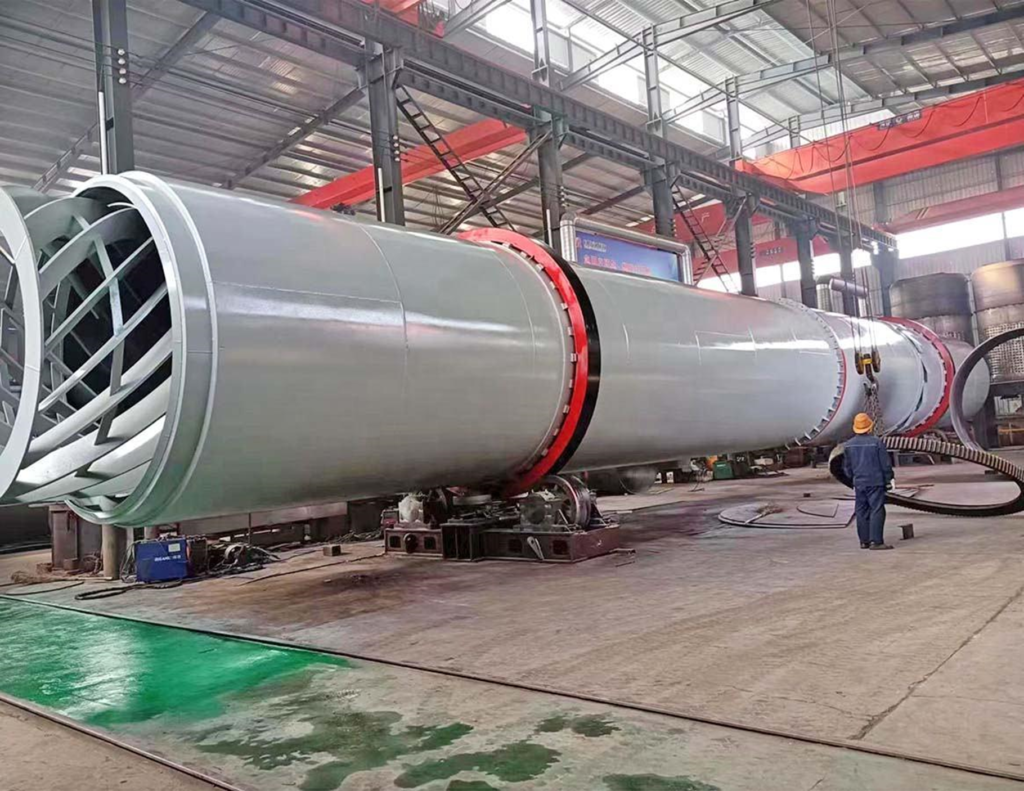
GTI Dryers engineers rotary systems in configurations such as:
- Direct-heated rotary dryers
- Indirect-heated rotary dryers
- Co-current and counter-current arrangements
- Single-pass and multi-pass designs
- Specialised versions for minerals, biomass, fertilizers, chemicals and selected sludge streams
The final configuration is determined by the material’s physical behaviour, moisture load and product-quality requirements.
Key Design Variables That Determine Performance
| Variable | Why it matters | Engineering implication |
|---|---|---|
| Drum diameter & length | Sets residence time and gas–solid contact area | Sized from evaporation duty, not nominal volume |
| Flight design | Controls cascading, gas contact and material transport | Must match particle size, stickiness and attrition sensitivity |
| Gas-flow direction | Affects product temperature profile | Co-current preferred for heat-sensitive or very wet feeds; counter-current for lower residual moisture |
| Residence time | Determines how long the material stays in the drying zone | Controlled by length, slope and rotational speed |
| Airflow & temperature | Drive the evaporation rate | Balanced against product-temperature limits and dust entrainment |
| Heat source | Influences operating cost and system design | Natural gas, biomass, steam, thermic fluid, waste heat or electric |
Typical Applications in India
Minerals & Mining
Silica sand, foundry sand, limestone, gypsum, clay, kaolin, bentonite, mineral concentrates and other bulk minerals. Moisture control improves handling, screening, storage and downstream processing.
Biomass & Renewable Energy
Wood chips, sawdust, rice husk, bagasse, agricultural residues, RDF and biomass fuels. Reducing moisture raises usable energy value and improves combustion or further processing.
Fertilizers
Organic fertilizers, compost, NPK granules and agricultural nutrient products. Controlled residual moisture is required before storage or packing.
Chemicals & Industrial Solids
Suitable chemical powders, industrial salts, granules and process intermediates. Thermal sensitivity and particle characteristics must be evaluated.
Food & Agricultural Bulk Materials
Selected grains, pulses, animal-feed ingredients and agricultural by-products where continuous high throughput is needed and the material can tolerate rotary cascading. Heat-sensitive products may require alternative technologies (band/belt dryers).
Sludge & Waste Streams
Selected industrial, ETP or paper sludge streams after mechanical dewatering, provided stickiness, odour and emission requirements can be managed.
Common Problems and Engineering Responses
| Problem | Typical causes | Practical response |
|---|---|---|
| Residual moisture above target | Insufficient residence time or heat-transfer area | Recalculate evaporation duty; verify flighting and gas temperature profile |
| Product overheating | Excessive inlet gas temperature or counter-current operation with heat-sensitive feed | Switch to co-current or lower gas temperature; monitor actual product temperature |
| Excessive dust / fines | High gas velocity or aggressive cascading | Optimise air velocity and flight design; strengthen cyclone + bag-filter system |
| Material buildup / sticking | Sticky intermediate moisture phase | Flight design modification, possible recycle of dry product, or evaluate alternative technology |
| High energy consumption | Excess air, poor insulation, no heat recovery | Optimise air–solids ratio; add heat recovery; improve insulation |
| Uneven moisture | Poor feed distribution or short-circuiting | Improve feeder design and internal flights |
How to Select a Rotary Dryer for an Indian Plant
Provide the following data for a meaningful technical assessment:
- Exact material and particle-size range
- Feed moisture (% wet basis) and target residual moisture
- Required throughput (kg/h or t/h dry basis)
- Maximum allowable product temperature
- Available heat source and utilities
- Operating hours (continuous or intermittent)
- Dust-emission or environmental constraints
- Space and layout limitations
Illustrative mass-balance example (not a design guarantee):
5 t/h material at 25 % moisture to 5 % residual moisture requires evaporation of approximately 1 053 kg/h of water. Actual drum size, gas flow and fuel consumption depend on heat-transfer rate, residence time and system losses.
Geographic Considerations & Market Evaluation
- India — High demand from minerals, biomass, fertilizer and chemical sectors; focus on robust continuous systems matched to local fuels (including biomass and waste heat), coastal or dusty environments, and CPCB emission norms.
- Export-oriented projects — GTI evaluates the same process data for customers supplying regional or international markets, adjusting materials of construction and documentation as required.
- Global applicability — The engineering principles remain the same; only utilities, ambient conditions and regulatory details change.
GTI’s approach is identical in every market: characterise the feed, calculate the evaporation duty, select the appropriate configuration and integrate the complete system.
How GTI Dryers Approaches Rotary Drying
GTI Dryers designs and manufactures industrial rotary drum drying systems for minerals, biomass, fertilizers, chemicals and bulk solids. The engineering sequence is:
- Define the actual evaporation load from feed and target moisture
- Select direct or indirect heating, co-current or counter-current flow
- Design flights, drum geometry and residence time around the material
- Integrate feeding, hot-air generation, dust collection, exhaust treatment and product discharge
- Support pilot evaluation when material behaviour is uncertain
The dryer is treated as part of a complete process line, not an isolated machine.
Frequently Asked Questions
What is a rotary dryer used for?
Continuous moisture removal from free-flowing granular, crystalline, fibrous or bulk solid materials such as minerals, sand, biomass, fertilizers, selected chemicals and agricultural products.
Is a rotary dryer suitable for biomass in India?
Yes, for many high-throughput biomass streams (wood chips, sawdust, agricultural residues). Heat-sensitive or very fine materials may require alternative technologies.
How is rotary dryer capacity calculated?
From the water evaporation rate, which is derived from feed rate, initial moisture and target residual moisture, together with material-specific drying characteristics and allowable residence time.
Can GTI customise a rotary dryer for my material?
Yes. Drum size, flight design, heating method, gas-flow direction and ancillary systems are engineered from the process data supplied by the customer.
What information do I need to provide for a quotation?
Material type, feed moisture, target residual moisture, required capacity, available heat source and any product-temperature or emission constraints.
Contact the GTI Technical Team:
Website: gtidryers.com
Email: mktg@gtidryers.com
Phone / WhatsApp: +91 9330077417