Rotary Dryer Canada for High-Capacity Industrial Drying
Canada represents an attractive market for industrial drying equipment because of its large mining, forestry, wood-pellet, biomass, fertilizer, chemical, food and agricultural-processing sectors.
From British Columbia and Quebec’s forestry and pellet industries to Ontario’s food and manufacturing sector, Saskatchewan’s potash and agricultural processing, and Alberta’s energy and industrial-processing operations, different industries require very different approaches to moisture removal.
A Rotary Dryer is therefore not simply a standard piece of equipment.
The critical question is:
Which Rotary Dryer configuration—direct or indirect—is appropriate for the Canadian material, industry, moisture requirement and regulatory environment?
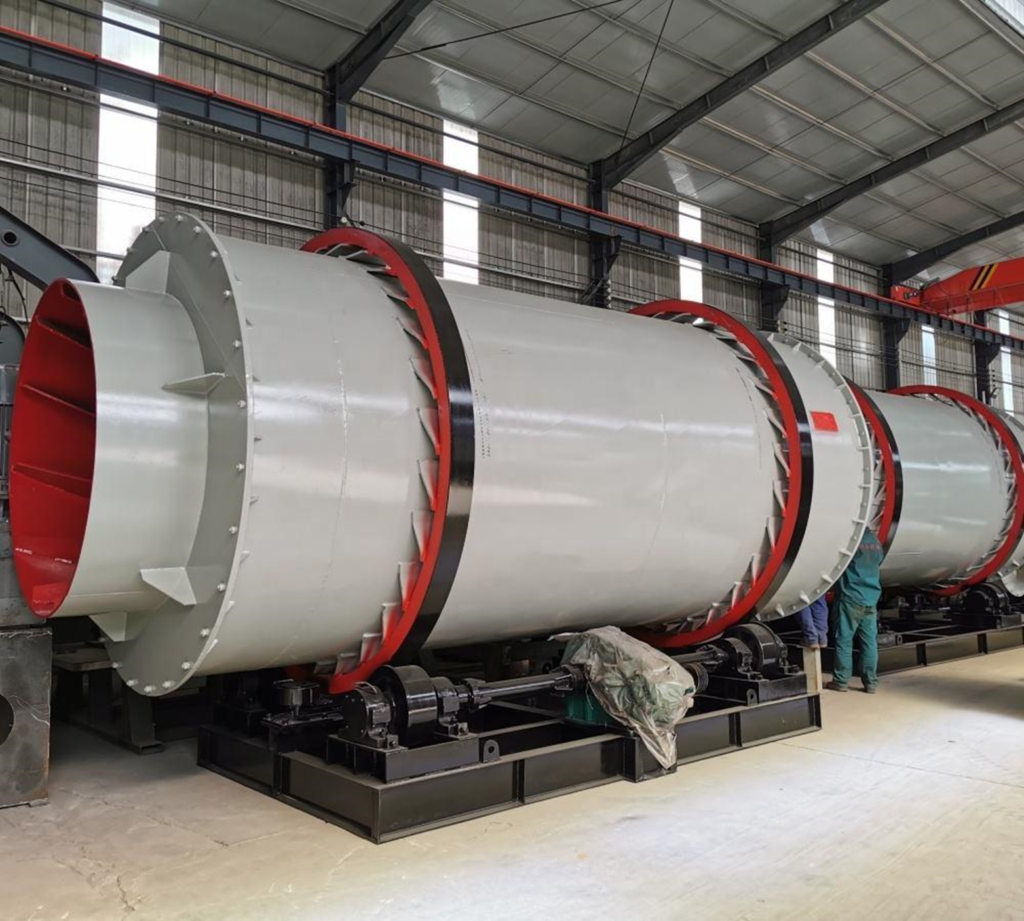
GTI Dryers designs customized Rotary Drum Dryers based on:
- Material characteristics
- Feed moisture
- Target moisture
- Production capacity
- Water evaporation requirement
- Particle size
- Drying temperature
- Residence time
- Heat source
- Product sensitivity
- Emission and environmental requirements
Canada’s wood-pellet industry is particularly relevant: the Wood Pellet Association of Canada describes rotary drum dryers as the most common and practical drying technology in Canadian pellet plants, while highlighting the importance of dryer safety and integrated process controls.
Why Rotary Dryers Are Important in the Canadian Market
A Rotary Dryer uses a rotating cylindrical drum and internal flights to continuously move material through a controlled drying environment.
This makes rotary dryers suitable for many high-throughput materials, including:
- Minerals and ores
- Potash
- Sand
- Wood chips
- Sawdust
- Biomass
- Wood-pellet feedstock
- Fertilizers
- Chemicals
- Agricultural products
- Industrial salts
- Construction minerals
However, the same rotary dryer configuration should not be used for every industry.
For example, Canadian wood-pellet plants commonly use direct-fired rotary drying, while certain food applications may require indirect heating or carefully controlled process air depending on product and contamination requirements.
That industry-specific approach is where GTI Dryers can differentiate itself.
Preferred Rotary Dryer Type by Industry in Canada
1. Wood Pellets & Biomass → Direct Rotary Drum Dryer
Canada’s forestry and wood-pellet industries represent one of the strongest applications for direct rotary drum dryers.
Wood-pellet production commonly starts with feedstocks such as:
- Sawdust
- Wood chips
- Shavings
- Bark
- Sawmill residues
- Other wood-processing residues
The feedstock must be dried before pelletizing to reach the required moisture range.
Canadian industry sources identify rotary drum dryers as the most common drying technology used for biomass feedstock in pellet plants.
Why Direct Rotary Dryers Are Preferred for Wood Pellets
A direct-fired system allows hot drying gases to contact the biomass directly.
This provides:
- High evaporation capacity
- Continuous operation
- Good gas-solid contact
- Large-volume moisture removal
- Efficient utilization of biomass fuel
- Suitability for high-throughput pellet plants
Canadian pellet plants can also use wood residues or other biomass fuels as the energy source, integrating the dryer with the plant’s overall thermal system.
A British Columbia government technical document describes pellet-plant drying of sawdust, shavings and chips using direct-fired rotary dryers, including single-pass and multiple-pass configurations.
Single-Pass vs Triple-Pass Rotary Dryer for Canadian Biomass
The choice between single-pass, triple-pass or another rotary configuration should be based on feedstock moisture, throughput, particle size, available heat source, emissions requirements and overall plant design.
Modern Canadian pellet plants also place significant emphasis on dryer fire and explosion prevention, combustible-dust management and integrated safety systems.
This is an important opportunity for GTI Dryers: a Canadian biomass customer is not only buying a drum—they are evaluating the complete drying and safety system.
2. Food Processing → Indirect Rotary Drum Dryer
Food processing requires a different engineering approach.
Applications can include suitable drying of:
- Pulses
- Starches
- Grains
- Food ingredients
- Sugar-based products
- Agricultural by-products
- Other bulk food materials
Why Indirect Heating Can Be Preferred for Food Applications
In an indirect rotary dryer, the product is heated without direct contact with combustion gases.
This can be advantageous when the process requires:
- Greater control over contamination risk
- Separation between combustion gases and product
- Controlled product temperature
- Hygienic processing
- Reduced risk of combustion-product carryover
- Better control of sensitive food characteristics
Canadian food regulations emphasize preventing contamination and require food-processing equipment to be properly designed, maintained and used in a manner that does not present a contamination risk.
For this reason, indirect rotary dryers using steam, thermal oil or another suitable indirect heat-transfer method can be considered for applications where direct hot-gas contact is undesirable.
However, the dryer configuration should always be selected according to the specific food product, process, hazard analysis and regulatory requirements.
3. Mining & Minerals → Heavy-Duty Rotary Dryer
Canada’s mining industry creates another major opportunity for industrial rotary dryers.
Potential applications include:
- Iron ore
- Nickel materials
- Copper concentrates
- Gold-bearing materials
- Potash
- Limestone
- Gypsum
- Silica sand
- Industrial minerals
Rotary dryers can be integrated before:
Screening → Grinding → Separation → Storage → Transportation → Downstream Processing
For abrasive materials, GTI Dryers can consider:
- Heavy-duty drum construction
- Wear-resistant components
- Customized flights
- Controlled residence time
- Dust-collection systems
- Process-specific airflow
The objective is to achieve reliable moisture reduction without unnecessarily increasing energy consumption or mechanical wear.
4. Potash & Fertilizer Processing → Rotary / Fluid Bed Dryer
Canada is particularly important in the global potash industry.
For fertilizer and mineral granules, dryer selection depends heavily on particle characteristics and required final moisture.
Depending on the material, options can include:
Rotary Dryer → Fluid Bed Dryer → Vibratory Fluid Bed Dryer
A rotary dryer can be advantageous for robust, high-capacity bulk materials, while fluid-bed technology can provide highly efficient gas-solid contact for suitable free-flowing granules.
GTI Dryers can determine the appropriate technology from the actual material and process data.
5. Chemicals & Industrial Materials → Direct or Indirect Rotary Dryer
Chemical applications require careful evaluation because materials may be:
- Corrosive
- Abrasive
- Sticky
- Heat-sensitive
- Hygroscopic
- Reactive
- Dust-forming
Depending on the application, GTI Dryers can evaluate direct rotary, indirect rotary, flash, paddle, vacuum or fluid-bed drying technologies.
This prevents a common mistake in industrial procurement:
Choosing the dryer first and trying to make the material fit the machine.
The better approach is:
Material → Process → Drying requirement → Technology → Equipment design.
Direct vs Indirect Rotary Dryer: Which Is Better for Canada?
| Application | Preferred Configuration to Evaluate | Main Reason |
| Wood pellets | Direct rotary | High throughput and biomass drying |
| Sawdust | Direct rotary | Efficient bulk moisture removal |
| Wood chips | Direct rotary | Robust continuous operation |
| Minerals | Direct rotary | High-capacity bulk drying |
| Sand | Direct rotary | High evaporation capacity |
| Fertilizers | Rotary / Fluid Bed | Depends on granule properties |
| Food ingredients | Indirect rotary where required | Process and contamination control |
| Heat-sensitive products | Indirect / specialized | Better temperature control |
| Chemicals | Direct or indirect | Depends on material chemistry |
The table should be treated as a technology-selection starting point, not a universal rule. Actual dryer selection requires process data.
How Much Does a Rotary Dryer Cost in Canada?
The cost of a rotary dryer depends on:
- Capacity
- Evaporation load
- Drum dimensions
- Material properties
- Direct or indirect heating
- Heat source
- Construction material
- Dust collection
- Automation
- Feed and discharge equipment
- Safety systems
- Installation requirements
A wood-pellet rotary dryer, mineral dryer and food-grade indirect rotary dryer can have very different costs because their supporting systems and engineering requirements are different.
For this reason, GTI Dryers recommends starting with a drying calculation and process evaluation rather than comparing equipment based only on purchase price.
How to Calculate Rotary Dryer Capacity
The first calculation is the amount of water that needs to be removed.
Water Evaporation = Water in Feed − Water Remaining in Product
The final dryer size depends on:
- Feed rate
- Initial moisture
- Target moisture
- Particle size
- Bulk density
- Specific heat
- Drying temperature
- Residence time
- Airflow
- Heat-transfer conditions
- Drum dimensions
- Flight configuration
For Canadian projects, seasonal ambient conditions can also be incorporated into the overall engineering calculation.
Rotary Dryer Energy Consumption: How to Reduce Operating Costs
For a high-throughput Canadian plant, dryer energy consumption can have a major effect on operating economics.
GTI Dryers can evaluate:
Heat Recovery
Recovering useful heat from exhaust streams where technically feasible.
Airflow Optimization
Reducing unnecessary exhaust losses while maintaining required drying performance.
Flight Design
Improving material cascading and gas-solid contact.
Insulation
Reducing heat loss from the drum and hot sections.
Heat-Source Integration
Evaluating natural gas, biomass, steam, thermal oil, electricity or available waste heat.
For Canadian pellet plants, integration with existing biomass furnaces or waste-heat sources can be particularly valuable.
Rotary Dryer vs Belt Dryer for Biomass
| Requirement | Rotary Dryer | Belt Dryer |
| High-volume wood biomass | Excellent | Good |
| Sawdust | Excellent | Good |
| Wood chips | Excellent | Good |
| Robust operation | Excellent | Good |
| Gentle drying | Moderate | Excellent |
| Multi-zone drying | Possible | Excellent |
| Long residence time | Possible | Excellent |
For large-volume wet sawdust and wood chips, rotary drying is often the stronger starting point.
For heat-sensitive biomass or materials requiring gentle, low-temperature, multi-zone drying, a belt dryer may be more appropriate.
What Is the Best Rotary Dryer for Wet Minerals?
There is no universal “best” rotary dryer.
The design should consider:
- Mineral type
- Abrasiveness
- Feed moisture
- Final moisture
- Particle size
- Bulk density
- Throughput
- Product temperature
- Residence time
- Dust generation
For high-abrasion Canadian mining applications, the dryer may require specialized wear protection and robust mechanical design.
Rotary Dryer Maintenance Checklist for Canadian Plants
Canadian operators should consider:
Daily
- Bearing inspection
- Vibration monitoring
- Temperature monitoring
- Burner inspection
- Exhaust-air monitoring
- Product moisture checks
Weekly
- Roller and tyre inspection
- Drive-system inspection
- Seal inspection
- Flight inspection
- Lubrication
- Dust-collection inspection
Periodic
- Drum alignment
- Shell inspection
- Flight wear
- Gearbox inspection
- Burner maintenance
- Instrumentation calibration
- Insulation/refractory inspection
For biomass and pellet plants, fire and combustible-dust safety deserves special attention. WPAC specifically identifies rotary-dryer fire and explosion risks as an important Canadian industry safety issue.
Why GTI Dryers Should Target the Canadian Rotary Dryer Market
Canada should not be approached simply as another geographical keyword.
It is a market where GTI can demonstrate application-specific engineering.
A Canadian buyer may be looking for:
“Rotary dryer Canada”
but their actual requirement could be:
- Wood pellet dryer British Columbia
- Sawdust dryer Alberta
- Biomass rotary dryer Quebec
- Mineral dryer Ontario
- Potash dryer Saskatchewan
- Food-grade indirect dryer Canada
- Industrial rotary drum dryer Canada
GTI Dryers can position itself around specific Canadian applications, dryer configurations and engineering problems.
Canadian Industrial Locations to Target
British Columbia
Vancouver, Prince George, Kamloops and major forestry/pellet-processing regions.
Alberta
Edmonton, Calgary, Grande Prairie, Fort McMurray and industrial/biomass-processing areas.
Saskatchewan
Saskatoon, Regina and major potash and agricultural-processing regions.
Ontario
Toronto, Sudbury, Thunder Bay, Timmins and major manufacturing/mineral-processing areas.
Quebec
Montreal, Quebec City, Saguenay, Rouyn-Noranda and forestry/mineral-processing regions.
Manitoba
Winnipeg and surrounding industrial/agricultural-processing areas.
This supports long-tail searches such as:
- Rotary dryer British Columbia
- Wood pellet dryer Canada
- Rotary dryer Alberta
- Biomass dryer Quebec
- Rotary dryer Saskatchewan
- Potash dryer Canada
- Rotary dryer Ontario
- Mineral dryer Canada
- Food rotary dryer Canada
- Indirect rotary dryer Canada
- Rotary drum dryer manufacturer Canada
Why Choose GTI Dryers for Canadian Rotary Dryer Projects?
GTI Dryers can provide customized drying solutions based on:
- Material testing
- Drying calculations
- Capacity calculations
- Direct/indirect heating selection
- Energy analysis
- Equipment sizing
- Heat-source selection
- Dust-collection requirements
- Automation
- Process integration
Rotary systems can be configured with:
- Customized drum dimensions
- Application-specific flights
- Direct or indirect heating
- Biomass-fired heating integration
- Gas/LPG heating
- Steam or thermal-oil systems
- Cyclones
- Bag filters
- PLC/HMI controls
- VFDs
- Temperature monitoring
- Heat-recovery systems
Final CTA: Explore Rotary Dryer Solutions for Canada
Whether you are developing a wood-pellet plant in British Columbia, a biomass project in Alberta, a potash facility in Saskatchewan, a mineral-processing plant in Ontario, or a food-processing operation in Quebec, the right rotary dryer configuration can have a major impact on production, energy consumption and product quality.
GTI Dryers can evaluate whether your application requires a:
Direct Rotary Dryer → Indirect Rotary Dryer → Rotary + Fluid Bed → Flash Dryer → Belt Dryer → Specialized Drying System
Send Your Process Data
Material + Feed Rate + Initial Moisture + Target Moisture + Particle Size + Heat Source + Operating Hours + Product Temperature Limit
GTI Dryers can then evaluate:
Evaporation Load → Dryer Capacity → Heat Requirement → Airflow → Dryer Configuration → Energy Requirement
Looking for a Rotary Dryer Manufacturer in Canada?
GTI Dryers provides customized industrial rotary drying systems for wood pellets, biomass, minerals, mining materials, potash, fertilizers, chemicals, food ingredients, sand and other bulk solids.
Request a drying calculation and discuss your Canadian rotary dryer project with GTI Dryers.