Rotary Dryer Europe: High-Performance Industrial Rotary Drum Drying Solutions
European manufacturers across Germany, France, Italy, Spain, the Netherlands, Poland, Belgium, Austria, Sweden and other industrial markets require reliable drying systems for minerals, biomass, chemicals, fertilizers, food ingredients, agricultural products and industrial waste.
For high-throughput applications, a rotary dryer provides a proven continuous drying solution capable of handling large volumes of bulk solids.
GTI Dryers designs and manufactures custom rotary drum dryers for international industrial applications, with the dryer configuration selected according to material characteristics, moisture content, production capacity, heat sensitivity, available utilities and final moisture requirements. GTI’s existing rotary-dryer portfolio covers direct and indirect heating, single- and multi-pass configurations, biomass, sludge, sand, minerals, fertilizer, food and chemical applications.
Why Rotary Drying Is Important for European Industry
Industrial drying directly affects product quality, energy consumption, production capacity and downstream processing.
European plants increasingly need drying systems that combine:
- Consistent final moisture
- High thermal efficiency
- Continuous operation
- Controlled product temperature
- Reliable mechanical performance
- Dust and exhaust management
- Automation and process monitoring
- Integration with existing production lines
A rotary dryer is particularly suitable where large quantities of bulk or granular material must be dried continuously.
The technology is already positioned by industrial dryer manufacturers for applications including minerals, fertilizers, food processing, chemicals and biomass.
How Does an Industrial Rotary Dryer Work?
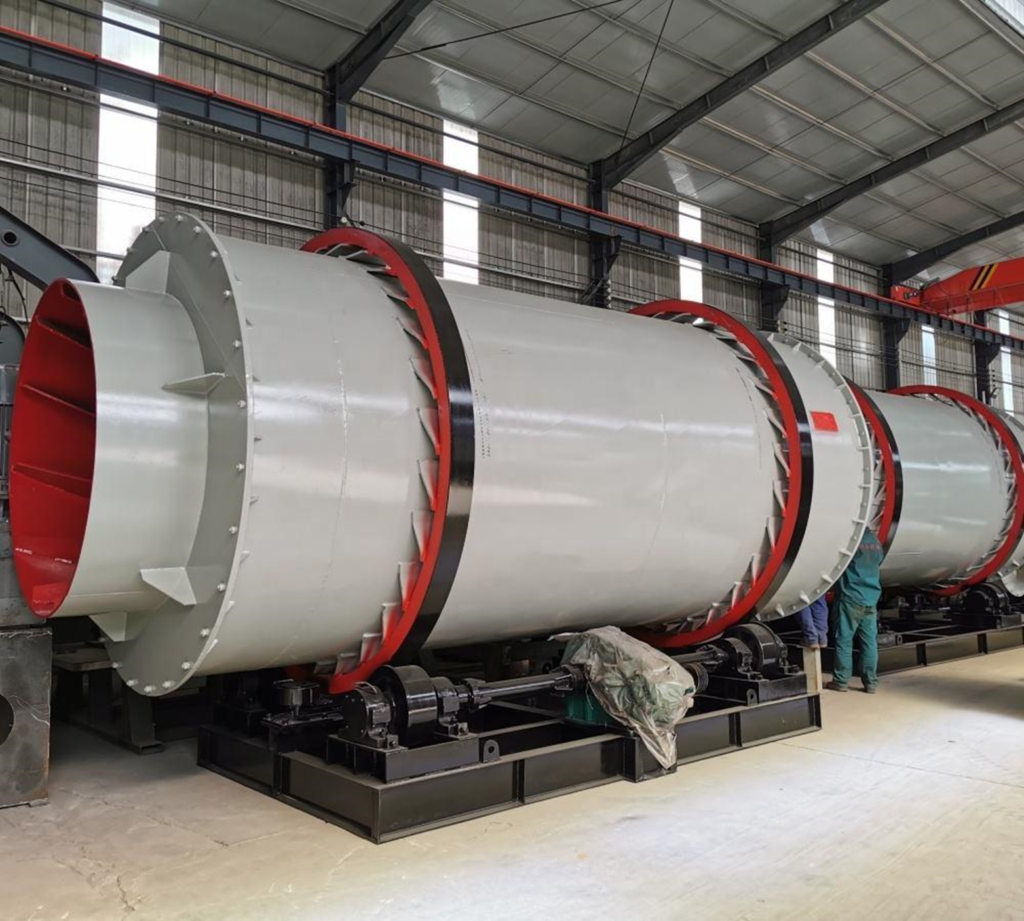
A rotary dryer consists of a rotating cylindrical drum through which wet material continuously travels.
As the drum rotates, internal lifting flights raise and cascade the material through the drying air. This increases contact between the material and heated gas and promotes moisture evaporation.
The drying performance depends on several interconnected parameters:
Feed moisture → Water evaporation → Airflow → Heat transfer → Residence time → Final moisture
GTI Dryers engineers these parameters according to the specific material rather than relying on a standard drum configuration. Its current rotary-dryer specifications include customized drum dimensions, direct or indirect heating, PLC-controlled moisture/process control and optional dust-collection systems.
Rotary Dryer Applications Across Europe
1. Minerals, Mining & Industrial Minerals
Rotary dryers can be considered for materials such as:
- Silica sand
- Limestone
- Gypsum
- Kaolin
- Bentonite
- Feldspar
- Dolomite
- Mineral concentrates
- Industrial powders
For mineral processors, controlled drying can improve material handling, storage, transportation and downstream processing. GTI’s mineral drying portfolio specifically includes sand, clay, gypsum, mineral powders and ore-drying applications.
2. Biomass & Renewable Energy
European biomass processors can use rotary drying technology for suitable materials including:
- Wood chips
- Sawdust
- Agricultural residues
- Rice husk
- Bagasse
- Biomass fuels
- Biomass pellets and feed stocks
Moisture reduction can improve the handling and energy characteristics of biomass before further processing.
GTI also identifies biomass, sawdust, wood chips, rice husk, bagasse and other agricultural residues among its industrial drying applications.
3. Fertilizer & Agricultural Materials
Rotary dryers can be integrated into fertilizer and agricultural processing lines for suitable:
- Organic fertilizers
- Granulated fertilizers
- NPK products
- Compost
- Agricultural minerals
- Bulk agricultural materials
The dryer can be designed around the required moisture specification and downstream packaging or storage requirements.
4. Food & Agro-Processing
For suitable bulk food and agricultural materials, rotary drying can provide continuous high-capacity processing.
Potential applications include:
- Grains
- Corn
- Rice
- Pulses
- Oilseeds
- Agricultural by-products
- Animal feed ingredients
However, products that are particularly heat-sensitive may require alternative technologies such as band dryers, belt dryers or specialized low-temperature drying systems.
5. Chemical & Industrial Processing
Rotary dryers can also be engineered for suitable:
- Chemical powders
- Industrial salts
- Granules
- Pigments
- Fertilizer chemicals
- Process intermediates
- Bulk industrial solids
The appropriate heating configuration should be selected according to the material’s thermal sensitivity, particle characteristics and process requirements.
Energy-Efficient Rotary Drying for European Plants
Energy efficiency should be considered during dryer design—not after installation.
GTI rotary drying systems can incorporate:
- Optimized airflow
- Heat recovery
- Thermal insulation
- Variable-frequency drives
- Automatic temperature control
- Optimized residence time
- Direct or indirect heating
- Dust collection
- Process monitoring
Depending on the application and available utilities, heating options can include:
Natural Gas | LPG | Biomass | Steam | Thermal Oil | Electricity | Waste Heat
Actual energy consumption and savings should be established from material-specific drying calculations, rather than relying on generic percentage claims.
Rotary Dryer Manufacturer Europe: Custom Engineering Matters
A rotary dryer is more than a rotating steel cylinder.
The performance of the system depends on:
- Drum diameter and length
- Flight design
- Drum speed
- Airflow
- Heating temperature
- Material loading
- Residence time
- Feed moisture
- Final moisture
- Particle size
- Bulk density
GTI’s approach is to begin with the material and process requirement and then determine the appropriate dryer configuration. Its existing engineering offering includes process evaluation, thermal calculations, dryer sizing, layout planning, automation and commissioning support.
Rotary Dryer Europe: Why Choose GTI Dryers?
For European industrial buyers, the focus should be on process performance rather than simply purchasing a standard machine.
GTI Dryers provides:
Application-Specific Design
Each rotary dryer can be designed around the material, moisture and throughput requirements.
Multiple Configurations
Options include:
- Single-pass rotary dryer
- Multi-pass rotary dryer
- Direct-heated rotary dryer
- Indirect-heated rotary dryer
- Co-current configuration
- Counter-current configuration
- Biomass rotary dryer
- Mineral rotary dryer
- Sand rotary dryer
- Fertilizer rotary dryer
- Chemical rotary dryer
- Sludge rotary dryer
These configurations are part of GTI’s current rotary-dryer offering.
Complete Process Integration
A rotary dryer can be integrated with:
Feeding System → Hot Air Generator → Rotary Dryer → Cyclone/Bag Filter → Exhaust System → Product Discharge → Automation
This allows GTI to approach the project as a complete drying system, rather than only supplying the drum.
Pilot Testing & Drying Calculations
Before investing in a large industrial dryer, European manufacturers should understand how their specific material behaves during drying.
Pilot Testing
Material-specific testing can help determine:
- Drying rate
- Final moisture
- Product temperature
- Residence time
- Capacity
- Energy requirement
- Product quality
Drying Calculations
GTI can evaluate parameters including:
Feed Rate + Initial Moisture + Final Moisture + Water Evaporation + Heat Requirement + Airflow + Residence Time
These calculations provide a technical basis for dryer sizing and project evaluation.
GTI’s existing rotary-dryer offering specifically includes material drying evaluation, capacity and heat-load calculations, equipment-layout planning and technical specifications.
Rotary Dryer Europe: Key Markets
GTI can target rotary-dryer requirements across major European industrial markets, including:
Germany | France | Italy | Spain | Netherlands | Poland | Belgium | Austria | Sweden | Czech Republic | Denmark | Finland | Norway | Portugal
For stronger GEO performance, individual country pages should subsequently address local industries, materials, terminology and buyer requirements rather than simply duplicating this European article.
For example:
Rotary Dryer Manufacturer Germany
Rotary Dryer Manufacturer Italy
Rotary Dryer Manufacturer France
Rotary Dryer Manufacturer Poland
This creates a broader Europe → Country → Application topical structure.
Frequently Asked Questions
What is a rotary dryer used for?
Rotary dryers are used for continuous moisture removal from suitable bulk solids, minerals, biomass, fertilizers, chemicals, agricultural materials, food products and industrial materials.
What materials can be dried in a rotary dryer?
Depending on the design, materials can include sand, minerals, biomass, fertilizers, agricultural products, chemicals, sludge and other bulk solids.
Is a rotary dryer suitable for biomass?
Yes. Rotary dryers can be engineered for suitable biomass materials such as sawdust, wood chips and agricultural residues.
Can GTI Dryers manufacture rotary dryers for European projects?
GTI Dryers designs and manufactures industrial rotary drying systems for international applications and can engineer configurations according to the material and project requirements.
How is rotary dryer capacity determined?
Capacity depends on feed rate, initial moisture, final moisture, evaporation load, material properties, airflow, thermal conditions and required residence time.
Can a rotary dryer use waste heat?
Yes, where the available waste-heat characteristics are suitable, waste heat can be evaluated as a potential energy source for the drying process.
Get a Customized Rotary Dryer for Your European Plant
If your facility in Germany, France, Italy, Spain, the Netherlands, Poland or another European market requires a high-capacity industrial drying system, GTI Dryers can evaluate your material and process requirements.
Whether you are processing minerals, biomass, fertilizers, chemicals, food ingredients, agricultural materials or industrial waste, the right rotary dryer configuration can help provide reliable moisture control and continuous production.
Send GTI Dryers Your Process Details
Material + Initial Moisture + Final Moisture + Production Capacity + Heat Source + Product Temperature
GTI’s engineering team can use these parameters to develop a preliminary drying calculation, equipment recommendation and technical proposal.
GTI Dryers — Industrial Rotary Drying Solutions for European Industries
Rotary Dryer | Rotary Drum Dryer | Biomass Dryer | Mineral Dryer | Sand Dryer | Fertilizer Dryer | Chemical Dryer
Discuss your European rotary-drying project with GTI Dryers and request a customized technical evaluation.