Industrial Food Drying Has Entered a New Era
The global food industry is rapidly evolving. Consumers today expect foods that retain their natural color, aroma, nutritional value, and clean-label appeal while also offering extended shelf life and convenience. This shift has transformed dehydration from a simple preservation method into a sophisticated food processing technology focused on quality, sustainability, and value addition.
Traditional high-temperature drying methods can remove moisture effectively, but they may also degrade heat-sensitive nutrients, alter natural pigments, affect flavor compounds, and change product texture. As food manufacturers increasingly serve premium retail, export, nutraceutical, and functional food markets, preserving these quality attributes has become just as important as reducing moisture.
This demand has accelerated the adoption of advanced drying technologies that combine efficient moisture removal with gentle thermal treatment. Among these innovations, Refractance Window Drying has emerged as one of the most promising solutions for processing high-value food products while maintaining their original characteristics.
GTI Dryers develops advanced drying solutions designed to meet the evolving needs of modern food processing industries. Our engineering approach focuses on optimizing product quality, production efficiency, hygiene, and operational reliability, enabling manufacturers to produce premium dehydrated ingredients for domestic and international markets.
Why Modern Food Manufacturers Are Moving Toward Gentle Drying Technologies
Food drying is no longer evaluated solely on how quickly moisture can be removed. Manufacturers now consider a broader set of performance indicators that directly influence product value and consumer acceptance.
Today’s food processors aim to achieve:
- Higher nutrient retention
- Better preservation of natural color
- Enhanced aroma and flavor stability
- Reduced thermal damage
- Improved rehydration characteristics
- Longer shelf life
- Consistent product quality
- Lower processing losses
- Export-grade product standards
- Sustainable production practices
These objectives require drying systems that apply heat carefully rather than aggressively.
Unlike many conventional drying methods that expose products to prolonged high temperatures, Refractance Window technology uses a controlled thermal process that supports efficient moisture removal while helping preserve the natural properties of sensitive food materials.
What is a Refractance Window Dryer?
A Refractance Window Dryer is an advanced continuous food drying system that transfers heat from circulating hot water through a specially engineered transparent conveyor surface to gently remove moisture from food products. This unique heat transfer mechanism allows rapid drying at relatively low product temperatures, helping preserve nutritional value, natural color, aroma, flavor, and texture.
The technology is particularly suitable for processing products that are sensitive to excessive heat, including fruit purees, vegetable purees, herbal extracts, functional food ingredients, dairy products, botanical materials, and plant-based formulations.
Unlike direct hot-air systems, the product is spread as a thin layer over a transparent belt while heated water circulates beneath it. Thermal energy passes efficiently through the belt, allowing moisture to evaporate rapidly without exposing the product to unnecessarily high temperatures.
This innovative approach combines the benefits of continuous production with gentle thermal treatment, making it an attractive solution for manufacturers producing premium food ingredients.
Featured Snippet Opportunity
A Refractance Window Dryer is a continuous low-temperature drying system that transfers heat through a transparent conveyor over circulating hot water, enabling rapid moisture removal while preserving nutrients, natural color, flavor, aroma, and product quality in heat-sensitive food products.
Understanding the Science Behind Refractance Window Drying
The principle behind this technology is based on efficient thermal energy transfer between heated water and the product through a specialized transparent drying surface.
Rather than exposing food directly to intense heated air, thermal energy travels through the conveyor film and gently heats the product layer. As moisture evaporates, the thermal transfer characteristics change naturally, preventing unnecessary overheating once drying is complete.
This self-regulating thermal behavior is one of the reasons why Refractance Window technology is widely recognized for producing high-quality dehydrated foods with excellent sensory and nutritional characteristics.
The process combines several heat transfer mechanisms simultaneously, including conduction, radiation, and controlled evaporation, resulting in highly efficient drying with relatively short residence times.
Why This Technology Matters for Premium Food Processing
Food manufacturers today compete on quality as much as on production capacity.
Whether producing fruit powders, vegetable flakes, herbal ingredients, functional foods, or nutritional supplements, maintaining the natural properties of raw materials directly influences market value.
Advanced low-temperature drying technology helps manufacturers produce ingredients that offer:
- Vibrant natural colors
- Better vitamin retention
- Higher antioxidant preservation
- Improved flavor intensity
- Natural aroma retention
- Enhanced consumer appeal
- Better ingredient functionality
- Premium export quality
These advantages create opportunities in high-value markets where product quality commands a premium price.
Continuous Drying for Modern Food Manufacturing
One of the significant advantages of Refractance Window technology is its ability to operate continuously.
Instead of processing products in individual batches, manufacturers can integrate the system directly into automated production lines.
Continuous operation provides several operational benefits:
- Stable production flow
- Reduced manual handling
- Consistent product quality
- Higher production efficiency
- Better process control
- Improved scheduling
- Lower labor requirements
- Easier integration with upstream and downstream equipment
For manufacturers producing large volumes of dehydrated food ingredients, continuous drying helps improve both productivity and consistency.
Applications Across the Food Value Chain
Refractance Window technology supports a wide variety of food processing applications where maintaining product quality is essential.
Typical sectors include:
Fruit Processing
For producing fruit powders, fruit flakes, fruit leather, concentrates, and natural fruit ingredients.
Vegetable Processing
Suitable for dehydrating vegetable purees, powders, flakes, and specialty ingredients while preserving natural color.
Functional Foods
Supports the production of nutrient-rich ingredients used in health foods and wellness products.
Nutraceutical Industry
Helps preserve bioactive compounds found in botanical and plant-derived ingredients.
Herbal Processing
Provides gentle drying conditions for medicinal herbs and aromatic plants.
Dairy Ingredients
Suitable for selected dairy formulations requiring controlled thermal processing.
Plant-Based Foods
Supports manufacturers developing vegan and plant-based food ingredients.
Natural Food Ingredients
Ideal for premium ingredients used in clean-label food formulations.
How Refractance Window Drying Supports Sustainable Food Processing
Sustainability has become a major consideration in modern food manufacturing.
Manufacturers increasingly seek technologies that improve resource utilization while reducing waste.
Refractance Window drying contributes to sustainability by:
- Minimizing product losses
- Supporting higher product yields
- Reducing food waste
- Producing shelf-stable ingredients
- Supporting efficient continuous processing
- Enabling value addition to seasonal crops
- Helping preserve surplus agricultural production
These advantages support both commercial profitability and sustainable food supply chains.
Why GTI Dryers Focuses on Application-Specific Engineering
Every food product responds differently to drying.
Factors such as moisture content, sugar concentration, acidity, viscosity, fiber content, and thermal sensitivity all influence drying behavior.
Instead of relying on standardized equipment configurations, GTI Dryers evaluates these variables to design drying systems that align with specific production objectives.
This engineering-led approach helps optimize:
- Product quality
- Drying efficiency
- Process reliability
- Production capacity
- Energy utilization
- Long-term operational performance
How Does a Refractance Window Dryer Work? | Engineering Principles, Heat Transfer & Process Flow
Primary Intent: Technical + Informational + Featured Snippet + GEO Optimization
This section is written to strengthen GTI Dryers‘ topical authority by answering one of the most searched questions in food dehydration: “How does a Refractance Window Dryer work?” Rather than repeating introductory content, it explains the science, engineering, and process behind the technology, helping the page rank for technical search queries and AI-generated answers.
How Does a Refractance Window Dryer Work?
A Refractance Window Dryer operates by transferring thermal energy from circulating hot water through a specially designed transparent conveyor belt to a thin layer of food product. This indirect heating process enables rapid moisture evaporation while maintaining relatively low product temperatures, helping preserve nutrients, natural color, flavor, aroma, and functional properties.
Unlike traditional hot-air drying methods that expose products to high temperatures for extended periods, this technology uses a controlled thermal transfer mechanism that minimizes heat stress on sensitive food materials. As moisture is removed, the rate of heat transfer naturally decreases, reducing the risk of overheating and helping maintain consistent product quality.
The process combines precision engineering with continuous production, making it suitable for manufacturers seeking high-quality dehydrated ingredients with reliable throughput and hygienic processing conditions.
Complete Process Flow of a Refractance Window Drying System
Raw Material Reception
│
▼
Cleaning & Sorting
│
▼
Washing & Preparation
│
▼
Cutting / Crushing / Pureeing
│
▼
Product Feed System
│
▼
Uniform Thin Layer Distribution
│
▼
Transparent Conveyor Belt
│
▼
Heated Water Chamber
│
▼
Rapid Heat Transfer
│
▼
Controlled Moisture Evaporation
│
▼
Dry Product Separation
│
▼
Cooling
│
▼
Grinding / Flaking (Optional)
│
▼
Packaging & Storage
Every stage is carefully controlled to ensure consistent moisture removal, hygienic handling, and preservation of product quality.
Step 1: Raw Material Preparation
The drying process begins with selecting high-quality raw materials. Proper preparation ensures consistent drying performance and final product quality.
Depending on the application, materials may undergo:
- Washing
- Peeling
- Sorting
- Cutting
- Crushing
- Grinding
- Puree preparation
- Filtration
- Blending
- Size reduction
Uniform feed characteristics improve drying efficiency and produce a more consistent final product.
Step 2: Product Feeding and Layer Formation
Prepared material is transferred to the feeding system, where it is evenly distributed across the transparent drying surface.
Maintaining a uniform product layer is one of the most important engineering considerations because it directly influences:
- Drying rate
- Heat transfer efficiency
- Moisture removal
- Product appearance
- Drying consistency
- Energy utilization
Advanced feeding systems are designed to minimize variations in layer thickness, ensuring predictable drying performance throughout production.
Step 3: Water-Based Heat Transfer
One of the defining characteristics of this technology is the use of heated water as the primary heat source.
Instead of exposing food directly to burners or high-temperature air, thermal energy is transferred through a transparent conveyor positioned above a circulating hot water chamber.
This indirect heating method provides several advantages:
- Stable thermal conditions
- Uniform heat distribution
- Reduced thermal shock
- Improved process control
- Gentle product treatment
- Lower risk of localized overheating
Because water has excellent heat transfer properties, energy can be delivered efficiently while maintaining relatively moderate operating temperatures.
Step 4: The “Refractance Window” Effect
The name “Refractance Window” comes from the unique way thermal energy passes through the transparent conveyor while the product contains moisture.
When the food is wet, thermal energy is efficiently transferred through the film into the product, allowing rapid evaporation.
As drying progresses and moisture decreases, this heat transfer mechanism naturally becomes less efficient. This creates a self-limiting effect that reduces the likelihood of excessive heating once the desired moisture level is reached.
This behavior distinguishes Refractance Window technology from many conventional drying systems and contributes to its ability to produce high-quality dehydrated foods.
Step 5: Moisture Migration and Evaporation
Drying is driven by the movement of moisture from inside the product to its surface, where it evaporates.
The process involves several stages:
- Internal moisture diffusion
- Surface moisture migration
- Water evaporation
- Vapor removal
- Continuous moisture reduction
Carefully balanced operating conditions help maintain efficient moisture movement while protecting delicate food structures.
Effective moisture removal contributes to:
- Longer shelf life
- Reduced microbial activity
- Improved storage stability
- Better transportation efficiency
- Enhanced product safety
Step 6: Product Cooling
After leaving the drying zone, the product passes through a controlled cooling stage.
Cooling helps:
- Stabilize product quality
- Prevent condensation
- Improve handling
- Prepare materials for grinding or packaging
- Maintain product integrity
Proper cooling is especially important for powders and thin dried sheets intended for premium food applications.
Step 7: Product Collection and Packaging
The dried product is collected and prepared for downstream processing.
Depending on the final application, products may be:
- Packed directly
- Ground into powder
- Converted into flakes
- Processed into granules
- Blended with other ingredients
The controlled drying process helps manufacturers produce consistent ingredients suitable for retail, industrial, or export markets.
The Science of Heat Transfer in Refractance Window Drying
Unlike conventional food dryers that rely primarily on heated air, this technology uses multiple heat transfer mechanisms working together.
Conduction
Thermal energy moves from the heated water through the transparent conveyor into the product.
Thermal Radiation
Additional energy is transferred through radiant heat, supporting uniform drying.
Moisture Evaporation
As the product absorbs heat, water changes from liquid to vapor, removing moisture efficiently.
Controlled Airflow
Air movement removes evaporated moisture from the drying environment, maintaining drying efficiency without excessive product temperatures.
The combination of these mechanisms enables rapid moisture removal while preserving product quality.
Why Thin-Layer Drying Improves Product Quality
The product is spread in a thin, uniform layer rather than forming a deep bed.
This offers several advantages:
- Faster heat penetration
- Uniform moisture removal
- Reduced drying time
- Better color retention
- Lower thermal degradation
- Consistent final moisture content
- Improved texture
- Enhanced rehydration properties
Thin-layer processing is particularly beneficial for fruit purees, vegetable purees, herbal extracts, and specialty food ingredients.
Engineering Parameters That Influence Drying Performance
Successful operation depends on balancing multiple process variables, including:
| Parameter | Importance |
| Water temperature | Controls thermal energy transfer |
| Product layer thickness | Influences drying speed and uniformity |
| Conveyor speed | Determines residence time |
| Initial moisture content | Affects drying duration |
| Final target moisture | Determines process endpoint |
| Product viscosity | Influences spreading characteristics |
| Feed rate | Controls production capacity |
| Airflow | Supports vapor removal |
| Ambient conditions | Affect process stability |
Optimizing these parameters helps manufacturers achieve consistent quality while maximizing production efficiency.
Advantages of Continuous Operation
Continuous production provides significant operational benefits over batch drying methods.
These include:
- Stable product quality
- Higher throughput
- Lower labor requirements
- Reduced production interruptions
- Improved process automation
- Better production planning
- Easier integration with upstream and downstream equipment
- Consistent moisture control
For commercial food processors, continuous drying supports large-scale production without compromising product quality.
Products Best Suited for Refractance Window Drying
This technology is particularly effective for heat-sensitive and high-value food materials, including:
Fruit Products
- Mango
- Banana
- Apple
- Pineapple
- Strawberry
- Blueberry
- Papaya
- Dragon Fruit
- Guava
- Berry blends
Vegetable Products
- Tomato puree
- Spinach
- Beetroot
- Pumpkin
- Carrot
- Sweet Potato
- Onion
- Garlic
- Green Peas
Herbs & Botanicals
- Moringa
- Mint
- Basil
- Parsley
- Coriander
- Turmeric
- Ginger
- Medicinal herbs
- Botanical extracts
Functional Food Ingredients
- Plant proteins
- Nutraceutical blends
- Superfood powders
- Natural color concentrates
- Functional fruit ingredients
- Dietary supplements
Why Low-Temperature Drying Has Become the Preferred Choice for Premium Food Processing
In today’s competitive food industry, success is measured not only by production volume but also by the ability to preserve the natural qualities that consumers value most. Buyers increasingly demand products that retain their original color, aroma, nutrients, texture, and taste while meeting international quality and food safety standards.
Traditional drying systems often rely on prolonged exposure to high temperatures, which can affect delicate food components such as vitamins, antioxidants, enzymes, and volatile flavor compounds. While these systems effectively reduce moisture, they may not always deliver the quality required for premium food applications.
Refractance Window Drying addresses this challenge by combining efficient moisture removal with gentle thermal processing. The technology enables manufacturers to produce high-quality dehydrated ingredients while maintaining many of the characteristics of fresh raw materials.
For businesses targeting export markets, nutraceutical applications, specialty foods, and clean-label products, this approach provides an important competitive advantage.
Why Product Quality Depends on Controlled Drying
Moisture removal influences almost every aspect of a finished food product. An optimized drying process improves stability while protecting the product’s functional and sensory properties.
Manufacturers benefit from:
- Better color preservation
- Higher nutrient retention
- Enhanced natural flavor
- Improved aroma stability
- Reduced oxidation
- Longer shelf life
- Better product consistency
- Improved rehydration characteristics
- Lower microbial activity
- Greater export acceptance
Rather than focusing only on drying speed, modern food processors aim to achieve the ideal balance between efficiency and product integrity.
Engineering Principles Behind Refractance Window Technology
Although the drying process appears simple, it is supported by several important engineering principles that determine product quality and operational efficiency.
Efficient Heat Transfer
Heat is transferred from circulating hot water through a transparent conveyor to the product layer. Because water has a high thermal capacity, it provides stable and uniform heating across the drying surface, minimizing localized overheating.
Controlled Moisture Migration
Water inside the product naturally moves toward the surface during drying. Uniform heat application encourages steady moisture migration, reducing internal stress and helping preserve product structure.
Thin-Layer Processing
A carefully controlled product layer allows rapid heat penetration and even moisture removal. This contributes to consistent drying and minimizes quality variations across the final product.
Residence Time Optimization
The time each product spends inside the dryer is adjusted according to its characteristics. Products with higher moisture content or greater thermal sensitivity require different residence times to achieve the desired moisture level without compromising quality.
Airflow Management
Although heat primarily comes from the circulating water, controlled airflow removes evaporated moisture from the drying environment. Balanced airflow supports efficient evaporation while preventing excessive surface drying.
Hygienic System Design
Food processing equipment must be designed for easy cleaning and compliance with international hygiene standards. Smooth product-contact surfaces, sanitary construction, and stainless-steel fabrication help reduce contamination risks and simplify maintenance.
Technical Specifications
Every installation is engineered according to the customer’s product characteristics, production capacity, and process requirements. Typical specifications include:
| Parameter | Typical Configuration |
| Drying Method | Continuous Thin-Layer Drying |
| Heat Source | Hot Water Circulation |
| Construction Material | Food Grade Stainless Steel (SS304 / SS316) |
| Product Feed | Continuous |
| Temperature Range | Application-Specific |
| Capacity | Custom Engineered |
| Automation | PLC, HMI & SCADA Integration |
| Process Control | Variable Speed Drive (VFD) |
| Cleaning | Hygienic Design for Easy Maintenance |
Industries That Benefit from Refractance Window Drying
The technology is suitable for industries where preserving natural quality is a priority.
Fruit Processing
Used for manufacturing fruit powders, fruit leather, puree concentrates, and dehydrated fruit ingredients while maintaining vibrant color and natural sweetness.
Applications include:
- Mango
- Banana
- Apple
- Pineapple
- Strawberry
- Blueberry
- Papaya
- Guava
- Dragon Fruit
- Mixed fruit formulations
Vegetable Processing
Ideal for producing premium vegetable powders, flakes, and concentrates with improved color retention.
Common products include:
- Tomato
- Carrot
- Beetroot
- Pumpkin
- Spinach
- Sweet Potato
- Onion
- Garlic
- Green Peas
- Capsicum
Herbs & Botanical Ingredients
Suitable for drying herbs and botanical materials used in functional foods, herbal supplements, and natural extracts.
Examples include:
- Moringa
- Mint
- Basil
- Coriander
- Parsley
- Turmeric
- Ginger
- Lemongrass
- Medicinal herbs
Functional Foods & Nutraceuticals
Manufacturers of health-focused ingredients use gentle drying technologies to help retain bioactive compounds.
Typical applications include:
- Superfood powders
- Plant protein blends
- Botanical extracts
- Functional fruit concentrates
- Nutritional supplements
- Natural antioxidant ingredients
Dairy & Specialty Food Ingredients
Certain dairy formulations and specialty food products benefit from controlled low-temperature processing to maintain functionality and quality.
Plant-Based Food Industry
The growing demand for vegan and plant-based foods has increased the need for drying technologies that preserve flavor, texture, and nutritional value.
Why Manufacturers Prefer Application-Specific Engineering
Every product behaves differently during drying. Differences in sugar content, fiber structure, moisture level, viscosity, acidity, and particle size influence the drying process.
Instead of offering standardized equipment, GTI Dryers evaluates:
- Initial moisture content
- Target final moisture
- Product consistency
- Heat sensitivity
- Production capacity
- Utility availability
- Factory layout
- Future expansion plans
This engineering-first approach supports better performance, improved product quality, and efficient operation over the long term.
How Food Processing Professionals Search for This Technology Worldwide
While Refractance Window Dryer remains the internationally recognized technical term, regional variations can help expand multilingual discoverability.
| Country / Region | Common Technical Search Term |
| 🇩🇪 Germany | Refraktanzfenster-Trockner Hersteller |
| 🇫🇷 France | Fabricant de séchoir à fenêtre de réfraction |
| 🇪🇸 Spain | Fabricante de secadores Refractance Window |
| 🇮🇹 Italy | Produttori di essiccatori Refractance Window |
| 🇵🇹 Portugal | Fabricantes de secadores Refractance Window |
| 🇳🇱 Netherlands | Refractance Window droger fabrikant |
| 🇵🇱 Poland | Producent suszarek Refractance Window |
| 🇹🇷 Türkiye | Refractance Window kurutucu üreticisi |
| 🇮🇩 Indonesia | Produsen Refractance Window Dryer |
| 🇻🇳 Vietnam | Nhà sản xuất máy sấy Refractance Window |
| 🇹🇭 Thailand | ผู้ผลิตเครื่องอบแห้ง Refractance Window |
| 🇯🇵 Japan | リフラクタンスウィンドウドライヤーメーカー |
| 🇰🇷 South Korea | 리프랙턴스 윈도우 드라이어 제조업체 |
| 🇨🇳 China | 折射窗干燥机制造商 |
| 🌍 Middle East | شركة تصنيع مجفف Refractance Window |
Why GTI Dryers Focuses on Customized Food Drying Solutions
Food processing challenges vary from one application to another. A fruit puree behaves differently from a herbal extract, and a vegetable concentrate requires different drying conditions than a plant protein blend.
GTI Dryers emphasizes application-specific engineering by evaluating process requirements before equipment selection. This approach supports:
- Consistent product quality
- Reliable continuous production
- Efficient energy utilization
- Hygienic processing
- Flexible system integration
- Long-term operational performance
Rather than delivering a generic machine, the objective is to provide a drying solution aligned with the customer’s product, production goals, and quality expectations.
Engineering Design Principles Behind Refractance Window Drying Systems
The performance of any advanced food drying system depends on far more than simply applying heat. Successful drying is achieved by carefully balancing thermal energy, product characteristics, residence time, moisture migration, conveyor speed, and process control.
Every food product behaves differently during dehydration. A fruit puree rich in sugars reacts differently than leafy herbs, vegetable pastes, dairy ingredients, or botanical extracts. Designing a system without understanding these characteristics can lead to uneven drying, nutrient degradation, excessive energy use, and inconsistent product quality.
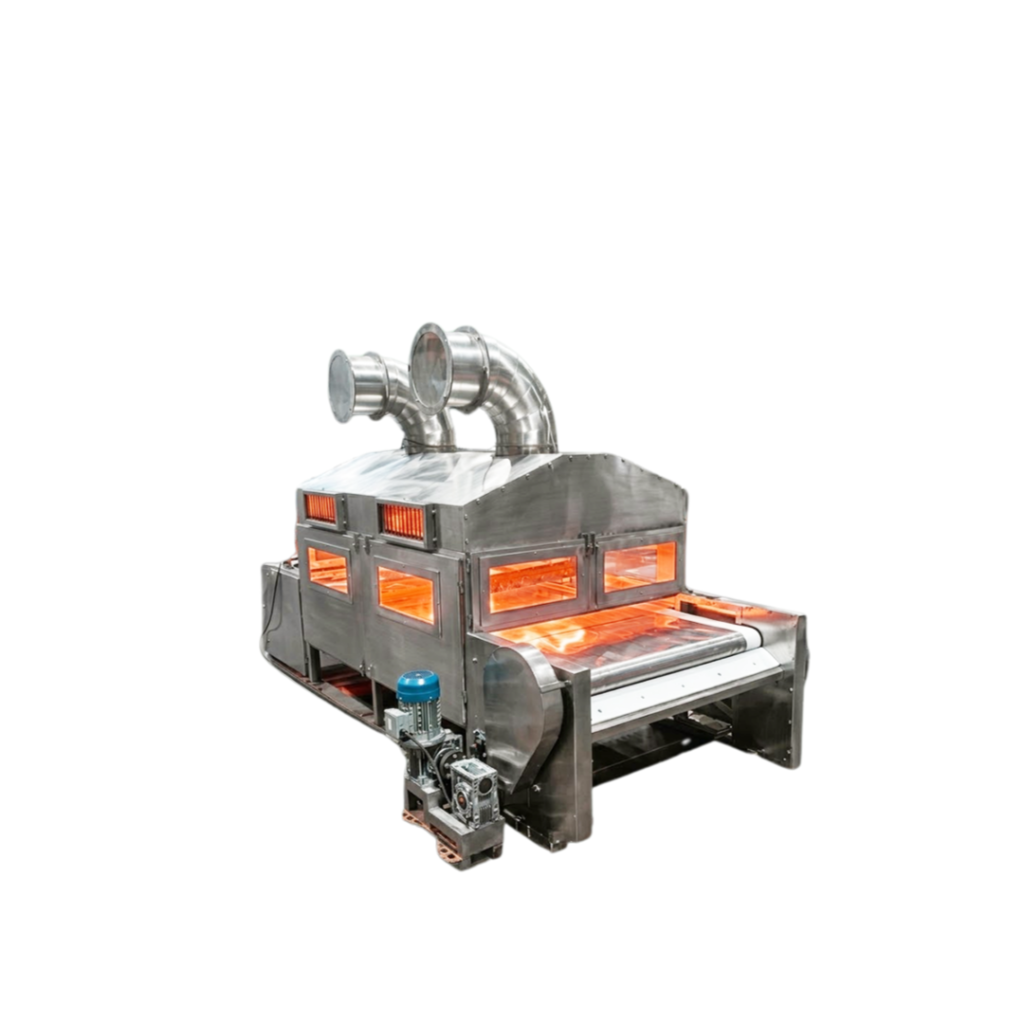
At GTI Dryers, every drying system is engineered after evaluating the thermal and physical properties of the product. Instead of offering standard machines, we develop customized solutions based on application requirements to optimize productivity while maintaining food quality.
Designing Around the Product Instead of the Machine
A successful drying project begins with understanding the product—not selecting equipment from a standard catalogue.
Key factors considered during engineering include:
- Initial moisture content
- Desired final moisture level
- Product viscosity
- Product layer thickness
- Sugar concentration
- Acidity (pH)
- Heat sensitivity
- Particle size
- Density
- Product stickiness
- Drying characteristics
- Production capacity
- Factory layout
- Utility availability
- Cleaning requirements
These variables determine the ideal process configuration and help ensure stable operation over the long term.
Important Design Parameters
Product Layer Thickness
The thickness of the product layer directly influences heat penetration and moisture removal.
A uniform layer promotes:
- Faster drying
- Even moisture reduction
- Better product appearance
- Consistent quality
- Improved energy utilization
Excessively thick layers can increase drying time and create uneven moisture distribution, while extremely thin layers may reduce production efficiency.
Conveyor Speed
The conveyor determines how long the product remains in the drying zone.
Proper speed selection ensures:
- Complete moisture removal
- Controlled product temperature
- Higher throughput
- Uniform product quality
- Stable production
Variable speed drives (VFDs) allow operators to fine-tune residence time according to changing production conditions.
Water Temperature Optimization
Unlike conventional hot-air systems, Refractance Window technology relies on heated water as the primary heat source.
Carefully controlled water temperature provides:
- Stable heat transfer
- Uniform drying conditions
- Reduced thermal stress
- Improved product quality
- Lower risk of overheating
Maintaining precise water temperature is essential for preserving heat-sensitive nutrients and natural pigments.
Residence Time Engineering
Residence time refers to the duration the product remains inside the dryer.
The ideal residence time depends on:
- Initial moisture
- Product composition
- Layer thickness
- Conveyor speed
- Water temperature
- Desired final moisture
Balancing these parameters improves drying consistency while minimizing unnecessary energy consumption.
Heat Transfer Engineering
Heat transfer is the foundation of Refractance Window Drying technology.
The process combines several mechanisms working together to remove moisture efficiently while protecting product quality.
Conduction
Thermal energy moves from circulating hot water through the transparent conveyor into the product.
This provides:
- Uniform heating
- Stable product temperature
- Rapid energy transfer
- Controlled thermal exposure
Thermal Radiation
Additional heat reaches the product through radiant energy, supporting even drying across the product layer.
Moisture Evaporation
As thermal energy enters the product, internal moisture migrates toward the surface and evaporates.
Controlled evaporation contributes to:
- Better texture
- Reduced shrinkage
- Improved nutritional preservation
- Higher product quality
Controlled Airflow
Airflow continuously removes evaporated moisture from the drying chamber.
Proper airflow helps maintain:
- Drying efficiency
- Stable humidity
- Uniform moisture removal
- Cleaner operating conditions
Moisture Balance in Food Drying
One of the primary engineering objectives is achieving the desired final moisture content without over-drying the product.
An optimized moisture balance improves:
- Shelf life
- Product stability
- Storage performance
- Consumer acceptance
- Packaging efficiency
Consistent moisture content also supports compliance with export quality standards and food safety requirements.
Energy Efficiency Strategies
Energy consumption significantly influences operating costs in food processing plants.
GTI Dryers integrates multiple engineering strategies to improve thermal efficiency while maintaining product quality.
Optimized Heat Transfer
Efficient heat transfer minimizes energy losses and supports rapid drying.
Insulated Construction
Proper insulation reduces heat loss to the surrounding environment and improves overall system efficiency.
Variable Speed Drives (VFD)
Adjustable motor speeds help optimize production while reducing unnecessary power consumption.
Intelligent Process Control
Automatic monitoring and control systems continuously adjust operating conditions according to production requirements.
Efficient Water Circulation
Optimized water circulation improves thermal uniformity while reducing energy demand.
Hygienic Design for Food Processing
Food processing equipment must comply with strict hygiene standards.
Key hygienic design features include:
- Stainless steel construction (SS304/SS316)
- Smooth product-contact surfaces
- Food-grade components
- Easy-access inspection doors
- Minimal dead zones
- Easy cleaning
- Sanitary welds
- Corrosion-resistant materials
These features support compliance with HACCP, GMP, and international food safety practices.
Automation & Smart Process Control
Modern food manufacturers increasingly rely on automation for consistent quality and improved operational efficiency.
Typical automation features include:
- PLC control
- Touchscreen HMI
- SCADA integration
- Variable Frequency Drives
- Temperature monitoring
- Conveyor speed control
- Alarm systems
- Data logging
- Remote diagnostics
- Production reporting
Automation reduces operator dependency while improving process consistency and traceability.
Refractance Window Dryer vs Other Drying Technologies
Refractance Window Dryer vs Freeze Dryer
| Feature | Refractance Window | Freeze Dryer |
| Drying Speed | Faster | Slower |
| Capital Cost | Moderate | High |
| Energy Consumption | Lower | Higher |
| Nutrient Retention | Excellent | Excellent |
| Operating Cost | Lower | Higher |
| Continuous Operation | Yes | Generally Batch |
Best Choice: Refractance Window Drying is often preferred for manufacturers seeking a balance between premium product quality, continuous production, and operational efficiency.
Refractance Window Dryer vs Spray Dryer
| Feature | Refractance Window | Spray Dryer |
| Product Form | Purees, Pastes, Thin Layers | Liquids & Slurries |
| Drying Temperature | Lower | Higher |
| Color Retention | Excellent | Good |
| Aroma Preservation | Better | Moderate |
| Heat Sensitivity | Excellent | Moderate |
| Suitable for Whole Food Ingredients | Yes | Limited |
Refractance Window Dryer vs Belt Dryer
| Feature | Refractance Window | Belt Dryer |
| Product Layer | Thin Film | Thick Bed |
| Heat Source | Heated Water | Heated Air |
| Product Quality | Premium | High |
| Nutrient Retention | Excellent | Good |
| Drying Method | Gentle | Conventional Continuous |
Refractance Window Dryer vs Rotary Drum Dryer
| Feature | Refractance Window | Rotary Drum |
| Product Type | Food Ingredients | Bulk Solids |
| Product Handling | Gentle | Aggressive |
| Temperature Exposure | Lower | Higher |
| Food Applications | Excellent | Limited |
| Nutritional Preservation | Excellent | Moderate |
Common Processing Challenges and Solutions
| Challenge | Possible Cause | Recommended Solution |
| Uneven Drying | Variable layer thickness | Improve product distribution |
| Product Sticking | High sugar content | Optimize layer thickness and process parameters |
| Reduced Product Quality | Excessive temperature | Optimize water temperature and residence time |
| High Moisture | Conveyor speed too high | Increase residence time |
| Low Throughput | Thick product layer | Optimize feed distribution |
| Surface Cracking | Rapid moisture loss | Fine-tune drying conditions |
Preventive Maintenance Practices
Reliable operation depends on routine maintenance.
Daily
- Inspect conveyor
- Verify water circulation
- Check temperatures
- Clean product-contact areas
Weekly
- Inspect drive systems
- Check pumps
- Verify sensors
- Inspect seals
Monthly
- Calibrate instruments
- Inspect insulation
- Check automation systems
- Review operating data
Annual
- Complete mechanical inspection
- Replace worn components
- Validate process performance
- Review preventive maintenance schedule
Global Applications
Refractance Window Drying supports premium food manufacturing across international markets, including:
- 🇮🇳 India – Fruit powders, herbal ingredients, nutraceuticals
- 🇺🇸 USA – Functional foods, premium ingredients
- 🇨🇦 Canada – Botanical extracts, health foods
- 🇩🇪 Germany – Organic food processing
- 🇫🇷 France – Gourmet fruit and vegetable ingredients
- 🇮🇹 Italy – Tomato products and specialty foods
- 🇧🇷 Brazil – Tropical fruit processing
- 🇮🇩 Indonesia – Coconut, spices, herbal products
- 🇻🇳 Vietnam – Agricultural value-added processing
- 🇹🇭 Thailand – Fruit exports and herbal ingredients
- 🇦🇺 Australia – Functional food ingredients
- Middle East & Africa – Food preservation and export-oriented processing
Why Leading Food Manufacturers Choose GTI Dryers
Selecting a drying system is more than purchasing equipment—it’s an investment in product quality, operational efficiency, and long-term business growth. Food manufacturers require solutions that are tailored to their process, production goals, and quality standards rather than a generic machine.
GTI Dryers follows an engineering-first approach. Every project begins with understanding the customer’s product, process requirements, and production objectives before proposing a customized drying solution.
Our focus is on delivering systems that integrate seamlessly into existing production lines while supporting consistent product quality, efficient operation, and future scalability.
What Sets GTI Dryers Apart
- Customized engineering based on product characteristics
- Hygienic stainless-steel construction
- Continuous process optimization
- Energy-efficient thermal design
- PLC, HMI & SCADA automation
- Turnkey project execution
- Factory Acceptance Testing (FAT)
- Site Acceptance Testing (SAT)
- Installation & commissioning support
- Operator training
- Preventive maintenance guidance
- Long-term technical support
Our Turnkey Project Execution Process
A successful drying project requires more than equipment manufacturing. GTI Dryers follows a structured workflow to ensure every installation meets customer expectations.
1. Process Consultation
The project begins with understanding:
- Product characteristics
- Initial moisture
- Target moisture
- Production capacity
- Utility availability
- Space constraints
- Product quality expectations
2. Product Evaluation
Engineers analyze:
- Moisture behavior
- Heat sensitivity
- Product consistency
- Drying characteristics
- Production goals
This helps determine the most suitable process configuration.
3. Thermal Process Design
Engineering calculations consider:
- Heat transfer
- Moisture removal
- Residence time
- Conveyor speed
- Water temperature
- Product layer thickness
- Energy efficiency
4. Mechanical Engineering
The equipment is designed for:
- Hygienic operation
- Structural reliability
- Easy maintenance
- Long service life
- Continuous production
5. Manufacturing & Quality Inspection
Each system undergoes quality inspections throughout manufacturing to verify fabrication accuracy, dimensional consistency, and compliance with project specifications.
6. Factory Acceptance Testing (FAT)
Before shipment, customers can review equipment performance under predefined testing procedures.
7. Installation & Commissioning
GTI Dryers supports installation, system integration, and process commissioning to help customers achieve stable production from the start.
8. Operator Training
Training programs typically cover:
- Equipment operation
- Safety practices
- Process monitoring
- Cleaning procedures
- Preventive maintenance
- Basic troubleshooting
9. After-Sales Technical Support
Long-term support may include:
- Technical consultation
- Spare parts assistance
- Maintenance recommendations
- Process optimization guidance
- Operational support
How to Select the Right Refractance Window Drying System
Every food processing application has unique technical requirements. Selecting the right system begins with evaluating the product and production process rather than focusing only on equipment size.
Product Characteristics
Consider:
- Fruit puree
- Vegetable puree
- Herbal extract
- Botanical ingredients
- Dairy formulations
- Plant-based products
- Functional food ingredients
Moisture Content
Evaluate:
- Initial moisture level
- Desired final moisture
- Storage requirements
- Product stability
Production Capacity
Estimate:
- Daily throughput
- Peak production
- Seasonal demand
- Future expansion
Product Quality Objectives
Determine whether priority is given to:
- Nutrient retention
- Color preservation
- Aroma protection
- Flavor quality
- Texture
- Functional ingredients
Automation Requirements
Automation options may include:
- PLC controls
- Touchscreen HMI
- SCADA integration
- Remote monitoring
- Production data logging
Utility Availability
Review:
- Water supply
- Electrical load
- Steam or hot water availability
- Factory infrastructure
Industries Benefiting from Advanced Food Drying
Refractance Window technology supports value-added processing in industries such as:
- Fruit processing
- Vegetable processing
- Herbal products
- Organic food manufacturing
- Functional foods
- Nutraceuticals
- Botanical extracts
- Dairy ingredients
- Superfoods
- Plant proteins
- Tea processing
- Coffee ingredients
- Natural colors
- Premium export foods
Why Customized Engineering Delivers Better Results
Standardized equipment may not account for variations in raw materials, production volumes, or quality expectations.
Customized engineering allows manufacturers to optimize:
- Product consistency
- Drying efficiency
- Throughput
- Product appearance
- Nutrient preservation
- Operational reliability
- Energy utilization
This application-specific approach supports better long-term process performance and operational flexibility.
How Food Processing Professionals Search Worldwide
International buyers often search using different engineering terms based on language and region. Including these naturally improves multilingual relevance without overusing keywords.
Common Search Terminology Around the World
| Region | Common Search Expression |
| Germany | Refraktanzfenster-Trockner |
| France | Sécheur Refractance Window |
| Spain | Secador Refractance Window |
| Italy | Essiccatore Refractance Window |
| Portugal | Secador Refractance Window |
| Netherlands | Refractance Window droger |
| Poland | Suszarka Refractance Window |
| Türkiye | Refractance Window kurutucu |
| Indonesia | Mesin Refractance Window Dryer |
| Vietnam | Máy sấy Refractance Window |
| Thailand | เครื่องอบแห้ง Refractance Window |
| Japan | リフラクタンスウィンドウ乾燥機 |
| South Korea | 리프랙턴스 윈도우 건조기 |
| China | 折射窗干燥机 |
| Arabic Markets | مجفف Refractance Window |
Instead of creating separate language pages, this section helps search engines understand that the content is relevant to a global audience while keeping the primary content in English.
Why Customers Trust GTI Dryers (EEAT)
- Application-specific engineering
- Process-oriented design
- Technical consultation
- Hygienic equipment manufacturing
- Factory testing procedures
- Installation and commissioning support
- Operator training
- Preventive maintenance guidance
- Documentation and process transparency
This approach builds confidence with both buyers and search engines.
Frequently Asked Questions (Schema-Ready)
1. What is Refractance Window Drying?
It is a low-temperature continuous drying technology that transfers heat through a transparent conveyor over heated water, helping preserve nutrients, color, flavor, and product quality.
2. Which products are suitable?
Fruit purees, vegetable purees, herbs, botanical extracts, nutraceutical ingredients, dairy formulations, and plant-based products.
3. Is it suitable for heat-sensitive products?
Yes. The controlled thermal process is designed for products that require gentle drying conditions.
4. Can it operate continuously?
Yes. It is designed for continuous production, making it suitable for commercial food processing.
5. Does it preserve nutrients?
Low-temperature processing can help retain more heat-sensitive nutrients compared with higher-temperature drying methods, depending on the product and process conditions.
6. Is the system customizable?
Yes. Systems can be engineered based on product characteristics, production capacity, and process requirements.
7. What industries use this technology?
Food processing, nutraceuticals, herbal products, botanical ingredients, dairy ingredients, and functional food manufacturing.
8. Can the system be automated?
Yes. PLC, HMI, SCADA, and production monitoring options can be incorporated based on project requirements.
9. How is product quality maintained?
By optimizing heat transfer, residence time, layer thickness, and process control.
10. Can GTI Dryers support installation?
Yes. Installation assistance, commissioning support, operator training, and after-sales technical guidance are available.
Looking for an Advanced Food Drying Solution?
Whether you’re developing premium fruit powders, vegetable ingredients, herbal extracts, functional foods, or nutraceutical products, selecting the right drying technology can significantly influence product quality, process efficiency, and long-term operational performance.
GTI Dryers works closely with manufacturers to understand their processing challenges and recommend application-specific drying solutions tailored to their production goals.
Request a consultation for:
- Product feasibility assessment
- Process evaluation
- Equipment sizing
- Plant layout recommendations
- Thermal process analysis
- Automation planning
- Budgetary quotation
- Turnkey project support