Refractance Window Dryer USA: A New Approach to High-Value Food & Nutraceutical Drying
The U.S. market for advanced drying technology is increasingly focused on product quality, energy efficiency, clean-label processing and value-added ingredients.
This is particularly important for manufacturers producing:
- Superfood powders
- Fruit and vegetable powders
- Nutraceutical ingredients
- Functional food ingredients
- Botanical extracts
- Natural food colors
- Microalgae products
- Natural pet-food ingredients
- Organic baby-food ingredients
- Fruit and vegetable purees
For these applications, conventional high-temperature drying can create challenges related to color, flavor, aroma, nutritional quality and heat sensitivity.
This creates an opportunity for technologies such as the Refractance Window (RW) Dryer, which uses a unique heat-transfer approach to dry thin layers of liquid, puree or slurry while aiming to minimize excessive thermal exposure.
For U.S. processors looking for an alternative to conventional hot-air or energy-intensive freeze-drying, industrial Refractance Window drying can be evaluated as a potential solution.
Why Is the U.S. a High-Potential Market for Refractance Window Dryers?
The United States has a large and sophisticated market for functional foods, nutraceuticals, organic foods, specialty ingredients and premium pet-food products.
At the same time, manufacturers are under continuous pressure to improve:
Product Quality → Processing Efficiency → Energy Consumption → Production Capacity → Operating Cost → Sustainability
This combination creates demand for advanced drying technologies capable of handling valuable, heat-sensitive materials.
Key U.S. application areas include:
Functional Foods
Growing demand for clean-label ingredients and functional food formulations creates opportunities for drying fruit, vegetable, botanical and other food-based ingredients.
Nutraceuticals
Nutraceutical manufacturers require controlled drying processes for ingredients where maintaining desirable functional properties, color and flavor is important.
Superfood Powders
Products such as berry, kale, spinach, botanical and algae-based ingredients can require gentle drying to preserve important product characteristics.
Natural Ingredients
Natural colors, flavors, extracts and specialty food ingredients can benefit from carefully controlled thermal processing.
Pet Food Ingredients
Premium and natural pet-food manufacturers increasingly use specialty ingredients where appearance, nutritional characteristics and ingredient quality influence product value.
Organic & Baby Food
Heat-sensitive fruit and vegetable purees and specialty ingredients may require controlled drying conditions to produce stable powders or dry ingredients.
What Is a Refractance Window Dryer?
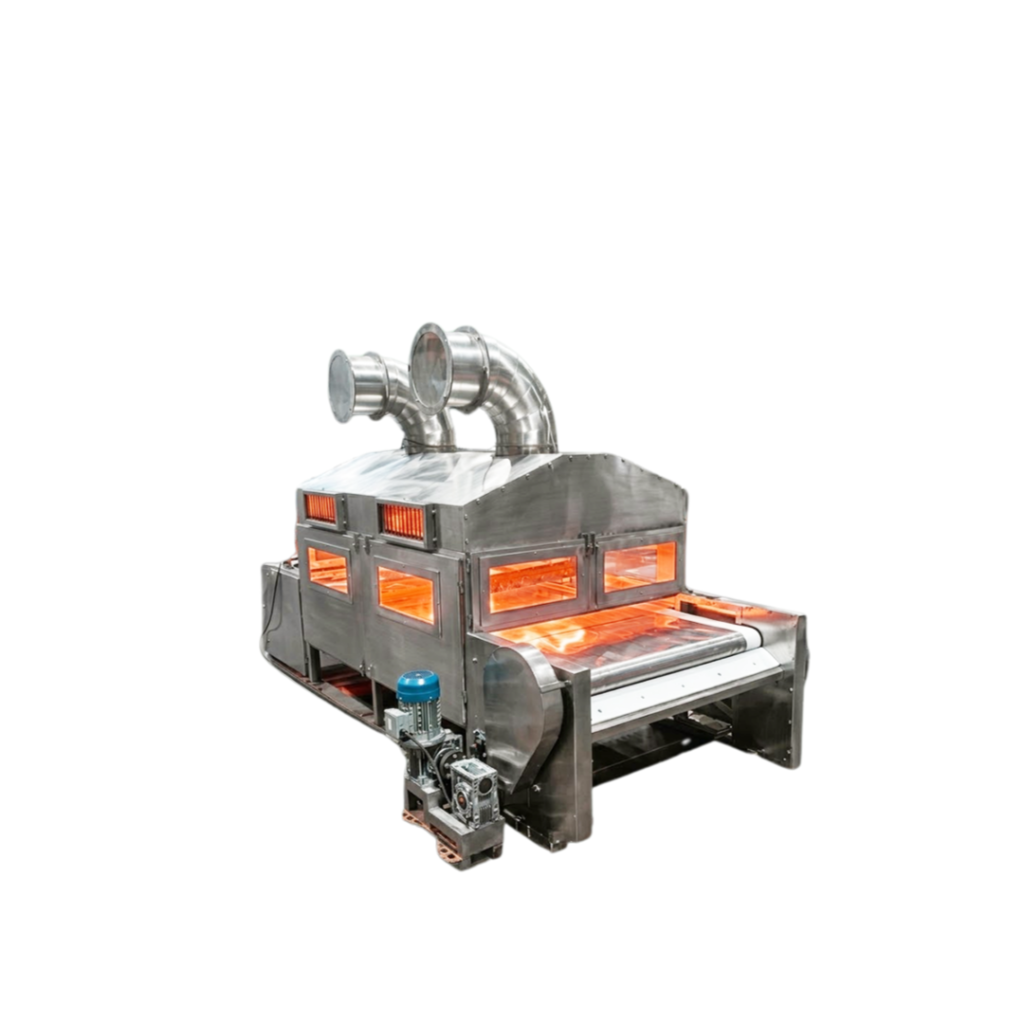
A Refractance Window Dryer is a continuous drying technology designed primarily for liquid, puree and slurry-type products.
Unlike conventional dryers that rely primarily on hot air to transfer heat to the product, RW drying uses a heated surface and a thin product layer to transfer thermal energy efficiently.
A simplified process can be represented as:
Liquid / Puree / Slurry
↓
Thin-Layer Application
↓
Controlled Heat Transfer
↓
Moisture Evaporation
↓
Dry Sheet / Flake
↓
Milling / Grinding
↓
Final Powder or Dry Ingredient
The actual operating parameters depend on the material, feed solids, viscosity, target moisture, product thickness and required production capacity.
Why U.S. Food & Nutraceutical Manufacturers Are Evaluating RW Drying
For high-value products, the cost of drying is not determined only by how quickly water is removed.
The processor must also consider:
Product Quality
Maintaining desirable color, flavor, aroma, texture and functional characteristics can be critical for premium ingredients.
Controlled Thermal Exposure
A carefully engineered drying profile can help reduce unnecessary exposure to excessive temperatures.
Continuous Production
RW systems can provide continuous drying rather than relying entirely on batch processing.
Product Recovery
Dry material can subsequently be processed into:
- Powder
- Flakes
- Granules
- Ingredient blends
depending on the application.
Energy Considerations
For commercial processors, energy efficiency is an important part of the total cost of ownership.
However, actual energy savings should be determined through material-specific drying trials and engineering calculations, rather than assumed as a fixed percentage.
Refractance Window Dryer vs Freeze Dryer
Freeze-drying is widely used for premium products requiring excellent preservation, but it can involve substantial capital investment, long processing times and significant energy requirements.
RW drying provides another technology option for suitable products.
| Parameter | Refractance Window Dryer | Freeze Dryer |
| Process | Continuous thermal drying | Vacuum sublimation |
| Feed | Purees, liquids, slurries | Frozen product |
| Production | Continuous | Typically batch-oriented |
| Processing time | Generally short | Generally long |
| Capital requirement | Application dependent | Typically high |
| Energy requirement | Application dependent | Typically high |
| Best suited for | Food ingredients, purees, nutraceuticals | Premium heat-sensitive products |
| Product form | Flakes/powder after milling | Porous dried product |
The correct choice depends on product sensitivity, desired quality, production capacity, moisture target, economics and final application.
High-Value U.S. Applications for Refractance Window Drying
1. Superfood Powder Drying
The U.S. market has strong demand for premium food ingredients and superfood powders.
Potential applications include:
- Berry powders
- Kale powder
- Spinach powder
- Vegetable powders
- Microalgae
- Botanical ingredients
- Functional plant ingredients
RW drying can be evaluated where maintaining desirable product characteristics is a priority.
2. Nutraceutical Ingredient Drying
Nutraceutical manufacturers often process high-value ingredients where conventional high-temperature drying may not provide the desired product characteristics.
Potential materials include:
- Botanical extracts
- Fruit concentrates
- Functional food ingredients
- Plant-based ingredients
- Specialty nutritional formulations
The dryer configuration should be developed around the specific feed chemistry and thermal sensitivity.
3. Fruit & Vegetable Puree Drying
Fruit and vegetable purees can be converted into stable dry ingredients for:
- Beverage formulations
- Bakery products
- Instant foods
- Nutritional products
- Ingredient blends
- Food supplements
The ability to continuously dry puree-based materials makes RW technology particularly relevant for this category.
Why GTI Dryers Can Be a Competitive Option for the U.S. Market
For a U.S. buyer, the question should not simply be:
“Where is the dryer manufactured?”
The more important question is:
“Can the manufacturer engineer and support the complete drying solution according to our process requirements?”
This is where GTI Dryers can position itself as an India-based industrial drying technology manufacturer serving international markets.
The objective should be to combine:
International Process Requirements + Indian Engineering & Manufacturing + Competitive Total Project Cost
rather than competing purely on low equipment price.
Why Consider an Indian Refractance Window Dryer Manufacturer?
India has developed a substantial engineering and manufacturing ecosystem covering mechanical fabrication, process equipment, automation and industrial machinery.
For international buyers, this can provide several potential advantages:
1. Competitive Manufacturing Economics
Indian manufacturing can provide competitive equipment and engineering costs, potentially improving overall project economics.
2. Customized Engineering
Dryers can be designed around:
- Feed characteristics
- Moisture content
- Required evaporation
- Final moisture
- Production capacity
- Product sensitivity
- Available utilities
3. Stainless-Steel Fabrication
Depending on application requirements, equipment can be manufactured using appropriate stainless-steel grades such as SS304, SS316 or SS316L.
For food, nutraceutical and specialty applications, material selection and hygienic design should be specified according to the customer’s requirements.
4. Automation Integration
A modern RW drying system can incorporate:
PLC + HMI + VFD + Temperature Control + Feed Control + Conveyor Control + Instrumentation
This enables better process monitoring and repeatability.
5. Complete Drying-System Engineering
GTI can position the project as more than a standalone dryer.
A complete system may include:
Feed Preparation → Pumping → RW Dryer → Dry Product Collection → Milling → Conveying → Packing
The exact configuration depends on the material and process.
GTI Dryers: Engineering for the U.S. Market
For entry into the U.S. market, GTI Dryers should position its Refractance Window Dryer USA offering around engineering performance rather than geography alone.
GTI’s proposed international value proposition:
Engineered in India. Designed for Global Processing Requirements.
Potential project support can include:
- Process engineering
- Dryer sizing
- Material evaluation
- Pilot testing
- Drying calculations
- Stainless-steel construction
- PLC/HMI automation
- VFD-controlled systems
- Heat-transfer optimization
- Product handling systems
- Dust collection where applicable
- Technical documentation
- Remote engineering support
- Installation and commissioning support
For U.S. projects, final equipment specifications should be developed according to the applicable application, safety, electrical, food-processing and customer-site requirements.
Refractance Window Dryer Cost in the USA: What Determines the Price?
There is no single standard price for an industrial RW dryer.
The project cost depends on factors such as:
- Feed capacity
- Water evaporation rate
- Feed solids
- Product viscosity
- Required final moisture
- Drying surface area
- Stainless-steel grade
- Automation level
- Heat source
- Product collection system
- Milling requirements
- Dust control
- Installation requirements
- Shipping and commissioning
Therefore, a reliable quotation should begin with process information rather than simply asking for the dryer price.
To estimate the project:
Feed Rate + Initial Moisture + Final Moisture + Available Heat Source + Operating Hours
↓
Water Evaporation Requirement
↓
Dryer Sizing
↓
Energy Requirement
↓
CAPEX + OPEX
↓
ROI / Payback Analysis
How to Calculate Refractance Window Dryer Capacity
A preliminary mass balance can begin with the quantity of water that must be removed.
For example:
Wet Feed = 1,000 kg/h
Initial Moisture = 80%
Therefore:
Dry Solids = 200 kg/h
If the target final moisture is 5%, the approximate final product quantity would be:
200 ÷ 0.95 = 210.5 kg/h
Approximate water evaporation:
1,000 − 210.5 = 789.5 kg/h
This provides a preliminary evaporation requirement.
Actual dryer sizing requires additional engineering parameters such as feed properties, product thickness, heat-transfer conditions, drying kinetics and operating conditions.
This is why GTI recommends pilot testing and process calculations before final equipment selection.
RW Dryer Energy Consumption: How Can U.S. Processors Reduce Operating Costs?
Energy performance should be evaluated on a kg of water evaporated or equivalent process basis.
Potential optimization strategies include:
Efficient Heat Transfer
Optimizing the heating surface and product layer can improve the use of available thermal energy.
Heat Recovery
Where technically suitable, heat from exhaust or other process streams can potentially be recovered.
Insulation
Proper insulation can reduce unnecessary thermal losses.
Automated Process Control
Temperature, feed rate and conveyor speed can be controlled to maintain stable operating conditions.
Heat Source Selection
Depending on the facility, the system may be integrated with appropriate:
- Steam
- Hot water
- Thermal oil
- Electric heating
- Other suitable thermal sources
Actual energy performance should be validated using the customer’s material and operating conditions.
Why Pilot Testing Matters Before Buying an RW Dryer
One of the biggest mistakes in industrial drying projects is selecting equipment based only on the product name.
For example:
“Fruit puree” does not automatically mean every fruit puree requires the same dryer configuration.
Different products can have significantly different:
- Solids content
- Viscosity
- Sugar concentration
- Acidity
- Thermal sensitivity
- Stickiness
- Drying behavior
Therefore, GTI can use material-specific pilot testing to evaluate:
Feed → Drying Behavior → Moisture Reduction → Product Quality → Energy Requirement → Production Rate
Pilot results can then support commercial dryer sizing and project economics.
Who in the USA Could Need a Refractance Window Dryer?
Food Manufacturing
- Food ingredient manufacturers
- Fruit processors
- Vegetable processors
- Functional food companies
- Ingredient suppliers
Nutraceuticals
- Nutraceutical manufacturers
- Botanical ingredient companies
- Dietary supplement ingredient suppliers
Specialty Ingredients
- Natural color manufacturers
- Flavor companies
- Plant-based ingredient manufacturers
- Microalgae processors
Pet Food
- Premium pet-food manufacturers
- Natural pet-food ingredient suppliers
Research & Product Development
- Food technology companies
- Ingredient R&D centers
- Pilot-scale processing facilities
- Universities and food research organizations
U.S. Targeting GTI Dryers
Priority States
California
Fruit processing, agricultural ingredients, nutraceuticals and specialty food production.
Texas
Large-scale food manufacturing, ingredients and industrial processing.
New York
Food, nutraceutical and specialty ingredient businesses.
New Jersey
Pharmaceutical, nutraceutical, chemical and food-processing industries.
Illinois
Large food manufacturing and ingredient-processing ecosystem.
Wisconsin
Dairy, food ingredients and nutritional products.
Minnesota
Food processing, agricultural products and nutraceutical applications.
Washington
Fruit processing, agricultural ingredients and specialty food products.
This creates location-specific search opportunities such as:
Refractance Window Dryer California
RW Dryer Manufacturer USA
Refractance Window Dryer Texas
Industrial Food Dryer USA
Nutraceutical Dryer USA
Fruit Puree Dryer USA
Superfood Powder Dryer USA
Refractance Window Dryer Supplier USA
Frequently Asked Questions About Refractance Window Dryers in the USA
What is a Refractance Window Dryer?
A Refractance Window Dryer is a continuous drying system primarily used for liquids, purees and slurries. It transfers heat through a heated surface and a thin product layer to remove moisture.
What products can be dried using an RW Dryer?
Potential applications include fruit purees, vegetable purees, nutraceutical ingredients, functional foods, botanical products, natural colors and specialty food ingredients. Suitability must be confirmed through product testing.
Is a Refractance Window Dryer better than a freeze dryer?
Not universally. RW drying and freeze-drying use different mechanisms and are suited to different applications. The appropriate technology depends on product sensitivity, quality requirements, capacity and economics.
How much does an industrial RW Dryer cost?
The cost depends on capacity, evaporation rate, construction materials, automation, heating system, product handling and other project requirements. A customized quotation is more meaningful than a generic price.
Can GTI Dryers supply an RW Dryer to the USA?
GTI Dryers is an India-based industrial drying equipment manufacturer that can develop customized drying solutions for international projects. Export requirements, site conditions, documentation and applicable U.S. standards should be defined during project engineering.
Can GTI test my product before designing the dryer?
Material-specific testing can help determine drying behavior, moisture removal, product quality and preliminary energy requirements before commercial equipment sizing.
Why GTI Dryers for Refractance Window Drying?
For U.S. processors evaluating advanced drying technology, GTI Dryers can offer a combination of:
Process Engineering
Customized Equipment
Competitive Manufacturing
Automation
Pilot Testing
Drying Calculations
International Project Support
The objective is not simply to supply an RW dryer.
It is to develop a complete drying solution around the customer’s material and production requirements.
Ready to Evaluate Refractance Window Drying for Your U.S. Plant?
If your company is processing fruit purees, vegetable products, superfoods, nutraceutical ingredients, botanical extracts, functional foods, natural colors or specialty ingredients, Refractance Window drying may be worth evaluating against conventional hot-air and freeze-drying technologies.
GTI Dryers can begin with your material data and evaluate:
Feed Capacity
Initial Moisture
Target Moisture
Product Characteristics
Required Production Rate
Available Heat Source
Energy Requirements
Dryer Configuration
Estimated CAPEX & Operating Economics
Start with the process—not the machine.
Send GTI Dryers your product details for an initial drying assessment, pilot-testing discussion and customized Refractance Window Dryer proposal for your U.S. application.
GTI Dryers — Engineered in India. Designed for Global Industrial Drying Applications.