Why Germany Is a Strategic Market for Refractance Window Drying Technology
Germany represents one of Europe’s most sophisticated markets for food processing, specialty ingredients, botanical products, nutraceuticals and pharmaceutical-related manufacturing.
German manufacturers increasingly evaluate production technologies not only according to initial equipment price, but also according to:
Product Quality + Energy Efficiency + Process Control + Sustainability + Automation + Lifecycle Cost
This makes advanced drying technologies particularly relevant for products where excessive thermal exposure can affect color, flavor, aroma, nutritional characteristics or functional properties.
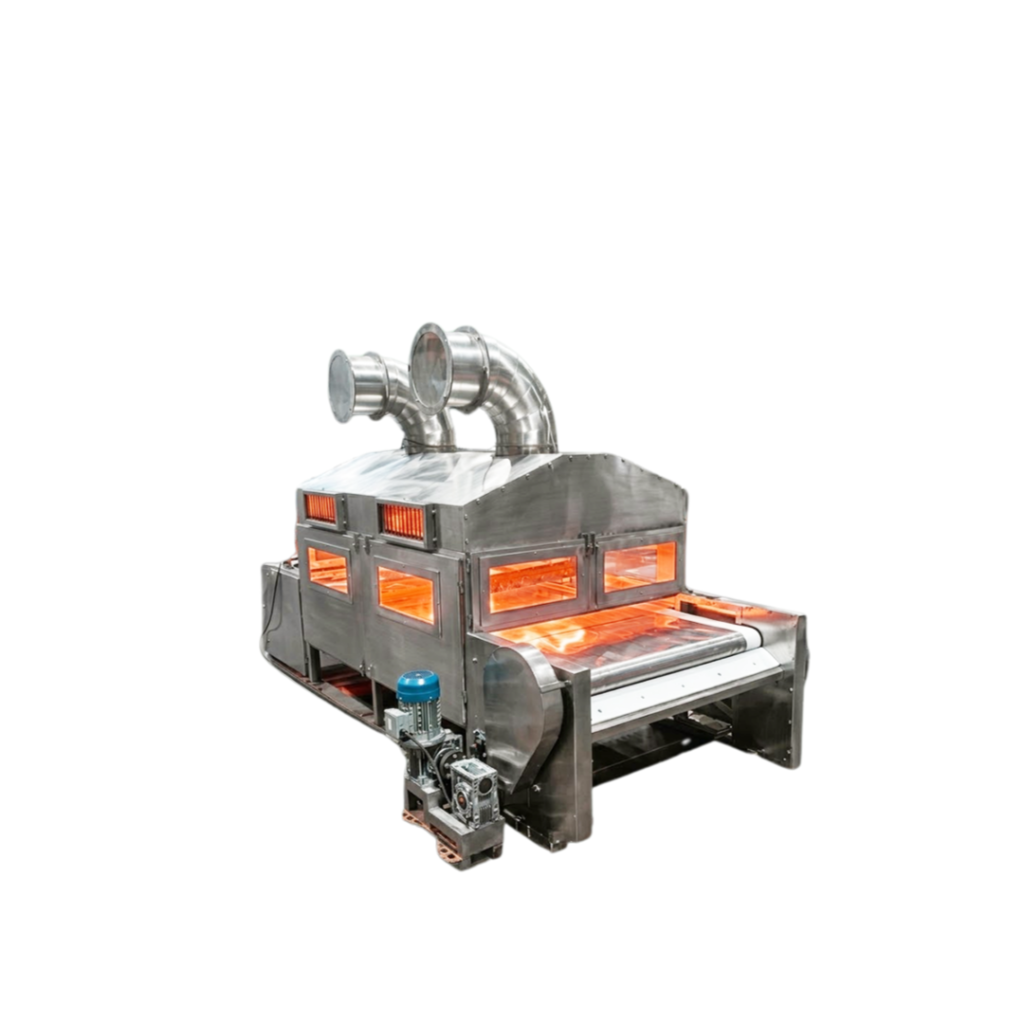
Among these technologies, Refractance Window (RW) drying offers an alternative approach for suitable liquid, puree and slurry-based products.
Potential German applications include:
- Organic food ingredients
- Botanical extracts
- Functional beverage ingredients
- Herbal products
- Nutraceutical ingredients
- Fruit and vegetable purees
- Natural colors
- Plant-based ingredients
- Specialty food powders
- High-value functional ingredients
For GTI Dryers, Germany is therefore not simply an export destination.
It represents an opportunity to introduce Indian-engineered Refractance Window drying technology to a high-specification European industrial market.
Germany’s RW Dryer Market: What Is Driving Demand?
The demand for advanced drying systems in Germany can be connected to several important market characteristics.
1. Strong Clean-Label Demand
German consumers and food manufacturers place significant importance on natural, transparent and clean-label ingredients.
This creates opportunities for dried:
- Fruits
- Vegetables
- Botanicals
- Herbs
- Plant extracts
- Natural colors
- Functional ingredients
2. Organic Food Processing
Germany has a major organic-food market, increasing the importance of controlled processing and preservation of natural ingredient characteristics.
For suitable products, low-temperature drying can be evaluated as part of a processing strategy designed to protect product quality.
3. High Energy Costs
Energy efficiency is a major consideration for European industrial processors.
A dryer consuming large quantities of thermal energy can significantly affect production economics.
Therefore, German buyers increasingly need to examine:
Energy per kg of water evaporated
rather than simply comparing the purchase price of different dryers.
4. Advanced Industrial Automation
German processing plants typically place high importance on:
- Automation
- Process repeatability
- Instrumentation
- Data monitoring
- Safety
- Predictive maintenance
- Production efficiency
An RW dryer can therefore be engineered with modern controls to integrate into an automated production environment.
GTI’s identity:
GTI Dryers is an Indian industrial drying equipment manufacturer specializing in customized drying technologies for food, pharmaceutical, chemical, biomass and specialty-material applications. The company can engineer Refractance Window drying systems around product characteristics, moisture requirements, production capacity and available utilities.
What Is a Refractance Window Dryer?
A Refractance Window Dryer is a continuous drying technology primarily designed for suitable:
Liquids + Purees + Slurries + Concentrates
The material is distributed as a thin layer over a specialized film.
Heat is transferred from a heated water surface through the film into the product, allowing moisture to evaporate.
A simplified process is:
Liquid / Puree / Slurry
↓
Thin-Layer Distribution
↓
Controlled Heat Transfer
↓
Moisture Evaporation
↓
Dry Sheet / Flake
↓
Milling
↓
Powder / Dry Ingredient
The actual drying conditions depend on the material’s solids content, viscosity, thickness, thermal sensitivity, moisture target and drying characteristics.
Why Refractance Window Drying Can Be Relevant to German Food Manufacturers
Yes, for selected liquid, puree, slurry and concentrate-based products. Refractance Window drying is particularly worth evaluating for German manufacturers producing organic food ingredients, botanical extracts, functional beverage ingredients, nutraceutical materials and other high-value products where controlled thermal processing and product quality are important.
Controlled Thermal Processing
Suitable drying conditions can be developed to minimize unnecessary thermal exposure.
Continuous Processing
RW technology can provide a continuous drying process for suitable feed materials.
High-Value Ingredient Production
The technology can be particularly interesting when the dried product has a high commercial value.
Product Quality
For appropriate products, process optimization can focus on retaining desirable:
- Color
- Flavor
- Aroma
- Nutritional characteristics
- Functional properties
Actual retention levels must be validated for each product through testing.
Germany’s Primary RW Dryer Applications
Organic Food Ingredients
Germany’s organic and natural food sectors create opportunities for dried:
- Fruit ingredients
- Vegetable ingredients
- Herbal materials
- Natural food concentrates
- Plant-based ingredients
RW drying can be evaluated for suitable puree and liquid-based feeds.
Botanical Extracts
Botanical and plant-derived ingredients can be sensitive to processing conditions.
Potential applications include:
- Botanical extracts
- Herbal concentrates
- Plant extracts
- Natural functional ingredients
The appropriate drying parameters should be established through material-specific testing.
Functional Beverages
The growing demand for functional beverages creates opportunities for dried ingredients used in:
- Instant beverage formulations
- Fruit-based beverages
- Plant-based beverages
- Functional drink mixes
- Nutritional beverages
RW drying can potentially convert suitable liquid or puree-based ingredients into stable dry forms for subsequent processing.
Herbal & Natural Products
Germany’s established pharmaceutical, herbal and natural-product ecosystem provides another potential application area.
Suitable extracts may be evaluated for drying where controlled thermal processing is required.
Refractance Window Dryer vs Freeze Dryer in Germany
Freeze drying is a well-established technology for high-value and highly sensitive products.
However, it is generally associated with significant equipment, vacuum and energy requirements.
RW drying provides another technology option for suitable materials.
| Factor | Refractance Window Dryer | Freeze Dryer |
| Feed | Suitable liquids, purees and slurries | Broad range of products |
| Process | Thin-layer thermal drying | Freezing + vacuum sublimation |
| Operation | Continuous | Commonly batch-based |
| Drying speed | Relatively rapid for suitable feeds | Generally slower |
| Capital cost | Application dependent | Generally high |
| Energy requirement | Application dependent | Generally energy intensive |
| Potential applications | Food ingredients, purees, extracts | Highly sensitive premium products |
| Final format | Sheet/flakes, then powder | Porous dried product |
Neither technology is universally superior.
The correct choice depends on:
Product + Quality Requirement + Throughput + Moisture Target + Energy + Economics
Why Energy Efficiency Matters for a German RW Dryer Project
A German manufacturer evaluating an industrial dryer should consider total lifecycle economics rather than equipment price alone.
The calculation should include:
CAPEX
Thermal Energy
Electrical Energy
Maintenance
Labor
Product Yield
Downtime
=
Total Cost of Ownership
Potential RW dryer optimization areas include:
Heat Transfer Optimization
Efficient transfer of thermal energy to the thin product layer.
Insulation
Reducing unnecessary heat losses.
Automated Feed Control
Maintaining consistent product loading.
Conveyor-Speed Control
Adjusting residence time according to product requirements.
Heat Recovery
Evaluating whether waste heat can be recovered and reused.
Process Monitoring
Continuous monitoring of operating conditions can improve process consistency.
Actual energy consumption should be calculated using the customer’s material and operating conditions.
Why Should a German Buyer Consider an Indian RW Dryer Manufacturer?
For developed-market buyers, the strongest argument for sourcing from India should not be simply lower price.
The stronger proposition is:
Advanced Engineering + Customized Manufacturing + Competitive Total Project Cost
India has a large engineering and industrial manufacturing ecosystem capable of combining:
Mechanical Engineering + Process Engineering + Fabrication + Automation + Customization
into one equipment project.
India’s engineering exports reached approximately US$122.43 billion in FY2025–26, according to the supplied market data. Industrial machinery represented an important segment of those exports, while North America and the EU were among the major regional destinations.
This demonstrates that Indian engineering companies are increasingly participating in international industrial supply chains.
For a German buyer, this can create an opportunity to evaluate a supplier based on engineering capability and total project value, rather than country of origin alone.
India’s Advantage for German Industrial Buyers
| India Advantage | What It Can Mean for German Buyers |
| Engineering + manufacturing | Fewer interfaces between suppliers |
| Competitive manufacturing | Potentially lower project CAPEX |
| Custom equipment | Suitable for specialized applications |
| SS304/SS316/SS316L fabrication | Suitable material options for demanding applications |
| Process engineering | Dryer designed around actual product requirements |
| PLC/HMI/VFD automation | Integration with modern plant controls |
| Flexible heating options | Opportunity to optimize plant utilities |
| Turnkey integration | Dryer and auxiliary equipment from one engineering partner |
| Export-oriented manufacturing | More practical international project execution |
| Remote technical support | Ongoing engineering assistance after delivery |
“Evaluate Indian engineering as a competitive source for customized industrial drying technology while maintaining the technical specifications required for your application.”
GTI Dryers: Refractance Window Technology for the German Market
GTI Dryers can position its RW dryer offering around process engineering, customization and international project support.
A German customer may require more than a standard machine.
The project can begin with:
Product Characterization
↓
Feed & Moisture Analysis
↓
Drying Trial
↓
Evaporation Calculation
↓
RW Dryer Sizing
↓
Energy Evaluation
↓
Equipment Engineering
↓
Automation
↓
Fabrication
↓
Inspection & Testing
↓
Export
↓
Installation / Commissioning Support
This engineering-led approach allows the dryer to be developed around the customer’s actual process rather than relying on a generic equipment configuration.
Materials & Construction for German Applications
Depending on the product and hygiene requirements, GTI can engineer equipment using suitable stainless-steel construction.
Potential materials include:
SS304
SS316
SS316L
Material selection should be determined according to:
- Product chemistry
- Corrosion requirements
- Hygiene requirements
- Cleaning process
- Operating temperature
- Applicable customer specifications
For food, nutraceutical and pharmaceutical-related applications, the final design should be reviewed against the relevant European and customer-specific requirements.
Automation: An Important Part of the German RW Dryer
A modern RW dryer can be integrated with:
PLC
↓
HMI
↓
VFD
↓
Temperature Sensors
↓
Feed Control
↓
Conveyor Control
↓
Alarm Management
↓
Data Monitoring
The objective is to achieve stable operating conditions and repeatable production.
For German industrial plants, automation can also make it easier to integrate the dryer into an existing production line.
How Much Does a Refractance Window Dryer Cost in Germany?
There is no universal price for an industrial RW dryer.
The cost depends on:
- Feed capacity
- Water evaporation requirement
- Product solids
- Feed viscosity
- Final moisture
- Drying surface area
- Stainless-steel specification
- Automation level
- Heating system
- Product collection
- Milling system
- Installation
- Shipping
- Commissioning
A preliminary project estimate should therefore begin with the material and process data.
Basic Engineering Inputs
Feed Rate
Initial Moisture
Final Moisture
Operating Hours
Available Heat Source
=
Preliminary Dryer Requirement
How to Calculate RW Dryer Capacity
Consider a hypothetical example:
Feed = 1,000 kg/h
Initial Moisture = 80%
Dry solids:
1,000 × 20% = 200 kg/h
If the final product contains 5% moisture:
Final Product ≈ 200 ÷ 0.95 = 210.5 kg/h
Approximate water evaporation:
1,000 − 210.5 = 789.5 kg/h
Therefore, the preliminary evaporation requirement is approximately:
790 kg/h of water
Actual commercial dryer sizing requires additional information such as drying kinetics, product thickness, feed properties, heat-transfer performance and target operating conditions.
Is RW Drying Suitable for Your German Product?
This is one of the most important questions.
RW drying may be worth evaluating if your product is:
- Liquid
- Puree
- Slurry
- Concentrate
- Extract
- Heat-sensitive
- High-value
- Intended for powder production
It may not be the best choice for every product.
For example, a conventional spray dryer may be more appropriate for certain large-scale liquid-to-powder applications, while a freeze dryer may remain preferable for specific highly sensitive products.
The correct technology should therefore be selected through process engineering and product testing.
Why Pilot Testing Is Critical for German Buyers
A laboratory or pilot drying test can answer questions that a brochure cannot.
GTI can evaluate:
How quickly does the product dry?
What final moisture can be achieved?
How does the product behave during drying?
What happens to color and flavor?
What is the approximate evaporation capacity?
What energy requirement should be expected?
What dryer configuration is appropriate?
This creates a more reliable basis for commercial investment.
Germany Strategy: Where GTI Can Target RW Dryer Leads
Bavaria
Target:
Refractance Window Dryer Bavaria
Food Drying Equipment Bavaria
Nutraceutical Dryer Germany
North Rhine-Westphalia
Target:
Industrial Food Dryer NRW
RW Dryer Manufacturer Germany
Industrial Drying Equipment NRW
Baden-Württemberg
Target:
Refractance Window Dryer Baden-Württemberg
Food Processing Dryer Germany
Lower Saxony
Target:
Food Drying Equipment Lower Saxony
Industrial Dryer Germany
Hamburg
Target:
Industrial Dryer Supplier Hamburg
Food Ingredient Drying Germany
These location-focused pages can support the primary national keyword:
Refractance Window Dryer Germany
Frequently Asked Questions
What is a Refractance Window Dryer used for?
It is primarily used for suitable liquid, puree, slurry and concentrate materials that need to be converted into stable dry products.
Can RW dryers be used for organic food ingredients?
Potentially, yes. Suitable organic fruit, vegetable, botanical and other food ingredients can be evaluated through product-specific drying trials.
Can RW dryers produce nutraceutical powders?
Suitable nutraceutical liquids, extracts and puree-based ingredients can potentially be dried and subsequently milled into powder.
Is RW drying energy efficient?
RW drying can offer attractive energy performance for suitable applications, but actual energy consumption depends on the product, moisture removal, heat source, operating conditions and system design.
Is RW drying cheaper than freeze drying?
It can potentially offer lower capital and operating costs for suitable applications, but the economics must be calculated for the specific product and production capacity.
Can GTI Dryers export RW dryers to Germany?
GTI Dryers is an India-based industrial drying equipment manufacturer developing customized drying solutions for international applications. German projects can be engineered around the customer’s technical, documentation, safety, electrical and installation requirements.
Can GTI Dryers test a product before manufacturing?
Product testing and pilot evaluation can be used to determine drying behavior and support commercial dryer sizing where testing facilities and project requirements permit.
The Opportunity for RW Drying in Germany
Germany’s combination of:
Clean-Label Foods
Organic Ingredients
Botanical Products
Functional Beverages
Nutraceuticals
Energy-Conscious Manufacturing
Advanced Automation
makes it an attractive market for specialized drying technologies.
For suitable applications, Refractance Window drying can provide German processors with another option between conventional hot-air drying and more capital- and energy-intensive technologies.
GTI Dryers: Engineered in India for Global Drying Applications
For GTI Dryers, entering Germany should not be about competing purely on equipment price.
The stronger strategy is to compete on:
Engineering + Customization + Process Understanding + Manufacturing Value + International Support
GTI can offer German customers an opportunity to evaluate Refractance Window drying technology around their actual product and production requirements.
Whether the requirement involves organic fruit ingredients, botanical extracts, functional beverage ingredients, nutraceutical materials or other specialty food products, the project should begin with the material—not the machine.
Looking for a Refractance Window Dryer in Germany?
Share your:
Product | Feed Rate | Initial Moisture | Final Moisture | Product Temperature | Available Heat Source | Required Production Capacity
with GTI Dryers.
Our engineering team can evaluate the application and develop a preliminary drying concept, capacity calculation and customized RW dryer solution for your German processing facility.
GTI Dryers
Advanced Drying Technology. Engineered & Manufactured in India. Designed for Global Industrial Applications.
This version gives GTI a stronger Germany-specific commercial position: it targets German cities/regions, German/EU buyer concerns, informational searches, price/capacity searches, technology-comparison searches, and finally converts those visitors toward a material-testing/quotation enquiry rather than making unsupported “cheap Indian machinery” claims.