Refractance Window Drying in Europe: Why the Technology Is Gaining Attention
Across Europe, food and ingredient manufacturers are under increasing pressure to balance product quality, energy efficiency, sustainability, production costs and consumer expectations.
The European processing industry is particularly interesting for advanced drying technologies because many manufacturers work with high-value and heat-sensitive materials such as:
- Fruit and vegetable purees
- Organic food ingredients
- Botanical extracts
- Herbal ingredients
- Nutraceuticals
- Functional food ingredients
- Natural colors
- Functional beverage ingredients
- Plant-based ingredients
- Specialty food powders
For these products, conventional high-temperature drying may not always provide the desired balance between drying speed and product quality.
At the other end of the spectrum, freeze drying can provide excellent product preservation but may involve substantial capital and operating requirements.
This creates an opportunity to evaluate Refractance Window (RW) drying technology as an alternative for suitable liquid, puree, slurry and concentrate-based products.
What Is a Refractance Window Dryer?
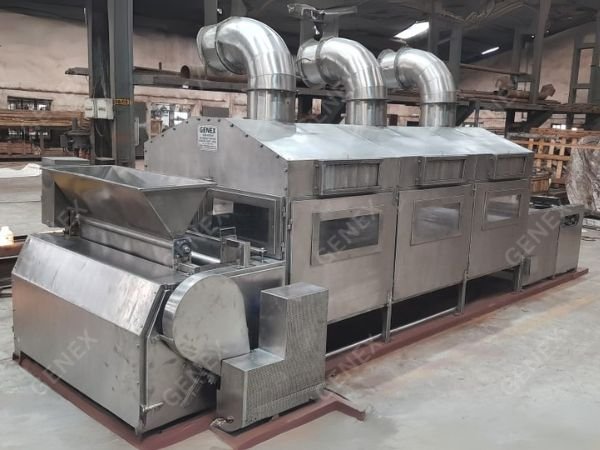
A Refractance Window Dryer is a continuous drying system designed primarily for suitable liquid, puree, slurry and concentrated feed materials.
The product is spread as a thin layer over a specialized drying surface.
Heat is transferred through the surface into the product, causing moisture to evaporate.
A simplified process is:
Liquid / Puree / Slurry
↓
Thin-Layer Spreading
↓
Controlled Heat Transfer
↓
Moisture Evaporation
↓
Dry Sheet / Flake
↓
Milling
↓
Powder / Dry Ingredient
The actual drying performance depends on product properties such as:
Moisture + Solids Content + Viscosity + Layer Thickness + Thermal Sensitivity + Residence Time
Why Europe Is an Important Market for RW Drying
Europe combines several conditions that make advanced drying technology commercially relevant.
1. Energy Efficiency Is a Major Industrial Priority
European processors increasingly evaluate production equipment based on energy consumption and overall lifecycle economics.
For drying applications, the key engineering question is not simply:
“How much does the dryer cost?”
It is:
“How much does it cost to remove each kilogram of water?”
This makes thermal efficiency, heat recovery, insulation, airflow management and process control important considerations when selecting industrial drying equipment.
2. Strong Clean-Label & Organic Food Demand
European consumers increasingly seek products positioned around:
Natural + Organic + Clean Label + Minimal Processing
This creates opportunities for manufacturers producing powders from:
- Fruits
- Vegetables
- Herbs
- Botanicals
- Natural extracts
- Functional ingredients
- Plant-based materials
RW drying can be evaluated for suitable products where maintaining desirable color, aroma, flavor and nutritional characteristics is important.
However, actual nutrient retention must always be validated for the individual product and process conditions.
3. Carrier-Free Powder Production
Some fruit and plant-based products can present challenges during conventional drying because of their sticky or hygroscopic nature.
Manufacturers may use carriers or processing aids in certain powder-production processes.
For suitable formulations, RW drying can provide an alternative route for converting concentrated purees or extracts into a dry sheet or flake that can subsequently be milled.
This can be particularly relevant to manufacturers developing:
Clean-label fruit powders + Botanical powders + Natural colors + Functional ingredients
The suitability of carrier-free processing depends on the product’s sugar content, solids, glass-transition behavior, viscosity and drying characteristics.
Europe’s RW Dryer Market: Three Major Opportunity Zones
Rather than treating Europe as one uniform market, GTI can target three major application regions.
1. Germany & Central Europe
Primary Applications
Germany and Central European markets provide potential opportunities in:
- Organic food powders
- Botanical extracts
- Herbal ingredients
- Functional beverages
- Nutraceutical ingredients
- Fruit and vegetable concentrates
- Natural food ingredients
Why This Region Matters
Germany has a sophisticated food-processing and ingredient ecosystem and strong interest in energy-efficient industrial equipment, automation and sustainable production.
For processors working with heat-sensitive botanical, fruit or functional ingredients, RW drying can be evaluated as a controlled low-temperature drying option.
The German buyer is likely to focus on:
Product Quality
Energy Consumption
Automation
Hygienic Design
Documentation
Reliability
Lifecycle Cost
This makes process engineering particularly important.
Germany Search Opportunities
GTI can create supporting content targeting:
- Refractance Window Dryer Germany
- RW Dryer Germany
- Food Dryer Germany
- Organic Food Dryer Germany
- Botanical Extract Dryer Germany
- Nutraceutical Dryer Germany
2. Southern Europe — Spain, Italy & Greece
Southern Europe provides a different opportunity.
The region has significant agricultural and food-processing activity involving fruits, vegetables, herbs and other plant-based materials.
Target Applications
Potential RW dryer applications include:
- Citrus purees
- Tomato products
- Berry ingredients
- Fruit concentrates
- Herbal extracts
- Natural colors
- Olive-derived ingredients
- Functional food ingredients
Turning Seasonal Produce Into Stable Ingredients
One important opportunity is the conversion of seasonal agricultural products into higher-value, shelf-stable ingredients.
The processing concept can be:
Fresh Produce
↓
Puree / Concentrate
↓
RW Drying
↓
Dry Sheet / Flake
↓
Milling
↓
Food Powder
This can potentially reduce the volume and moisture associated with transporting and storing certain agricultural ingredients.
It also provides processors with an opportunity to develop value-added powders rather than selling only fresh or semi-processed commodities.
Southern Europe Search Opportunities
Potential location-based keywords include:
- Refractance Window Dryer Spain
- RW Dryer Italy
- Food Dryer Italy
- Fruit Puree Dryer Spain
- Botanical Dryer Greece
- Food Powder Dryer Europe
3. Northern & Eastern Europe
Northern and Eastern European markets present another interesting opportunity because of their access to forest, agricultural and marine-derived ingredients.
Potential target materials include:
- Bilberries
- Lingonberries
- Sea buckthorn
- Mushrooms
- Herbal materials
- Algae
- Marine ingredients
- Functional plant extracts
These products can have significant commercial value when processed into functional powders and specialty ingredients.
RW Drying vs Conventional Hot-Air Drying
For suitable heat-sensitive products, uncontrolled or excessive thermal exposure can negatively affect desirable product characteristics.
RW drying can therefore be evaluated where manufacturers require:
Controlled Drying + Short Processing Time + Continuous Operation + Product Quality
However, actual performance should be established through pilot testing rather than assuming RW will outperform every alternative.
The European Clean-Label Opportunity
One of the strongest commercial opportunities for RW dryers is the growing demand for clean-label functional ingredients.
Food manufacturers increasingly develop products around:
“What is NOT added?”
rather than only:
“What is added?”
This creates opportunities for processing technologies that can produce dry ingredients while minimizing unnecessary formulation aids where technically feasible.
Potential products include:
- Fruit powders
- Vegetable powders
- Botanical powders
- Herbal extracts
- Natural food colors
- Functional beverage ingredients
- Nutraceutical ingredients
- Plant-based ingredients
For each product, GTI should evaluate whether RW drying can achieve the required:
Moisture + Water Activity + Powder Recovery + Flowability + Color + Flavor + Stability
RW Dryer vs Freeze Dryer for European Processors
Freeze drying remains an important technology for products requiring extremely gentle processing.
However, European processors may evaluate RW drying where continuous processing and economics are important.
| Parameter | Refractance Window Dryer | Freeze Dryer |
| Feed | Suitable liquids, purees & slurries | Broad range of products |
| Operation | Continuous | Often batch-based |
| Drying mechanism | Controlled thermal transfer | Freezing + vacuum sublimation |
| Processing time | Potentially short for suitable products | Generally longer |
| Product format | Sheet/flakes → powder | Porous dried product |
| Capital requirement | Application dependent | Generally high |
| Energy requirement | Application dependent | Generally energy intensive |
| Best suited for | Selected food, botanical & functional ingredients | Highly sensitive premium products |
The correct choice depends on product characteristics, required quality, production volume and economics.
How European Buyers Should Evaluate an RW Dryer
A professional dryer selection should begin with the product.
Step 1: Analyze the Feed
GTI should evaluate:
- Feed rate
- Initial moisture
- Solids concentration
- Viscosity
- Particle characteristics
- Sugar content
- Stickiness
- Thermal sensitivity
- pH
- Density
Step 2: Define the Final Product
The buyer should establish:
- Final moisture
- Water activity
- Product temperature
- Particle size
- Powder characteristics
- Shelf-life requirements
- Packaging requirements
Step 3: Calculate Evaporation
A preliminary calculation can be based on:
Feed Rate → Dry Solids → Final Moisture → Water Evaporation
For example, if a feed contains 80% moisture, the majority of the drying load will be associated with removing water.
The actual dryer capacity must then be established from drying kinetics and pilot testing.
Step 4: Conduct Product Testing
Pilot testing can determine:
Drying Rate + Product Quality + Final Moisture + Energy Requirement + Product Recovery
This creates a much stronger basis for selecting commercial equipment.
How Energy Efficiency Can Be Improved in European RW Dryer Systems
Energy performance should be considered during the engineering stage.
Potential optimization measures include:
Heat Recovery
Evaluate whether usable exhaust or process heat can be recovered.
Thermal Insulation
Minimize heat loss from heated surfaces and associated process equipment.
Feed Optimization
Maintaining consistent feed thickness can improve drying uniformity.
Conveyor-Speed Control
Residence time can be adjusted according to product requirements.
Temperature Control
Automated temperature control can help maintain consistent drying conditions.
Heat Source Optimization
Depending on plant utilities, the system may be designed around suitable heating options.
The final energy consumption should be calculated from the actual product and process rather than using a universal percentage.
Why European Buyers Should Consider an Indian RW Dryer Manufacturer
For a developed-market buyer, the strongest argument for Indian manufacturing is not simply low price.
It is:
Advanced Engineering + Custom Manufacturing + Competitive Total Project Cost
India has developed a large engineering and machinery manufacturing ecosystem.
According to the supplied data, India’s engineering exports reached approximately US$122.43 billion in FY2025–26, with industrial machinery representing a significant export segment and North America and the EU among major regional destinations.
For European buyers, this provides an important context:
Indian manufacturing can be evaluated as an international engineering supply option—not simply as a low-cost manufacturing source.
A capable Indian dryer manufacturer can potentially combine:
Process Engineering
Mechanical Engineering
Stainless-Steel Fabrication
Automation
Customized Manufacturing
Export Support
into one project.
What GTI Dryers Can Bring to the European Market
GTI Dryers can position its European RW dryer offering around the following capabilities:
Process-Based Engineering
The dryer can be designed around:
Feed Moisture + Product Properties + Evaporation Load + Final Moisture + Production Capacity
rather than simply selecting a standard machine.
Stainless-Steel Construction
Depending on application requirements, construction can be engineered using:
SS304 / SS316 / SS316L
with the final material specification determined by the product and process.
Industrial Automation
Possible control systems include:
- PLC
- HMI
- VFD
- Temperature monitoring
- Feed control
- Conveyor control
- Alarm management
- Process instrumentation
Customized Heating Systems
The dryer can be engineered around the available plant utilities and appropriate heat source.
Complete Drying Lines
Where required, the project can be developed beyond the dryer itself to include suitable:
Feed System → Dryer → Product Collection → Milling → Conveying → Packing
This can reduce the number of engineering interfaces for the customer.
Why GTI’s “Engineered in India” Positioning Matters
A stronger positioning is:
“International Drying Technology, Engineered & Manufactured in India.”
The value proposition is:
Competitive Manufacturing
Process Engineering
Customization
Automation
Stainless-Steel Fabrication
International Project Support
This allows GTI to compete on value and engineering capability, rather than price alone.
What European Buyers Should Ask Before Buying an RW Dryer
Before investing in an industrial Refractance Window Dryer, buyers should ask:
Product Questions
- What is the initial moisture?
- What is the solids content?
- Is the feed liquid, puree or slurry?
- Is the material sticky?
- What final moisture is required?
Process Questions
- What is the required production capacity?
- How much water must be evaporated per hour?
- What drying temperature is required?
- What residence time is expected?
Quality Questions
- What color retention is required?
- What flavor retention is required?
- What nutritional characteristics need to be preserved?
- What water activity is required?
Engineering Questions
- What stainless-steel grade is required?
- What automation level is required?
- What heat source is available?
- What cleaning system is required?
- What documentation is required?
These questions help determine whether RW drying is actually appropriate for the application.
Frequently Asked Questions About Refractance Window Dryers in Europe
What is a Refractance Window Dryer?
A Refractance Window Dryer is a continuous drying system primarily used for suitable liquid, puree, slurry and concentrate-based materials.
What products can be dried using RW technology?
Potential applications include fruit purees, vegetable products, botanical extracts, functional ingredients, nutraceutical materials and other suitable liquid or slurry-based products.
Is RW drying suitable for organic food products?
It can be evaluated for suitable organic food ingredients. The final process must satisfy the applicable product, hygiene and regulatory requirements.
Is RW drying suitable for nutraceutical ingredients?
Potentially. Suitable liquid extracts and functional ingredients can be evaluated through product-specific drying trials.
Is RW drying more energy efficient than freeze drying?
RW drying can offer attractive energy economics for suitable applications, but the actual comparison depends on the product, moisture load, operating conditions and system design.
Can RW dryers produce powder?
Yes. The dried material can typically be collected as a sheet or flake and subsequently processed through suitable milling equipment to produce a powder.
Can GTI Dryers supply RW dryers to Europe?
GTI Dryers is an Indian industrial drying equipment manufacturer that can develop customized drying solutions for international applications. European projects can be engineered around the customer’s process, material, automation and project requirements.
Refractance Window Dryer Europe: A Growing Opportunity for High-Value Ingredients
The European opportunity for RW drying is not limited to one country.
It extends across:
Germany & Central Europe
Organic Foods + Botanicals + Nutraceuticals
Spain, Italy & Greece
Fruit + Vegetable + Herbal + Agricultural Ingredients
Northern & Eastern Europe
Berries + Mushrooms + Marine Ingredients + Functional Products
Across these regions, the common requirement is increasingly clear:
Preserve Product Quality + Control Energy Consumption + Increase Processing Efficiency + Produce Higher-Value Ingredients
RW drying can be evaluated as one technology capable of addressing these requirements for suitable products.
GTI Dryers: Bringing Indian Drying Engineering to Europe
Europe’s advanced food and ingredient industry requires more than a standard dryer.
It requires a process solution.
GTI Dryers can work with European manufacturers to evaluate:
Product → Moisture → Evaporation → Drying Technology → Equipment Design → Automation → Testing
The objective is to determine whether a Refractance Window Dryer is the right solution—and, where it is, develop the system around the customer’s actual production requirements.
Looking for a Refractance Window Dryer in Europe?
Send GTI Dryers your:
Product | Feed Rate | Initial Moisture | Final Moisture | Solids Content | Product Temperature | Required Capacity | Available Heat Source
GTI can evaluate the application and develop a preliminary RW dryer concept, evaporation calculation and customized drying solution for European food, botanical, nutraceutical and functional-ingredient applications.
GTI Dryers
Engineered in India. Designed for Global Drying Applications.