Refractance Window Dryer Canada: A New Approach to High-Value Food & Nutraceutical Drying
Canada’s food-processing and agricultural industries are increasingly focused on producing high-value, clean-label and shelf-stable ingredients while maintaining the natural characteristics of the raw material.
This creates an important opportunity for advanced drying technologies.
Products such as blueberries, cranberries, Saskatoon berries, marine algae, plant-based proteins, fruit purees, nutraceutical ingredients and functional food products can be sensitive to excessive thermal exposure.
For these applications, conventional high-temperature drying may not always provide the desired balance between:
Moisture Removal + Product Quality + Color Retention + Flavor Preservation + Energy Efficiency
This is where Refractance Window (RW) drying technology can become an attractive option.
GTI Dryers is exploring opportunities to supply customized Refractance Window drying systems from India to Canadian food, nutraceutical, botanical and specialty ingredient manufacturers.
Why Is Refractance Window Drying Relevant to Canada?
Canada presents a particularly interesting market for advanced drying technology because of its combination of:
- Large agricultural production
- Berry processing
- Food ingredient manufacturing
- Plant-based food production
- Nutraceutical development
- Functional food products
- Marine and botanical ingredients
- Export-oriented food processing
- Demand for clean-label products
- Increasing focus on energy-efficient processing
Canadian processors often need to transform moisture-rich materials into stable powders, flakes, sheets or concentrated dried ingredients without unnecessarily compromising their original characteristics.
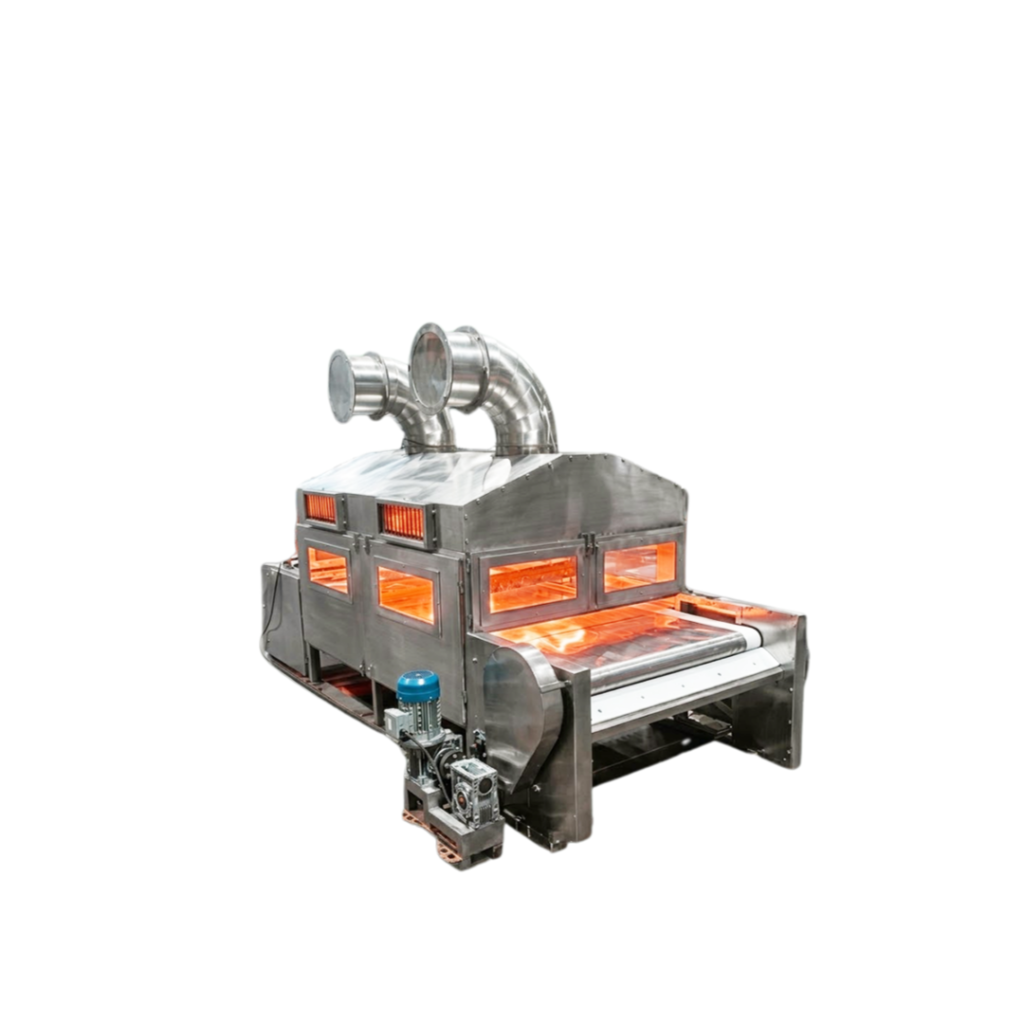
RW drying provides a controlled drying approach in which a thin product layer is dried through heat transfer from a heated water surface through a specialized polymer film.
The process can provide relatively rapid moisture removal while operating at controlled product temperatures.
Canada’s High-Value RW Dryer Applications
The strongest opportunities for Refractance Window dryers in Canada are not necessarily commodity products.
The technology becomes particularly interesting where product quality has a direct impact on selling price.
1. Canadian Berry Processing
Canada is well known for the production and processing of berries, creating opportunities for value-added drying.
Potential products include:
- Blueberry powders
- Cranberry powders
- Saskatoon berry ingredients
- Berry purees
- Fruit concentrates
- Functional fruit ingredients
- Natural color ingredients
- Instant beverage ingredients
Instead of selling only fresh or frozen berries, processors can convert fruit into higher-value shelf-stable ingredients for food, beverage and nutraceutical manufacturers.
2. Plant-Based Protein Ingredients
The growth of plant-based foods creates opportunities for drying:
- Plant protein extracts
- Botanical extracts
- Protein-rich slurries
- Functional ingredients
- Plant-based beverage ingredients
- Specialty food formulations
For these materials, drying conditions need to be developed around the product’s rheology, solids concentration, thermal sensitivity and desired final moisture.
3. Nutraceutical & Functional Food Powders
Canadian nutraceutical manufacturers can potentially use RW drying for suitable:
- Fruit extracts
- Vegetable concentrates
- Botanical ingredients
- Functional food ingredients
- Natural supplements
- Herbal extracts
- Antioxidant-rich formulations
The objective is not simply to remove water.
The objective is to produce a stable ingredient while maintaining desirable physical and sensory characteristics.
4. Marine Algae & Specialty Biomaterials
Canada’s marine and natural-resource sectors also create potential applications for advanced drying.
Suitable algae or marine-derived slurries may be evaluated for:
- Algae powders
- Functional ingredients
- Nutraceutical materials
- Protein-rich biomass
- Specialty extracts
However, actual suitability must be established through material testing and process trials.
Why Energy Efficiency Matters for Canadian Processors
Drying can represent a significant portion of the energy requirement in a food or ingredient manufacturing process.
This becomes particularly important when processors operate at large production volumes.
For a Canadian plant, dryer selection should therefore consider more than the equipment purchase price.
A proper evaluation should consider:
CAPEX → Thermal Energy → Electricity → Throughput → Product Yield → Maintenance → Labor → Product Quality → Lifecycle Cost
RW drying can be evaluated as an alternative to conventional drying technologies where its process characteristics match the material.
The potential advantages can include:
- Controlled product temperatures
- Efficient heat transfer
- Shorter drying exposure for suitable products
- Reduced dependence on very high air temperatures
- Compact processing configuration
- Potentially lower energy demand than some conventional technologies
- High-value product preservation
Important: Energy savings and product-retention results depend on the feed material, solids concentration, target moisture, dryer configuration and operating conditions. They should be established through pilot testing rather than treated as universal guarantees.
Refractance Window Dryer vs Freeze Dryer for Canadian Applications
Freeze drying remains an important technology for premium products requiring very high preservation.
However, freeze drying can involve significant capital and operating requirements.
For selected products, RW drying can provide an alternative approach worth evaluating.
| Parameter | Refractance Window Dryer | Freeze Dryer |
| Drying mechanism | Conductive/radiative heat transfer through a film-water interface | Sublimation under vacuum |
| Processing temperature | Controlled according to product requirements | Low product temperature |
| Drying time | Generally relatively short for suitable thin-layer feeds | Typically longer |
| Product format | Purees, slurries, extracts and suitable liquid/semi-liquid feeds | Broad range of high-value products |
| Capital requirement | Potentially lower for suitable applications | Generally high |
| Energy requirement | Potentially lower for suitable applications | Typically energy intensive |
| Best suited for | Fruit ingredients, functional foods, extracts and specialty materials | Premium products requiring freeze-drying characteristics |
The correct technology should always be selected based on product quality requirements, moisture content, throughput, formulation and economics.
What Makes Canada’s Market Different?
A Canadian dryer project cannot simply be designed around the same assumptions used in another country.
The dryer must be engineered around the actual operating environment and production requirements.
Important considerations include:
Canadian Climate
Cold ambient conditions can affect:
- Air heating requirements
- Building conditions
- Heat losses
- Utility consumption
- Startup conditions
Product Seasonality
Berry and agricultural processors may experience seasonal raw-material availability.
This makes it important to evaluate:
- Storage requirements
- Production scheduling
- Feed consistency
- Annual operating hours
- Required dryer flexibility
Food-Grade Construction
For food and nutraceutical applications, equipment may require appropriate hygienic design and materials such as:
SS304 / SS316L
depending on the product and process.
Automation
Canadian processors can benefit from modern control systems incorporating:
- PLC
- HMI
- VFD
- Temperature monitoring
- Feed-rate control
- Drying-zone control
- Alarm systems
- Data logging
- Recipe management
Why Canadian Buyers Can Consider an Indian RW Dryer Manufacturer
One of the important questions for a Canadian buyer is:
Why source specialized drying equipment from India instead of purchasing only from a North American or European supplier?
The answer should not simply be “lower price.”
The stronger proposition is:
Advanced Process Engineering + Competitive Manufacturing Economics
India has developed a substantial engineering and industrial manufacturing ecosystem.
India’s engineering exports reached approximately US$122.43 billion in FY2025–26, according to the data referenced for this market strategy, with industrial machinery representing an important export segment.
For a Canadian buyer, this creates an opportunity to work with an Indian manufacturer that combines:
Engineering + Fabrication + Automation + Process Design + Customization
under one project.
Why GTI Dryers Can Fit the Canadian Market
GTI Dryers can position itself not as a low-cost machinery supplier, but as an international drying technology partner engineered and manufactured in India.
1. Customized Process Engineering
GTI Dryers can develop drying configurations around:
- Feed moisture
- Final moisture
- Feed temperature
- Solids concentration
- Throughput
- Product sensitivity
- Residence time
- Heat requirement
This means the equipment is developed around the process, rather than simply selling a standard machine.
2. Stainless-Steel Fabrication
For appropriate food, nutraceutical and specialty applications, equipment can be engineered using suitable stainless-steel construction, including:
- SS304
- SS316
- SS316L
The final material specification should be determined from the product and hygiene requirements.
3. Automation for Modern Processing Plants
GTI Dryers can integrate:
PLC + HMI + VFD + Sensors + Temperature Control + Process Monitoring
to provide controlled and repeatable dryer operation.
4. Flexible Heat Integration
Depending on the project, the drying system can be evaluated with suitable heating arrangements such as:
- Hot water
- Steam
- Thermal systems
- Electric heating
- Other engineered heat sources
The best option depends on the Canadian plant’s available utilities and operating economics.
5. Pilot Testing Before Commercial Investment
For a specialized technology such as Refractance Window drying, pilot testing is especially valuable.
A Canadian processor should be able to evaluate:
Feed Material → Drying Performance → Moisture Reduction → Product Quality → Throughput → Energy Requirement
before committing to a full-scale system.
GTI Dryers can use material testing and drying calculations as part of the process-development stage.
From India to Canada: What Should a Canadian Buyer Expect?
A successful international dryer project requires more than manufacturing the machine.
GTI Dryers can structure an export-oriented project around:
Process Discussion
↓
Material & Moisture Data
↓
Laboratory/Pilot Evaluation
↓
Drying Calculation
↓
Equipment Design
↓
Fabrication
↓
Inspection & Testing
↓
Export Documentation
↓
Installation / Commissioning Support
↓
Technical & Spare Parts Support
This approach helps reduce the technical uncertainty associated with purchasing specialized drying equipment internationally.
How to Select a Refractance Window Dryer for a Canadian Plant
Before purchasing an RW dryer, Canadian processors should evaluate at least these parameters:
Feed Characteristics
- Initial moisture
- Solids concentration
- Viscosity
- Feed temperature
- Particle characteristics
- Stickiness
- Thermal sensitivity
Production Requirements
- kg/hour feed rate
- Required evaporation rate
- Final moisture
- Operating hours
- Seasonal production requirements
Product Quality
- Color
- Flavor
- Nutritional characteristics
- Solubility
- Powder morphology
- Rehydration properties
Plant Requirements
- Available utilities
- Available floor area
- Automation requirements
- Hygiene requirements
- Cleaning requirements
- Dust handling
- Exhaust management
These parameters allow the manufacturer to determine whether Refractance Window drying is genuinely suitable or whether another technology such as spray drying, freeze drying, vacuum drying, belt drying or fluid-bed drying would be more appropriate.
RW Dryer vs Spray Dryer for Canadian Food Ingredients
The choice between an RW dryer and spray dryer depends heavily on the feed and desired product.
Refractance Window Dryer
Can be particularly interesting for:
- Fruit purees
- Vegetable purees
- Botanical extracts
- Heat-sensitive functional ingredients
- High-value specialty products
Spray Dryer
Typically becomes attractive for:
- Liquid feeds
- Dairy products
- Milk powders
- Whey
- Beverage powders
- Fine powders
- Large continuous powder production
The question should therefore not be:
“Which dryer is better?”
Instead:
“Which drying technology provides the required product quality, throughput and economics for this specific Canadian application?”
Why GTI Dryers Is Exploring Canada
Canada represents a strategic opportunity for GTI Dryers because the market combines:
Agriculture + Food Processing + Nutraceuticals + Plant-Based Ingredients + Export Manufacturing + High-Value Products
These conditions create opportunities for specialized drying technologies.
GTI Dryers can bring Indian manufacturing capability together with customized process engineering to serve Canadian companies looking for alternatives to conventional drying systems.
The objective is not simply to supply an RW dryer.
It is to develop a complete drying solution around the customer’s material and production requirements.
Refractance Window Dryer Canada: Key Applications at a Glance
| Canadian Industry | Potential RW Dryer Application |
| Berry Processing | Blueberry, cranberry & Saskatoon berry powders |
| Fruit Processing | Fruit purees and concentrates |
| Functional Foods | Natural food ingredients |
| Nutraceuticals | Botanical and functional extracts |
| Plant-Based Foods | Protein and specialty plant extracts |
| Marine Ingredients | Suitable algae and biomass slurries |
| Beverage Ingredients | Instant and concentrated ingredients |
| Natural Ingredients | Botanical and plant-based materials |
| Pet Food Ingredients | Selected natural functional ingredients |
Frequently Asked Questions About Refractance Window Dryers in Canada
What is a Refractance Window Dryer?
A Refractance Window Dryer is a drying system that transfers heat through a specialized film from a heated water surface to a thin layer of product. It is designed for rapid drying of suitable liquid, slurry, puree and semi-liquid materials.
Is a Refractance Window Dryer suitable for Canadian berry processing?
It can be suitable for certain berry purees, concentrates and extracts. The actual drying performance depends on the berry variety, feed formulation, solids content and target moisture.
Can RW dryers produce fruit powder?
Yes, RW drying can be used to dry suitable fruit-based materials into dried sheets, flakes or materials that can subsequently be milled into powder.
Is RW drying better than freeze drying?
Not universally. Freeze drying remains advantageous for certain highly sensitive products. RW drying can be attractive where processors require rapid drying, high product quality and potentially lower capital or operating costs.
How much does a Refractance Window Dryer cost in Canada?
The price depends on capacity, evaporation load, construction material, automation, heating system, product characteristics and plant integration. A meaningful quotation should be prepared after reviewing the material and process requirements.
Can GTI Dryers export RW dryers to Canada?
GTI Dryers can develop export-oriented drying solutions for international projects, subject to the project’s technical, commercial, documentation, installation and regulatory requirements.
How can I determine the required RW dryer capacity?
Capacity should be calculated using:
Feed Rate + Initial Moisture + Final Moisture + Water Evaporation Rate + Operating Hours
Pilot testing and drying calculations can then be used to refine the commercial dryer specification.
The Future of Advanced Food Drying in Canada
Canadian food and ingredient manufacturers are moving toward higher-value processing rather than relying only on traditional commodity production.
The opportunity lies in converting:
Fresh Produce → Stable Ingredients
Fruit → Powder
Puree → Functional Ingredient
Plant Extract → Nutraceutical Ingredient
Agricultural Biomass → Value-Added Product
Advanced drying technologies can play an important role in this transition.
For suitable applications, Refractance Window drying offers Canadian processors another technology to evaluate alongside spray drying, freeze drying, vacuum drying, belt drying and other industrial drying systems.
Looking for a Refractance Window Dryer for Canada?
If you are a Canadian food processor, berry manufacturer, nutraceutical company, plant-protein producer, ingredient manufacturer or specialty food business, GTI Dryers can evaluate your drying requirement and recommend an appropriate process configuration.
Share your:
Product → Feed Moisture → Final Moisture → Feed Rate → Desired Capacity → Product Temperature → Available Heat Source
and GTI Dryers can develop a preliminary drying calculation, process recommendation and equipment concept.
GTI Dryers
International Drying Technology. Engineered & Manufactured in India.
From pilot testing and process engineering to customized RW dryer manufacturing and export support, GTI Dryers aims to help Canadian processors evaluate efficient drying solutions for high-value food, nutraceutical and specialty ingredients.
Looking for a Refractance Window Dryer in Canada? Start with your material and drying requirement—not just the machine.