
From wet filter cake and chemical slurry to controlled, free-flowing powder — GTI Dryers designs industrial drying systems for pigments, dyes, dye intermediates, TiO₂, silica and specialty inorganic/organic chemicals.
In pigment and dye manufacturing, drying is rarely just a moisture-removal operation.
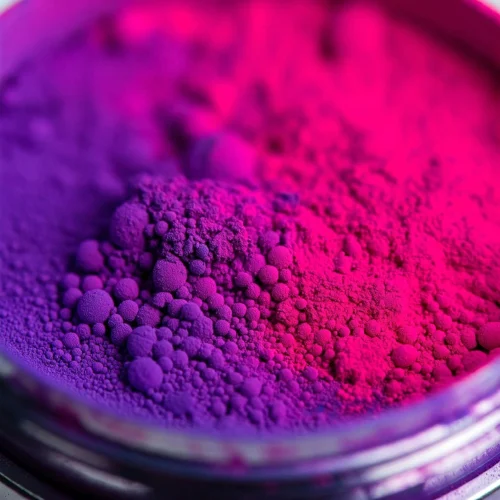
A dryer can influence particle size distribution, agglomeration, bulk density, flowability, dispersibility, residual moisture, colour/shade performance and downstream milling or packaging requirements.
That is why selecting a dryer only by production capacity can create problems later.
The better approach is to start with the feed condition and the required final powder properties.
GTI Dryers designs customized industrial drying systems for chemical manufacturers handling liquid slurries, suspensions, filter cakes, pastes, powders and granules. Depending on the material and process, technologies such as spray dryers, spin-flash dryers, flash dryers and vibratory fluidized-bed dryers (VFBD) can be evaluated.
The Real Dryer-Selection Problem in Pigment & Dye Plants
A pigment or dye plant may have a perfectly successful precipitation, synthesis, filtration or washing stage — and still face quality problems at the dryer.
Typical situations include:
- Wet filter cake does not disperse properly
- Slurry viscosity changes during production
- Powder becomes too coarse or too fine
- Product forms hard agglomerates
- Final moisture varies between batches
- Powder becomes difficult to convey or package
- Excessive dust is generated
- Product sticks to the drying chamber
- Drying changes the desired particle structure
- Thermal exposure affects product quality
- Dryer capacity does not match upstream filtration
- Energy consumption becomes unnecessarily high
- Existing equipment creates a production bottleneck
The important question therefore is not simply:
“Which dryer has the highest capacity?”
It is:
“Which drying technology can accept our actual feed and produce the powder properties we need?”
What Materials Can Be Considered for Pigment & Dye Drying?
Industrial drying systems may be evaluated for a wide range of chemical products, including:
Pigments
- Titanium dioxide (TiO₂)
- Iron oxide pigments
- Inorganic pigments
- Organic pigments
- Precipitated pigments
- Specialty coating pigments
- Functional pigments
Dyes
- Reactive dyes
- Acid dyes
- Disperse dyes
- Direct dyes
- Specialty dyestuffs
- Pigment preparations
Dye Intermediates
- Organic dye intermediates
- Reactive dye intermediates
- Filter-cake intermediates
- Sulfonated intermediates
- Aromatic chemical intermediates
- Specialty chemical intermediates
Inorganic & Specialty Powders
- Silica
- Precipitated silica
- Calcium carbonate
- Zinc compounds
- Alumina
- Industrial salts
- Specialty inorganic chemicals
The appropriate technology depends on the actual physical and chemical characteristics of each product.
Start With the Feed: Slurry, Filter Cake, Paste or Powder?
This is one of the most important decisions in dryer selection.
1. Pumpable slurry or suspension → Spray Dryer
When the product is available as a pumpable slurry, suspension, solution or suitable liquid feed, spray drying can convert the liquid directly into powder through atomization and hot-air drying.
GTI’s spray dryer systems are designed for suitable liquid and slurry feeds and can be configured around particle-size, moisture and powder-quality requirements.
2. Wet filter cake or paste → Spin-Flash / Flash Dryer
When the material leaves a filter press, centrifuge or filtration system as a cohesive cake or paste, atomization may not be practical.
A spin-flash dryer can mechanically disperse wet material while simultaneously exposing it to a drying gas stream.
This makes the technology particularly relevant to difficult wet cakes and pastes encountered in pigment, dye-intermediate and specialty chemical manufacturing.
3. Free-flowing particles → Fluid Bed / VFBD
When the feed already exists as suitable particles, granules or powder, a fluidized-bed system may provide efficient gas-solid heat and mass transfer.
GTI’s VFBD range includes chemical applications such as pigments, dyes, catalysts, resins, fine chemicals and inorganic salts.
This feed-state approach prevents one of the most common mistakes in industrial dryer selection: choosing equipment based only on the product name rather than the physical condition entering the dryer.
1. Spray Dryer for Pigments, Dyes & Chemical Slurries
A spray dryer is particularly useful when a chemical product is available as a pumpable liquid, slurry or suspension and the desired output is a controlled powder.
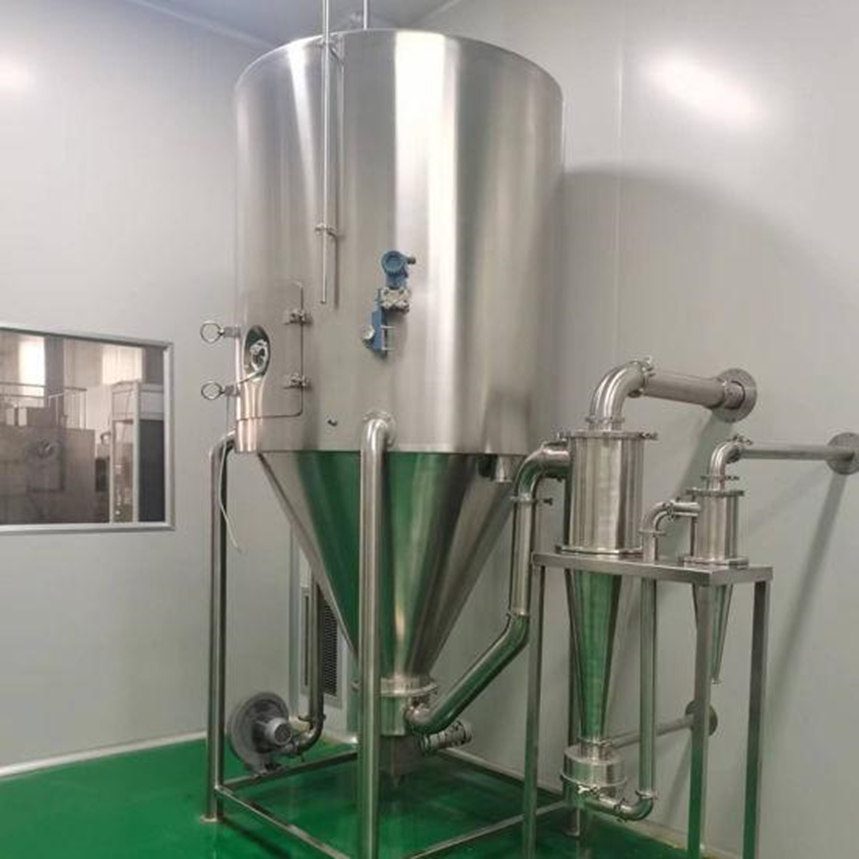
The basic route is:
Slurry / Liquid → Feed Pump → Atomization → Hot-Air Contact → Moisture Evaporation → Powder Separation → Collection
GTI spray dryers can use different atomization approaches, including:
- Pressure nozzles
- Rotary atomizers
- Twin-fluid nozzles
The selection depends on the feed properties and desired powder characteristics.
Spray drying can be considered when the plant needs:
- Continuous liquid-to-powder conversion
- Controlled particle formation
- Consistent moisture
- Good powder flowability
- High production throughput
- Reduced intermediate handling
- Automated operation
The key engineering variables include:
- Feed solids concentration
- Feed viscosity
- Feed temperature
- Atomizer selection
- Droplet size
- Drying-air temperature
- Airflow
- Residence time
- Final moisture
- Powder recovery
- Exhaust treatment
The final dryer should therefore be designed around the feed and powder specification, rather than using a standard configuration for every chemical.
2. Spin-Flash Dryer for Pigment & Dye Filter Cakes
This is where dryer selection becomes particularly important.
A wet pigment or dye intermediate may leave filtration as a cake that is:
- Sticky
- Cohesive
- Pasty
- Difficult to convey
- Difficult to atomize
- Prone to forming lumps
A conventional spray dryer is not automatically the right choice for such material.
A spin-flash system can combine feeding, mechanical disintegration, drying and powder classification/collection in a continuous process.
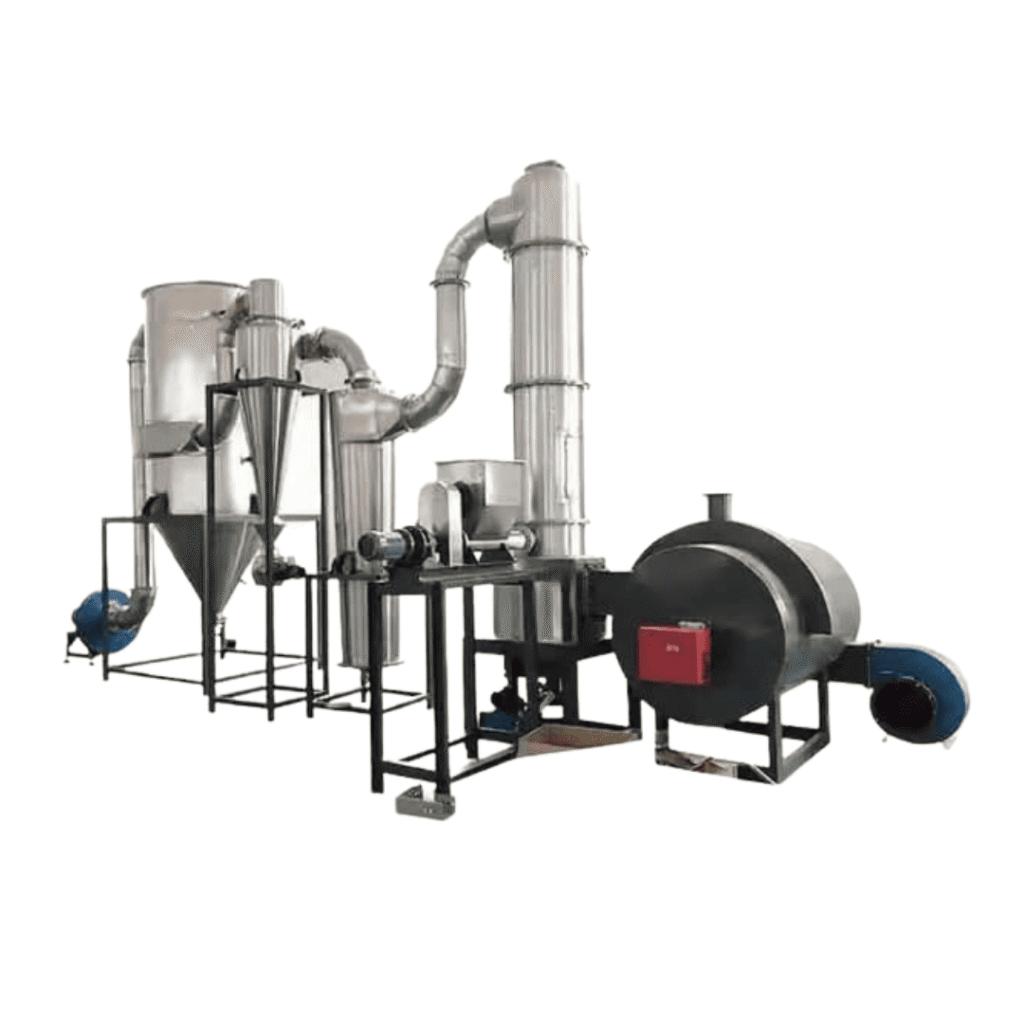
Industry applications include pigments, dye intermediates, organic salts, silica and other chemical filter cakes.
Why this technology can be attractive
Wet Cake
↓
Controlled Feeding
↓
Mechanical Disintegration
↓
Hot-Air Drying
↓
Particle Classification
↓
Cyclone / Bag Filter
↓
Dry Powder
The exact configuration depends on material behaviour and required product properties.
3. Fluid Bed & VFBD Dryers for Pigments and Chemical Powders
Fluidized-bed drying becomes attractive when the material is sufficiently particulate and can be fluidized effectively.
In a fluid bed, heated air or another suitable gas passes upward through a distributor, creating intimate contact between the drying gas and the particles.
GTI’s VFBD systems are applicable to chemical materials including pigments, dyes, catalysts, resins, fine chemicals and inorganic salts.
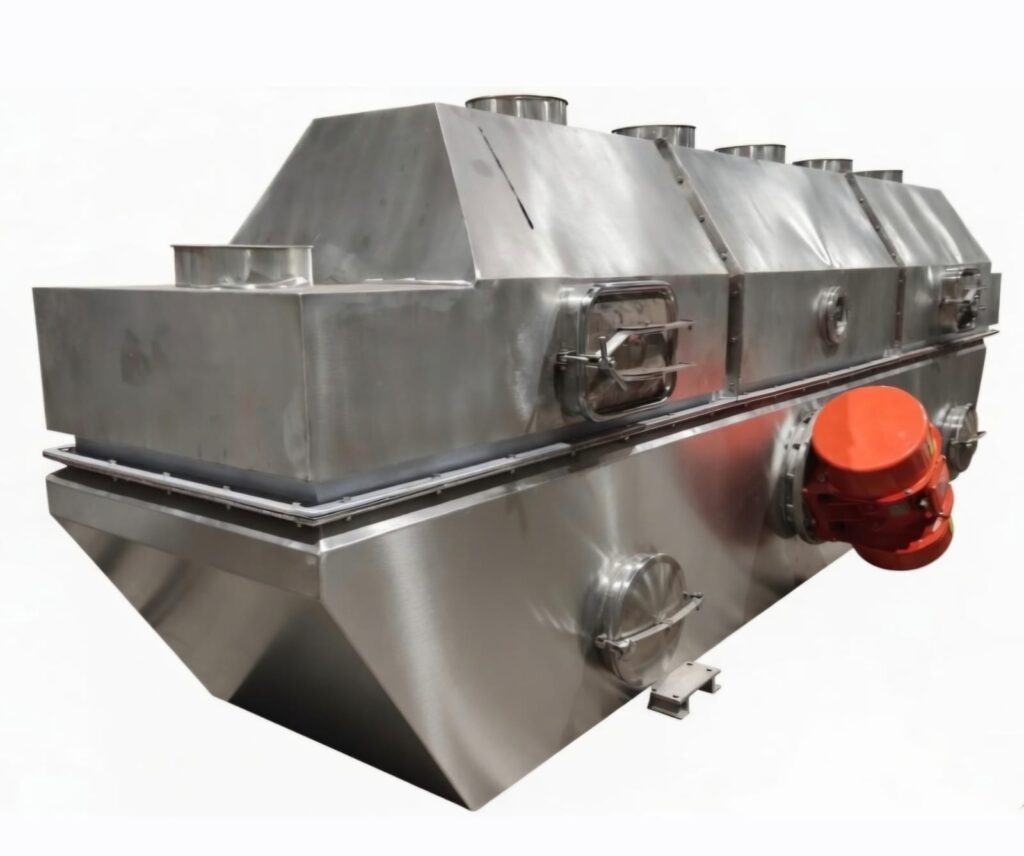
Fluid-bed drying may be considered for:
- Free-flowing pigment particles
- Chemical granules
- Conditioned powders
- Inorganic salts
- Dye intermediates in suitable particulate form
- Post-drying applications
- Drying + cooling operations
It can also be considered as part of a multi-stage drying system where spray drying performs primary moisture removal and fluid-bed drying provides secondary drying or cooling.
TiO₂ Drying: Why Particle Properties Matter
Titanium dioxide is a particularly important example of why chemical dryer selection cannot be based solely on moisture removal.
TiO₂ processing can involve wet milling, dewatering and filtration, leaving a fine filter cake that must be dried while maintaining important pigment characteristics. Industry sources identify flash and spray drying among the technologies that may be considered for TiO₂ filter cake depending on the process route and required product characteristics.
The drying system may need to consider:
- Filter-cake moisture
- Particle-size distribution
- Agglomeration tendency
- Final moisture
- Product temperature
- Dispersion behaviour
- Downstream milling
- Powder recovery
- Dust control
Important: specific temperatures, moisture levels and particle-size targets should not be copied from another TiO₂ plant. They must be established from the actual feed, product specification and process trials.
Silica Powder Drying
Silica is another material where particle behaviour is central to dryer selection.
Silica can be processed through different drying routes depending on whether the feed is a slurry, wet cake or particulate material.
Spin/roto-flash, spray and ring drying technologies are all used in industry for suitable silica applications, with the choice influenced by feed condition and the required powder properties.
Important considerations may include:
- Particle size
- Bulk density
- Agglomeration
- Residual moisture
- Surface characteristics
- Powder flow
- Downstream milling
- Dust collection
For silica, drying and particle engineering may therefore need to be considered together.
Dye Intermediate Drying: The Problem Is Often the Material Behaviour
Dye intermediates can be particularly challenging because the feed may change significantly between synthesis, filtration and drying.
A filter cake can contain:
- Water
- Residual process chemicals
- Soluble salts
- Fine chemical particles
- Organic material
- Sticky or cohesive solids
The dryer may therefore need to handle both moisture removal and controlled solids dispersion.
A spin-flash or suitable flash-drying configuration can be evaluated for wet cakes and pastes, while fluid-bed drying can be considered when the material is already sufficiently particulate.
For solvent-containing products, the system may require additional engineering for containment, solvent recovery, inert operation and explosion protection.
Problem → Dryer Technology: A Practical Selection Guide
| Production Problem | Feed Condition | Technology to Evaluate |
| Liquid slurry must become powder | Pumpable slurry | Spray Dryer |
| Fine chemical suspension | Pumpable suspension | Spray Dryer |
| Sticky filter cake | Cohesive wet cake | Spin-Flash Dryer |
| Pasty chemical material | Paste | Spin-Flash / Flash Dryer |
| Fine wet powder | Dispersible wet solid | Flash Dryer |
| Free-flowing chemical particles | Granules / particles | Fluid Bed / VFBD |
| Powder requires secondary drying | Particulate material | Fluid Bed / VFBD |
| Liquid-to-powder + final conditioning | Slurry | Spray + Fluid Bed |
| Silica wet cake | Wet cake / slurry | Spin-Flash / Spray / other suitable route |
| TiO₂ filter cake | Fine wet cake | Flash / Spin-Flash / Spray depending on process |
This table is a screening guide, not a final equipment specification.
What Causes Poor Powder Quality After Drying?
Problem 1: Powder Is Too Coarse
Possible causes may include:
- Large droplets
- Poor atomization
- Agglomeration
- Insufficient classification
- Feed concentration changes
Engineering response: evaluate atomization, dispersion, classification and feed rheology.
Problem 2: Excessive Fines
Possible contributors include:
- Excessive atomization
- Particle breakage
- High gas velocity
- Aggressive mechanical dispersion
- Inappropriate classification
Engineering response: review particle formation and separation together rather than changing dryer temperature alone.
Problem 3: Hard Agglomerates
Agglomeration may occur because of:
- Product stickiness
- High residual moisture
- Surface characteristics
- Inappropriate drying profile
- Poor powder collection
The solution may involve changes to drying conditions, particle classification or downstream conditioning.
Problem 4: Uneven Moisture
Uneven moisture can originate from:
- Non-uniform feed
- Variable cake consistency
- Poor dispersion
- Inadequate residence time
- Unstable airflow
- Feed-rate fluctuations
Instrumentation and process control therefore become important parts of the drying system.
Problem 5: High Dust Loss
Pigments and chemical powders can generate significant fine particles.
A complete drying system may therefore require:
Dryer → Cyclone → Bag Filter → Exhaust Treatment
The final dust-collection arrangement should be designed around particle size, powder loading, product recovery and environmental requirements.
Drying Is Only One Part of the Powder-Production System
A commercially successful pigment or dye drying plant should be viewed as a complete process:
Synthesis / Precipitation
↓
Washing
↓
Filtration / Centrifugation
↓
Wet Filter Cake
↓
Drying
↓
Particle Classification / Milling if required
↓
Powder Collection
↓
Blending / Conditioning
↓
Packaging
The dryer should therefore be matched with the upstream filtration capacity and downstream powder-processing requirements.
A dryer that can theoretically achieve the required evaporation rate is not necessarily the correct plant solution if the upstream filter cake cannot be fed consistently.
Energy Efficiency: Look Beyond Dryer Efficiency
For chemical drying plants, energy consumption depends on more than the dryer itself.
Important factors include:
- Initial moisture
- Final moisture
- Evaporation load
- Feed solids
- Drying-air temperature
- Heat-source efficiency
- Airflow
- Heat recovery
- Exhaust losses
- Insulation
- Product residence time
- Automation
- Operating hours
GTI’s industrial dryer selection guidance similarly emphasizes feed material, moisture, heat sensitivity, capacity, residence time, energy source and product-quality requirements when selecting drying equipment.
The most economical dryer is therefore not always the machine with the lowest purchase price.
It is the system that achieves the required product quality with an appropriate combination of energy consumption, throughput, recovery, reliability and operating cost.
Materials of Construction & Corrosion Considerations
Pigment and dye plants may handle acidic, alkaline, saline, abrasive or chemically reactive materials.
Dryer design may therefore require evaluation of:
- Product-contact materials
- Corrosion resistance
- Abrasion resistance
- Sealing
- Gaskets
- Dust collection
- Cleaning requirements
- Inspection access
- Product contamination risk
The correct material of construction should be selected from the actual chemical composition, temperature and operating environment.
Automation & Process Control
Modern pigment and dye drying systems can incorporate automation to maintain consistent production.
Potential control points include:
- Feed flow
- Feed pressure
- Dryer temperature
- Airflow
- Product temperature
- Exhaust temperature
- Differential pressure
- Rotor speed
- Classifier speed
- Powder recovery
- Final moisture
PLC/SCADA-based control can help operators monitor the process and respond to variations in feed and operating conditions.
GTI’s industrial drying systems can be configured with automation according to project requirements.
When Should You Choose Spray, Spin-Flash or Fluid Bed?
Choose Spray Drying when:
- Feed is pumpable
- Feed is a slurry, suspension or solution
- Direct liquid-to-powder conversion is required
- Particle engineering is important
Evaluate Spin-Flash Drying when:
- Feed is a wet cake
- Material is sticky or cohesive
- Mechanical dispersion is required
- Direct drying of cake/paste is preferred
Evaluate Fluid Bed / VFBD when:
- Feed is particulate
- Material can be fluidized
- Secondary drying or cooling is required
- Controlled gas-solid contact is beneficial
Evaluate a Hybrid System when:
The process requires multiple functions such as:
Spray Drying → Fluid Bed Drying → Cooling
or
Wet Cake → Spin-Flash Drying → Classification → Collection
The final configuration should be established from process data and testing.
Why Pilot Testing Can Be Valuable
For difficult pigments, dyes and intermediates, laboratory or pilot-scale testing can provide useful information before committing to a large production system.
Testing may help determine:
- Drying behaviour
- Feed dispersion
- Evaporation rate
- Product temperature
- Final moisture
- Particle-size distribution
- Agglomeration
- Powder recovery
- Wall deposition
- Energy requirement
This is particularly valuable when the material is new, highly cohesive, heat-sensitive, abrasive or expected to produce tightly controlled powder characteristics.
GTI Dryers: Process-Engineered Drying Solutions for Chemical Powder Production
GTI Dryers designs and manufactures industrial drying systems for food, pharmaceutical, chemical and specialty-material applications.
For pigment, dye and dye-intermediate projects, the engineering approach can begin with:
What is the feed?
→ Slurry
→ Suspension
→ Filter cake
→ Paste
→ Powder
→ Granules
Then:
What must the final product achieve?
→ Moisture
→ Particle size
→ Bulk density
→ Flowability
→ Dispersibility
→ Agglomeration level
→ Powder recovery
And finally:
Which drying technology best connects the two?
GTI’s industrial dryer range includes spray dryers, flash dryers, rotary dryers, paddle dryers and vibratory fluidized-bed dryers, allowing the process route to be evaluated rather than forcing every application into one dryer type.
What Information Should You Send a Dryer Manufacturer?
For a meaningful technical evaluation, chemical manufacturers should ideally provide:
- Product name
- Chemical composition
- Feed type
- Initial moisture
- Desired final moisture
- Wet-feed capacity
- Required dry-product capacity
- Feed temperature
- Product temperature limit
- Particle-size requirement
- Bulk-density requirement
- Feed viscosity, where applicable
- Solvent or water content
- Stickiness or caking behaviour
- Abrasiveness
- Operating hours per day
- Available heat source
- Available utilities
- Required dust/emission control
- Installation location
If available, providing a representative sample for process testing can make dryer selection more reliable.
Pigment & Dye Dryer Manufacturer in India — What Buyers Should Look For
When evaluating a pigment dryer manufacturer, dye dryer manufacturer or dye intermediate dryer manufacturer in India, look beyond a standard machine catalogue.
Evaluate whether the manufacturer can support:
- Process evaluation
- Dryer technology selection
- Pilot testing where necessary
- Material-of-construction selection
- Feed-system design
- Dust collection
- Automation
- Heat integration
- Plant layout
- Installation
- Commissioning
- Operator training
- After-sales support
This becomes especially important when the product is a high-value specialty chemical where powder quality can be as important as evaporation capacity.
Frequently Asked Questions
What dryer is used for pigments?
Depending on the feed condition, pigment manufacturers may evaluate spray dryers, flash/spin-flash dryers or fluid-bed dryers. Pumpable slurries may suit spray drying, while wet filter cakes may be better suited to flash or spin-flash drying.
Which dryer is suitable for TiO₂?
TiO₂ filter cake can be dried using technologies such as flash, spin-flash or spray drying depending on the process route, feed condition and required pigment properties. The final selection should be based on actual process data and testing where necessary.
Which dryer is used for dye intermediates?
Wet dye-intermediate filter cakes and pastes can be evaluated for spin-flash or flash drying, while suitable particulate materials may be processed using fluid-bed systems.
Can a spray dryer dry pigment slurry?
Yes. A spray dryer can convert suitable pumpable pigment slurries or suspensions into dry powder through atomization and hot-air drying. The feed rheology, solids concentration and required powder properties must be evaluated before final design.
Is spin-flash drying suitable for wet filter cakes?
Spin-flash drying is specifically used in industry for suitable wet cakes, pastes and cohesive materials because mechanical disintegration can occur simultaneously with drying.
Can fluid-bed dryers be used for pigments and dyes?
Yes, for suitable particulate materials. GTI’s VFBD systems are positioned for chemical applications including pigments, dyes, catalysts, resins and inorganic salts.
Does every pigment require the same dryer?
No. Two pigments can have very different feed rheology, moisture, particle size, thermal behaviour and powder specifications. Dryer selection should therefore be product-specific.
Can GTI Dryers provide customized pigment and chemical drying systems?
GTI Dryers designs customized industrial drying systems according to material characteristics, capacity, moisture requirements, energy source and product-quality objectives.
Final Buyer Takeaway
For pigments, dyes, dye intermediates, TiO₂ and silica, dryer selection should begin with material behaviour — not machine capacity alone.
A pumpable slurry may point toward spray drying.
A cohesive filter cake may point toward spin-flash or flash drying.
A suitable particulate material may point toward fluid-bed/VFBD drying.
And where the process requires more than one function, a multi-stage drying and conditioning system may provide a better route.
The objective is not simply to remove moisture.
It is to produce a stable, consistent and process-ready powder while controlling energy, dust, product quality and operating reliability.
GTI Dryers — Engineered Drying Solutions from India for Global Chemical Industries.
Talk to GTI Dryers
Share your feed condition, moisture levels, production capacity and required final powder properties with the GTI engineering team for a technology-selection discussion.