
Pharmaceutical powders — APIs, intermediates, co-processed excipients and spray-dried dispersions — only remain pure and stable when drying respects thermal limits, residual solvent targets, containment and cleanability. A pharmaceutical powder dryer is therefore selected by feed form and quality risk, not by catalogue familiarity alone.
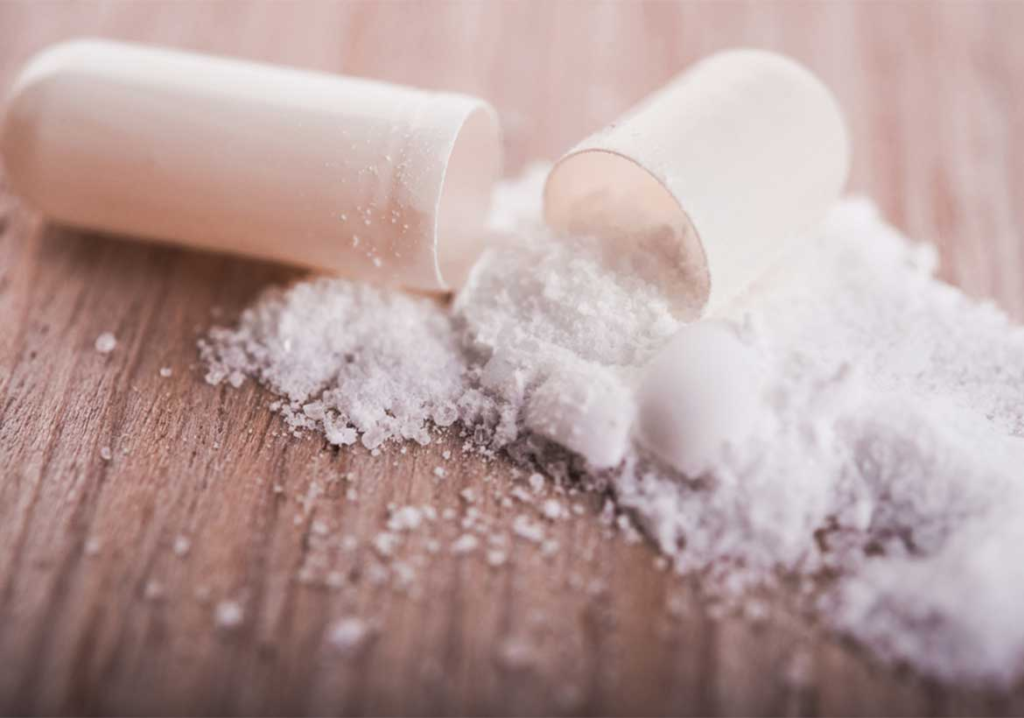
Three technologies appear most often:
- Vacuum tray dryers
- Fluid bed dryers
- Spray dryers
This guide explains how each supports purity and stability, when to use which, and what buyers should specify.
Quick answer: Use vacuum tray drying for solvent-wet cakes and heat-sensitive batch powders needing low-temperature closed drying. Use fluid bed drying for free-flowing wet granules or powders that fluidise cleanly. Use spray drying when the feed is a pumpable solution/suspension and particle engineering or solid dispersion is required. Purity depends on materials, cleaning and closed handling; stability depends on residual moisture/solvent and thermal history.
1. Purity and Stability — What the Dryer Must Protect
| Requirement | Drying-related risk |
|---|---|
| Chemical purity | Thermal degradation, oxidation, hydrolysis |
| Residual solvent | Incomplete removal; regulatory and safety failure |
| Residual moisture | Hydrolysis, microbial risk, physical instability |
| Polymorph / solid form | Form conversion under heat/humidity/solvent |
| Cross-contamination | Shared equipment, poor cleaning design |
| Particulate contamination | Wear metals, filter breakthrough, poor MOC |
| Physical stability | Caking, sinter, amorphous collapse if moisture wrong |
2. Vacuum Tray Dryers for Pharmaceutical Powders
Role in purity and stability
Vacuum lowers boiling point so water and organic solvents leave at reduced product temperature. Closed chambers support condenser recovery and limited oxygen exposure when inerted.
Best for
- Heat-sensitive APIs and intermediates
- Solvent-wet filter cakes loaded on trays
- Small to medium batches with simple static drying
- Products that must not be fluidised or strongly agitated
Purity / stability strengths
- Gentle thermal path
- Minimal mechanical attrition
- Solvent recovery capability
- Straightforward batch identity for many sites
Watch-outs
- Manual tray handling can raise exposure and contamination risk if containment is weak
- Moisture/solvent uniformity depends on tray loading and shelf temperature mapping
- Throughput is limited versus continuous or agitated systems
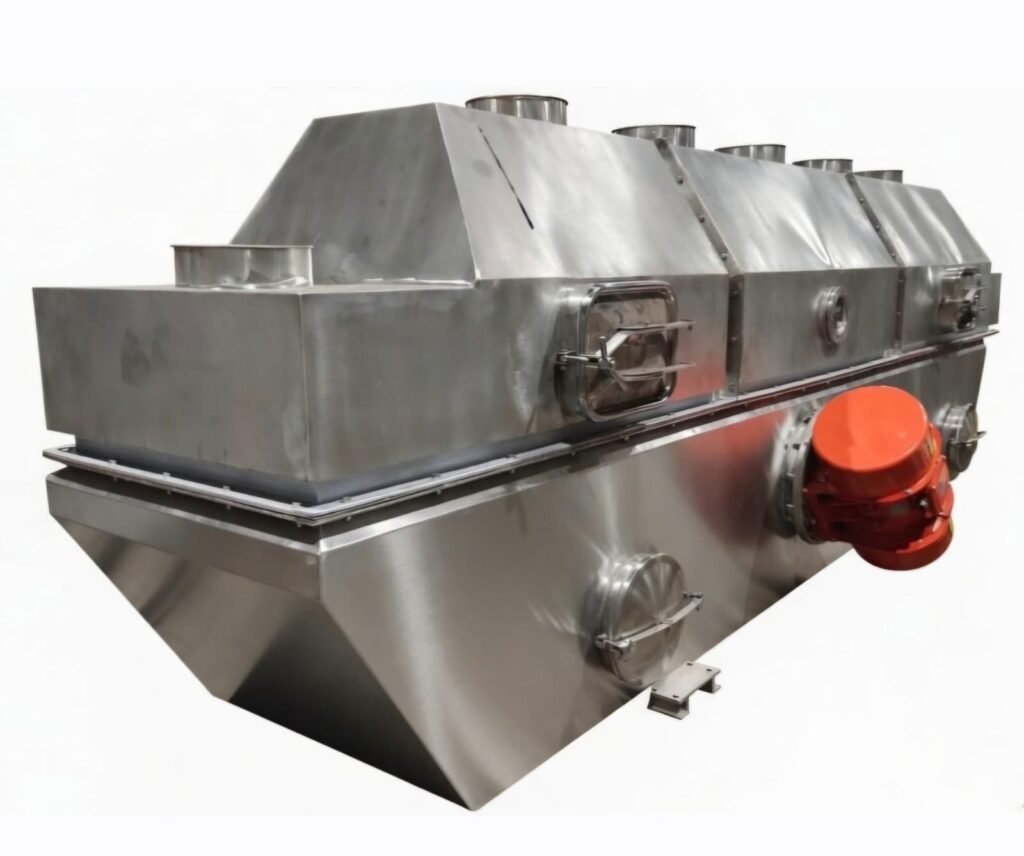
3. Fluid Bed Dryers for Pharmaceutical Powders / Granules
Role in purity and stability
Conditioned air fluidises particles for rapid, even moisture removal. Pharma designs emphasise filtered inlet air, product filters, cleanable product contact parts and recipe control.
Best for
- Wet granules destined for oral solid dose
- Free-flowing powders that fluidise without extreme sticking
- Validated aqueous drying cycles with tight LOD targets
Purity / stability strengths
- Uniform drying when fluidization is correct
- Short cycle times vs static trays for suitable feeds
- Recipe repeatability for moisture endpoints
- Optional WIP/CIP features on modern units
Watch-outs
- Sticky or very fine powders may channel
- Attrition can shift PSD and dissolution
- Potent neat APIs may need containment beyond standard FBD use
- Inlet air quality must match product risk (humidity and filtration)
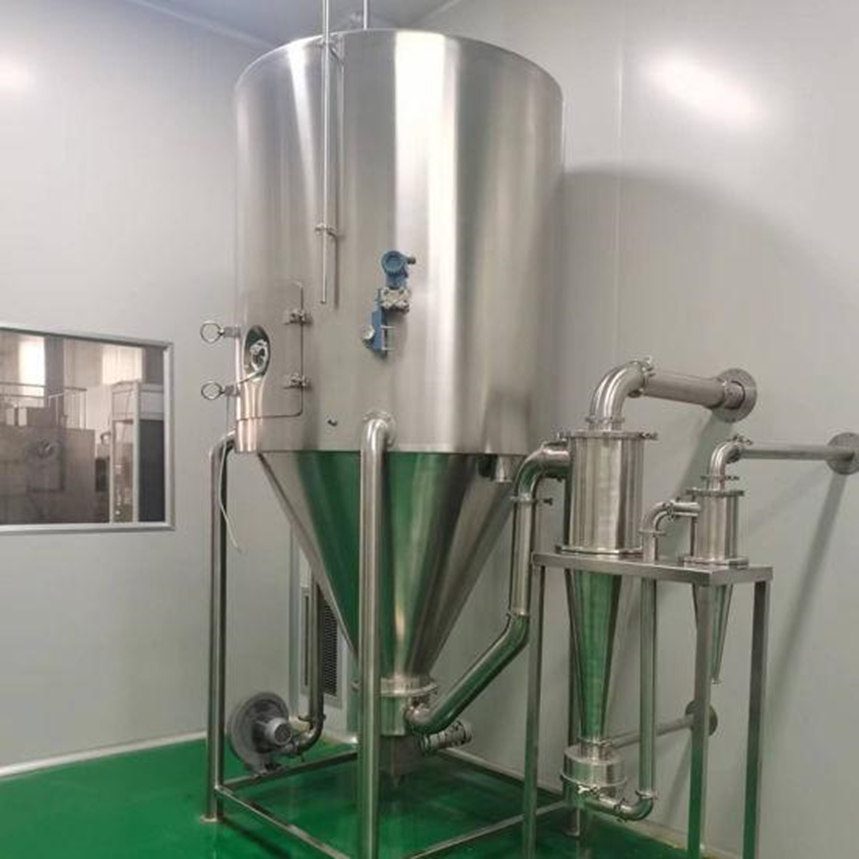
4. Spray Dryers for Pharmaceutical Powders
Role in purity and stability
A solution or suspension is atomised into hot drying gas to form powder in seconds. Used for engineered particles, amorphous solid dispersions, inhalable powders and some excipient/API systems where liquid feed is intentional.
Best for
- Pumpable pharmaceutical solutions/suspensions
- Particle engineering (size, density, dispersions)
- Continuous or large batch powder production from liquid feed
Purity / stability strengths
- Very short droplet lifetime if parameters are controlled
- Closed powder collection paths with proper design
- Ability to create stable amorphous systems when formulation and process are matched
- Reproducible PSD within a validated design space
Watch-outs
- Thermal outlet conditions can degrade actives if poorly set
- Residual solvent/moisture must be proven, not assumed
- Cleaning between products is non-trivial (chamber, ducts, cyclones)
- Feed must be truly sprayable; re-slurrying a cake only for convenience wastes energy and can hurt quality
5. Selection Matrix
| Feed / goal | Prefer |
|---|---|
| Solvent-wet cake, heat-sensitive, batch | Vacuum tray (or agitated vacuum filter-dryer where containment demands it) |
| Wet granules for tablets/capsules | Fluid bed |
| Solution → engineered powder / ASD | Spray dryer |
| Minimal attrition | Vacuum tray |
| Fast uniform LOD on fluidisable granules | Fluid bed |
| Closed solvent recovery priority | Vacuum tray / vacuum contact systems |
| High continuous capacity from liquid | Spray dryer |
6. How Each Technology Supports Purity
| Control | Vacuum tray | Fluid bed | Spray |
|---|---|---|---|
| Closed product path | Good (chamber) | Good if sealed & filtered | Good with contained collection |
| Cleaning design criticality | Trays + chamber | Bowl, filters, ducts | Chamber, ducts, cyclones — high |
| Wear-metal risk | Low | Distributor/filter hardware | Atomiser wear — monitor |
| Solvent handling | Excellent with vacuum train | Possible; design carefully | Possible with specialised recovery |
| Batch segregation | Natural batch | Batch recipes | Batch or continuous campaigns |
Purity is lost as often from poor cleaning and open handling as from heat.
7. How Each Technology Supports Stability
| Stability lever | Practical action |
|---|---|
| Residual moisture target | Validate LOD/water activity band for the product |
| Residual solvent target | Vacuum and condenser capacity; proven cycle |
| Product temperature limit | Map shelves (VTD), inlet/product T (FBD), outlet T (spray) |
| Oxygen sensitivity | Nitrogen blanketing / inert process gas where required |
| Packaging link | Cool powder; barrier packs; controlled RH staging areas |
| Solid form control | Stay inside filed process design space |
8. Problem–Solution Map
| Problem | Likely cause | Direction |
|---|---|---|
| Assay drop after drying | Excessive thermal history | Lower product T; vacuum route; shorter hot residence |
| High residual solvent | Weak vacuum/time or mass transfer | Vacuum tray/contact; condenser sizing |
| Caking on stability | Moisture too high or packaging RH | Tighten endpoint; pack design |
| Polymorph change | Heat/humidity/solvent path | Review design space; gentler cycle |
| Contamination findings | Incomplete cleaning, shared filters | Cleanability redesign; change parts strategy |
| Uneven moisture in trays | Loading variation | Shelf mapping; loading SOP |
| Spray powder instability | Wrong residual solvent/moisture or ASD collapse | Optimise outlet conditions; packaging; formulation |
9. GMP-Oriented Buyer Requirements
Regardless of dryer type, pharmaceutical powder projects should address:
- Materials of construction and surface finish
- Drainability and inspection access
- Cleaning method and validation approach
- Containment aligned to potency
- Instrumentation and data recording for critical parameters
- Qualification documentation support (as agreed)
- Change control after validation
Equipment selection enables compliance; the manufacturing authorisation holder owns GMP operation and release.
10. RFQ Checklist for Pharmaceutical Powder Dryers
- Powder / product type (API, intermediate, excipient, dispersion)
- Feed form — cake, granules, solution/suspension
- Solvents and residual solvent targets
- Residual moisture / water activity targets
- Maximum product temperature / solid-form constraints
- Batch size or continuous rate
- Containment / OEL needs
- Preferred technology or request recommendation
- Cleaning (manual, WIP, CIP)
- Documentation package required
- Utilities — steam, vacuum, nitrogen, AHU
11. How GTI Dryers Supports Pharmaceutical Powder Drying Discussions
GTI Dryers designs continuous and engineered drying systems including fluid bed, spray-related and vacuum/contact-oriented process concepts for heat-sensitive solids.
For pharmaceutical powder enquiries we:
- Map feed form to vacuum tray vs fluid bed vs spray logic
- Focus on residual moisture/solvent and product temperature limits
- Discuss cleanability and closed handling at system level
- Recommend pilot trials when stability or solid form is at risk
- Keep clear boundaries: site validation and regulatory compliance remain the pharma manufacturer’s responsibility
Geographic Note
Pharmaceutical powder drying supports formulation and API plants across India and global regulated markets. Humidity control in packing areas is especially important in monsoon climates for stability outcomes. Local engineering partners can support utilities and installation interfaces while quality systems stay with the licensed site.
Frequently Asked Questions
What is the best pharmaceutical powder dryer?
The best dryer matches feed form: vacuum tray for many solvent-wet heat-sensitive cakes, fluid bed for fluidisable wet granules, spray dryer for engineered powders from liquid feeds.
How do vacuum tray dryers improve stability?
By removing water/solvents at lower product temperature under vacuum, reducing thermal degradation risk when cycles are validated.
Can fluid bed dryers dry potent APIs?
Sometimes, with appropriate containment and product behaviour. Many sites use FBD primarily for granules; potent neat powders need careful assessment.
When is spray drying used in pharma powders?
When particle engineering or drying from solution/suspension is required, including some amorphous solid dispersions — under controlled residual solvent and moisture targets.
What should I send GTI?
Feed form, solvents, residual moisture/solvent targets, batch size, temperature limits and containment needs.
Next Step
If purity or stability issues trace back to drying — residual solvent, moisture variation or thermal damage — share your powder feed data. GTI will help evaluate vacuum tray, fluid bed and spray routes for a pharmaceutical powder drying stage aligned with your quality constraints.
Request a pharmaceutical powder drying assessment with your process data.
Contact the GTI Technical Team:
Website: gtidryers.com
Email: mktg@gtidryers.com
Phone / WhatsApp: +91 9330077417