
In oral solid dose (OSD) manufacturing, wet granules must be dried to a tight residual-moisture band before milling, blending and compression. Moisture that is too high, too low or uneven between granules shows up later as tablet weight variation, hardness drift, sticking, capping risk and stability problems.
The standard pharmaceutical granule dryer for this duty is the fluid bed dryer (FBD). This guide explains how fluid bed systems achieve uniform moisture control, what breaks uniformity, and how buyers should specify equipment for tablet manufacturing.
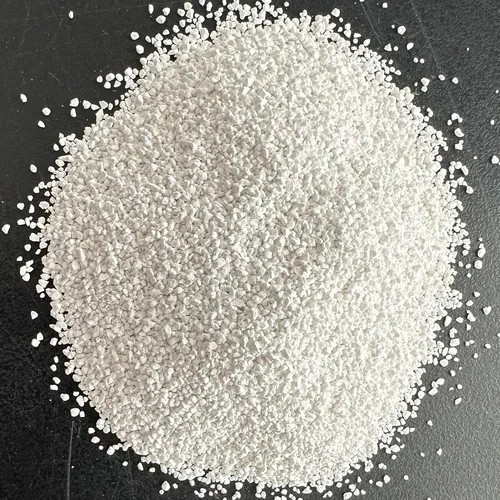
Quick answer: A pharmaceutical fluid bed dryer suspends wet granules in heated process air so each particle is dried under similar conditions. Uniform moisture depends on proper fluidization, inlet air control, batch loading, filter integrity and endpoint detection — not only on a high inlet temperature.
1. Why Granule Moisture Uniformity Matters for Tablets
| Downstream step | Effect of poor moisture control |
|---|---|
| Milling | Smearing if wet; excess fines if over-dry |
| Blending | Segregation and content uniformity risk |
| Compression | Weight variation, hardness scatter, sticking/picking |
| Coating | Defects linked to core moisture variability |
| Stability | Microbial risk if wet; brittleness or static if over-dry |
Average LOD (loss on drying) can look acceptable while distribution within the batch is not. Uniformity is the real goal.
2. Where the Granule Dryer Sits in the Tablet Train
Text
Dispensing → Dry mix → Wet granulation (high-shear / other)
        ↓
Pharmaceutical granule dryer (typically FBD)
        ↓
Milling → Final blend → Compression → Coating (if any)
Drying endpoint must match the validated process: target moisture, granule size integrity and product temperature limits.
3. How Fluid Bed Dryers Dry Granules Uniformly
Principle
Process air is conditioned (temperature, and often humidity control on advanced systems), then forced through a perforated distributor plate at a velocity that fluidises the granule bed. Each granule is surrounded by drying air, giving high heat and mass transfer.
Why this supports uniform moisture
| FBD feature | Uniformity benefit |
|---|---|
| Individual particle contact with air | Less dependency on slow conduction through a static bed |
| Continuous mixing in the fluidised state | Reduces wet/dry pockets when fluidization is healthy |
| Controlled inlet air temperature | Repeatable recipes |
| Filter shaking / blowback | Keeps airflow path open for consistent drying |
| Endpoint monitoring | Product temperature, exhaust temperature, or in-process LOD |
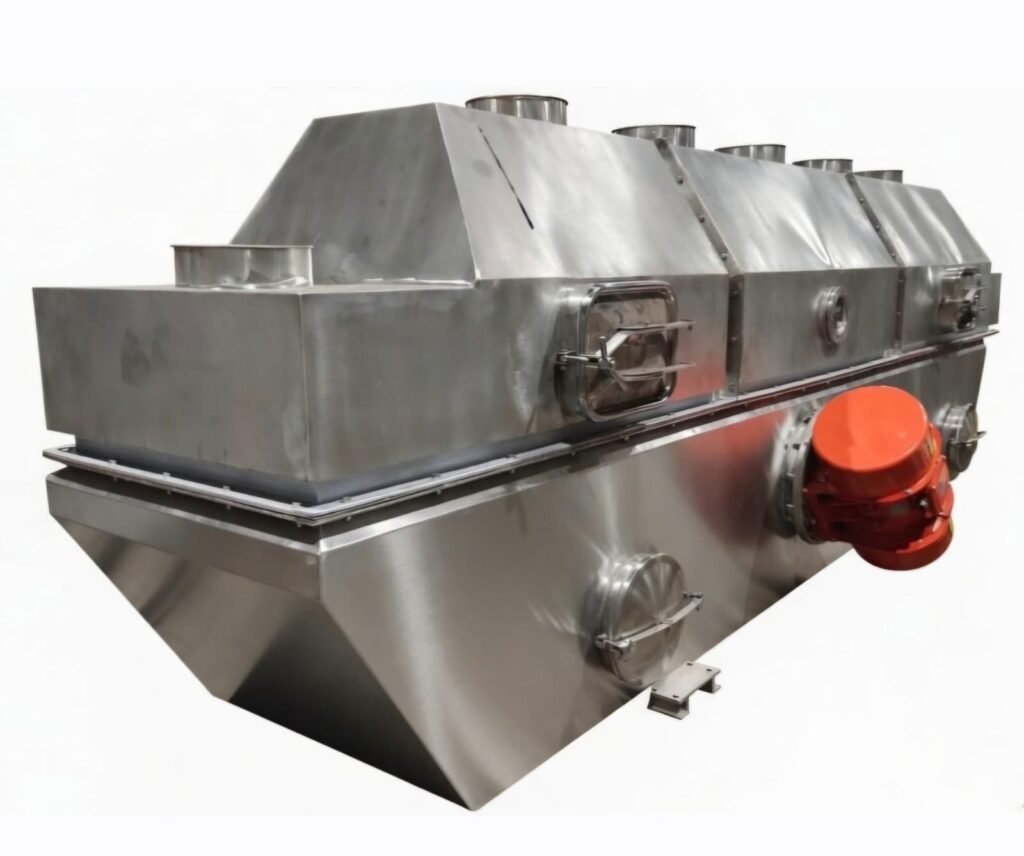
Typical pharmaceutical FBD features buyers expect
- Stainless product contact parts with appropriate finish
- Qualified inlet air handling (filtration levels per site standard)
- Product and exhaust filters with integrity/safe-change strategy as required
- WIP/CIP options depending on plant standard
- Recipe-based control and batch records support
- Explosion protection / relief strategy for combustible organic dusts as applicable
4. Critical Process Parameters for Moisture Control
| Parameter | Role |
|---|---|
| Batch charge weight | Overfill → poor fluidization and wet cores |
| Inlet air temperature | Driving force; limited by product stability |
| Airflow / fluidization level | Mixing vs attrition and filter loading |
| Inlet air humidity | Especially important in humid climates for endpoint consistency |
| Product / exhaust temperature | Endpoint indication and thermal limit control |
| Spray rate (if top-spray granulation in FBD) | For combined granulation-drying processes |
| Filter condition | Blocked filters change airflow and drying rate |
Validated ranges — not “operator feel” — sustain uniform moisture across batches.
5. Problem–Solution Map (Granule Moisture & Tablet Defects)
| Problem | Likely FBD-related cause | Direction |
|---|---|---|
| Wet centres, dry surfaces | Poor fluidization; overloaded bowl | Correct charge; airflow; distributor condition |
| Moisture variation batch-to-batch | Ambient humidity swings; weak endpoint method | Inlet air control; defined endpoint |
| Over-dried granules / excess fines | Excessive time/temperature; high attrition | Endpoint discipline; gentler fluidization |
| Sticking on compression | Residual moisture high or uneven | Re-validate LOD sampling map |
| Long drying times | Blocked filters; low airflow; wet granulation mass too wet | Filter maintenance; upstream liquid amount |
| Product degradation | Inlet temperature too high | Lower inlet; longer gentle dry if needed |
6. Fluid Bed vs Other Pharmaceutical Granule Drying Options
| Technology | Typical role vs FBD |
|---|---|
| Fluid bed dryer | Default for free-flowing wet granules in OSD plants |
| Tray / vacuum tray dryer | Small batches, heat-sensitive cases, non-fluidisable masses |
| Microwave-assisted / hybrid | Specialty speed or difficult products (site-specific) |
| ANFD / contact dryers | More for API cakes than classic wet-granule OSD trains |
If granules do not fluidise (very sticky, highly cohesive), fixing granulation end-point or choosing a non-fluid-bed dryer may be required — forcing FBD airflow is not a solution.
7. Endpoint Control — How Plants Know “Dry Enough”
Common approaches:
- Exhaust air temperature rise pattern
- Product temperature approaching a validated value
- Timed recipes after proven granulation consistency
- In-process LOD sampling (with a defined sampling plan)
- Advanced PAT tools where implemented
For tablet manufacturing, the endpoint method should be tied to compression behaviour, not only a single LOD average.
8. GMP and Documentation Expectations
A pharmaceutical granule dryer project should plan for:
- Design suitable for cleaning and inspection
- Material certificates and surface finish as required by site
- IQ/OQ/PQ support documentation from vendor as agreed
- Alarm/interlock philosophy for airflow, temperature, filter ΔP
- Data recording appropriate to the site’s data-integrity standards
- Change control after validation
Equipment enables compliance; the licensed manufacturer owns batch release and validated process performance.
9. RFQ Checklist for Pharmaceutical Granule Dryers
- Product / granule type and batch size range
- Typical wet granule moisture after granulation
- Target LOD before milling/compression
- Maximum product temperature
- Bowl working volume and scale (R&D / pilot / production)
- Inlet air handling expectations (filtration, RH control)
- WIP/CIP vs manual cleaning
- Explosion protection requirements
- Control system and batch-report needs
- Utilities — AHU steam/electric, compressed air
10. How to Evaluate FBD Suppliers for Tablet Plants
| Check | Positive signal |
|---|---|
| Asks granulation moisture and target LOD | Process-led sizing |
| Discusses fluidization and charge weight | Understands uniformity |
| Filter and airflow design clarity | Stable drying rate |
| Cleaning and validation documentation support | Pharma-ready approach |
| Endpoint control options | Repeatable batches |
| Safety for dust | Responsible design |
Red flags: “Same FBD for all products” without charge/airflow discussion; no filter integrity concept; capacity claims without moisture basis.
11. How GTI Dryers Supports Granule Drying Projects
GTI Dryers designs fluid bed and vibratory fluid bed systems for solid drying duties and supports process discussion for uniform moisture control in granulated materials.
For pharmaceutical granule drying enquiries we:
- Focus on feed granule behaviour, target moisture and thermal limits
- Discuss fluidization, airflow and endpoint logic at system level
- Address hygienic construction and cleaning access expectations
- Recommend pilot trials when product fluidization or heat sensitivity is uncertain
- Clarify battery limits: site GMP validation and release remain the manufacturer’s responsibility
Geographic Note
OSD manufacturing across India and export-oriented pharma hubs depends on FBD moisture control that remains stable through monsoon humidity. Inlet air conditioning and validated endpoints reduce seasonal tablet defects. Local engineering support helps maintain airflow, filters and calibration on continuous production campaigns.
Frequently Asked Questions
What is a pharmaceutical granule dryer?
Typically a fluid bed dryer used to remove moisture from wet granules before milling and tablet compression, under controlled and documentable conditions.
How does an FBD improve moisture uniformity?
By fluidising granules in conditioned air so particles dry under similar heat and mass transfer conditions, when charge weight and airflow are correct.
Why do tablets stick if average LOD is in range?
Because moisture may be uneven within the batch, or surface moisture differs from bulk. Review fluidization, sampling plan and endpoint method.
Can we replace FBD with tray dryers for all tablet granules?
Tray dryers suit some small or sensitive batches but generally provide slower, less uniform drying for routine wet-granulation OSD production.
What should I send GTI?
Batch size, wet granule moisture, target LOD, product temperature limits and cleaning/containment expectations.
Next Step
If tablet defects point to granule moisture variation, review the pharmaceutical granule dryer stage — fluidization, charge, inlet air and endpoint — before changing compression settings alone. Share your process data with GTI for a fluid bed drying assessment oriented to uniform moisture control.
Request a pharmaceutical granule / FBD drying assessment with your process data.
Contact the GTI Technical Team:
Website: gtidryers.com
Email: mktg@gtidryers.com
Phone / WhatsApp: +91 9330077417