Paddle Dryer Germany: A Growing Opportunity for Efficient Sludge & Chemical Drying
Germany has one of Europe’s most advanced industrial processing and wastewater-management ecosystems, creating demand for reliable and energy-efficient industrial drying technologies.
The opportunity is particularly relevant to:
Chemical Manufacturing → Fine Chemicals → Pharmaceuticals → Wastewater Treatment → Sewage Sludge → Resource Recovery
For these applications, an industrial paddle dryer can provide controlled indirect heat transfer for wet, sticky, pasty and difficult-to-handle materials.
Germany is also moving toward a more resource-oriented approach to sewage sludge management. The German Environment Agency (UBA) reports that about 1.67 million tonnes of sewage sludge dry matter were generated by public wastewater treatment plants in 2024, with around 82% thermally utilized.
This makes sludge preparation, drying, thermal treatment and resource recovery increasingly important areas for process engineers and wastewater operators.
For an Indian manufacturer such as GTI Dryers, Germany therefore represents an important market for customized paddle dryers, sludge dryers and industrial drying systems.
Why Germany Is an Important Market for Paddle Dryers
German industries often process materials where basic hot-air drying is not necessarily the best solution.
Typical materials include:
- Municipal sewage sludge
- Industrial wastewater sludge
- Chemical filter cakes
- Fine chemical intermediates
- Pharmaceutical materials
- Pigments and dyes
- Organic residues
- Sticky process solids
- High-moisture industrial by-products
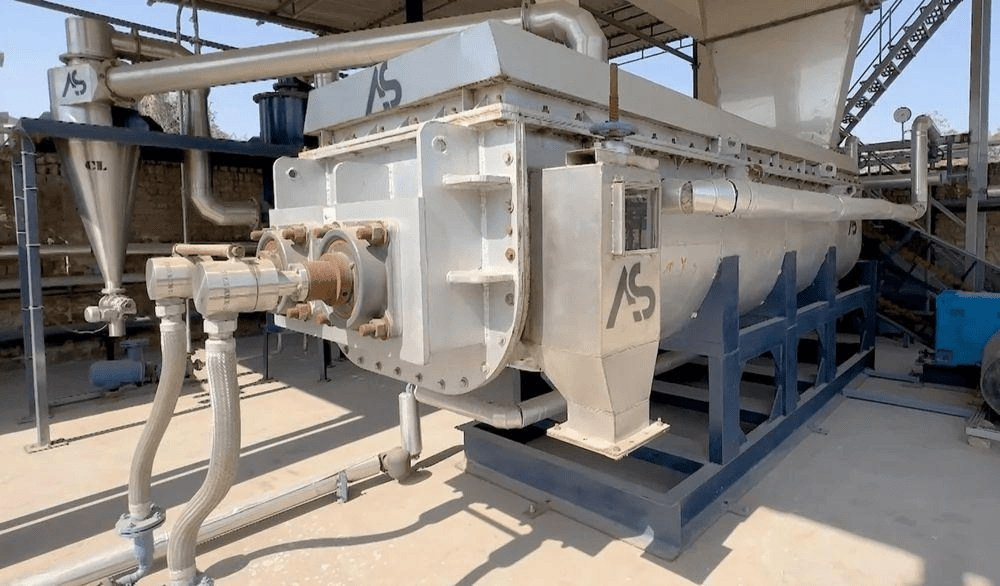
A paddle dryer works through indirect heat transfer, allowing the product to be heated through specially designed surfaces rather than relying solely on direct contact with combustion gases.
The basic process can be represented as:
Wet Feed → Indirect Heat Transfer → Moisture Evaporation → Dry Solids → Thermal Treatment / Recovery / Disposal
The actual dryer configuration must be established from the material properties, moisture load and final-product requirements.
Germany’s Sewage Sludge Challenge: Why Drying Matters
Sewage sludge management is a particularly important application in Germany.
The amended Sewage Sludge Ordinance (AbfKlärV) introduced restrictions on soil-based sewage sludge utilization and established phosphorus-recovery requirements. According to UBA, phosphorus recovery becomes mandatory for relevant sludge streams from 2029, while larger wastewater treatment plants face restrictions on soil-based utilization from 2029 and 2032.
Germany has already shifted strongly toward thermal treatment. UBA’s latest data states that approximately 82% of municipal sewage sludge was thermally utilized in 2024, while untreated sewage sludge landfill disposal has been prohibited since 2005.
This creates an important process requirement:
Dewatering → Drying → Thermal Treatment → Ash Processing → Phosphorus Recovery
A paddle dryer can potentially form part of this chain where its operating characteristics match the sludge and downstream process.
Where Can Paddle Dryers Be Used in Germany?
Municipal wastewater treatment plants can generate high-moisture sludge that requires further processing.
Potential applications include:
- Dewatered sewage sludge
- Digested sludge
- Biosolids
- Filter-press cake
- Centrifuge cake
- Sludge prepared for thermal treatment
An indirect paddle dryer can be evaluated where controlled drying and enclosed material handling are important.
2. Industrial Wastewater Sludge
Germany’s chemical, pharmaceutical, food and manufacturing sectors generate diverse wastewater residues.
Potential materials include:
- ETP sludge
- Chemical sludge
- Pharmaceutical wastewater solids
- Food-processing sludge
- Industrial filter cake
- Organic process residues
Because these materials can be sticky or variable in consistency, material testing is especially important before selecting the dryer.
3. Chemical & Fine Chemical Processing
Germany’s chemical industry creates demand for sophisticated drying technologies.
Paddle dryers can be considered for suitable:
- Chemical filter cakes
- Pigments
- Dyes
- Salts
- Crystalline materials
- Specialty chemicals
- Fine chemical intermediates
The ability to use indirect heating can be advantageous for applications where direct hot-gas contact is undesirable.
For selected pharmaceutical and fine-chemical applications, vacuum paddle dryers can be evaluated when lower-temperature drying or controlled-atmosphere processing is required.
Potential requirements may include:
- Heat-sensitive materials
- API intermediates
- Pharmaceutical filter cakes
- Crystalline solids
- Solvent-containing materials
The final equipment design should be based on the required containment, cleaning, temperature and solvent-handling requirements.
Indirect Paddle Dryer vs Vacuum Paddle Dryer in Germany
German industrial buyers often require a clear distinction between dryer configurations.
| Requirement | Indirect Paddle Dryer | Vacuum Paddle Dryer |
| Sewage sludge | Suitable for selected applications | Possible |
| Industrial sludge | Suitable | Suitable |
| Chemical filter cake | Suitable | Suitable |
| Fine chemicals | Suitable | Strong candidate |
| Heat-sensitive materials | Application dependent | Strong candidate |
| Solvent-containing feed | Application dependent | Often preferred |
| Low-temperature drying | Depends on process | Advantageous |
| Atmospheric operation | Yes | No |
| Vacuum operation | No | Yes |
The right choice depends on the feed characteristics, evaporation load and downstream process.
Paddle Dryer & Phosphorus Recovery: Where Does It Fit?
One of Germany’s most important wastewater-management developments is the transition toward phosphorus recovery.
UBA states that phosphorus recovery from relevant sewage sludge streams is required from 2029 and that recovered phosphorus can contribute to fertilizer production and resource conservation.
Drying does not itself recover phosphorus.
Instead, it can potentially serve as a pre-treatment or conditioning step in an overall sludge-management chain:
Wastewater Treatment
↓
Sludge Generation
↓
Mechanical Dewatering
↓
Paddle Drying
↓
Thermal Treatment / Incineration
↓
Sludge Ash
↓
Phosphorus Recovery
The exact process route depends on the selected phosphorus-recovery technology and plant configuration.
Why Indirect Drying Can Be Attractive for German Plants
Energy efficiency and emissions management are important considerations for German industrial projects.
An indirect Paddle Dryer can provide controlled heat transfer and enclosed processing.
Potential advantages include:
Controlled Heat Transfer
Heat is transferred through heated surfaces rather than requiring direct combustion gas/product contact.
Enclosed Process
An enclosed dryer can help integrate controlled vapor and off-gas handling.
Suitable for Difficult Materials
Paddle dryers can be considered for sticky, pasty and high-moisture materials that may be challenging for conventional fluidization.
Heat Recovery
Where appropriate, recovered heat from downstream processes can potentially be integrated into the overall thermal system.
Flexible Heating
Depending on plant infrastructure, heating may be based on:
- Steam
- Thermal oil
- Hot water
- Electricity
- Waste heat
- Other suitable thermal sources
How Much Sludge Can a Paddle Dryer Process?
There is no universal paddle-dryer capacity because capacity depends on evaporation rather than simply wet-feed weight.
For example:
Wet Sludge Feed = 5,000 kg/h
If initial moisture is 70%:
- Water = 3,500 kg/h
- Dry solids = 1,500 kg/h
If the target final moisture is 10%, final product mass would theoretically be:
1,500 ÷ 0.90 = approximately 1,667 kg/h
Therefore, the approximate water evaporation requirement would be:
3,500 − 167 = approximately 3,333 kg/h
This illustrates why German wastewater projects require an actual drying calculation before selecting equipment.
How GTI Dryers Can Approach the German Market
As an Indian industrial dryer manufacturer, GTI Dryers can position itself around custom engineering rather than generic equipment supply.
A German project can begin with:
Material → Moisture → Feed Rate → Final Moisture → Heat Source → Operating Hours → Process Conditions
The engineering workflow can then be:
Material Characterization
↓
Drying Calculation
↓
Pilot Testing
↓
Paddle Dryer Selection
↓
Engineering & Manufacturing
↓
Installation / Commissioning Support
This approach is particularly useful for sludge and chemical applications where material behavior can change significantly during drying.
Pilot Testing: Critical for German Industrial Drying Projects
A paddle dryer should not be selected purely from a catalogue capacity.
Pilot testing can help evaluate:
- Drying rate
- Moisture reduction
- Material behavior
- Stickiness
- Discharge characteristics
- Product temperature
- Energy requirement
- Residence time
- Final product quality
For German sewage sludge, chemical sludge and fine chemical materials, testing can help reduce uncertainty before a commercial-scale investment.
How to Calculate Paddle Dryer Energy Consumption
A preliminary energy calculation should start with the amount of water that must be evaporated.
Water Evaporation
↓
Latent Heat Requirement
↓
Sensible Heating
↓
Heat Losses
↓
Heat Recovery
↓
Total Thermal Requirement
The actual energy consumption depends on:
- Initial moisture
- Final moisture
- Feed temperature
- Product temperature
- Dryer efficiency
- Heat-source efficiency
- Exhaust temperature
- Heat recovery
- Ambient conditions
- Residence time
Therefore, quoting a fixed kWh/tonne figure without material data can be misleading.
Paddle Dryer Germany: What Industrial Buyers Should Evaluate
Before selecting a supplier, German plant managers should examine:
1. Engineering Capability
Can the supplier calculate the actual evaporation load?
2. Material Testing
Can the manufacturer test the customer’s sludge or chemical feed?
3. Energy Optimization
Does the system incorporate heat recovery and optimized thermal design?
4. Material of Construction
Is the dryer suitable for corrosive, abrasive or chemically active materials?
5. Automation
Can the system integrate PLC, sensors, VFDs and plant-level monitoring?
6. International Project Support
Can the manufacturer provide technical documentation and support for international installation?
7. After-Sales Service
Are spare parts and technical assistance available?
Germany-Specific Questions Potential Buyers Are Searching
What is a paddle dryer used for?
An industrial Paddle Dryer is used to dry suitable wet, sticky, pasty or granular materials using indirect heat transfer. Applications include sludge, chemicals, filter cakes and selected pharmaceutical or food materials.
Is a paddle dryer suitable for sewage sludge?
It can be suitable for selected sludge streams, particularly where indirect heat transfer and controlled drying are beneficial. Feed moisture, solids concentration, stickiness and target moisture must be evaluated.
Why is sludge drying important in Germany?
Germany has moved strongly toward thermal sewage-sludge treatment and phosphorus recovery. UBA reports that around 82% of municipal sewage sludge was thermally utilized in 2024.
Is phosphorus recovered directly in a paddle dryer?
No. A paddle dryer is a drying technology, not inherently a phosphorus-recovery technology. Drying may form part of an integrated sludge-treatment process before thermal treatment and subsequent phosphorus recovery.
What is the difference between a paddle dryer and a rotary dryer?
Paddle dryers generally use indirect heat transfer and are particularly suitable for certain sticky or pasty materials. Rotary dryers are widely used for bulk solids and can be configured for different direct or indirect drying applications.
Why GTI Dryers for Germany?
GTI Dryers can develop customized industrial paddle drying systems based on actual process requirements.
Potential GTI Dryers solutions include:
Indirect Paddle Dryer | Vacuum Paddle Dryer | Rotary Dryer | Flash Dryer | Fluid Bed Dryer | Band Dryer | Mesh Belt Dryer | Industrial Sludge Dryer
For German applications, the objective should be:
Energy Efficiency + Controlled Drying + Reliable Operation + Material Compatibility + Process Integration
Rather than selecting a dryer simply because it is labelled a “sludge dryer” or “chemical dryer.”
Germany Paddle Dryer Market: The Opportunity for GTI Dryers
Germany’s combination of chemical manufacturing, wastewater treatment, thermal sludge utilization and phosphorus-recovery requirements creates a technically sophisticated market for industrial drying systems.
The regulatory direction is particularly important: UBA states that phosphorus recovery from relevant sewage sludge becomes mandatory from 2029, while thermal utilization has already become the dominant route for municipal sludge.
For GTI Dryers, this creates an opportunity to introduce Indian-engineered industrial paddle dryers and customized sludge-drying solutions to German engineering companies, wastewater operators, chemical manufacturers and EPC/project developers.
Looking for a Paddle Dryer Manufacturer for Germany?
If your project involves:
Municipal Sewage Sludge | Industrial ETP Sludge | Chemical Filter Cake | Fine Chemicals | Pharmaceutical Materials | Organic Residues | High-Moisture Industrial Solids
GTI Dryers can evaluate the application and recommend an appropriate drying configuration.
Send Your Material Details
Provide:
- Material name
- Wet feed capacity
- Initial moisture
- Target final moisture
- Feed temperature
- Available heat source
- Operating hours
- Required production capacity
The engineering process can then move from:
Drying Calculation → Pilot Testing → Dryer Selection → Customized Design → Manufacturing
GTI Dryers — Indian industrial drying engineering for global applications, including Germany.