
Moisture removal is a routine operation in organic chemical manufacturing—but selecting the wrong dryer can create problems throughout the production line. Wet crystals may agglomerate, pastes may stick to heated surfaces, and liquid solutions may require conversion into powders with specific particle characteristics. Meanwhile, excessive heat, uneven moisture, product loss and high energy consumption can affect product quality and operating costs.
For chemical manufacturers, the objective is not simply to remove moisture. It is to achieve the required final product specification while maintaining process stability, material quality and efficient production.
GTI Dryers, from Genex Tech Industries LLP, provides industrial drying equipment and customized drying solutions for chemical and process industries. Its dryer portfolio includes spray, fluidized-bed, rotary, flash, paddle and other drying technologies, selected according to feed properties and process requirements.
This guide helps chemical manufacturers identify the right drying approach for crystals, pastes, filter cakes and solutions—and understand what to evaluate before investing in a new industrial dryer.
1. Start With the Material, Not the Machine
A common mistake in dryer selection is beginning with equipment capacity before understanding the material entering the dryer.
Two chemical products may require completely different systems even when their production capacities are similar. A free-flowing crystalline material behaves differently from a sticky filter cake, while a pumpable solution requires a different process approach from an already-formed solid.
Before choosing a dryer, identify the feed condition.
| Feed condition | Main processing challenge | Technology to evaluate |
| Wet crystals | Uneven moisture, agglomeration and crystal breakage | Fluid-bed dryer or another suitable solids dryer |
| Free-flowing granules | Consistent moisture and product temperature | Fluid-bed, vibratory fluid-bed or rotary dryer |
| Fine chemical powder | Dust handling, product loss and moisture consistency | Application-specific fluid-bed, flash or other suitable dryer |
| Wet paste or filter cake | Stickiness, poor flow and difficult material discharge | Contact, paddle, flash or spin-flash drying, depending on properties |
| Pumpable solution | Converting dissolved solids into a powder | Spray dryer, where the product and formulation permit |
| Slurry or suspension | Atomization, solids loading and final particle properties | Spray drying or a specifically engineered alternative |
| Heat-sensitive material | Thermal degradation or changes in product properties | Contact, vacuum or another lower-temperature process, where suitable |
This is an initial screening guide, not a final equipment specification. Actual selection depends on viscosity, solids content, particle size, thermal stability, solvent properties and the required finished-product characteristics.
2. The Three Main Drying Approaches: Fluid-Bed, Spray and Contact
Rather than treating every organic chemical as the same application, compare technologies according to the physical state of the feed and the form of the required product.
A. Fluid-Bed Dryers for Crystals and Granules
A fluid-bed dryer passes heated, conditioned gas through a perforated distribution plate and a bed of suitable particles. At the required operating conditions, the gas suspends or fluidizes the particles, improving contact between the drying medium and the solid material.
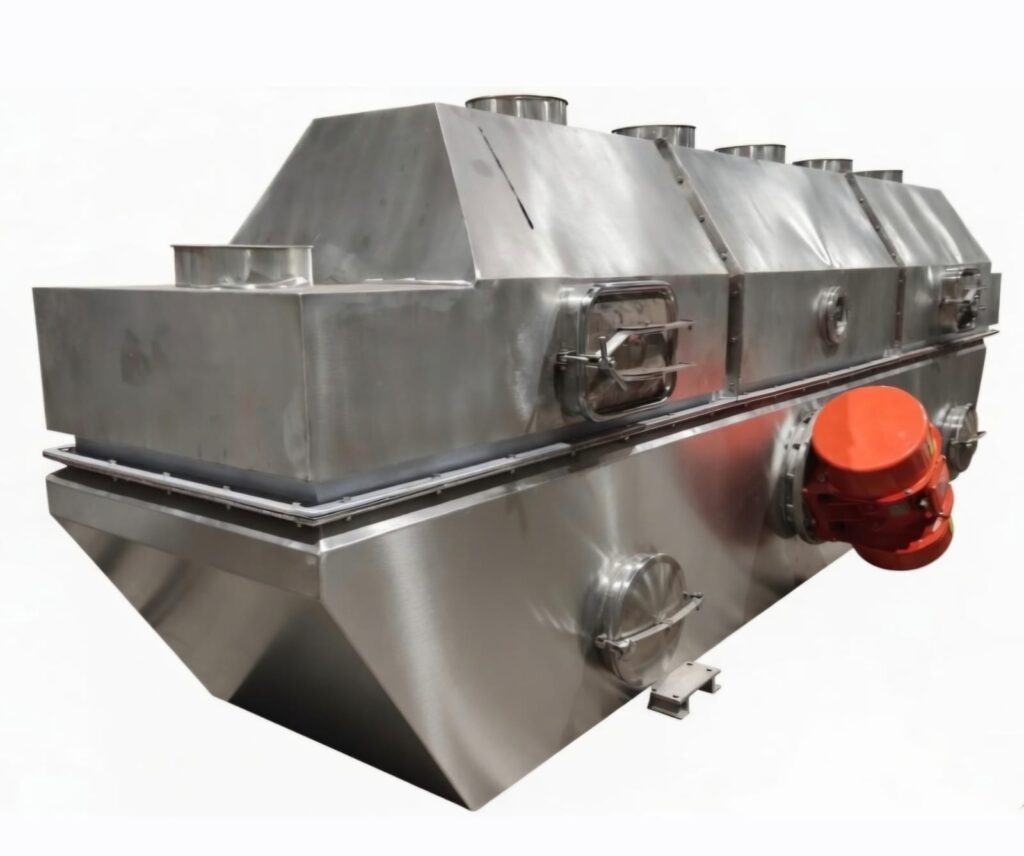
GTI’s fluidized-bed and vibratory fluidized-bed dryer range is intended for suitable particulate products, including granules, powders and crystals.
When should a chemical manufacturer consider a fluid-bed dryer?
- The feed consists of suitable crystals or granules.
- Moisture must be reduced consistently across the product.
- The material can withstand the required particle movement.
- The process benefits from controlled drying and, where required, cooling.
- The downstream operation requires a defined moisture specification before screening, blending or packaging.
Problems this technology may help address
- Variation in final moisture between batches or across the product stream.
- Excess moisture that contributes to storage or handling problems.
- Unwanted heating of the finished material after drying.
- Inconsistent operation caused by changes in feed moisture or particle distribution.
Important limitation: Very sticky, cohesive or poorly fluidizing materials may not be suitable for conventional fluid-bed drying without upstream conditioning or a different design. Fine powders may also require careful gas distribution and dust collection.
B. Spray Dryers for Solutions, Slurries and Pumpable Feeds
Spray drying is fundamentally different from drying already-formed crystals. It is used to transform a suitable liquid feed into a powder through atomization and rapid evaporation.
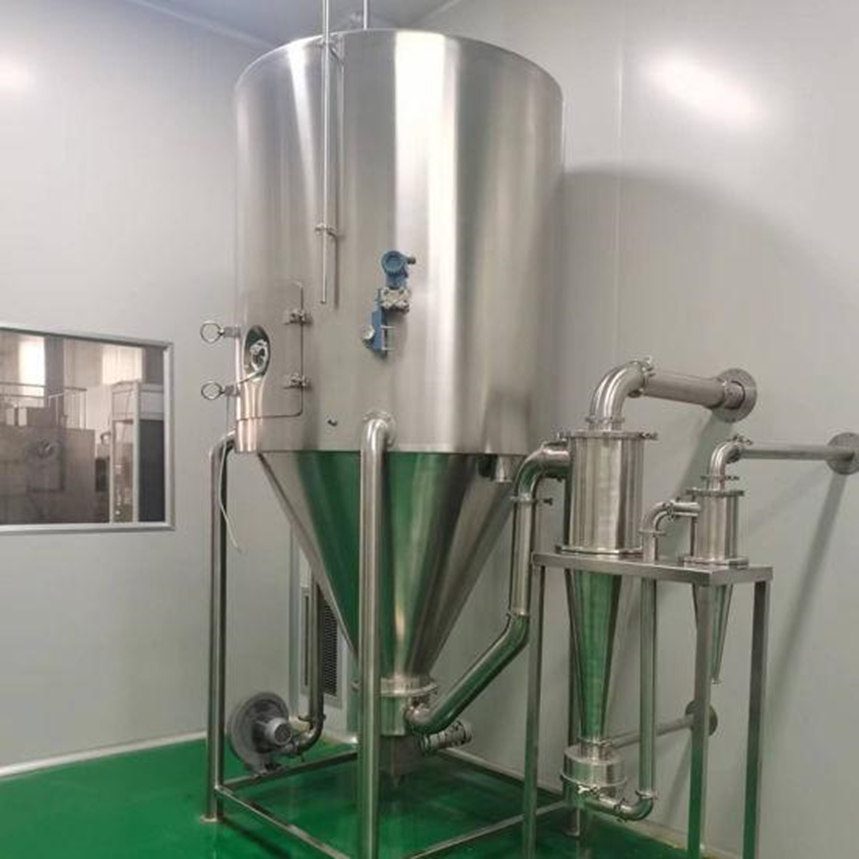
The liquid or slurry is pumped to an atomizer, which produces droplets inside a drying chamber. Contact with the drying gas removes moisture or the applicable volatile component, and the resulting particles are collected using an appropriate separation system. GTI describes spray drying for suitable solutions, slurries, suspensions and other pumpable feeds.
When should a spray dryer be considered?
- The feed is pumpable and can be atomized reliably.
- The production process requires conversion from liquid to powder.
- The desired powder characteristics can be achieved through spray-drying process development.
- Continuous processing is desirable.
- Particle size, bulk density, residual moisture or powder handling characteristics need to be evaluated together.
Problems to solve before selecting a spray dryer
- High feed viscosity that interferes with atomization.
- Nozzle blockage or unstable feed delivery.
- Wall deposition and powder recovery losses.
- Powder that is too fine, too coarse or difficult to handle.
- Excessive residual moisture or unwanted thermal exposure.
- Solvent-vapour management and safe exhaust handling.
The feed’s solids concentration, viscosity, surface properties, solvent system and thermal behaviour all influence design. Organic solvents may require a specially engineered closed-loop system, suitable vapour recovery and appropriate explosion-protection measures.
Important limitation: Spray drying is not automatically the best choice for wet crystals or mechanically dewatered filter cake. It is most relevant when the feed can be prepared and atomized as a suitable liquid, slurry or suspension.
C. Contact Dryers for Suitable Pastes and Solids
Contact drying transfers heat from a heated surface to the material. Depending on the equipment, heat may be supplied through a heated plate, drum, jacket, hollow shaft or other product-contact surface.
Contact drying can be worth evaluating when direct heating through a surface is more appropriate than relying entirely on hot gas. Certain contact-dryer configurations can also support enclosed processing and controlled handling of volatile components.
Potential applications include:
- Suitable pastes and concentrated chemical materials.
- Selected wet cakes or cohesive solids.
- Materials that require indirect heat transfer.
- Products for which reducing the volume of process gas is advantageous.
- Applications where containment or vapour recovery is a key design consideration.
Problems contact drying may help address
- Poor handling of sticky feed in conventional particulate dryers.
- Unnecessary contact with large volumes of hot gas.
- Difficulties containing process vapours.
- The need for a controlled heat-transfer approach.
However, not every paste is suitable for every contact dryer. Material distribution, adhesion, viscosity changes during drying, heat-transfer resistance and discharge behaviour must be assessed. Some products may be better served by a paddle dryer, while others may need flash or spin-flash drying.
3. What Is the Actual Production Problem?
A dryer purchase should solve a defined process problem—not simply replace an existing machine with a larger one.
Use the following guide to prepare a technical discussion with your equipment supplier.
| Production problem | What to investigate | Possible engineering direction |
| Final moisture is inconsistent | Feed variation, gas distribution, residence time and control strategy | Improved feed conditioning and dryer control |
| Wet crystals form lumps | Crystal size distribution, surface moisture and bed behaviour | Fluid-bed suitability, feed distribution or upstream dewatering |
| Paste sticks inside the dryer | Rheology, stickiness during drying and surface adhesion | Contact or mechanically assisted drying evaluation |
| Powder recovery is low | Particle size, exhaust velocity and separator performance | Cyclone, filtration and collection-system review |
| Product loses quality during drying | Thermal sensitivity, product temperature and exposure time | Alternative heat-transfer method or revised operating strategy |
| Energy consumption is high | Evaporation load, heat losses, exhaust conditions and heat recovery | Heat integration and system-efficiency assessment |
| Dryer output is unstable | Feed-rate variation, solids content and control limitations | Feed-system upgrades and process automation |
| Product is difficult to package | Final moisture, temperature, particle size and caking tendency | Integrated drying, cooling and product-conditioning review |
These are diagnostic starting points. The correct solution must be established using actual process data and, where necessary, material testing.
4. Drying Organic Acids and Chemical Intermediates
Organic chemical production covers a broad range of compounds, formulations and process routes. The correct dryer depends on the material’s state after crystallization, reaction, filtration or concentration—not merely its chemical name.
Organic acid crystals
Crystalline acids may need controlled moisture removal after separation from a mother liquor. The evaluation should consider crystal size, fines content, surface moisture, solubility, heat sensitivity and whether the required product is a hydrated or anhydrous grade.
A fluid-bed dryer may be considered for suitable free-flowing crystals. Other drying systems may be appropriate where the material’s behaviour or process configuration requires a different approach.
Specialty chemical intermediates
Chemical intermediates may arrive as granules, powders, wet cakes, pastes or solutions. Drying requirements vary with product purity, downstream reaction needs, residual solvent limits and material sensitivity.
The design should begin with the actual intermediate, its feed condition and the final specification. A generic dryer selection based only on the phrase “chemical intermediate” is insufficient.
Anhydrides and other solid chemical products
Some anhydride production routes include condensation, solidification, flaking or other finishing operations. A separate drying stage should not be assumed to be necessary for every product or process.
Where moisture or another volatile component must be removed, engineers should establish its source, concentration and effect on product quality before deciding whether a dryer is required.
Chemical solutions converted into powders
Where the required process transforms a suitable liquid feed into a solid powder, spray drying may be worth evaluating. The feed must be assessed for solids content, viscosity, atomization behaviour, solvent compatibility and powder recovery.
These examples illustrate the importance of designing the drying process around the actual product specification, rather than assuming that one dryer type suits all organic chemicals.
5. How to Choose Between Fluid-Bed, Spray and Contact Drying
Use this decision path as a first screening step.
Step 1: Is the feed already a solid?
- Yes — crystals or free-flowing granules: Evaluate a fluid-bed or other suitable solids dryer.
- Yes — sticky paste or filter cake: Evaluate contact, paddle, flash or spin-flash drying according to material behaviour.
- No — pumpable solution, slurry or suspension: Evaluate spray drying if the feed can be atomized and the required product can be produced through this route.
Step 2: What must the final product achieve?
Consider the required moisture or residual-solvent specification, particle size, bulk density, flowability, purity, temperature and downstream handling conditions.
Step 3: What are the process constraints?
Review thermal sensitivity, corrosivity, flammability, dust-explosion hazards, vapour handling, available utilities, plant layout and cleaning requirements.
Step 4: Confirm the technology.
Use material data, process calculations and pilot or laboratory testing where appropriate. Final equipment selection should be based on verified process requirements rather than a generic technology comparison.
6. What Determines Drying Performance and Operating Cost?
A dryer’s performance depends on the complete process, not just its heating system.
Moisture load
The quantity of moisture to be removed depends on the feed rate and the difference between initial and target moisture content. A high evaporation load may require a different system configuration from a low-moisture finishing application.
Feed consistency
Variations in moisture, viscosity, particle size or solids concentration can destabilize the drying process. Upstream filtration, dewatering, mixing or feed preparation may be necessary.
Heat transfer and gas handling
The appropriate heat-transfer method depends on the product, the required evaporation rate and the acceptable operating conditions. Airflow, exhaust conditions, insulation and heat recovery may influence energy consumption.
Product recovery
Dust collection, filtration and material discharge affect yield, workplace conditions and environmental control. Fine or valuable chemical powders require particular attention to recovery performance.
Automation and monitoring
Depending on the application, instrumentation may monitor feed rate, temperature, pressure, airflow, moisture or other critical process variables. PLC/SCADA integration can support process monitoring and repeatability when configured for the specific plant.
Cooling and downstream handling
A product leaving the dryer may need cooling, screening, conveying or controlled packaging. These stages can influence caking, handling and storage stability, so they should be considered during overall plant design.
7. Safety and Material Compatibility Must Be Part of the Design
Organic chemical drying can involve elevated temperatures, fine combustible dust, flammable solvents, corrosive materials or potentially harmful vapours. The relevant hazards vary significantly from one product and process to another.
Before equipment selection, evaluate:
- Chemical compatibility of product-contact surfaces.
- Dust explosibility and the need for appropriate explosion prevention or protection.
- Solvent vapour containment, recovery and exhaust treatment.
- Corrosion, abrasion and product contamination risks.
- Electrical and instrumentation requirements for the classified area, where applicable.
- Pressure, temperature and process-interlock requirements.
- Applicable site, environmental and occupational safety regulations.
A closed system or a particular dryer type does not automatically make a process safe. Protection measures must be established through a product-specific hazard assessment and suitable engineering design.
8. Why Consider GTI Dryers for Organic Chemical Processing?
Genex Tech Industries LLP develops industrial drying systems for chemical and other process industries. GTI’s equipment range includes fluidized-bed, spray, flash, rotary and paddle dryers, among other technologies.
For an organic chemical drying project, the selection process should consider:
Application-led engineering: Start with the material and its process requirements rather than prescribing a standard machine.
Technology evaluation: Assess whether the feed is best handled as crystals, granules, a wet cake, paste or liquid.
Process integration: Consider feed preparation, drying, cooling, collection, conveying and packaging as connected operations.
Product-quality requirements: Identify the critical moisture, particle and temperature specifications before finalizing the design.
Utilities and operating costs: Evaluate the available heating medium, energy requirements, exhaust handling and opportunities for heat recovery.
Project-specific configuration: Equipment materials, controls, containment and auxiliaries should be selected to match the actual application.
The final design and expected performance depend on the product data, process conditions, equipment configuration and validation results.
9. Get a Technical Evaluation for Your Chemical Drying Project
If your production line is experiencing high residual moisture, inconsistent product quality, sticking, powder loss or high energy consumption, a useful first step is to document the current process.
Share the following information with GTI Dryers to help the engineering team assess potential solutions.
- Chemical or product name: Include the grade and relevant material properties.
- Feed form: Crystals, granules, powder, paste, filter cake, slurry or solution.
- Feed capacity: Kilograms per hour or tonnes per day, with operating hours.
- Initial moisture or solids content: Include the measurement basis.
- Required final specification: Target moisture or residual solvent, as applicable.
- Product characteristics: Particle size, bulk density, viscosity, stickiness and heat sensitivity.
- Process conditions: Feed temperature, solvent system, upstream filtration or concentration and downstream operations.
- Utilities: Available steam, hot air, gas, electricity or other heating sources.
- Safety requirements: Corrosivity, flammability, dust hazards and containment needs.
- Project scope: New installation, replacement, capacity expansion or performance improvement.
- Installation location: Country and plant location for project planning.
With this information, the appropriate drying technologies can be evaluated before a final configuration is selected.
Planning a new organic chemical drying system or upgrading an existing plant?
Contact GTI Dryers to discuss your feed material, production target and moisture-removal challenges.
- Website: https://gtidryers.com/
- Email: mktg@gtidryers.com
- Phone: +91-9330077417
GTI Dryers — Engineered Drying Solutions from India for Global Industries.
10. Frequently Asked Questions
Which dryer is best for organic chemical processing?
There is no single best dryer for all organic chemicals. Fluid-bed dryers may suit appropriate crystals and granules; spray dryers are used for suitable pumpable liquids and slurries converted into powders; and contact or mechanically assisted dryers may suit selected pastes and solids. The final choice depends on material and process data.
What is the difference between a fluid-bed dryer and a spray dryer?
A fluid-bed dryer removes moisture from suitable solid particles using a gas flowing through the material bed. A spray dryer atomizes a suitable liquid feed into droplets and converts it into powder through evaporation.
Can spray drying handle organic chemical solutions?
Yes, suitable solutions can be spray dried when the feed formulation, atomization behaviour and desired powder properties support the process. Solvent-containing feeds may require specialized containment, recovery and safety measures.
Can a contact dryer process sticky chemical pastes?
Some contact-dryer configurations can handle suitable pastes and cohesive materials. However, adhesion, viscosity, material distribution, heat transfer and discharge behaviour must be evaluated before confirming suitability.
How can a chemical manufacturer reduce drying costs?
Begin by calculating the actual evaporation load and reviewing feed consistency, heat losses, exhaust conditions, product recovery and operating hours. Appropriate heat recovery, insulation, controls and upstream dewatering may help, but savings should be established from application-specific engineering calculations.
What information is needed to select an industrial chemical dryer?
The main inputs include product identity, feed form, feed rate, initial and final moisture, particle size or viscosity, thermal sensitivity, solvent properties, utilities, downstream requirements and safety constraints.
Does every organic chemical require a separate drying stage?
No. Some process routes produce a solid through crystallization, solidification, flaking or another finishing operation without requiring a separate dryer. The need for drying should be established from the actual process and final product specification.
Can GTI Dryers help with a customized chemical drying system?
GTI provides industrial drying equipment and customized drying solutions for process industries. A project-specific evaluation should establish the appropriate technology, configuration, auxiliaries and expected operating conditions before equipment selection.
Conclusion: Solve the Moisture Problem Before Selecting the Dryer
Reliable organic chemical drying begins with understanding the material and the product specification. Crystals, pastes and solutions present different engineering challenges, so selecting equipment by capacity alone can overlook important factors such as particle quality, sticking, heat sensitivity, solvent management and energy consumption.
By assessing the feed condition, evaporation requirement, safety constraints and downstream process together, chemical manufacturers can make a more informed equipment decision.
For organic chemical plants evaluating fluid-bed, spray or contact drying, GTI Dryers can be approached for a product-specific discussion of industrial drying options and process requirements.