
Your starch dryer may be running continuously, but is it delivering the powder quality your customers expect?
In modified starch manufacturing, a drying problem rarely affects only moisture. Excessive fines can reduce product recovery. Uneven drying can create inconsistent batches. Overheating may affect colour or functional properties, while poor feed dispersion can lead to wet lumps, deposits and unstable operation.
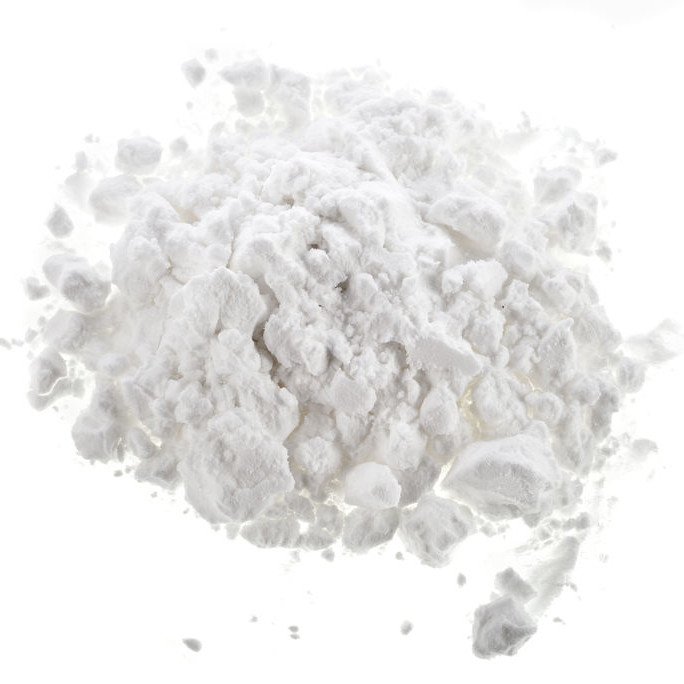
Choosing the right industrial dryer requires more than comparing machine capacities. The correct system depends on the starch type, modification process, incoming feed condition, final moisture specification, powder characteristics and downstream application.
GTI Dryers evaluates industrial drying requirements based on the material and process. This guide helps starch manufacturers identify the source of common drying problems, compare flash, ring and fluid bed dryer technologies, and prepare the information needed for a technically sound equipment enquiry.
The 60-second dryer selection guide
Before reviewing equipment specifications, identify your process situation.
| Your production situation | Technology worth evaluating | Why it may fit |
| Dewatered starch cake needs conversion into dry powder | Flash dryer | Rapid pneumatic drying with short product residence time |
| Modified starch requires additional drying or internal solids recirculation | Ring dryer | Recirculation can provide additional drying opportunities for suitable material |
| Particles or granules need controlled final drying and cooling | Fluid bed dryer | Air passes through a suitable bed of particles for moisture removal and cooling |
| Flash drying alone does not meet the final product specification | Flash + fluid bed system | Separates rapid initial drying from final drying or cooling |
| The feed is sticky, difficult to disperse or highly variable | Application assessment first | Feed conditioning and another process route may be necessary |
These are starting points, not universal rules. Ring dryers are a specialised form of pneumatic drying with product recirculation, while fluid bed systems depend on the material being suitable for fluidisation. Equipment selection must be validated against the actual feed and product specification.
1. Why modified starch needs a different drying assessment
Native starch and modified starch may share similar raw materials, but they are not necessarily interchangeable in a drying process.
Modified starch is processed physically, chemically or enzymatically to change selected functional properties. Depending on the modification and intended application, the final ingredient may be designed for specific viscosity, stability, thickening, binding, dispersion or processing behaviour.
The drying system must therefore preserve the properties required by the product specification.
Starch types and drying considerations
Native starch
Corn, tapioca, potato, wheat and other starches are commonly processed into powders after separation and dewatering. Feed dispersion, heat exposure, moisture removal and starch quality are important design considerations.
Modified food starch
Modified starch used in sauces, soups, bakery products, confectionery and other food applications may have specific requirements for viscosity, swelling, dispersibility or stability. The drying conditions must be evaluated against those functional requirements.
Industrial modified starch
Starches used in paper, textiles, adhesives, construction materials and related applications may require different particle characteristics and functional performance from food-grade products.
Specialty starch derivatives
Different derivatives and modification routes can produce different feed properties and drying behaviour. The process should be designed around the actual material rather than the broad label “modified starch.”
A critical distinction: drying is not the same as starch modification. A dryer removes moisture; it does not automatically create the required chemical or functional modification. The modification process, drying step and downstream finishing operations must work together.
2. The three main technologies: What each one actually does
<AsyncImageGroup query={[“industrial starch flash dryer pneumatic drying duct cyclone starch processing plant”,”industrial ring dryer modified starch pneumatic recirculation drying system”,”industrial fluid bed dryer food starch powder processing equipment”]} aspectRatio=”5:4″ layout=”bento”/>
A. Flash dryer: When fast moisture removal is the priority
A flash dryer uses a high-velocity stream of heated air to disperse and transport suitable wet material through a drying duct. Moisture evaporates as the material travels through the system, after which the dried solids are separated and collected.
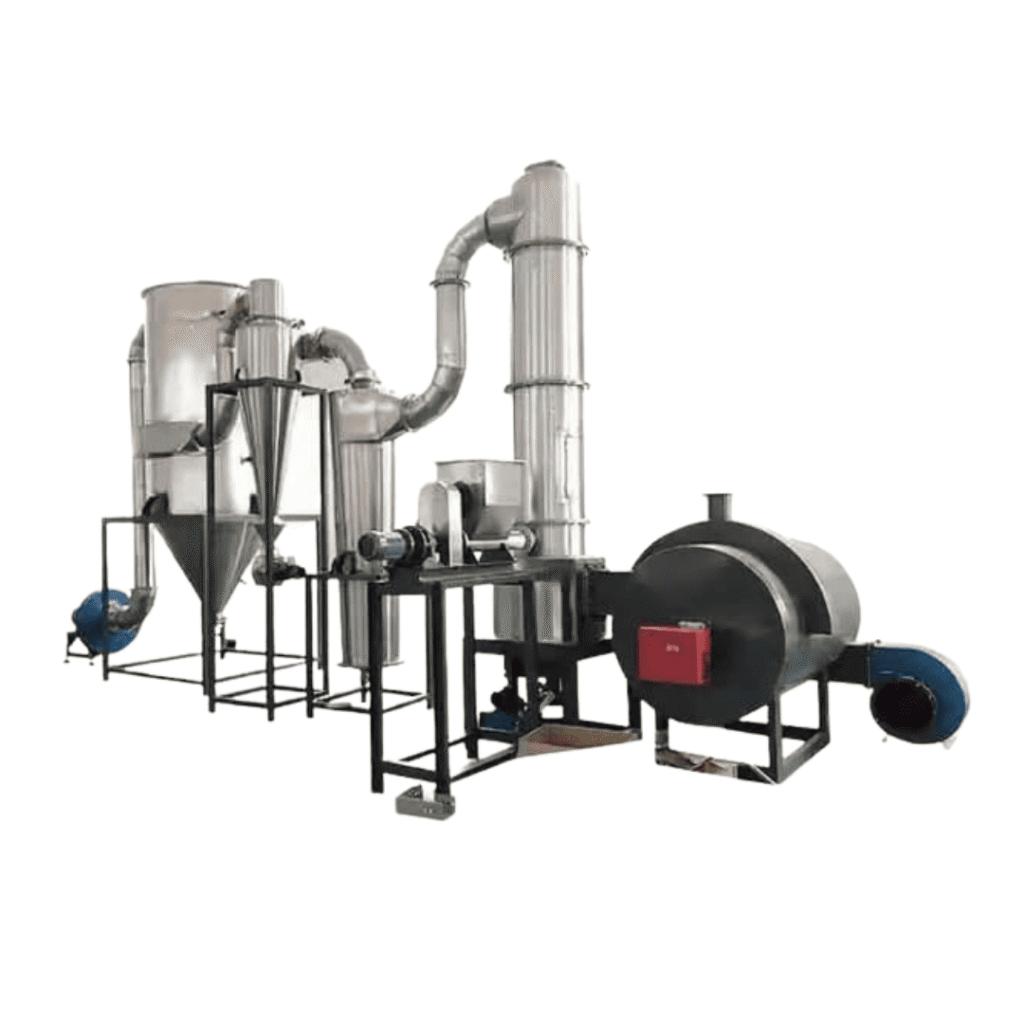
Flash drying is used in starch processing because it can provide rapid moisture removal with short residence time. The design must still account for feed dispersion, particle behaviour, starch quality and the required final moisture.
Consider a flash dryer when:
- Dewatered starch cake or a suitable wet feed needs continuous drying.
- The feed can be dispersed into the drying airstream.
- Rapid removal of readily removable moisture is required.
- Continuous production and integration with upstream dewatering are priorities.
- Powder collection and conveying can be designed for the resulting particle characteristics.
What can go wrong?
A flash dryer may perform poorly if the incoming feed is too sticky, too coarse, inconsistently dewatered or difficult to disperse. Fine powder may be lost if the collection system is not appropriate. Excessive thermal or mechanical exposure may also affect product quality.
Engineering question to ask: Is the incoming starch feed sufficiently dewatered and dispersible for stable pneumatic drying, and can the system achieve the required final specification in one pass?
B. Ring dryer: When recirculation and additional drying are important
A ring dryer builds on pneumatic drying by incorporating a recirculation arrangement. Depending on the design, partially dried or larger particles can be returned for additional drying rather than immediately leaving the system.
This can be valuable for certain modified starches and other materials where one-pass flash drying does not provide the required moisture reduction. The actual benefit depends on the feed properties, recirculation arrangement and process conditions.
Consider a ring dryer when:
- A suitable starch feed needs more drying opportunity than a single-pass system provides.
- The incoming material has a moisture profile that benefits from controlled recirculation.
- Product quality requires careful control of residence time and thermal exposure.
- A pneumatic drying system is appropriate, but additional drying or classification is needed.
What can go wrong?
Recirculation does not automatically correct every moisture problem. Incorrect feed preparation, poor air distribution, unsuitable classification or excessive fines can still reduce performance. The system must be designed to balance product circulation, drying load and collection efficiency.
Engineering question to ask: Will internal recirculation address the actual moisture-removal limitation, or is the main problem caused by upstream dewatering, feed consistency or product formulation?
C. Fluid bed dryer: When controlled particle finishing matters
A fluid bed dryer passes air through a bed of suitable particles, causing them to move and mix while moisture is removed. Fluid bed equipment may be used for final drying, cooling or controlled moisture adjustment in suitable granular or particulate products.
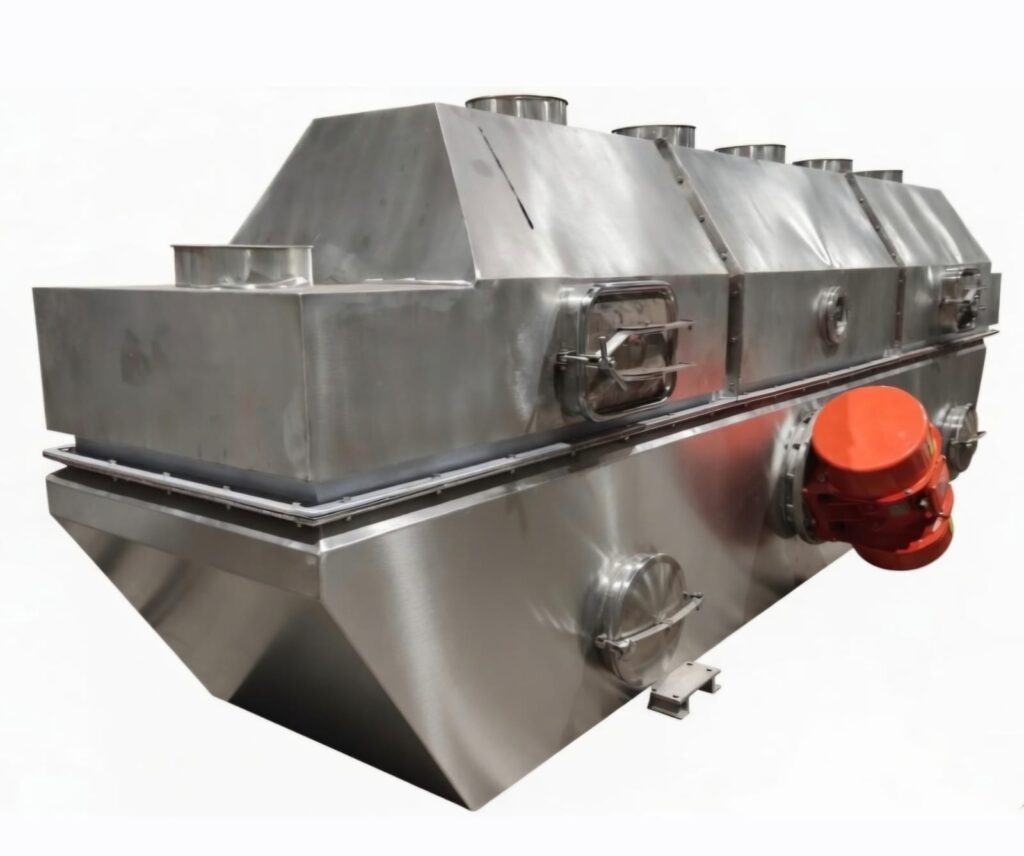
In starch processing, its role depends on the product form and process route. It should not automatically be selected as a direct replacement for a flash or ring dryer when the feed is a wet, cohesive starch cake.
Consider a fluid bed dryer when:
- The feed is already particulate or can be prepared into suitable particles.
- Final drying requires controlled airflow and particle mixing.
- The process needs a drying and cooling stage.
- The product is compatible with fluidisation without unacceptable entrainment, agglomeration or breakage.
What can go wrong?
Poor fluidisation can create uneven drying. Fine particles may be carried into the exhaust, while sticky material may agglomerate or interfere with airflow. Particle size, density, moisture and mechanical strength must be assessed before selecting the bed design.
Engineering question to ask: Is the feed suitable for fluidisation, and should the fluid bed perform the main drying duty or only final drying and cooling?
3. The production problem map: Diagnose before replacing equipment
When a starch line underperforms, the first step should be to identify where the problem begins.
| Symptom | Possible causes to investigate | First corrective action |
| Final moisture varies between batches | Variable incoming moisture, inconsistent feed rate, airflow fluctuations or poor process control | Record feed moisture and production conditions across multiple batches |
| Starch powder appears discoloured | Excessive thermal exposure, unsuitable operating conditions or changes in feed quality | Review product temperature history and compare against the product specification |
| Wet lumps or agglomerates appear | Poor feed dispersion, sticky feed, uneven distribution or unsuitable feed preparation | Inspect the feed system and determine whether conditioning is needed |
| Too many fines are produced | Feed disintegration, particle attrition, airflow or classification issues | Measure particle-size distribution before and after drying |
| Product recovery is low | Dust carryover, inefficient collection, leakage or unsuitable operating conditions | Review cyclone, bag filter and exhaust-system performance |
| Energy consumption is high | Excessive incoming water, heat losses, unsuitable operating conditions or poor heat integration | Calculate actual water evaporation and review the heat balance |
| Product functionality changes | Unsuitable process conditions or variability in the modification and drying steps | Test the relevant functional properties and isolate the process stage responsible |
| Dryer capacity is below expectations | Design assumptions do not match actual feed rate, moisture or operating hours | Recalculate evaporation load using measured plant data |
These are possible causes, not guaranteed diagnoses. A process audit should separate dryer-related issues from upstream modification, filtration, centrifugation, feed preparation and downstream milling or classification.
4. How to select the right dryer for your starch product
Use the following sequence to narrow down the technology.
Step 1 — Define the feed condition.
Is the material a pumpable slurry, dewatered cake, crumb, fine powder or granulated product? If the feed is wet and cohesive, confirm that it can be dispersed or prepared for the selected system.
Step 2 — Establish the required moisture removal.
Measure the incoming moisture and specify the final target on the same basis. Do not compare dryer quotations if one supplier uses wet-basis moisture and another uses dry-basis moisture without converting the figures.
Step 3 — Define the functional specification.
List the relevant product requirements, such as colour, viscosity, dispersibility, flowability, particle size and storage behaviour. The relevant tests depend on the grade and end use.
Step 4 — Compare process routes.
Evaluate flash drying for rapid pneumatic drying, ring drying when recirculation is beneficial, and fluid bed drying for suitable particle finishing. Consider a combined arrangement when a single stage cannot meet all requirements.
Step 5 — Verify safety and collection.
Starch dust can present a combustible-dust hazard. The equipment, dust collection, isolation, explosion protection and operating procedures must be assessed by qualified engineers for the actual material and applicable local requirements. Safety should be part of the original design, not an afterthought.
5. A practical moisture calculation for dryer sizing
Suppose a starch plant processes 2,000 kg/h of wet feed at 40% moisture on a wet basis and targets 12% final moisture on a wet basis.
Assuming dry solids are conserved and ignoring product losses:
- Dry solids entering the dryer: (2{,}000 \times 0.60 = 1{,}200) kg/h
- Final product flow: (1{,}200 \div 0.88 \approx 1{,}363.6) kg/h
- Water remaining in the final product: approximately 163.6 kg/h
- Water entering with the feed: 800 kg/h
- Approximate water removal: (800 – 163.6 = 636.4) kg/h
The illustrative mass balance indicates that approximately 636 kg/h of water must be removed.
This is not a recommended moisture specification for every starch grade. The final target depends on the product and customer specification. Actual dryer sizing also requires the feed’s behaviour, thermal properties, operating schedule, heat balance, collection efficiency and appropriate engineering margins.
A supplier should size the system against the actual evaporation load rather than relying on wet feed throughput alone.
6. Energy efficiency: Where starch manufacturers should look first
Energy consumption is influenced by the amount of water entering the dryer, the final moisture target, the heat source, air handling, exhaust conditions, heat losses and the overall process configuration.
Before assuming that a new dryer will reduce energy costs, assess the entire drying line.
- Upstream dewatering: Removing additional water mechanically may reduce the thermal evaporation load, depending on the feed and equipment.
- Feed consistency: Stable feed moisture and feed rate can make the drying process easier to control.
- Exhaust heat recovery: Recovering suitable waste heat may reduce fresh energy demand, subject to process compatibility and safety.
- Insulation and air leakage: Poor insulation and uncontrolled air ingress can increase losses.
- Process integration: Matching the dryer to existing dewatering, conveying, cooling and collection systems can improve overall operation.
- Control strategy: Appropriate instrumentation and control can help reduce unnecessary overheating, unstable operation and off-specification production.
Ring and flash dryers can be configured differently depending on the application, including options for exhaust-gas recirculation or heat integration. The potential benefit must be established from a process-specific energy balance, not a generic savings percentage.
7. Buyer checklist: What to send a dryer manufacturer
A technically useful quotation starts with complete process data. Share the following information with the equipment supplier.
Material details
- Starch source: corn, tapioca, potato, wheat or other
- Type of starch modification and product grade
- Feed form and physical characteristics
- Incoming moisture and solids concentration
- Relevant thermal and functional sensitivity
Production requirements
- Wet feed rate in kg/h or tonnes/day
- Required operating hours per day
- Target final moisture and measurement basis
- Required particle size and powder characteristics
- Product quality tests and acceptance criteria
- Expected production variability
Plant requirements
- Available heat source and utilities
- Existing filter, centrifuge or other dewatering equipment
- Available floor space and building height
- Product collection and dust-handling requirements
- Cleaning, hygiene and maintenance needs
- Automation, monitoring and control expectations
Commercial and project information
- New plant or retrofit
- Required delivery and commissioning schedule
- Preferred level of supply: dryer package or integrated process line
- Destination market and applicable product or safety requirements
The more representative the data, the more useful the comparison between alternative technologies will be.
8. How GTI Dryers can support a starch-drying assessment
GTI Dryers — Genex Tech Industries — provides industrial drying engineering for process applications. For modified starch and starch derivative projects, the starting point should be an assessment of feed behaviour, moisture-removal duty and the final product specification.
A technical review can establish:
- Whether flash drying, ring drying or fluid bed drying should be evaluated for the feed.
- Whether upstream dewatering or feed preparation needs attention.
- Whether a single-stage or multi-stage route is worth investigating.
- What information, testing and process calculations are required before final equipment sizing.
For unfamiliar or highly specification-sensitive materials, representative feed testing or pilot-scale trials may be appropriate before confirming a commercial design. The final recommendation should be based on verified process data and engineering review.
Explore relevant equipment and application information through the GTI Dryers website.
Frequently asked questions
Which dryer is best for modified starch?
There is no universal answer. Flash dryers are commonly considered for rapid pneumatic drying of suitable starch feeds. Ring dryers may be useful where recirculation and additional drying are required. Fluid bed dryers are considered for suitable particles, particularly for final drying or cooling. The right selection depends on the feed and product specification.
What is the difference between a flash dryer and a ring dryer?
A flash dryer generally transports and dries suitable material through a pneumatic drying path. A ring dryer incorporates a recirculation arrangement that allows selected particles or partially dried material to receive additional drying. The actual configuration varies by design and application.
Can a fluid bed dryer replace a flash dryer?
Not in every application. A flash dryer may be better suited to dispersible wet starch feed, while a fluid bed requires suitable particles or granules. Some processes may benefit from using both technologies in separate stages.
Why is the final moisture of modified starch inconsistent?
Possible causes include changes in incoming moisture, feed rate, solids concentration, feed dispersion, airflow and process-control settings. The cause should be confirmed using measured operating data.
Does drying temperature affect modified starch quality?
It can. The relevant effect depends on the starch type, modification route, moisture condition and product requirements. The process should be validated against the required functional properties rather than based on a universal temperature recommendation.
How is starch dryer capacity calculated?
Capacity depends on wet feed rate, incoming moisture, final moisture, dry-solids flow, heat and mass transfer, product behaviour and collection efficiency. A mass balance provides an initial estimate of water removal, but final equipment sizing requires detailed engineering.
Can the same dryer process food-grade and industrial starch?
The drying technology may overlap, but product-contact materials, hygiene, cleaning, contamination control and regulatory requirements may differ. The design must match the intended application and destination market.
What information is needed for a modified starch dryer quotation?
At minimum, provide starch type, feed form, feed rate, incoming moisture, target final moisture, product specifications, heat source, operating hours and available space. Representative samples and functional test data are helpful for challenging applications.
Need to solve a starch-drying problem?
If your plant is experiencing inconsistent moisture, powder losses, wet lumps, high energy use or changes in product quality, begin with the actual feed and finished-product data.
Request a technical assessment from GTI Dryers and share your starch type, feed condition, production capacity, incoming moisture and target product specification. This information helps establish whether a flash dryer, ring dryer, fluid bed dryer or combined process should be evaluated.
GTI Dryers — Engineered Drying Solutions from India for Global Industries.