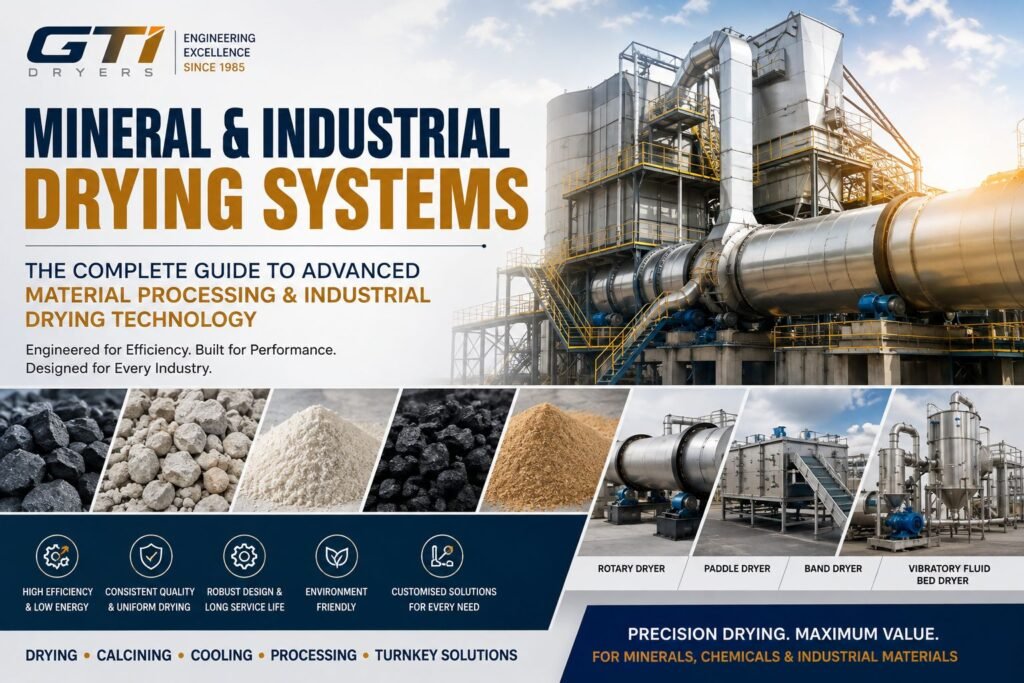
Mineral & Industrial Drying Systems: Driving the Future of Modern Manufacturing
Every modern industry depends on minerals. Whether it is electric vehicles, semiconductors, renewable energy, aerospace, pharmaceuticals, construction materials, ceramics, glass, steel, fertilizers, or advanced electronics, processed minerals form the foundation of industrial development.
Before these materials can be transformed into finished products, they must undergo several processing stages, including crushing, grinding, classification, washing, and one of the most critical steps—industrial drying.
Moisture may appear insignificant, but even small amounts can affect product quality, storage stability, chemical reactions, production efficiency, and transportation costs. Efficient drying ensures that minerals and industrial materials meet the stringent quality standards required by today’s manufacturers.
At GTI Dryers, we develop customized industrial drying solutions engineered to deliver consistent moisture control, high thermal efficiency, continuous production, and long-term reliability. Our systems are designed to support industries processing everything from fine mineral powders to heavy bulk solids while optimizing productivity and reducing operating costs.
Why Minerals Are More Important Than Ever in Today’s World
The modern economy is built on minerals. Every technological advancement, infrastructure project, and manufacturing innovation relies on processed mineral resources.
Minerals are essential for:
- Electric Vehicle (EV) batteries
- Solar panels
- Wind turbines
- Semiconductors
- Smartphones
- Data centers
- Steel manufacturing
- Cement production
- Construction materials
- Aerospace components
- Defense equipment
- Chemical manufacturing
- Water treatment systems
- Advanced ceramics
- Glass production
As industries embrace automation, electrification, and sustainable manufacturing, the demand for high-quality processed minerals continues to rise. This has made efficient industrial drying an indispensable step in ensuring material quality, reducing waste, and supporting global production.
What Are Mineral & Industrial Drying Systems?
Mineral and industrial drying systems are engineered solutions designed to remove controlled amounts of moisture from ores, mineral concentrates, industrial powders, aggregates, and other raw materials before further processing or storage.
Unlike simple drying methods, industrial systems carefully regulate temperature, airflow, residence time, and material handling to achieve uniform moisture reduction without compromising product characteristics.
These systems are widely used to:
- Improve material flowability
- Enhance storage stability
- Prevent agglomeration
- Prepare materials for grinding or packaging
- Increase production efficiency
- Reduce transportation costs
- Improve downstream processing performance
Modern industrial drying solutions are designed for continuous operation, energy efficiency, and integration into automated manufacturing environments.
The Role of Drying in Mineral Processing
Mining and mineral processing involve several stages before a raw mineral becomes a valuable industrial product.
A typical process may include:
- Mining or extraction
- Crushing
- Screening
- Grinding
- Washing
- Classification
- Dewatering
- Drying
- Storage
- Packaging
- Transportation
- Further industrial processing
Drying bridges the gap between raw material preparation and value-added manufacturing. By achieving the required moisture level, manufacturers can improve product consistency, reduce operational issues, and meet customer specifications.
Understanding Moisture Control in Industrial Materials
Moisture affects every aspect of industrial processing.
Excessive moisture can result in:
- Material sticking
- Poor flowability
- Product contamination
- Equipment blockages
- Reduced grinding efficiency
- Increased transportation weight
- Storage instability
- Lower product quality
Effective moisture control improves:
- Material handling
- Product uniformity
- Process efficiency
- Storage life
- Energy utilization
- Production reliability
This is why industrial drying is considered one of the most important operations in modern material processing plants.
Why Continuous Drying Technology Matters
Manufacturing industries are moving away from labor-intensive batch operations toward automated continuous production systems.
Continuous drying offers several advantages:
- Stable production rates
- Uniform product quality
- Reduced labor requirements
- Better energy utilization
- Lower operational costs
- Consistent moisture control
- Easy integration with production lines
- Higher plant productivity
GTI Dryers designs continuous drying solutions that support uninterrupted industrial production while maintaining consistent process performance.
India’s Growing Importance in the Global Mineral Industry
India is one of the world’s fastest-growing industrial economies and a major producer of minerals required by construction, manufacturing, energy, and advanced technology sectors.
The country possesses significant reserves of:
- Iron Ore
- Limestone
- Bauxite
- Manganese
- Coal
- Quartz
- Silica Sand
- Gypsum
- Kaolin
- Bentonite
- Dolomite
- Feldspar
- Graphite
- Rare Earth Elements
These minerals are processed and exported to markets across Asia, Europe, North America, Africa, and the Middle East.
With increasing investments in infrastructure, renewable energy, electric mobility, and industrial manufacturing, the demand for efficient drying technologies continues to grow.
GTI Dryers supports this transformation by providing advanced drying solutions that help mineral processors achieve higher productivity, better energy efficiency, and consistent product quality for domestic and international markets.
The Rise of Critical Minerals in Advanced Technologies
The transition toward clean energy and digital transformation has increased global demand for critical minerals used in:
- Electric vehicle batteries
- Energy storage systems
- Renewable energy infrastructure
- Electronics manufacturing
- Telecommunications
- Aerospace engineering
- Artificial Intelligence hardware
- Data center infrastructure
These industries require precisely processed mineral materials with controlled moisture and consistent quality, making advanced drying technology an essential part of the production process.
Applications of Industrial Drying Systems
Industrial drying equipment is used across a wide range of sectors.
Mining Industry
Applications include:
- Iron Ore
- Copper Concentrates
- Bauxite
- Coal
- Nickel Ore
- Zinc Concentrates
- Lead Concentrates
Construction Materials
Suitable for:
- Cement Raw Materials
- Limestone
- Sand
- Fly Ash
- Aggregates
Ceramic Industry
Processing of:
- Kaolin
- Feldspar
- Quartz
- Clay
- Ceramic Powders
Glass Industry
Applications include:
- Silica Sand
- Soda Ash
- Industrial Minerals
Battery Material Processing
Suitable for:
- Graphite
- Lithium Minerals
- Battery Precursors
- Specialty Mineral Powders
Chemical & Industrial Materials
Applications include:
- Industrial Salts
- Pigments
- Fillers
- Catalyst Materials
- Specialty Powders
Why Drying Determines Product Quality
Industrial drying is not simply about removing water.
A properly engineered drying process improves:
- Material consistency
- Flowability
- Storage stability
- Product purity
- Packaging efficiency
- Processing reliability
- Manufacturing productivity
Poorly controlled drying can lead to product degradation, operational disruptions, excessive energy consumption, and inconsistent material quality.
GTI Dryers: Engineering Solutions for Heavy-Duty Industrial Applications
Every mineral behaves differently during drying. Factors such as particle size, density, abrasiveness, moisture content, thermal sensitivity, and production capacity influence equipment design.
Instead of offering standardized machines, GTI Dryers develops customized drying systems tailored to the customer’s material characteristics and production objectives.
Our engineering process evaluates:
- Material properties
- Moisture characteristics
- Production capacity
- Heat source availability
- Plant layout
- Utility requirements
- Automation level
- Future expansion plans
This application-specific approach ensures reliable operation, optimized energy consumption, and long-term plant performance.
Who Should Read This Guide?
This comprehensive guide is designed for:
- Mining Companies
- Mineral Processing Plants
- EPC Contractors
- Industrial Manufacturers
- Ceramic Producers
- Glass Manufacturers
- Battery Material Producers
- Chemical Processing Companies
- Engineering Consultants
- Plant Designers
- Production Managers
- Procurement Professionals
- Project Engineers
- Investors in Industrial Processing
Whether you are planning a new mineral processing facility, upgrading an existing plant, or evaluating drying technologies for industrial materials, this guide provides the knowledge needed to make informed decisions.
Understanding the Science Behind Industrial Drying
Industrial drying is much more than simply removing moisture from a material. It is a carefully engineered thermal process that combines heat transfer, airflow management, material movement, and process control to produce a stable, high-quality product.
Whether processing iron ore, silica sand, limestone, gypsum, graphite, battery minerals, ceramic powders, or specialty industrial materials, every product responds differently to heat and moisture removal. A successful drying system must therefore be designed around the physical and thermal characteristics of the material being processed.
At GTI Dryers, our engineering philosophy focuses on delivering drying systems that maximize productivity, preserve material quality, reduce energy consumption, and provide reliable long-term performance.
The Four Stages of Industrial Drying
Every industrial material passes through several stages during the drying process.
Stage 1 – Surface Moisture Evaporation
At the beginning of drying, moisture present on the surface of the material evaporates rapidly due to the transfer of thermal energy.
This stage generally requires less energy because free moisture is easily removed.
Stage 2 – Internal Moisture Migration
Once the surface moisture has evaporated, moisture trapped inside the particles begins moving toward the surface.
This is one of the most critical phases because improper temperature control may cause:
- Uneven drying
- Surface cracking
- Product degradation
- Reduced processing efficiency
Stage 3 – Controlled Moisture Removal
As moisture continues migrating outward, the drying system carefully balances:
- Heat input
- Air velocity
- Residence time
- Product movement
This stage determines final product quality.
Stage 4 – Final Moisture Stabilization
The final stage ensures the material reaches its target moisture content without overheating.
Proper stabilization improves:
- Storage life
- Product consistency
- Transportation efficiency
- Downstream processing
Heat Transfer Fundamentals
Heat transfer is the foundation of every industrial drying process.
The objective is to supply sufficient thermal energy for moisture evaporation while protecting the physical and chemical properties of the material.
Industrial drying systems rely on three primary heat transfer mechanisms.
1. Convection
Hot air transfers heat directly to the material.
Advantages include:
- Fast drying
- Uniform heat distribution
- Continuous operation
- Suitable for bulk materials
Convection is widely used in Belt Dryers, Flash Dryers, and Fluid Bed Dryers.
2. Conduction
Heat moves through direct contact between the heating surface and the material.
Advantages include:
- High thermal efficiency
- Reduced dust generation
- Better temperature control
- Suitable for sticky materials
Commonly used in Paddle Dryers and Contact Dryers.
3. Radiation
Thermal energy is transferred through infrared radiation.
Although less common in heavy industrial processing, radiation is useful for specialized applications requiring controlled surface heating.
Moisture Migration: The Hidden Engineering Challenge
Many people believe drying only removes water from the surface.
In reality, the most important engineering challenge is the movement of internal moisture.
Moisture migrates through:
- Capillary action
- Diffusion
- Internal vapor pressure
- Molecular movement
If heat is applied too aggressively, the surface may dry before internal moisture escapes, causing:
- Hard surface formation
- Internal moisture pockets
- Reduced product quality
- Higher energy consumption
GTI Dryers optimizes drying parameters to achieve balanced moisture migration throughout the material.
Material Characteristics That Influence Dryer Design
No two minerals behave exactly the same during drying.
Engineers evaluate several properties before selecting drying equipment.
Particle Size
Fine powders require different airflow characteristics than coarse aggregates.
Bulk Density
Dense materials demand different residence times and heat transfer rates.
Moisture Content
Higher initial moisture generally requires greater drying capacity.
Thermal Sensitivity
Certain industrial minerals can undergo physical or chemical changes if exposed to excessive temperatures.
Abrasiveness
Highly abrasive minerals require wear-resistant equipment and specialized construction materials.
Flowability
Poor-flowing materials require optimized conveying and handling systems.
Direct vs. Indirect Drying Technology
Selecting the appropriate drying method is one of the most important engineering decisions.
Direct Drying
The material comes into direct contact with heated air.
Advantages
- High drying speed
- Continuous production
- Lower installation cost
- Suitable for most mineral applications
Applications include:
- Sand
- Coal
- Iron Ore
- Limestone
- Fertilizers
- Mineral concentrates
Indirect Drying
Heat is transferred through metal surfaces without direct contact between combustion gases and the product.
Advantages
- Better temperature control
- Reduced contamination
- Suitable for specialty materials
- Improved product purity
Applications include:
- Specialty chemicals
- Battery materials
- High-value industrial powders
Airflow Engineering
Airflow is just as important as temperature.
Proper airflow ensures:
- Uniform heat distribution
- Efficient moisture removal
- Reduced dust accumulation
- Stable drying conditions
Poor airflow may lead to:
- Uneven drying
- Hot spots
- Product degradation
- Higher energy consumption
GTI Dryers uses computational engineering principles to optimize airflow throughout the drying chamber.
Residence Time Optimization
Residence time refers to how long material remains inside the dryer.
If residence time is too short:
- Moisture remains high
- Product quality suffers
If residence time is too long:
- Product overheating
- Increased operating costs
- Lower productivity
GTI Dryers carefully balances production speed with drying efficiency to achieve consistent results.
Bulk Material Handling During Drying
Industrial drying is not only about thermal energy.
Materials must also move smoothly through the production system.
Important handling considerations include:
- Feeding systems
- Conveyors
- Material distribution
- Product discharge
- Dust collection
- Cooling systems
Proper material handling minimizes product loss while improving plant efficiency.
Industrial Dryer Technologies Used in Mineral Processing
Different materials require different drying technologies.
Belt Dryers
Best for:
- Continuous production
- Uniform moisture control
- Heat-sensitive industrial materials
Rotary Dryers
Suitable for:
- High-capacity mineral processing
- Bulk solids
- Aggregates
- Mining operations
Flash Dryers
Ideal for:
- Fine powders
- Small particles
- Rapid moisture removal
Fluid Bed Dryers
Suitable for:
- Granules
- Crystals
- Uniform particle drying
Paddle Dryers
Best for:
- Sticky materials
- Sludges
- Industrial residues
- Filter cakes
Spray Dryers
Applications include:
- Liquid minerals
- Suspensions
- Specialty chemical solutions
Selecting the Appropriate Heating Medium
Different industries require different heating systems depending on product requirements and available utilities.
Common options include:
- Steam Heating
- Thermal Oil Heating
- Natural Gas
- LPG
- Biomass Fuel
- Electric Heating
- Waste Heat Recovery Systems
GTI Dryers evaluates energy availability, operating costs, environmental requirements, and process efficiency before recommending the most suitable heating solution.
Process Automation in Modern Drying Plants
Industrial drying has become increasingly automated.
Automation improves:
- Product consistency
- Process stability
- Energy efficiency
- Operator safety
- Production monitoring
Typical automation features include:
- PLC-based control
- Touchscreen HMI
- SCADA integration
- Temperature monitoring
- Moisture sensors
- Variable Frequency Drives (VFD)
- Automatic alarms
- Remote diagnostics
Sustainability Through Energy-Efficient Drying
Modern industries are under increasing pressure to reduce energy consumption and carbon emissions.
GTI Dryers integrates sustainable engineering practices such as:
- High-efficiency insulation
- Heat recovery systems
- Intelligent airflow control
- Variable-speed drives
- Low-emission heating technologies
- Optimized thermal efficiency
These features help manufacturers lower operational costs while supporting environmental sustainability.
Common Engineering Challenges
Industrial mineral drying systems often encounter challenges such as:
Uneven Moisture Distribution
Solved through optimized airflow and controlled residence time.
Material Build-Up
Prevented using proper material handling and equipment design.
Excessive Dust Generation
Controlled through enclosed systems and efficient dust collection.
High Energy Consumption
Reduced using heat recovery and advanced process control.
Product Overheating
Avoided with precise temperature regulation and intelligent automation.
Why Engineering Expertise Matters
Selecting an industrial drying system involves far more than choosing a machine. Every project requires a detailed understanding of:
- Material behavior
- Production goals
- Thermal engineering
- Utility availability
- Plant layout
- Future expansion
- Environmental regulations
- Process integration
At GTI Dryers, our engineering team develops customized drying solutions based on scientific analysis, practical industrial experience, and customer-specific requirements. This ensures each system delivers consistent performance, reliable operation, and long-term value across mining, mineral processing, and industrial manufacturing applications.
The Future of Industrial Growth Begins with Advanced Drying Technology
As industries become more automated, sustainable, and quality-focused, industrial drying has evolved from a basic moisture removal process into a strategic manufacturing operation.
From mining and metallurgy to battery materials, renewable energy, construction, ceramics, specialty chemicals, and advanced manufacturing, modern industries require precise moisture control to maintain product quality, reduce production costs, and improve operational efficiency.
Today, industrial drying systems play a vital role in helping manufacturers produce consistent, export-quality materials while supporting global sustainability goals.
At GTI Dryers, we combine process engineering, thermal technology, automation, and customized system design to deliver reliable drying solutions for industries operating in highly competitive global markets.
Industrial Drying Across the Global Supply Chain
Every stage of industrial manufacturing depends on properly processed raw materials.
Industrial drying supports:
- Mining Operations
- Mineral Beneficiation Plants
- Cement Manufacturing
- Steel Production
- Glass Manufacturing
- Ceramic Industries
- Battery Material Processing
- Chemical Manufacturing
- Fertilizer Production
- Foundries
- Environmental Engineering
- Recycling Industries
Whether producing construction materials or advanced battery minerals, consistent moisture control improves manufacturing performance and product quality.
Critical Minerals Powering the Modern World
The demand for critical minerals has increased dramatically due to the growth of electric mobility, renewable energy, and digital infrastructure.
Some of the most important industrial minerals include:
Lithium
Essential for:
- Electric Vehicle Batteries
- Energy Storage Systems
- Consumer Electronics
Graphite
Used in:
- Battery Anodes
- Refractories
- Lubricants
- Steel Manufacturing
Rare Earth Elements
Applications include:
- Wind Turbines
- Electric Motors
- Electronics
- Defense Equipment
Silica
Required for:
- Glass Manufacturing
- Semiconductors
- Solar Panels
- Construction Materials
Kaolin
Widely used in:
- Ceramics
- Paper
- Paints
- Rubber
- Pharmaceuticals
Bentonite
Applications include:
- Drilling Fluids
- Foundries
- Pelletizing
- Civil Engineering
Each of these materials requires carefully controlled drying before entering downstream manufacturing processes.
Mineral Drying Supports Every Modern Industry
Industrial minerals are present in products people use every day.
Without efficient drying, manufacturers face problems such as:
- Product instability
- Higher transportation costs
- Poor storage life
- Manufacturing defects
- Lower production efficiency
Industries benefiting from advanced drying include:
Construction
- Cement
- Concrete Additives
- Dry Mortars
- Building Minerals
Renewable Energy
- Battery Materials
- Solar Glass
- Wind Energy Components
Electronics
- Semiconductor Materials
- High-Purity Minerals
- Specialty Powders
Automotive
- EV Battery Minerals
- Lightweight Fillers
- Industrial Coatings
Aerospace
- High-performance Ceramics
- Specialty Metal Powders
- Advanced Composite Materials
Agriculture
- Mineral Fertilizers
- Soil Conditioners
- Micronutrients
Sustainability Through Efficient Industrial Drying
Sustainability has become a key objective across industrial sectors.
Efficient drying systems contribute by:
- Reducing fuel consumption
- Lowering greenhouse gas emissions
- Minimizing product waste
- Supporting resource conservation
- Improving process efficiency
- Extending equipment life
GTI Dryers develops energy-efficient systems that help manufacturers achieve both operational and environmental goals.
Why Customized Engineering Matters
No two industrial materials behave the same.
Each product has unique characteristics including:
- Moisture content
- Bulk density
- Particle size
- Abrasiveness
- Flowability
- Heat sensitivity
- Desired final moisture
Because of these variations, selecting a standard dryer is rarely the best solution.
GTI Dryers begins every project with detailed engineering analysis to design equipment specifically for the customer’s material and production objectives.
Industries Served by GTI Dryers
GTI Dryers provides customized drying solutions for a wide range of industrial sectors.
Mining Industry
Suitable for:
- Iron Ore
- Copper Concentrates
- Coal
- Nickel Ore
- Zinc
- Lead
- Manganese
Mineral Processing
Applications include:
- Silica Sand
- Quartz
- Limestone
- Dolomite
- Feldspar
- Gypsum
- Bentonite
- Kaolin
Battery Material Processing
Drying solutions for:
- Graphite
- Lithium Minerals
- Battery Precursors
- Specialty Powders
Building Material Industry
Processing of:
- Cement Raw Materials
- Fly Ash
- Construction Sand
- Aggregates
- Lightweight Fillers
Chemical & Specialty Materials
Applications include:
- Industrial Pigments
- Catalysts
- Industrial Salts
- Specialty Mineral Powders
GTI Dryers’ Engineering Approach
Every project follows a systematic engineering methodology.
Step 1 – Material Analysis
Understanding physical and thermal properties.
Step 2 – Process Evaluation
Studying moisture behavior and production requirements.
Step 3 – Equipment Selection
Choosing the most suitable drying technology.
Step 4 – Thermal Design
Optimizing airflow and heat transfer.
Step 5 – Automation Integration
Implementing intelligent process controls.
Step 6 – Performance Optimization
Testing for efficiency, productivity, and quality.
How Industrial Drying Solutions Are Known Across Global Markets
Industrial engineers, mining companies, EPC contractors, and procurement specialists often use different search terms depending on the country and industry. Incorporating these localized terms naturally improves international discoverability while keeping the primary content in professional English.
| Country / Region | Common Industry Search Term |
| 🇮🇳 India | Industrial Mineral Drying Systems |
| 🇦🇺 Australia | Mining Drying Equipment Manufacturer |
| 🇨🇦 Canada | Bulk Material Drying Solutions |
| 🇿🇦 South Africa | Mineral Processing Drying Plant |
| 🇨🇱 Chile | Ore Drying Equipment Supplier |
| 🇮🇩 Indonesia | Produsen Mesin Pengering Mineral Industri |
| 🇲🇾 Malaysia | Industrial Material Drying Systems |
| 🇩🇪 Germany | Hersteller von Industriellen Trocknungsanlagen für Mineralien |
| 🇫🇷 France | Fabricant de systèmes industriels de séchage des minéraux |
| 🇪🇸 Spain | Fabricante de sistemas de secado industrial para minerales |
| 🇧🇷 Brazil | Fabricante de Secadores Industriais para Mineração |
| 🇦🇪 UAE | Industrial Bulk Material Drying Equipment |
| 🌍 Middle East | شركة تصنيع أنظمة تجفيف المعادن الصناعية |
Why Global Industries Choose GTI Dryers
Industrial customers require more than just machinery—they need a long-term engineering partner capable of supporting productivity, efficiency, and future expansion.
GTI Dryers delivers:
- Customized process engineering
- Heavy-duty industrial construction
- Continuous production capability
- Energy-efficient designs
- Intelligent automation
- Application-specific solutions
- Global project support
- Reliable after-sales service
- Long equipment life
- Optimized operating costs
Every system is engineered to meet customer-specific production goals while ensuring dependable operation under demanding industrial conditions.
Building Trust Through Engineering Excellence (EEAT)
Industrial buyers increasingly rely on technical expertise when selecting process equipment. GTI Dryers strengthens its credibility by providing:
- Application-specific engineering knowledge
- Detailed technical resources
- Process optimization guidance
- Industry-focused case studies
- Transparent design methodology
- Customized project consultation
- Long-term technical support
Engineering Excellence Behind High-Performance Industrial Drying
Modern mineral processing plants operate in highly competitive environments where productivity, energy efficiency, product consistency, and operational reliability directly impact profitability. Choosing the right drying technology is no longer just an equipment decision—it is a strategic investment that influences the entire production process.
Whether processing iron ore, silica sand, gypsum, limestone, graphite, bentonite, kaolin, coal, or battery minerals, every application requires an engineered solution based on material behavior, moisture content, production capacity, and downstream process requirements.
At GTI Dryers, every industrial drying solution is designed through a comprehensive engineering approach that balances heat transfer, airflow, automation, material handling, and energy optimization to deliver reliable long-term performance.
Why Dryer Selection Matters
No single dryer is suitable for every industrial material. Selecting the wrong equipment can lead to:
- Higher fuel consumption
- Uneven drying
- Product degradation
- Excessive maintenance
- Lower production efficiency
- Increased operating costs
- Product rejection
- Reduced equipment life
Proper dryer selection ensures:
- Uniform moisture control
- Stable production
- Better product quality
- Lower operational costs
- Reliable continuous operation
- Improved return on investment
Key Engineering Factors Before Selecting a Dryer
Before recommending a drying solution, GTI Dryers evaluates several technical parameters.
Material Characteristics
Every mineral behaves differently depending on:
- Initial moisture content
- Final moisture requirement
- Bulk density
- Particle size distribution
- Abrasiveness
- Heat sensitivity
- Flow characteristics
Production Capacity
Equipment sizing depends on:
- Hourly throughput
- Daily production
- Future expansion
- Batch or continuous operation
Utility Availability
Heating options include:
- Steam
- Thermal Oil
- Natural Gas
- LPG
- Biomass
- Electric Heating
- Waste Heat Recovery
The available utility infrastructure significantly influences system design and operating costs.
Plant Layout
A well-designed drying system integrates seamlessly with:
- Crushers
- Conveyors
- Grinding Mills
- Screens
- Storage Silos
- Packaging Systems
Proper layout minimizes material handling and maximizes operational efficiency.
Types of Dryers Used in Mineral & Industrial Processing
Different materials require different drying technologies depending on their physical properties and production objectives.
Belt Dryers
Belt Dryers are widely used for continuous drying of materials requiring gentle moisture removal and controlled residence time.
Suitable Applications
- Industrial powders
- Fine minerals
- Specialty materials
- Battery minerals
- Lightweight aggregates
Advantages
- Continuous production
- Uniform drying
- Excellent moisture control
- Low thermal stress
- High automation capability
Rotary Dryers
Rotary Dryers are among the most common drying systems used in mining and bulk material processing.
Suitable For
- Iron Ore
- Limestone
- Sand
- Coal
- Aggregates
- Fertilizers
Advantages
- High production capacity
- Rugged construction
- Suitable for abrasive materials
- Reliable operation
- Cost-effective for bulk processing
Flash Dryers
Flash Dryers provide rapid drying of fine powders and lightweight materials.
Applications
- Fine mineral powders
- Pigments
- Filter cakes
- Industrial chemicals
Benefits
- Extremely fast drying
- Compact footprint
- Continuous processing
- Efficient moisture removal
Fluid Bed Dryers
Fluid Bed Dryers suspend particles in controlled airflow for highly uniform drying.
Best For
- Granules
- Crystalline products
- Free-flowing particles
Advantages
- Uniform drying
- Excellent heat transfer
- High thermal efficiency
- Consistent product quality
Paddle Dryers
Paddle Dryers use indirect heat transfer for sticky, viscous, and difficult-to-handle materials.
Applications include:
- Industrial sludge
- Filter cakes
- Industrial residues
- High-moisture materials
Advantages include:
- Low dust generation
- High thermal efficiency
- Closed operation
- Precise temperature control
Spray Dryers
Spray Dryers suitable for converting liquid feeds into dry powders.
Applications include:
- Specialty chemicals
- Mineral suspensions
- Industrial solutions
Benefits include:
- Fine powder production
- Rapid drying
- Controlled particle characteristics
Direct vs Indirect Drying
Choosing between direct and indirect drying depends on product characteristics.
Direct Drying
Heat comes into direct contact with the material.
Ideal for:
- Mining
- Bulk solids
- Construction minerals
- Sand
- Limestone
Benefits:
- Fast drying
- Lower capital cost
- High throughput
Indirect Drying
Heat transfers through a metal surface without direct contact.
Suitable for:
- High-value minerals
- Specialty materials
- Sensitive industrial powders
Benefits:
- Better product purity
- Precise temperature control
- Reduced contamination
Heat Recovery for Energy Efficiency
Energy consumption is one of the largest operating costs in industrial drying.
GTI Dryers incorporates:
- Waste heat recovery
- Air recirculation
- Heat exchangers
- Intelligent burner control
- High-performance insulation
These technologies significantly reduce fuel consumption while maintaining drying efficiency.
Intelligent Automation & Industry 4.0 Integration
Modern drying systems increasingly rely on automation to ensure consistency and reduce manual intervention.
GTI Dryers offers:
- PLC Control Systems
- HMI Touchscreen Interfaces
- SCADA Monitoring
- Real-Time Temperature Control
- Moisture Sensors
- VFD-Controlled Fans
- Automated Alarm Systems
- Remote Monitoring & Diagnostics
These features improve operational reliability, optimize energy use, and support predictive maintenance.
Dust Collection & Environmental Compliance
Mineral drying processes often generate dust that must be controlled to ensure safety and regulatory compliance.
Our systems integrate:
- Cyclone Separators
- Bag Filters
- Wet Scrubbers
- Dust Extraction Units
- Air Pollution Control Systems
Benefits include:
- Cleaner working environment
- Product recovery
- Reduced emissions
- Compliance with environmental standards
Common Challenges in Mineral Drying
Industrial plants frequently encounter issues such as:
Uneven Moisture
Caused by improper airflow or residence time.
Solution: Optimized airflow design and automated process control.
Material Build-Up
Sticky materials can accumulate inside equipment.
Solution: Customized internal geometry and material handling systems.
High Fuel Consumption
Often due to poor insulation or inefficient heat transfer.
Solution: Heat recovery systems and optimized thermal engineering.
Excessive Wear
Abrasive minerals can reduce equipment life.
Solution: Wear-resistant liners, hardened components, and durable construction materials.
Dust Generation
Fine powders may create handling challenges.
Solution: Integrated dust collection and enclosed process design.
Maintenance Strategies for Long Equipment Life
Preventive maintenance ensures consistent performance and minimizes unexpected downtime.
Recommended practices include:
- Regular inspection of moving components
- Lubrication schedules
- Cleaning of air ducts and filters
- Monitoring bearings and drive systems
- Checking insulation and heating systems
- Calibration of sensors and automation equipment
- Periodic wear-part replacement
A proactive maintenance program increases equipment lifespan and improves production reliability.
Return on Investment (ROI)
An efficiently engineered drying system delivers long-term value by:
- Reducing fuel costs
- Increasing production throughput
- Improving product consistency
- Lowering maintenance expenses
- Reducing product losses
- Supporting future capacity expansion
Instead of focusing solely on initial equipment cost, manufacturers should evaluate total lifecycle value when selecting a drying solution.
Why GTI Dryers Stands Apart
GTI Dryers combines engineering expertise with application-specific design to develop drying systems tailored to each customer’s operational needs.
Our approach includes:
- Detailed material analysis
- Customized dryer selection
- Thermal process optimization
- Energy-efficient system design
- Intelligent automation
- Heavy-duty industrial construction
- Complete turnkey project execution
- Long-term technical support
Whether serving mining companies, mineral processors, EPC contractors, or advanced material manufacturers, our objective is to deliver dependable drying systems that improve efficiency, product quality, and profitability.
Dryer Comparison Guide
| Dryer Type | Best Applications | Key Advantages |
| Belt Dryer | Fine minerals, specialty materials | Gentle continuous drying, uniform moisture |
| Rotary Dryer | Iron ore, limestone, coal, aggregates | High capacity, rugged construction |
| Flash Dryer | Fine powders, pigments, filter cakes | Rapid drying, compact design |
| Fluid Bed Dryer | Granules, crystalline materials | Excellent heat transfer, uniform drying |
| Paddle Dryer | Sludge, filter cake, sticky materials | Indirect heating, low dust generation |
| Spray Dryer | Liquid feeds, suspensions | Fine powder production, fast evaporation |
Engineering the Future of Mineral & Industrial Processing
Industrial growth has always depended on efficient material processing. From mining operations and construction materials to advanced battery minerals and high-performance industrial powders, every manufacturing sector requires precise moisture control before materials can move to the next stage of production.
As industries continue to embrace automation, sustainability, and digital manufacturing, drying technology has become one of the most valuable investments in modern processing plants.
At GTI Dryers, we believe that an industrial dryer should not simply remove moisture—it should improve productivity, reduce energy consumption, enhance product quality, and support long-term business growth.
Our engineering-driven approach allows customers to operate more efficiently while meeting international quality standards and adapting to future industrial demands.
Why Choose GTI Dryers for Mineral & Industrial Drying Solutions?
Industrial drying systems operate under demanding conditions, handling abrasive materials, high production volumes, and continuous operation. Every project requires application-specific engineering rather than a standard machine.
GTI Dryers delivers customized solutions based on:
- Detailed process engineering
- Material-specific dryer selection
- Advanced thermal design
- Heavy-duty industrial construction
- Intelligent automation
- Energy-efficient operation
- Low maintenance requirements
- Long equipment life
- Global technical support
Every drying system is engineered to match the customer’s production goals, utility availability, plant layout, and future expansion plans.
Complete Turnkey Mineral Processing Drying Solutions
GTI Dryers provides complete turnkey project execution from concept to commissioning.
Our services include:
Process Engineering
- Material testing
- Moisture analysis
- Heat and mass balance calculations
- Dryer sizing
- Utility estimation
- Process flow development
- Production optimization
Equipment Manufacturing
We manufacture:
- Belt Dryers
- Rotary Dryers
- Flash Dryers
- Fluid Bed Dryers
- Paddle Dryers
- Spray Dryers
- Material Handling Systems
- Conveyors
- Feeding Equipment
- Air Handling Systems
Automation & Control
Modern drying plants include:
- PLC Control
- HMI Interface
- SCADA Integration
- Process Monitoring
- Automatic Temperature Control
- Moisture Monitoring
- Variable Frequency Drives
- Remote Diagnostics
Installation & Commissioning
Complete project support includes:
- Mechanical Installation
- Electrical Integration
- Trial Production
- Performance Validation
- Operator Training
- Process Optimization
After-Sales Services
GTI Dryers provides:
- Spare Parts
- Preventive Maintenance
- Annual Service Contracts
- Technical Support
- Equipment Upgrades
- Process Improvements
Industries We Serve
GTI Dryers supplies industrial drying solutions to a wide range of sectors.
Mining Industry
Applications include:
- Iron Ore
- Copper Concentrates
- Zinc
- Lead
- Nickel
- Coal
- Manganese
Industrial Minerals
Suitable for:
- Silica Sand
- Quartz
- Feldspar
- Kaolin
- Bentonite
- Limestone
- Gypsum
- Dolomite
- Calcite
Construction Materials
Processing:
- Cement Raw Materials
- Fly Ash
- Construction Sand
- Building Minerals
- Lightweight Aggregates
Battery & Advanced Materials
Applications include:
- Graphite
- Lithium Minerals
- Battery Precursors
- Rare Earth Materials
- Specialty Powders
Chemical & Process Industries
Processing:
- Pigments
- Catalysts
- Industrial Salts
- Fillers
- Specialty Chemicals
India: A Global Hub for Mineral Processing
India has established itself as one of the world’s leading mineral-producing nations, supported by abundant natural resources, a growing manufacturing sector, and increasing investments in mining, infrastructure, and clean energy.
The country’s mineral industry supplies materials to global markets for:
- Steel Manufacturing
- Cement Production
- Glass Industry
- Ceramic Manufacturing
- Electronics
- Renewable Energy
- Electric Vehicles
- Construction
- Chemical Processing
With initiatives such as Make in India, expanding mining reforms, and investments in battery manufacturing, India’s demand for advanced industrial drying technologies continues to grow.
GTI Dryers proudly supports Indian manufacturers with world-class drying systems that help businesses compete successfully in domestic and international markets.
Global Opportunities in Industrial Mineral Processing
The worldwide demand for processed minerals continues to increase due to rapid industrialization and technological advancements.
Growing markets include:
- Electric Vehicle Manufacturing
- Battery Gigafactories
- Renewable Energy
- Semiconductor Manufacturing
- Infrastructure Development
- Smart Cities
- Aerospace
- Industrial Automation
Manufacturers investing in efficient drying technology are better positioned to improve productivity, reduce operational costs, and meet strict quality requirements.
Choosing the Right Industrial Dryer
Selecting the appropriate drying system depends on multiple engineering factors.
Material Properties
- Moisture Content
- Particle Size
- Bulk Density
- Flowability
- Abrasiveness
- Heat Sensitivity
Production Capacity
Consider:
- Hourly Throughput
- Daily Production
- Expansion Plans
- Continuous or Batch Operation
Utility Availability
Heating options:
- Steam
- Thermal Oil
- Natural Gas
- LPG
- Biomass
- Electricity
- Waste Heat Recovery
Automation Requirements
Depending on operational needs, systems can be:
- Manual
- Semi-Automatic
- Fully Automatic
- Industry 4.0 Ready
Factory Acceptance Testing (FAT)
Before shipment, every GTI Dryers system undergoes Factory Acceptance Testing to verify:
- Mechanical Performance
- Automation Functionality
- Temperature Control
- Safety Systems
- Operational Reliability
FAT minimizes project risks and ensures the equipment performs according to design specifications.
Site Acceptance Testing (SAT)
Following installation, Site Acceptance Testing confirms:
- Process Performance
- Utility Integration
- Product Quality
- Production Capacity
- Stable Continuous Operation
SAT ensures customers receive a fully operational and optimized drying system.
Installation, Commissioning & Operator Training
GTI Dryers provides end-to-end project execution, including:
- Mechanical Installation
- Electrical Commissioning
- PLC Programming
- Trial Runs
- Production Optimization
- Operator Training
- Technical Documentation
- Long-Term Support
This comprehensive approach enables customers to achieve faster startup and reliable long-term performance.
Return on Investment (ROI)
A well-engineered drying system creates value through:
- Lower Fuel Consumption
- Higher Throughput
- Reduced Downtime
- Lower Maintenance Costs
- Better Product Consistency
- Longer Equipment Life
- Increased Profitability
By focusing on lifecycle performance rather than initial equipment cost, GTI Dryers helps customers maximize their return on investment.
Why EEAT Matters in Industrial Manufacturing
Search engines and AI platforms increasingly prioritize content that demonstrates:
Experience
Real-world industrial projects and practical expertise.
Expertise
Engineering knowledge backed by process understanding.
Authoritativeness
Comprehensive educational content and application-specific guidance.
Trustworthiness
Transparent engineering practices, technical accuracy, and dependable customer support.
GTI Dryers strengthens these signals by combining engineering excellence with customer-focused solutions and detailed technical resources.
Frequently Asked Questions (SEO-Optimized)
1. What is a Mineral & Industrial Drying System?
It is an engineered solution designed to remove controlled moisture from minerals, ores, powders, and industrial materials while maintaining product quality and process efficiency.
2. Which industries require industrial drying systems?
Mining, cement, ceramics, glass, chemicals, battery materials, fertilizers, construction materials, and mineral processing industries.
3. Which dryer is best for mineral processing?
The ideal dryer depends on the material characteristics, moisture level, production capacity, and process requirements. Common options include Belt Dryers, Rotary Dryers, Flash Dryers, Fluid Bed Dryers, and Paddle Dryers.
4. How does industrial drying improve production efficiency?
It enhances material flowability, reduces storage problems, improves downstream processing, lowers transportation costs, and ensures consistent product quality.
5. Can GTI Dryers customize drying systems?
Yes. Every system is designed according to the customer’s material properties, production targets, available utilities, and plant layout.
6. What heating media can be used?
Steam, thermal oil, natural gas, LPG, biomass, electricity, and waste heat recovery systems.
7. Does GTI Dryers provide turnkey solutions?
Yes. We offer engineering, manufacturing, installation, automation, commissioning, operator training, and after-sales support.
8. Are GTI Dryers systems energy efficient?
Yes. Our systems incorporate optimized airflow, heat recovery, insulation, and intelligent controls to reduce energy consumption.
9. Can the drying systems be integrated into existing plants?
Yes. GTI Dryers designs solutions that integrate seamlessly with existing production lines and material handling systems.
10. Does GTI Dryers support international projects?
Yes. We provide customized solutions, documentation, commissioning support, and technical assistance for customers across global markets.
(Expand this section to 40–50 FAQs targeting long-tail keywords such as “rotary dryer for silica sand,” “industrial drying system for limestone,” and “mineral dryer manufacturer in India” for stronger SEO.)
Partner with GTI Dryers for Future-Ready Industrial Drying Solutions
As industries continue to evolve toward automation, sustainability, and advanced manufacturing, efficient drying technology has become a cornerstone of successful mineral and industrial processing.
GTI Dryers combines engineering expertise, customized design, energy-efficient technologies, and comprehensive project support to deliver high-performance drying systems that improve productivity, reduce operating costs, and ensure consistent product quality.
Whether you are planning a new mineral processing facility, upgrading an existing production line, or expanding into emerging markets, GTI Dryers is your trusted engineering partner for reliable, future-ready industrial drying solutions.
Build Better Processing Plants with GTI Dryers
Contact GTI Dryers today to discuss your mineral processing and industrial drying requirements. Our engineering experts will help you identify the most suitable drying technology, optimize plant performance, reduce lifecycle costs, and create a reliable solution tailored to your production goals—helping your business compete confidently in the global industrial marketplace.