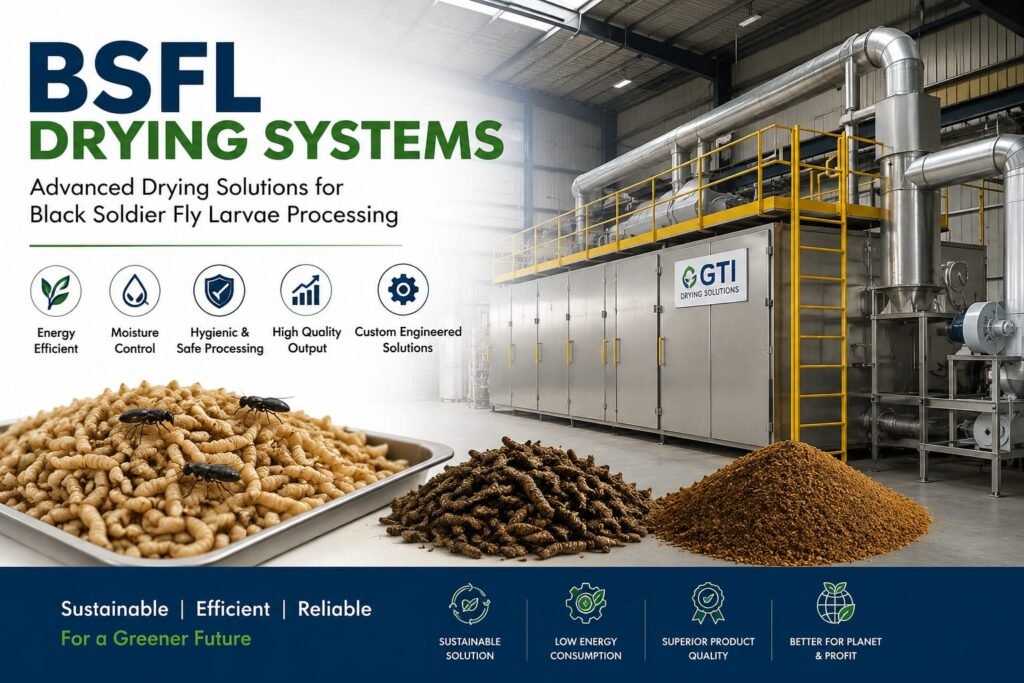
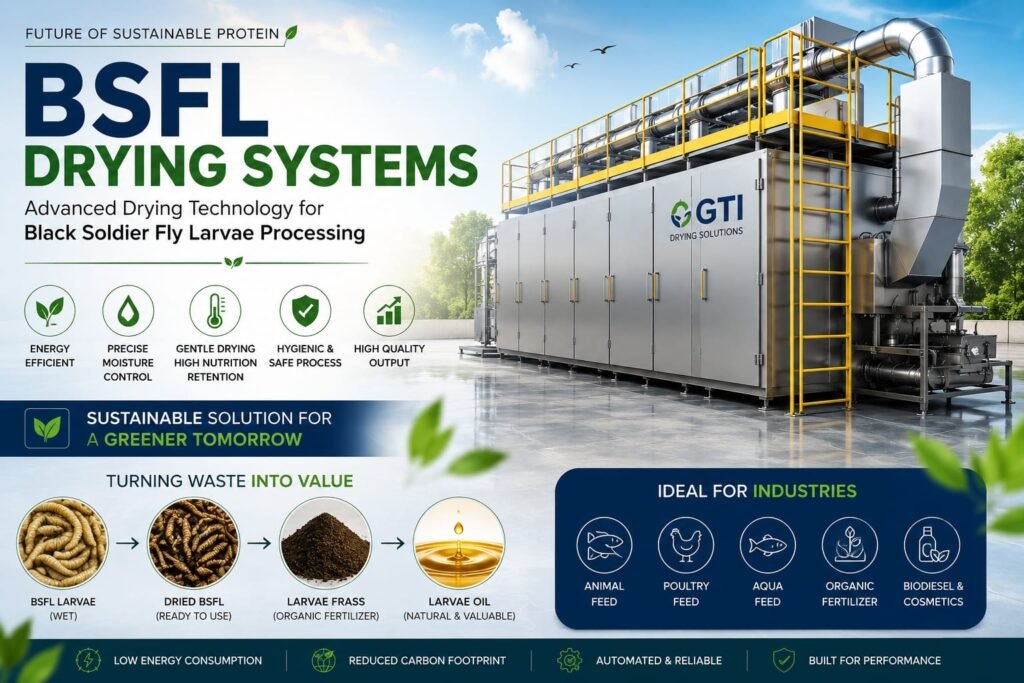
The global demand for sustainable protein sources is transforming the feed, agriculture, aquaculture, and pet food industries. As the world’s population continues to grow, traditional protein sources such as fish meal and soybean meal face increasing challenges, including rising costs, limited availability, and environmental concerns.
One of the most promising alternatives is Black Soldier Fly Larvae (BSFL). Rich in protein, healthy fats, amino acids, and essential nutrients, BSFL has emerged as a sustainable ingredient for animal nutrition, aquaculture, poultry feed, pet food, and organic agriculture.
However, producing premium-quality insect protein requires much more than successful insect farming. One of the most critical stages in the production process is controlled drying, where moisture is carefully removed to preserve nutritional value, improve shelf life, and ensure product stability.
At GTI Dryers, we design and manufacture advanced industrial drying solutions that help insect protein producers achieve hygienic processing, consistent moisture control, energy efficiency, and export-ready product quality. Our customized systems support businesses looking to scale their operations while maintaining the highest standards of performance and reliability.
Why Insect Protein Is Becoming a Global Necessity
The world is facing unprecedented challenges in food security, livestock nutrition, and sustainable resource management. Increasing demand for meat, fish, eggs, and dairy products requires enormous quantities of high-quality animal feed, placing pressure on conventional protein sources.
Insect protein offers a practical and environmentally responsible alternative because it requires:
- Less land than traditional livestock farming
- Lower water consumption
- Reduced greenhouse gas emissions
- Efficient conversion of organic waste into valuable protein
- High nutritional value for animal feed
- Support for circular economy initiatives
As governments and industries promote sustainable agriculture, insect protein is rapidly becoming an essential component of future feed production rather than simply an emerging trend.
What Is an Insect Protein & BSFL Drying System?
An insect protein and BSFL drying system is an industrial solution designed to reduce moisture from harvested Black Soldier Fly Larvae and other insect-based materials while preserving proteins, fats, amino acids, and nutritional quality.
Unlike traditional drying methods that may cause uneven moisture removal or excessive nutrient loss, industrial drying systems use controlled temperature, airflow, and residence time to produce consistent, high-quality insect meal suitable for commercial applications.
The objective is not only to dry the larvae but also to create a stable product that can be safely stored, transported, and processed into premium feed ingredients.
Modern drying systems are engineered for continuous production, hygienic operation, and energy-efficient performance, making them ideal for both growing insect farms and large-scale commercial facilities.
Understanding Black Soldier Fly Larvae (BSFL)
Black Soldier Fly Larvae are the immature stage of the Hermetia illucens insect, widely recognized for their remarkable ability to convert organic waste into nutrient-rich biomass.
During their growth cycle, BSFL consume a wide variety of organic materials and efficiently transform them into valuable protein and lipid-rich biomass.
After harvesting, the larvae undergo several processing stages:
- Harvesting
- Washing
- Dewatering
- Drying
- Cooling
- Grinding
- Packaging
Each stage contributes to the final quality of insect protein, but drying remains one of the most important because it determines product stability and shelf life.
Why Moisture Control Is Critical in BSFL Processing
Fresh Black Soldier Fly Larvae contain a high percentage of moisture, making them highly susceptible to microbial growth and spoilage if not processed promptly.
Excess moisture can lead to:
- Bacterial contamination
- Fungal growth
- Product spoilage
- Reduced shelf life
- Nutrient degradation
- Poor grinding performance
- Transportation challenges
Controlled drying helps maintain:
- Protein quality
- Essential amino acids
- Healthy lipid content
- Product stability
- Safe storage
- Export-quality standards
Proper moisture control is therefore one of the most important quality parameters in insect protein production.
Sustainable Protein Production Through Circular Economy
One of the greatest advantages of BSFL farming is its contribution to the circular economy.
Instead of allowing food waste and agricultural by-products to become environmental burdens, Black Soldier Fly Larvae convert these organic materials into valuable resources.
This sustainable process produces:
- High-quality insect protein
- Healthy insect oil
- Organic fertilizer (frass)
- Reduced organic waste
- Lower environmental impact
Industrial drying plays a key role in preserving these valuable products and making them commercially viable for global markets.
India’s Emerging Role in the Insect Protein Industry
India is witnessing increasing interest in alternative protein technologies, sustainable agriculture, and waste-to-value innovations.
With its abundant agricultural resources, expanding livestock sector, and growing focus on environmental sustainability, India has become an attractive destination for insect farming and BSFL-based processing.
Key factors driving growth include:
- Large availability of agricultural by-products
- Expanding poultry and aquaculture industries
- Growing pet food market
- Increasing demand for sustainable feed ingredients
- Government initiatives promoting waste management and bioeconomy
Although the insect protein export market in India is still developing, the country has strong potential to become a major supplier of high-quality insect meal and organic fertilizers to international markets.
Advanced drying technology enables Indian manufacturers to meet global quality expectations while improving production efficiency and product consistency.
Supporting Sustainable Exports with Advanced Drying Technology
International buyers increasingly seek insect protein products that meet strict quality and safety standards.
Export-ready insect meal requires:
- Uniform moisture content
- Stable nutritional composition
- Hygienic processing
- Longer shelf life
- Reliable product consistency
GTI Dryers develops customized drying solutions that help insect protein producers achieve these objectives while reducing operating costs and improving energy efficiency.
Applications of Industrial Insect Drying Technology
Modern drying systems support numerous industries.
Animal Feed Industry
Suitable for:
- Poultry Feed
- Pig Feed
- Cattle Feed
- Horse Feed
Aquaculture
Applications include:
- Fish Feed
- Shrimp Feed
- Specialty Aquaculture Nutrition
Pet Food Industry
Suitable for:
- Dog Food
- Cat Food
- Premium Pet Nutrition
Organic Agriculture
Applications include:
- Organic Fertilizer
- Soil Conditioners
- Sustainable Farming Inputs
Biotechnology
Used for:
- Alternative Protein Research
- Sustainable Feed Development
- Circular Bioeconomy Projects
Why Drying Determines Product Quality
Every stage of insect protein processing is important, but drying has the greatest impact on the final product.
Proper drying helps maintain:
- Protein concentration
- Nutritional integrity
- Product stability
- Storage performance
- Processing efficiency
- Commercial value
Poor drying, on the other hand, can lead to nutrient degradation, microbial contamination, and inconsistent product quality.
GTI Dryers: Engineering Sustainable Protein Solutions
Every insect protein facility has unique production requirements.
The drying behavior of BSFL depends on:
- Initial moisture content
- Fat composition
- Protein concentration
- Production capacity
- Desired final moisture
- Heating medium
- Product handling requirements
Rather than supplying standardized machines, GTI Dryers develops customized drying systems engineered to match each customer’s production goals and operational requirements.
Our engineering approach considers:
- Product characteristics
- Capacity requirements
- Energy efficiency
- Plant layout
- Utility availability
- Future expansion
- Automation preferences
This ensures every drying solution delivers reliable performance, consistent quality, and long-term operational value.
Engineering Sustainable Protein Production Through Advanced Drying Technology
The insect protein industry is no longer an experimental sector. It has evolved into a rapidly growing global industry supplying sustainable protein ingredients for aquaculture, poultry, livestock, pet food, and organic agriculture.
As production capacities increase, manufacturers require drying systems capable of delivering consistent moisture control, preserving nutritional value, reducing energy consumption, and ensuring food and feed safety.
Drying is one of the most technically demanding stages in insect protein processing because Black Soldier Fly Larvae (BSFL) contain high levels of moisture, proteins, fats, and bioactive compounds. Improper drying can reduce product quality, shorten shelf life, and negatively impact commercial value.
At GTI Dryers, every drying solution is engineered using scientific process analysis, thermal engineering, and intelligent automation to deliver reliable performance for continuous insect protein production.
Understanding the Engineering Challenges of BSFL Drying
Unlike grains or biomass, Black Soldier Fly Larvae are biological materials with unique physical and chemical properties.
Important engineering parameters include:
- Initial moisture content
- Fat percentage
- Protein concentration
- Larvae size
- Bulk density
- Heat sensitivity
- Desired final moisture
- Daily production capacity
- Product handling characteristics
Each of these parameters influences dryer selection, airflow design, heat transfer efficiency, and production capacity.
Proper engineering ensures that valuable nutrients remain intact while achieving the required storage stability.
Heat Transfer Engineering in Insect Protein Drying
Efficient heat transfer is the foundation of every successful drying system.
The objective is to transfer sufficient thermal energy to remove moisture while preventing excessive temperatures that may damage proteins or oxidize fats.
Proper heat transfer provides:
- Uniform drying
- Reduced drying time
- Stable product quality
- Lower operating costs
- Improved production efficiency
GTI Dryers designs optimized heat transfer systems that maximize energy utilization while protecting the nutritional integrity of BSFL products.
Airflow Optimization for Uniform Moisture Removal
Airflow distribution directly affects drying efficiency.
Poor airflow can create:
- Uneven moisture content
- Overheated products
- Excessive dust
- Product degradation
- Longer drying cycles
Advanced airflow engineering ensures:
- Uniform temperature distribution
- Balanced air velocity
- Consistent moisture reduction
- Improved product consistency
- Higher production reliability
Our drying systems are designed to maintain controlled airflow throughout the drying chamber for consistent product quality.
Moisture Migration: The Science Behind Drying
Drying is not simply about evaporating surface moisture.
Moisture inside the larvae gradually migrates toward the surface before evaporation occurs.
If moisture migration is too rapid or too slow, it can result in:
- Surface hardening
- Internal moisture pockets
- Uneven drying
- Reduced storage stability
GTI Dryers carefully balances temperature, airflow, and residence time to promote uniform moisture migration throughout the product.
Importance of Low-Temperature Drying
BSFL contains valuable nutrients that can deteriorate under excessive heat.
Low-temperature drying helps preserve:
- Essential amino acids
- Proteins
- Beneficial fats
- Nutritional quality
- Product color
- Natural aroma
Carefully controlled drying conditions improve overall product quality and increase market value.
Preserving Protein Quality
Protein is the primary commercial value of insect meal.
Improper drying may lead to:
- Protein denaturation
- Reduced digestibility
- Lower nutritional performance
- Reduced feed conversion efficiency
GTI Dryers develops drying systems that minimize thermal stress while maintaining the functional properties of insect protein.
Maintaining Healthy Lipid Content
BSFL naturally contains valuable oils used in feed formulations.
Improper drying temperatures can cause:
- Fat oxidation
- Rancidity
- Reduced product quality
- Shortened shelf life
Optimized drying preserves healthy lipid content while improving storage stability.
Hygienic Engineering for Sustainable Protein Production
Modern insect protein facilities require equipment that supports hygienic production.
GTI Dryers incorporates:
- Food-grade stainless steel construction
- Smooth internal surfaces
- Easy cleaning access
- Dust-controlled operation
- Sanitary product contact areas
- Hygienic airflow management
These features help producers maintain consistent quality while simplifying cleaning and maintenance.
Intelligent Automation for Modern Insect Processing Plants
Automation improves productivity while reducing operator dependency.
GTI Dryers offers advanced automation features including:
- PLC Control Systems
- Touchscreen HMI
- SCADA Integration
- Automatic Temperature Control
- Airflow Monitoring
- Moisture Monitoring
- Variable Frequency Drives (VFD)
- Production Data Logging
- Alarm Management
- Remote Monitoring
Automation enables:
- Consistent product quality
- Reduced labor requirements
- Improved process control
- Better traceability
- Higher production efficiency
Energy-Efficient Drying Technology
Energy consumption is one of the largest operating costs in industrial drying.
GTI Dryers improves energy efficiency through:
- Optimized heat exchangers
- Heat recovery systems
- High-efficiency insulation
- Intelligent burner control
- Variable-speed fans
- Multi-zone drying
- Automated process optimization
These technologies reduce fuel consumption while maintaining production performance.
Supporting Circular Bioeconomy Through Efficient Drying
One of the greatest strengths of BSFL processing is its contribution to sustainable resource utilization.
Industrial drying supports circular economy initiatives by enabling:
- Organic waste recycling
- Sustainable protein production
- Renewable feed ingredients
- Reduced landfill waste
- Lower greenhouse gas emissions
- Efficient resource utilization
Advanced drying technology transforms biological resources into commercially valuable products while supporting environmental sustainability.
Selecting the Right Drying Technology
Every insect protein processing facility has different production goals.
The appropriate drying solution depends on:
- Production capacity
- Product characteristics
- Desired moisture content
- Utility availability
- Automation requirements
- Future expansion plans
GTI Dryers performs detailed engineering evaluations before recommending the most suitable drying system.
Comparison of Industrial Drying Technologies
Ideal for:
- BSFL
- Insect Protein
- Animal Feed
- Organic Materials
Advantages:
- Continuous production
- Gentle drying
- Uniform moisture control
- High energy efficiency
Best for:
- Granules
- Pellets
- Small particles
Advantages:
- Excellent airflow
- Fast drying
- Uniform processing
Suitable for:
- Fine powders
- Protein concentrates
- Powdered ingredients
Advantages:
- Very rapid drying
- Compact installation
- High throughput
Recommended for:
- High-moisture materials
- Sticky products
- Organic sludge
- Processing residues
Advantages:
- Indirect heating
- Excellent thermal efficiency
- Low dust generation
Vacuum Dryer
Suitable for:
- Heat-sensitive proteins
- Premium specialty products
- Nutritional ingredients
Advantages:
- Low-temperature processing
- Maximum nutrient preservation
- Reduced oxidation
Common Processing Challenges
Uneven Moisture
Possible causes:
- Poor airflow
- Excessive loading
- Improper residence time
Engineering solution:
- Optimized airflow distribution
- Intelligent process control
Product Darkening
Possible causes:
- Excessive temperature
- Long drying time
Engineering solution:
- Low-temperature drying
- Precise thermal control
High Energy Consumption
Possible causes:
- Heat losses
- Poor insulation
- Inefficient burners
Engineering solution:
- Heat recovery
- Advanced insulation
- Automated burner management
Product Oxidation
Possible causes:
- High temperatures
- Extended exposure to oxygen
Engineering solution:
- Controlled process conditions
- Optimized residence time
Preventive Maintenance for Reliable Operation
Regular maintenance helps maximize production efficiency.
Recommended activities include:
- Cleaning drying chambers
- Inspecting conveyors
- Checking air filters
- Lubricating bearings
- Inspecting fans
- Calibrating sensors
- Monitoring heating systems
- Inspecting insulation
- Testing automation controls
Preventive maintenance reduces unexpected downtime and extends equipment life.
Digital Manufacturing & Industry 4.0 Integration
Modern protein production plants increasingly rely on digital technologies.
GTI Dryers supports Industry 4.0 through:
- Real-time process monitoring
- Remote diagnostics
- Performance analytics
- Predictive maintenance
- Energy monitoring
- Production reporting
- Smart process optimization
Digitalization enables manufacturers to improve efficiency, reduce operating costs, and make informed production decisions.
Why GTI Dryers Delivers Superior Drying Solutions
Every insect protein production facility has unique process requirements.
Rather than supplying standardized equipment, GTI Dryers develops customized drying systems using engineering calculations, product testing, and application-specific process optimization.
Our solutions provide:
- Customized engineering
- Continuous production
- Uniform moisture control
- Low-temperature drying
- Energy-efficient operation
- Intelligent automation
- Hygienic construction
- Low maintenance
- Long equipment life
- Reliable after-sales support
Whether your application involves Black Soldier Fly Larvae, insect meal, alternative proteins, organic fertilizers, or sustainable feed ingredients, GTI Dryers delivers drying solutions designed to maximize product quality, production efficiency, and long-term operational success.
Building the Future of Sustainable Protein with GTI Dryers
The global protein industry is undergoing a major transformation. As concerns over food security, environmental sustainability, and resource efficiency continue to grow, insect protein has emerged as one of the most promising alternatives to conventional protein sources.
Black Soldier Fly Larvae (BSFL) are increasingly used in aquaculture, poultry, livestock, pet food, and organic agriculture because they provide high nutritional value while supporting sustainable waste management. However, producing premium insect protein at a commercial scale requires advanced processing technologies that ensure consistent quality, hygiene, and efficiency.
At GTI Dryers, we provide customized drying solutions that help insect protein manufacturers optimize production, preserve nutritional value, reduce operating costs, and meet international quality standards. Our engineering-driven approach enables businesses to scale confidently while maintaining reliable, continuous production.
Why Choose GTI Dryers for Insect Protein & BSFL Drying Projects?
Every insect protein production facility has unique challenges. Differences in moisture content, production capacity, product characteristics, and processing methods require customized engineering rather than standard equipment.
GTI Dryers offers complete drying solutions based on:
- Detailed process engineering
- Product-specific dryer selection
- Energy-efficient system design
- Hygienic construction
- Intelligent automation
- Low operating costs
- Reliable after-sales support
- Long equipment lifespan
- Continuous production capability
Our objective is to provide drying systems that maximize productivity while protecting the nutritional integrity of insect protein products.
Complete Turnkey Insect Protein Processing Solutions
GTI Dryers delivers comprehensive turnkey solutions covering every stage of industrial drying system implementation.
Our project scope includes:
Engineering & Process Design
- Process evaluation
- Material testing
- Heat and mass balance calculations
- Dryer sizing
- Utility estimation
- Plant layout development
Manufacturing
- Industrial drying systems
- Material handling equipment
- Conveyors
- Feeding systems
- Air handling systems
- Heating systems
- Dust collection systems
Automation
- PLC Control
- HMI Interface
- SCADA Integration
- Process monitoring
- Production data logging
- Remote diagnostics
Installation & Commissioning
- Mechanical installation
- Electrical integration
- Performance testing
- Process optimization
- Operator training
After-Sales Support
- Spare parts
- Maintenance assistance
- Technical consultation
- Process upgrades
- Performance optimization
Industries Served
Our insect protein drying solutions support:
Animal Feed Industry
Applications include:
- Poultry feed
- Swine feed
- Cattle feed
- Horse feed
Aquaculture
Suitable for:
- Fish feed
- Shrimp feed
- Aquatic nutrition
Pet Food
Processing solutions for:
- Dog food
- Cat food
- Premium pet nutrition
Organic Fertilizer
Applications include:
- BSFL Frass
- Organic soil conditioners
- Sustainable fertilizers
Biotechnology & Research
Supporting:
- Alternative protein development
- Sustainable agriculture projects
- Circular bioeconomy initiatives
- Academic research facilities
India’s Growing Potential in Insect Protein Manufacturing
India is steadily emerging as one of Asia’s promising markets for insect protein and Black Soldier Fly Larvae processing.
Several factors contribute to this growth:
- Expanding livestock industry
- Rapidly growing aquaculture sector
- Increasing pet food demand
- Large availability of agricultural waste
- Government focus on sustainable agriculture
- Growing investments in biotechnology and agri-tech
India’s abundant organic resources make it well suited for large-scale BSFL production, enabling businesses to convert agricultural and food waste into valuable insect protein and organic fertilizers.
As international demand increases, India is well positioned to become an important supplier of sustainable protein ingredients for domestic and export markets.
GTI Dryers supports this emerging industry by providing reliable drying systems that help manufacturers produce high-quality, export-ready insect protein with consistent moisture control and hygienic processing.
Global Market Opportunities
The insect protein industry is growing rapidly across:
- Europe
- Southeast Asia
- Australia
- North America
- Middle East
- South America
Major applications include:
- Aquaculture
- Poultry nutrition
- Livestock feed
- Pet food
- Organic fertilizers
- Sustainable agriculture
- Alternative protein manufacturing
This expanding global demand creates significant opportunities for companies investing in modern insect protein processing facilities.
How Insect Protein Equipment Is Searched Across Global Markets
Industrial buyers often search using regional terminology rather than identical English keywords. Understanding these search behaviors improves international discoverability while keeping the content natural and professional.
| Country / Region | Common Industry Search Term |
| India | BSFL Drying System Manufacturer |
| Indonesia | Produsen Mesin Pengering Larva BSF |
| Vietnam | Nhà sản xuất máy sấy ấu trùng ruồi lính đen |
| Thailand | ผู้ผลิตเครื่องอบหนอนแมลงวันลาย |
| Malaysia | Insect Protein Drying Equipment Supplier |
| Singapore | Industrial Insect Processing Systems |
| Netherlands | BSF Droogsysteem Fabrikant |
| Germany | Hersteller von Insektenprotein-Trocknungsanlagen |
| France | Fabricant de systèmes de séchage de protéines d’insectes |
| United States | Industrial Insect Protein Drying Systems |
| Brazil | Fabricante de Secadores para Proteína de Insetos |
| Middle East | شركة تصنيع أنظمة تجفيف بروتين الحشرات |
Selecting the Right Drying System
Before investing in a drying system, manufacturers should evaluate several technical and operational factors.
Product Characteristics
- Initial moisture content
- Fat content
- Protein concentration
- Particle size
- Heat sensitivity
Production Requirements
- Hourly capacity
- Daily output
- Future expansion
- Production flexibility
Heating Medium
Available options include:
- Steam
- Thermal Oil
- Natural Gas
- LPG
- Biomass
- Electric Heating
Automation Level
Depending on production requirements, systems can include:
- Manual operation
- Semi-automatic controls
- Fully automatic PLC & SCADA systems
Plant Layout
Engineering should consider:
- Material flow
- Equipment accessibility
- Maintenance space
- Utility connections
- Future scalability
Factory Acceptance Testing (FAT)
Before dispatch, every drying system undergoes Factory Acceptance Testing to verify:
- Mechanical performance
- Process control
- Automation functionality
- Safety systems
- Equipment reliability
This minimizes installation risks and ensures the equipment meets design specifications.
Site Acceptance Testing (SAT)
Following installation, Site Acceptance Testing confirms:
- Operational performance
- Utility integration
- Production capacity
- Product quality
- Process stability
SAT ensures the system performs reliably under actual operating conditions.
Installation, Commissioning & Operator Training
GTI Dryers provides complete project support, including:
- Mechanical installation
- Electrical commissioning
- Automation setup
- Performance testing
- Operator training
- Preventive maintenance guidance
- Technical documentation
- Long-term service support
This ensures customers achieve smooth startup and maximum productivity.
Return on Investment (ROI)
A well-engineered drying system provides long-term value beyond the initial investment.
Benefits include:
- Lower energy consumption
- Higher production efficiency
- Reduced maintenance costs
- Improved product quality
- Longer equipment life
- Better profitability
- Faster payback period
GTI Dryers focuses on delivering sustainable lifecycle value rather than simply supplying machinery.
Why EEAT Matters for Industrial Drying Solutions
Modern search engines and AI platforms prioritize content demonstrating:
Experience
Real-world industrial projects and application expertise.
Expertise
Engineering-based technical knowledge.
Authoritativeness
Comprehensive educational resources covering the complete drying process.
Trustworthiness
Accurate information, transparent engineering practices, and reliable customer support.
GTI Dryers strengthens these trust signals through practical engineering knowledge, application-specific guidance, and customized drying solutions.
Frequently Asked Questions (FAQ)
1. What is a BSFL drying system?
A BSFL drying system removes moisture from Black Soldier Fly Larvae while preserving protein, fats, and nutritional quality for feed and industrial applications.
2. Why is drying important in insect protein production?
Drying extends shelf life, prevents microbial growth, preserves nutrients, and improves storage and transportation.
3. Which industries use insect protein?
Aquaculture, poultry, livestock, pet food, biotechnology, and organic fertilizer industries.
4. Which drying technology is best for BSFL?
The ideal solution depends on product characteristics, capacity, and process requirements. Belt Dryers are widely preferred for continuous and uniform drying of BSFL.
5. Can GTI Dryers provide customized drying solutions?
Yes. Every system is engineered according to the customer’s material characteristics, production capacity, and operational objectives.
6. Does GTI Dryers offer turnkey insect protein plants?
Yes. We provide complete engineering, manufacturing, installation, commissioning, and technical support.
7. What heating options are available?
Steam, thermal oil, natural gas, LPG, biomass, and electric heating systems.
8. Is automation available?
Yes. PLC, HMI, SCADA integration, remote monitoring, and intelligent process control systems are available.
9. How does industrial drying improve export quality?
It ensures uniform moisture content, hygienic processing, improved shelf life, and compliance with international quality standards.
10. Does GTI Dryers provide after-sales service?
Yes. We provide spare parts, maintenance services, technical support, process optimization, and long-term customer assistance.
(Expand this section to 40–50 FAQs using long-tail keywords for stronger SEO.)
Partner with GTI Dryers to Shape the Future of Sustainable Protein
As the global demand for sustainable protein continues to grow, efficient drying technology has become essential for producing high-quality, safe, and export-ready insect protein products.
GTI Dryers combines advanced engineering, customized system design, intelligent automation, and comprehensive project support to deliver reliable drying solutions for insect farms, feed manufacturers, agritech companies, biotechnology firms, and circular economy projects worldwide.
Whether you are establishing a new Black Soldier Fly processing facility, expanding production capacity, or upgrading an existing drying system, GTI Dryers provides the expertise and technology to help you succeed.
Build Your Sustainable Protein Processing Plant with GTI Dryers
Contact GTI Dryers today to discuss your BSFL or insect protein processing requirements. Our engineering team will help you select the most suitable drying technology to improve product quality, reduce operating costs, enhance energy efficiency, and strengthen your position in the rapidly growing global insect protein market.