
Short answer: Insect frass is the mixture of insect excrement, feeding substrate and insect remains left after rearing. To sell it as an organic fertiliser it is usually dried or conditioned to a stable moisture, and in the EU it must also meet a heat treatment of at least 70 °C for 60 minutes. Moisture varies widely, so dryer choice starts with measuring your frass.
Last updated: 23 November 2026
This guide is for insect farm operators, organic fertiliser producers and project consultants planning to dry insect frass from black soldier fly larvae (BSFL), mealworm or cricket rearing. It covers what frass is, why its moisture varies, how moisture and heat treatment requirements interact, how to estimate the water to remove, and which dryer types are usually considered. Frass drying is an emerging application, and rules differ by country, so treat the regulatory points as background and confirm requirements with the authority in your market. Worked numbers are illustrative inputs, not GTI performance data.
What is insect frass, and why does it need drying?
In EU rules, frass is defined as a mixture of excrement from farmed insects, the feeding substrate, parts of farmed insects and dead eggs, with a content of dead farmed insects of not more than 5% by volume and 3% by weight. This definition was added to Regulation (EU) No 142/2011 by Commission Regulation (EU) 2021/1925, which aligned the rules for placing frass on the market with those for processed manure. The International Platform of Insects for Food and Feed (IPIFF), the industry association, summarises that frass treated at 70 °C or above for at least one hour is required for placing on the market in EU Member States, along with other standards such as the microbiological thresholds.
Drying is a separate question from that heat treatment. Fresh frass is a wet, biologically active material. High moisture supports microbial activity, odour and heating in storage, adds transport weight, and makes spreading and bagging difficult. Drying reduces the water, stabilises the product and lowers weight per tonne of nutrient. But drying too far has costs too: a composting study in Fermentation notes that low moisture can cause rewetting difficulty and excessive dust when frass-based material is used. So the target is a practical storage and handling range, not the driest possible product.
How wet is fresh frass?
It depends heavily on the insect species, the feed substrate and the rearing system. A peer-reviewed study from KU Leuven on heat treatment and storage of BSFL and yellow mealworm frass measured fresh BSFL frass at an average of 37.7% moisture (range 29% to 45%) and water activity of about 0.92 to 0.97, against an average of 13.7% (range 11% to 17%) for yellow mealworm frass at water activity of about 0.60 to 0.80. The same paper notes earlier reports of 23% to 74% moisture in BSFL residue from different facilities on vegetable waste streams. The composting study in Fermentation, citing other work, says fresh, non-pasteurised BSFL frass can be 65% to 80% moisture depending on feedstock and processing.
Moisture here is on a wet basis unless stated. Always keep wet basis and dry basis apart when you specify a dryer, and measure your own frass, because published ranges are wide.
How much water must the dryer remove?
Use a mass balance with wet feed, dried product and evaporation kept separate. Worked example (illustrative inputs): 1,000 kg/h of wet BSFL frass, dried to an assumed target of 20% moisture (wet basis). The target is only an example; set yours from storage tests and your market’s requirements.
| Quantity | Frass at 37.7% | Frass at 65% |
|---|---|---|
| Wet feed | 1,000 kg/h | 1,000 kg/h |
| Dry solids | 1,000 × (1 − 0.377) = 623 kg/h | 1,000 × (1 − 0.65) = 350 kg/h |
| Dried product at 20% | 623 ÷ 0.80 = 779 kg/h | 350 ÷ 0.80 = 438 kg/h |
| Water evaporated | 1,000 − 779 = 221 kg/h | 1,000 − 438 = 562 kg/h |
The wetter frass needs about 2.5 times the evaporation per tonne fed, while giving less dried product. At about 2.26 MJ/kg for the latent heat of vaporisation of water near 100 °C (steam-table data such as the NIST Chemistry WebBook), that is at least about 500 MJ/h (around 139 kW) for the first case and about 1,270 MJ/h (around 353 kW) for the second, before sensible heat and losses. That is thermal energy only. Fan, agitator or drive and odour-treatment power are electrical energy and must be counted separately. Mechanical dewatering before the dryer, where the frass allows it, is the cheapest way to reduce this load. For the general method see our guide to dryer capacity and evaporation load.
How does drying relate to the 70 °C for 60 minutes heat treatment?
They are different things that can happen in the same equipment, but one does not automatically deliver the other. The EU requirement is about the material reaching a time and temperature, with microbiological criteria checked on samples. The KU Leuven study found that reference heat-treated BSFL and yellow mealworm frass complied with the EU criteria, while untreated BSFL frass did not meet them and milder treatments left Enterococcaceae counts above the limit in BSFL frass. It also notes that tailored treatments may be appropriate depending on microbial load. That is a research view; the legal requirement applies in each jurisdiction.
For dryer design the important engineering point is that product temperature is not the same as hot-air temperature. While free water remains, evaporation keeps the product near the wet-bulb temperature, well below the air temperature. Whether frass actually spends 60 minutes at or above 70 °C depends on dryer type, residence time, moisture and mixing, and must be demonstrated by measurement. Whether a dryer can serve as the heat-treatment step, or a separate hygienisation step is needed, should be decided with your regulator and a validated process. GTI does not claim here that any dryer meets a regulatory requirement.
Which dryer types are usually considered for frass?
GTI’s organic waste drying page lists belt, rotary drum, paddle and fluidised bed dryers, and solar drying, as technologies used for organic waste. Digestate is among the materials it names. The points below are general guidance and need trials on your frass.
| Dryer type | Where it may fit frass | Points to check |
|---|---|---|
| Belt dryer | Drier, crumbly or preformed frass that forms a permeable bed; gentle, zoned drying | Wet cohesive frass may need preforming or spreading; fines and odour in exhaust air |
| Rotary drum dryer | Larger volumes of mixed, variable material where tumbling helps | Dust and odour in a large exhaust stream; fines; fire risk with dry organic dust |
| Paddle dryer | Wet, sticky or lumpy frass; indirect heating; low exhaust volume | Heat transfer surface fouling; steam or thermal oil supply; feed lump size |
| Fluid bed dryer | Fine, free-flowing, drier fractions | Not suited to wet lumpy feed; fines carryover |
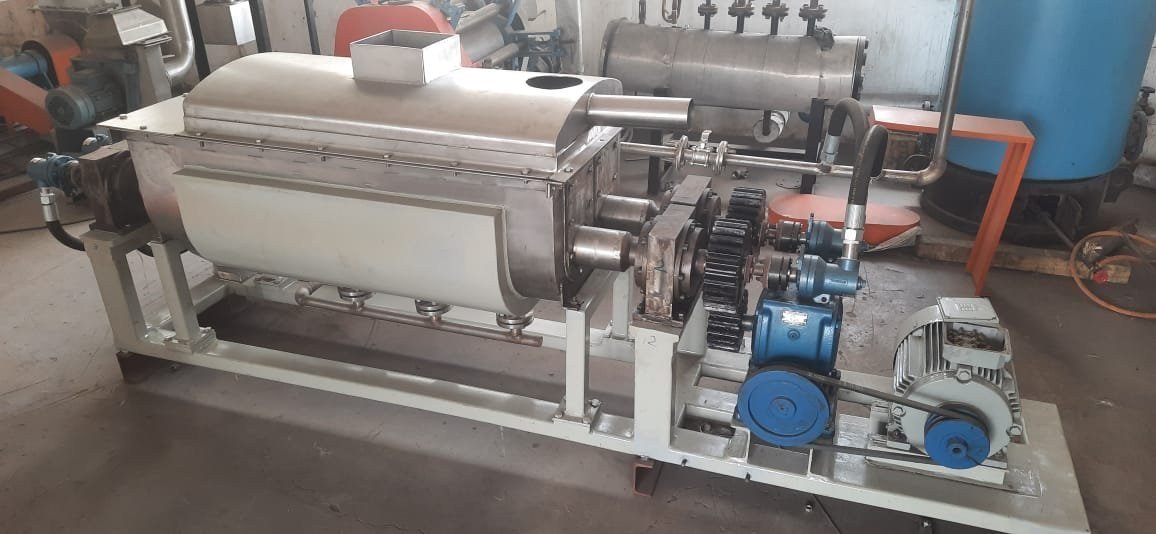
GTI’s paddle dryer page describes indirect heating, a closed trough, low exhaust gas volume and an enclosed system that reduces dust and odour release, and lists sticky and high-moisture materials among its suitable feeds. That makes it a candidate worth testing for wet frass, but it is not proof of fit. Our article on paddle dryer versus tube bundle dryer explains the indirect-heating options, and the group-site guide on drying digestate and LFOM from a CBG plant covers a related wet organic residue.
What else affects dryer choice for frass?
- Nitrogen loss: frass can be rich in ammonium. A study in Plant and Soil on BSFL frass as a fertiliser found that in the two commercial products tested, 98% of the mineral nitrogen was in the form of ammonium. Heating may release ammonia, so measure nitrogen before and after drying in trials, and plan for exhaust gas treatment.
- Odour: wet frass and its dryer exhaust can be odorous. Closed, low-airflow designs and exhaust treatment reduce the load.
- Fire and dust: dried organic dust can burn. See our dryer fire and dust explosion checklist.
- Variability: frass from different feed substrates and insect species differs in moisture, texture and microbial load. Test each type.
- Heat source: steam, thermal oil, hot air or other sources each suit different dryers. See our guide to choosing a dryer heat source.
- Upstream and downstream: insect drying lines for larvae are a separate topic; see our guides to BSFL drying systems and the insect protein drying page.
What to prepare before you request a quotation
- Insect species, feed substrate and frass moisture (wet basis) at several samples.
- Texture: lumps, crumbs or paste, bulk density and fines.
- Target product moisture and any storage or bagging requirement.
- Regulatory target market and any required time-temperature treatment.
- Wet-feed capacity per hour and operating hours per day.
- Available heat source and utilities.
- Odour and exhaust treatment requirements at the site.
- Samples for a drying trial.
Frequently asked questions
Does frass need to be dried before sale as fertiliser?
Not by definition, but high moisture causes handling, storage and odour problems, so many producers dry or condition it. The target depends on your market and product specification.
How much moisture does insect frass contain?
It varies. The KU Leuven study measured an average of 37.7% for BSFL frass and 13.7% for mealworm frass. Other studies report wider ranges, so measure yours.
Is drying the same as heat treatment for frass?
No. Heat treatment in the EU means reaching at least 70 °C for at least 60 minutes, with microbiological criteria. A dryer may or may not deliver that, so it must be validated.
Which dryer is best for wet BSFL frass?
There is no single best dryer. Indirect paddle dryers and rotary dryers are typically tested for wet or lumpy feed, and belt dryers for drier or preformed material. A drying trial decides.
Can GTI test my frass?
Please contact GTI with your frass details and sample quantity to discuss a drying trial.
Discuss insect frass drying with GTI
For assistance with dryer selection, frass or organic fertiliser drying, processing requirements or a project-specific quotation, contact Genex Tech Industries LLP (GTI Group).
Email: mktg@gtidryers.com
Call or WhatsApp: +91-93300 77417
Website: https://gtidryers.com/
Please share your material, required wet-feed capacity, initial and target moisture, available heating source and installation location.