
Thermal Processing Technology for Zimbabwe’s Commercial Tea Estates
Zimbabwe’s commercial tea sector, anchored along the misty mountain corridors of the Eastern Highlands, yields over 11,000 tonnes of high-grade tea annually. Major growing clusters—including Chipinge, Honde Valley, Mutare, Nyanga, and Chimanimani—depend on robust industrial infrastructure to convert heavy green-leaf flushes into export-ready black and specialty teas.
┌─────────────────────────────────────────────────────────────────────────┐
│              ZIMBABWE EASTERN HIGHLANDS TEA SUPPLY CHAIN                │
└─────────────────────────────────────────────────────────────────────────┘
        │                                                     │
        ▼                                                     ▼
┌─────────────────────────────┐               ┌─────────────────────────────┐
│ Large Commercial Plantations│               │ Smallholder Outgrower Schemes│
│(Ratelshoek, Aberfoyle, etc.)│               │  (Honde Valley & Chipinge)  │
└──────────────┬──────────────┘               └──────────────┬──────────────┘
               └──────────────────────┬──────────────────────┘
                                      │
                                      ▼
                      ┌───────────────────────────────┐
                      │  Centralized Factory Drying   │
                      └───────────────┬───────────────┘
                                      │
             ┌────────────────────────┴────────────────────────┐
             ▼                                                 ▼
┌──────────────────────────────┐              ┌──────────────────────────────┐
│ CTC Continuous Processing    │              │ Specialty & Orthodox Lines   │
│ Technology: VFBD Systems     │              │ Technology: Multi-Zone FBD   │
└──────────────────────────────┘              └──────────────────────────────┘
For factory managers across Zimbabwean tea estates, operational success rests on addressing critical processing bottlenecks:
Core Factory Questions:
- How can a factory maintain exact 2.5%–3.5% final moisture levels despite ambient humidity shifts during the rainy summer harvest?
- What thermal design minimizes boiler wood-fuel or thermic fluid consumption per kilogram of evaporated water?
- How can high-throughput drying lines eliminate leaf scorching while preserving liquor brightness and granule size?
- What modular equipment enables seamless expansion when outgrower green-leaf intakes peak?
GTI Dryers engineers customized industrial thermal systems tailored specifically to the regional conditions and operational scales of Zimbabwean tea processing plants:
- CTC Tea Processing: Vibratory Fluid Bed Dryer (VFBD)
- Orthodox Tea Line: Multi-Stage Combination Fluid Bed Dryer
- Green Tea Line: Controlled-Temperature Fluid Bed Dryer
Geographic Distribution & Localized Equipment Demand
To support regional buyers and estate managers, thermal drying installations must address the specific microclimates and factory footprints of Zimbabwe’s primary tea districts.
Chipinge District (Southern Eastern Highlands)
Home to historical tea estates such as Ratelshoek, Jersey, Zona, and New Year’s Gift, Chipinge is Zimbabwe’s primary bulk tea hub. High throughput and continuous 24/7 reliability during peak flushes are essential.
- Target Terms: Tea dryer manufacturer Chipinge, Industrial tea dryer Chipinge, Tea factory equipment Ratelshoek, VFBD tea dryer Southern Zimbabwe.
Honde Valley & Mutare (Central Highlands)
Extending along the Mozambican border, Honde Valley combines major commercial estates (Aberfoyle, Katiyo) with extensive smallholder outgrower networks.
- Target Terms: Tea dryer Honde Valley, Tea processing machinery Mutare, Tea factory equipment Hauna, Smallholder tea drying system Zimbabwe.
Nyanga & Northern Highlands
High-altitude tea fields in Nyanga produce specialized tea profiles requiring delicate, staged drying cycles to preserve volatile flavor compounds.
- Target Terms: Tea dryer Nyanga, Specialty tea dryer Zimbabwe, Orthodox tea processing equipment Nyanga.
Strategic Drivers Shaping Equipment Selection in Zimbabwe
Estate Infrastructure Modernization
Many processing facilities in the Eastern Highlands are upgrading legacy chain-grate or conventional tilting-tray dryers. Modern vibratory fluid bed systems significantly reduce energy consumption, footprint, and maintenance downtime while eliminating unevenly dried batches.
Managing Seasonal Flush Peaks
Smallholder outgrowers supply substantial volumes of green leaf to regional factories. High-capacity VFBD units handle variable feed moistures without risking under-drying or clogging the bed.
Meeting Export Moisture Compliance
World Bank WITS trade data shows Zimbabwe exports millions of kilograms of black tea annually to regional and international markets, including South Africa, Mozambique, Zambia, and Europe. Precise final moisture control prevents mold development during regional road transit and container shipping.
Technology Matrix: System Selection by Product Line
| Product Type | GTI System Architecture | Primary Operational Focus |
| CTC Black Tea | Vibratory Fluid Bed Dryer (VFBD) | Continuous high-volume fluidization with active particle cooling |
| Orthodox Tea | Combination Fluid Bed Dryer | Staged temperature profile to protect twisted whole-leaf structure |
| Green Tea | Multi-Stage Combination Dryer | Rapid surface moisture removal following enzyme deactivation |
A Vibratory Fluid Bed Dryer (VFBD) and a Combination Fluid Bed Dryer differ fundamentally in their mechanical movement, airflow mechanics, thermal efficiency strategies, and plant footprint:
1. Airflow Dynamics & Fluidization Mechanism
| Parameter | Vibratory Fluid Bed Dryer (VFBD) | Combination Fluid Bed Dryer |
| Fluidization Source | Dual Mechanical + Pneumatic: Relies on mechanical vibration combined with low-to-medium velocity hot air. | Multi-Stage Airflow Circuits: Combines gentle low-velocity surface air (in tray/belt pre-drying stages) with higher-velocity fluidization air in the final bed zone. |
| Air Velocity Requirement | Lower Velocity Needed: Because vibration mechanically moves, breaks up, and conveys the product, lower air pressure and velocity are required to achieve fluidization. | Variable Velocity by Stage: Airflow is segmented—very low, laminar air in initial zones prevents delicate leaves from scattering; higher airflow in later stages fluidizes the material. |
| Particle Carryover (Dust & Fly-off) | Higher Carryover Risk: Single-stage continuous vibration can cause lighter particles or tea dust to lift into the exhaust air stream, requiring heavy-duty cyclones or dust collectors. | Lower Fly-off / Gentle Handling: Initial stage drying settles and reduces the moisture of delicate or larger leaves without heavy agitation, keeping fine dust and light leaves intact before fluidization. |
2. Thermal Efficiency & Heat Transfer
| Parameter | Vibratory Fluid Bed Dryer (VFBD) | Combination Fluid Bed Dryer |
| Heat Transfer Rate | Extremely High Constant Transfer: Direct, continuous contact between fluidized particles and hot air yields high heat and mass transfer rates, ideal for rapid surface moisture flash-off. | Staged Thermal Profile: Uses zone-based heat input—higher heat during initial moisture flash, followed by gentle, controlled heat to evaporate internal moisture without case-hardening or scorching. |
| Exhaust Heat Recovery & Recycling | Single Exhaust Path: Exhaust air typically exits through a single plenum, making localized zone-recirculation more complex without multi-chamber ducting. | Multi-Zone Air Recirculation: Offers multi-chamber designs where low-moisture exhaust air from later dry zones can be recycled into earlier heating zones, lowering total thermal energy consumption per kg of water evaporated. |
| Power & Fuel Balance | Balanced Thermal/Higher Fan Energy: Requires constant blower power to sustain fluidization across the entire bed length, though mechanical vibration lowers total fan static pressure requirements compared to static FBDs. | Optimized Fan Load: Utilizes smaller, dedicated zonal blowers matching the exact airflow needs of each stage, offering higher overall system thermal efficiency for variable or multi-product lines. |
3. Equipment Footprint & Plant Integration
| Parameter | Vibratory Fluid Bed Dryer (VFBD) | Combination Fluid Bed Dryer |
| Floor Space (Length vs. Height) | Linear Horizontal Layout: Operates as a single-deck, long horizontal trough. Requires a longer plant floor footprint to allow adequate residence time for the vibrating bed. | Vertical / Modular Multi-Pass Layout: Often utilizes multi-tier tray or belt passes over a shorter horizontal span. It trade-offs vertical height for a significantly reduced floor footprint. |
| Structural Foundation & Clearance | Isolation Springs / Heavy Frame: Requires heavy structural floor isolation or dynamic balancing frames to absorb continuous mechanical vibration forces. | Static Frame / Low Vibration: Since vibration is minimal or restricted to a smaller fluidized zone, structural foundation requirements are lighter and simpler to install. |
| Footprint Efficiency Ratio | Floor Space Intensive: Sized primarily by horizontal length $\times$ bed width based on product residence time. | Compact Footprint: Accommodates high capacity in tight plant layouts by stacking drying zones vertically. |
CTC Tea Drying: Vibratory Fluid Bed Dryer (VFBD)
The vast majority of Zimbabwean tea is processed using the CTC (Crush, Tear, Curl) method. Wet, oxidized CTC tea requires rapid, uniform thermal transfer to lock in the liquor strength, color, and briskness expected by commercial buyers.
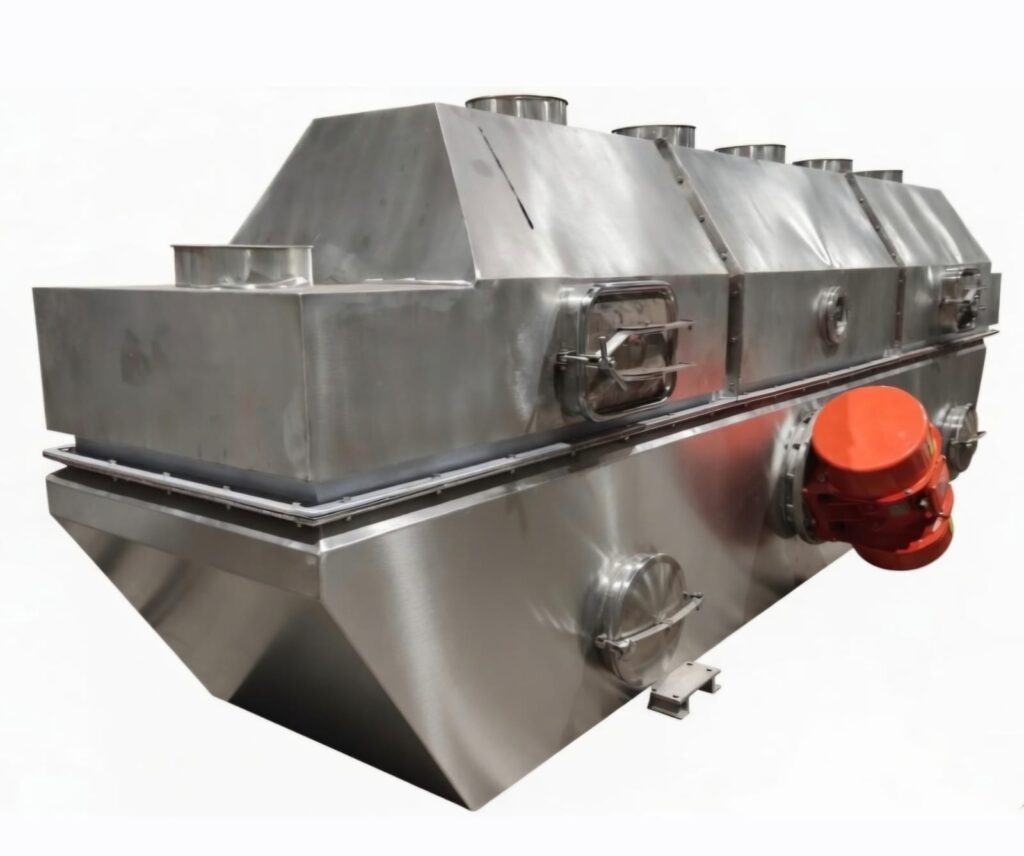
GTI’s Vibratory Fluid Bed Dryer VFBD combines engineered directional vibration with a pressurized hot air plenum, suspending tea particles in a uniform fluid bed.
Incoming Oxidized CTC Leaf (55%–60% Moisture)
                     │
                     ▼
       ┌───────────────────────────┐
       │ Variable-Speed Rotary Feed│
       └─────────────┬─────────────┘
                     │
                     ▼
  ┌─────────────────────────────────────┐
  │  VFBD Multi-Zone Drying Chamber     │
  │  • Zone 1: High-Temp Moisture Flash │
  │  • Zone 2: Controlled Fluid Evap    │
  │  • Zone 3: Final Stabilization      │
  └──────────────────┬──────────────────┘
                     │
                     ▼
       ┌───────────────────────────┐
       │ Integrated Ambient Cooling│
       └─────────────┬─────────────┘
                     │
                     ▼
Dried Granular Tea (2.5%–3.0% Moisture)
Core Features of GTI VFBD Systems:
- Zoned Temperature Control: High inlet temperatures rapidly evaporate surface moisture in Zone 1, while lower downstream temperatures gently dry the particle core without scorching.
- Optimized Vibration Amplitude: Prevents balling or clump formation of high-moisture CTC feeds.
- Integral Cooling Deck: Built-in ambient air cooling zone stabilizes tea temperatures before discharge, preventing moisture condensation in storage bins.
- Thermal Efficiency: Insulated dryer casing and optimized exhaust ductwork minimize heat loss, reducing wood/biomass fuel consumption per tonne of made tea.
Orthodox & Specialty Tea Drying Systems
For estates in Nyanga and Honde Valley expanding into whole-leaf Orthodox or artisanal teas, traditional fluid bed drying can break delicate leaf twists.
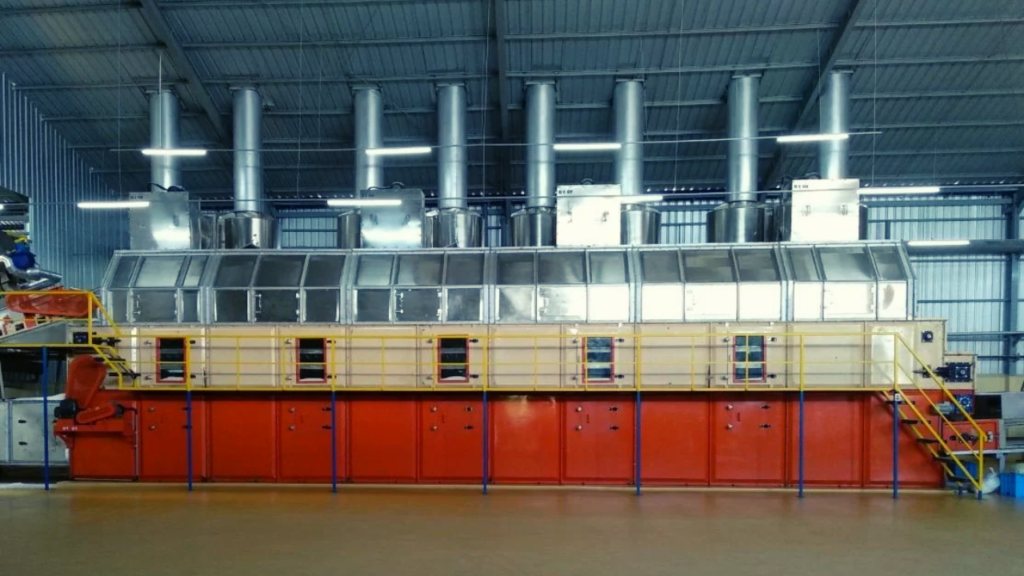
GTI’s Combination Fluid Bed Dryer incorporates gentle vibratory conveyancing and multi-stage air distribution:
- Stage 1 (Flash Removal): Removes surface water quickly after rolling to fix leaf color and arrest oxidation.
- Stage 2 (Gentle Evaporation): Low-velocity hot air penetrates the rolled leaf mass without causing mechanical breakage.
- Stage 3 (Equilibration): Uniformly balances internal leaf moisture to achieve long-term shelf stability.
Green Tea Processing Infrastructure
Green tea processing skips the fermentation/oxidation phase entirely, relying on immediate heat treatment (fixation/steaming) to deactivate polyphenol oxidase enzymes.
GTI Green Tea Drying Systems feature:
- Precision Airflow Velocity: Keeps light green tea leaves suspended without blowing fine particles into the exhaust.
- Controlled Thermal Profile: Prevents leaf yellowing or stewed off-flavors, retaining natural chlorophyll and antioxidant profiles.
- Versatile Fuel Integration: Connects seamlessly with existing steam boilers, thermic fluid heaters, or direct-fired biomass furnaces.
Technical Audit & System Design Factors
When specifying an industrial dryer for a Zimbabwean tea project, factory technical teams should assess key parameters:
┌─────────────────────────────────────────────────────────────────┐
│              TECHNICAL PARAMETERS FOR DRYER SIZING             │
├───────────────────────────────┬─────────────────────────────────┤
│ Operational Inputs            │ Mechanical & Thermal Specs      │
├───────────────────────────────┼─────────────────────────────────┤
│ • Production Capacity (kg/hr) │ • MOC: Contact Parts SS304      │
│ • Initial Leaf Moisture (%)   │ • Heating: Biomass / Steam / Oil│
│ • Target Final Moisture (%)   │ • Exhaust: High-Efficiency Cyclone│
│ • Altitude & Ambient Relative │ • Controls: PLC with Touchscreen│
│   Humidity (Eastern Highlands)│   HMI Interface                 │
└───────────────────────────────┴─────────────────────────────────┘
Shona Language Integration for Localized Content
Integrating Shona terms reflects local operational contexts across Zimbabwean tea estates:
| English Term | Shona Equivalent / Local Term | Processing Context |
| Tea | Tii | Agricultural plantation crop |
| Tea Dryer | Mashini yekubvisa hunyoro mu tii / Chikamu chekuomesa tii | Industrial drying system |
| Tea Factory | Fekitari ye tii | Commercial processing facility |
| Tea Processing | Kugadzirwa kwe tii / Kuchokota tii | Leaf treatment sequence |
| Green Tea | Tii yakasviba (Green Tea) | Unfermented tea category |
| Fluid Bed Dryer | Kikaushio che hewa inopisa | Fluidized drying equipment |
Complete Scope of Supply for Zimbabwe Projects
GTI Dryers provides end-to-end engineering deliverables for processing plant upgrades:
- Process Engineering: Heat balance calculations, airflow modeling, and custom factory layout integration.
- Precision Manufacturing: Heavy-duty vibratory frames, food-grade SS304 drying beds, and dynamic balancing.
- Air Handling Assemblies: High-pressure centrifugal supply fans, exhaust blowers, and stainless steel cyclone dust collectors.
- Control Systems: Fully automated PLC panels with real-time temperature tracking, bed-speed drives, and fault diagnostics.
- On-Site Commissioning: Field installation supervision, system balancing, and factory operator training.
Frequently Asked Questions
What makes a Vibratory Fluid Bed Dryer (VFBD) superior to legacy tray dryers for CTC tea?
A VFBD suspends tea particles in a uniform cushion of hot air assisted by mechanical vibration. This ensures every particle receives equal heat exposure, eliminating dry/wet spots, reducing drying time, and significantly lowering fuel consumption compared to static tray systems.
How does altitude in the Eastern Highlands affect tea dryer selection?
Higher elevations in regions like Nyanga (over 1,800m) feature lower atmospheric pressure and air density. GTI engineers adjust fan static pressures, air volumes, and burner ratings to ensure complete fluidization and heat transfer at higher altitudes.
What heat sources can be integrated with GTI Tea Dryers in Zimbabwe?
GTI dryers can be coupled with steam heat exchangers, thermic fluid heaters, direct/indirect gas burners, or hot-air furnaces running on locally sourced biomass (wood chips/macadamia shells).
Can a single factory run CTC and Green Tea through the same dryer?
While possible on multi-mode combination systems, dedicated drying lines are recommended for high-volume operations due to differing particle sizes, moisture profiles, and thermal sensitivities between CTC black tea and green tea.
Technical Proposal Request for Zimbabwe Operations
Upgrading existing processing lines, expanding factory throughput, or commissioning a new tea project in Zimbabwe? Share your operational parameters for a customized proposal.
Required Project Inputs:
- Tea Types: CTC / Orthodox / Green Tea
- Capacity Requirements: Feed Rate (kg/hr) or Made Tea Output (kg/hr)
- Moisture Range: Initial Intake Moisture (%) & Target Final Moisture (%)
- Factory Location: Chipinge, Honde Valley, Mutare, Nyanga, or Chimanimani
- Thermal Energy Source: Steam Boiler, Thermic Fluid, Biomass Furnace, or Hybrid
- Scope: New Line, Capacity Expansion, or Dryer Replacement
Engineered in India. Built for Zimbabwe’s Eastern Highlands Tea Sector.
Contact GTI Dryers today for technical consultation and plant design.