
Sri Lanka’s Spice Transition: From Commodity Crops to High-Value Dehydrated Ingredients
Sri Lanka’s spice industry generates over $440+ million in export earnings, but the commercial landscape is shifting. Under national agricultural initiatives and post-harvest technology development programs, Sri Lankan food processors are moving beyond raw agricultural exports toward value-added food ingredients, standardized extracts, powders, and shelf-stable dehydrated products.
Silk Foods Ceylon
Major agricultural belts—including Central Province (Matale, Kandy, Nuwara Eliya), Uva Province (Badulla, Monaragala), North Central (Anuradhapura, Polonnaruwa), and North Western (Kurunegala, Puttalam)—produce substantial quantities of fresh ginger, turmeric, chilli, big onion, and red onion.
However, tropical island moisture—with relative humidity often climbing above 80% and unseasonal monsoon rain cycles—creates heavy post-harvest challenges. Uncontrolled open-air drying frequently results in mold contamination, loss of essential oils, dark discoloration, and aflatoxins that violate strict export guidelines (such as EU Regulation limits and SLSI standards).
Silk Foods Ceylon
To satisfy global buyers and supply Sri Lanka’s expanding domestic food manufacturing sector, processing plants are replacing traditional drying with enclosed, temperature- and airflow-controlled industrial dehydration systems.
Technical & Commercial Impact of Industrial Dehydration in Sri Lanka
Freshly harvested Sri Lankan ginger (inguru / இஞ்சி), turmeric (kaha / மஞ்சள்), onions (loonu / வெங்காயம்), garlic (suduloonu / பூண்டு), and chilli (miris / மிளகாய்) enter the processing line with 75% to 85% initial moisture. Uncontrolled thermal exposure destroys critical bio-active compounds like gingerol, curcumin, allicin, and capsaicin.
Precision thermal dehydration transforms fresh harvests into multi-tier product streams:
Fresh Inguru (Ginger) → Dehydrated Slices → Ginger Flakes → High-Solubility Powder / Extract
Fresh Kaha (Turmeric) → Sliced Roots → Polished Granules → High-Curcumin Powder (SLS 613)
Fresh Loonu (Onion) → Dehydrated Flakes → Kibbled Onion → Seasoning Powder / Granules
Fresh Suduloonu (Garlic)→ Dried Slices → Garlic Granules → Industrial Garlic Powder
Fresh Miris (Chilli) → Whole Dried Pods → Crushed Flakes → Premium Red Chilli Powder
Operational Advantages for Sri Lankan Processing Plants
- Aflatoxin & Contamination Control: Completely sealed chambers protect high-value spices from rain, bird droppings, airborne dust, and mold toxins (Aflatoxin B1 / Ochratoxin A).
- Essential Oil & Color Preservation: Low-to-medium temperature drying cycles maintain natural yellow/red pigments and retain volatile aromatic oils.
- Monsoon Uptime: Operates continuously through wet monsoon cycles without weather-induced production shutdowns.
- SLS & Export Compliance: Reaches target moisture levels (≤8%−10%) required for downstream pulverizing and long-distance container shipment.
Application Engineering: Five Core Spice Pillars
Multi-product spice dehydrators allow Sri Lankan food plants to configure customized drying profiles for different seasonal crops on a single platform.
| Crop Application | Commercial Target | Key Dehydration Requirement |
| Ginger (Inguru) | Slices, granules, powder | Rapid surface moisture removal while preserving volatile oils (≥1.5 ml/100g) |
| Turmeric (Kaha) | Slices, ground powder | Precise heat distribution to retain curcumin content and vibrant yellow color |
| Onion (Loonu) | Flakes, kibbled, powder | Managed airflow to handle high natural sugars without scorching or caramelization |
| Garlic (Suduloonu) | Slices, granules, powder | Gentle thermal profile to preserve allicin active compounds without surface yellowing |
| Chilli (Miris) | Whole pods, flakes, powder | Controlled humidity removal to prevent pod collapse and preserve capsaicin potency |
1. Ginger Dryer Machine Manufacturer in Sri Lanka
Ginger cultivation is concentrated in regions like Kandy, Kurunegala, and Badulla. Driven by growing demand for Sri Lankan ginger extracts, herbal wellness products, and commercial spice powders, precision industrial drying replaces weather-dependent outdoor drying.
- Typical Processing Line:
Raw Ginger Washing → Peeling / Mechanical Slicing → Controlled Dehydration → Industrial Cooling → Flaking / Powder Pulverizing → Moisture-Proof Packaging
- Sinhala Search Terms:
ඉඟුරු වියළන යන්ත්රය ශ්රී ලංකාව | ඉඟුරු විජලන යන්ත්ර | ඉඟුරු කුඩු නිෂ්පාදන යන්ත්ර
2. Turmeric Dryer Machine Manufacturer in Sri Lanka
Sri Lankan turmeric (kaha) is celebrated for its organic purity and rich curcumin levels. Grown extensively across Matale, Ampara, and Kurunegala, raw turmeric requires rapid drying after boiling/slicing to avoid mold formation.
- Primary Advantage: Controlled indirect hot-air circulation preserves deep pigmentation and meets SLS 613 / ISO international quality standards.
- Sinhala Search Terms:
කහ වියළන යන්ත්රය ශ්රී ලංකාව | කහ විජලන යන්ත්රය | කහ කුඩු නිෂ්පාදන යන්ත්ර
3. Onion Dryer Machine Manufacturer in Sri Lanka
Anuradhapura, Matale, and Hambantota represent key cultivation zones for big onions and red onions (loonu). Because fresh onions suffer heavy seasonal spoilage, dehydrating surplus yields into dried onion flakes, granules, and powders helps stabilize supply chains and serves national food processing facilities.
- Engineering Requirement: Features specialized non-stick contact materials and variable air velocity to process high-sugar slices without browning.
- Sinhala Search Terms:
ලූනු වියළන යන්ත්රය | ලොකු ලූනු විජලන යන්ත්ර | ලූනු කුඩු සැකසුම් යන්ත්ර
4. Garlic Dryer Machine Manufacturer in Sri Lanka
To support local garlic processing and food ingredient blending across Sri Lanka, industrial garlic dehydrators convert fresh cloves into shelf-stable garlic flakes, granules, and powders used in ready-to-eat seasoning mixes, sauces, and instant food products.
- Key Feature: Low-temperature dehydration preserves essential garlic aromas without blistering the slices.
- Sinhala Search Terms:
සුදුළූණු වියළන යන්ත්රය | සුදුළූණු විජලන යන්ත්ර | සුදුළූණු කුඩු නිෂ්පාදන
5. Chilli Dryer Machine Manufacturer in Sri Lanka
Chilli (miris) is a major condiment crop cultivated across the Dry Zone (Anuradhapura, Monaragala, Puttalam). Drying raw green and red chillies under humid atmospheric conditions risks color loss and fungal development. Industrial chilli dryers allow processors to produce whole dried chillies, flakes, and chilli powder with consistent heat and vibrant red aesthetics.
- Quality Assurance: Retains natural capsaicin levels, preserves brilliant red aesthetics, and achieves low moisture targets required for fine grinding mills.
- Sinhala Search Terms:
මිරිස් වියළන යන්ත්රය ශ්රී ලංකාව | මිරිස් විජලන යන්ත්ර | වියළි මිරිස් නිෂ්පාදන යන්ත්ර
Dryer Technology Selection for Sri Lankan Facilities
Selecting the proper dehydration equipment depends on raw input volume, plant floor layout, and energy availability:
Raw Spice Harvest (Central / Uva / Dry Zone)
│
├── Batch / Multi-Recipe Processing (Small-to-Medium Facilities) ──► Industrial Multi-Tray / Cabinet Dryers
│
└── High-Volume Continuous Output (Industrial Processing Zones) ──► Multi-Layer Conveyor / Belt Dryers
- Continuous Multi-Layer Belt / Conveyor Dryers
- Best For: Large-scale commercial food processing plants handling high daily tonnage of sliced ginger, turmeric, onions, or chillies.
- Features: Automated material feed, multi-stage temperature zone management, high energy efficiency.
- Industrial Multi-Tray / Cabinet Dryers
- Best For: Medium enterprises, agricultural cooperatives, or facilities running varied batch runs.
- Features: Stainless steel food-contact zones (SS304/SS316), uniform cross-flow air distribution, compact floor footprint.
Continuous Multi-Layer Belt Dryers and Batch Tray Dryers represent two fundamentally different engineering approaches for spice processing in Sri Lanka. Selecting between them depends on daily raw fresh crop intake, labor allocation, available plant floor space, and operational targets.
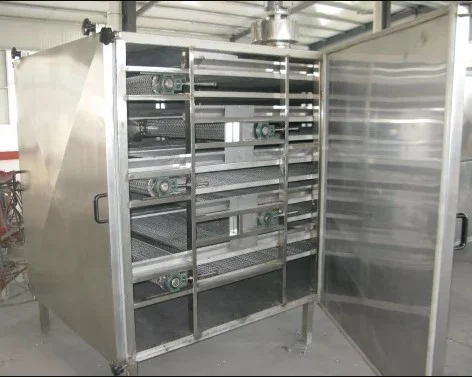
1. Executive Comparison Summary
| Metric / Parameter | Continuous Multi-Layer Belt Dryer | Industrial Batch Tray / Cabinet Dryer |
| Primary Suitability | High-tonnage, continuous industrial spice production | Small-to-medium enterprises, multi-product batch runs |
| Fresh Crop Throughput | High: $500\text{ kg/hr}$ to $5,000+\text{ kg/hr}$ (12–100+ Tons/Day) | Low-to-Medium: $50\text{ kg/batch}$ to $1,500\text{ kg/batch}$ |
| Footprint Requirements | Long horizontal linear layout ($12\text{ m}$ to $25+\text{ m}$ length) | Compact vertical/box footprint ($2\text{ m}$ to $6\text{ m}$ length) |
| Thermal Efficiency | Higher (Recirculation, closed-loop zoning) | Medium (Air exhaust losses during tray loading/unloading) |
| Labor Requirement | Minimal (Automated feeding, conveying, and discharge) | High (Manual tray loading, spreading, unloading, & cleaning) |
| Moisture Uniformity | Excellent (Continuous flipping at belt transition drop points) | Variable (Requires periodic tray rotation to prevent hot spots) |
| Capital Investment (CAPEX) | High initial capital expenditure | Low-to-Moderate initial capital expenditure |
2. Deep-Dive Metrics: Throughput, Footprint & Energy Efficiency
A. Fresh Crop Throughput & Operational Flow
- Continuous Multi-Layer Belt Dryer:
Fresh sliced ginger, turmeric roots, or chopped onions are continuously fed via a feeder onto a top mesh belt. As the product moves horizontally, it drops from upper belts to lower belts, automatically flipping the spice layers.
- Continuous Output: Eliminates plant downtime between cycles, making it ideal for large processing hubs in key agricultural zones (e.g., Matale, Anuradhapura, Kurunegala).
- Scalability: Unloads directly into automatic cooling conveyers, inline pulverizers, or packing lines.
- Industrial Batch Tray / Cabinet Dryer:
Spices are manually spread onto perforated SS304/SS316 trays, loaded onto trolleys, and locked inside the insulated drying cabinet.
- Batch Constraints: Requires $8\text{ to }16\text{ hours}$ per batch depending on slice thickness ($3\text{–}5\text{ mm}$) and moisture reduction ($\sim 80\%\rightarrow 8\%$).
- Product Flexibility: Highly suitable for processing small, specialized runs of high-value crops (e.g., Ceylon cardamom, cloves, or specialty black pepper) without risking cross-contamination between batches.
B. Footprint & Civil Installation
- Continuous Belt Dryer Footprint:
Requires significant horizontal space. A typical 3-layer or 5-layer belt dryer spanning $15\text{ meters}$ in length with feed hoppers and discharge conveyors requires an industrial factory bay with at least $20\text{ m}\times 5\text{ m}$ clear floor area and $4\text{ m}$ ceiling clearance.
- Batch Tray Dryer Footprint:
Highly space-efficient. Multi-trolley cabinet units (e.g., 96, 192, or 384 trays) utilize vertical height effectively. A dual-trolley system fits comfortably inside a standard $4\text{ m}\times 3\text{ m}$ processing room, requiring minimal civil modifications.
C. Energy Efficiency & Fuel Economics in Sri Lanka
Drying energy costs impact operating expenditure (OPEX) in Sri Lanka:
- Thermal Management in Belt Dryers:
Designed with multi-stage temperature zoning (e.g., high heat at $75^\circ\text{C}$ in Zone 1 for rapid surface evaporation, stepping down to $55^\circ\text{C}$ in Zone 3 to preserve active compounds like curcumin or volatile oils). Exhaust air recirculation systems recover heat energy, lowering overall biomass/LPG consumption per kilogram of evaporated water.
- Thermal Management in Tray Dryers:
Airflow is driven cross-wise or top-to-bottom across stationary trays. Heat retention is high during the middle of the cycle, but thermal losses occur when the cabinet doors are opened for trolley loading/unloading and manual tray flipping.
- Sri Lankan Fuel Integration:
- Biomass / Wood-Fired Air Heaters: Highly cost-effective in rural agricultural belts (Uva, Central, North Central) for both belt and tray systems.
- LPG / Diesel / Indirect Steam: Preferred in export-oriented zones (Gampaha, Ja-Ela, Colombo logistics hubs) where precise zero-soot thermal controls are mandated by European Union (EU) or ISO export quality standards.
3. Financial & Process Selection Guidance
Is your raw input > 3,000 kg/day of a single crop?
│
┌───────────────┴───────────────┐
▼ ▼
[ YES ] [ NO ]
│ │
Continuous Multi-Layer Industrial Batch Tray
Belt Dryer Cabinet Dryer
│ │
• High automated throughput • Low capital outlay (CAPEX)
• Minimal manual labor cost • Ideal for multi-crop switching
• Integrated continuous line • Fits compact factory footprints
- Choose a Continuous Belt Dryer if: You run a commercial processing center processing large seasonal volumes of fresh ginger, turmeric, chilli, or onions ($>3\text{ to }10+\text{ tons/day}$). The labor savings, high thermal efficiency, and moisture uniformity offset the higher initial equipment cost.
- Choose a Batch Tray Dryer if: You run a decentralized cooperative, agricultural SME, or multi-spice processing facility handling smaller batch volumes ($\le 1,500\text{ kg/day}$) across various spices without requiring dedicated 24/7 continuous conveying lines.
Targeting Sri Lanka’s Industrial & Agro Hubs
Equipment design, energy selection, and service coverage are tailored to regional processing hubs across Sri Lanka:
Central & Uva Provinces (Spice & Hill-Country Corridor)
- Kandy, Matale, Badulla, & Monaragala: Primary zones for ginger, turmeric, pepper, and cardamom production.
- Target Keywords: Spice Dryer Kandy, Turmeric Dryer Matale, Ginger Dehydrator Badulla, Agro Processing Monaragala
North Central & North Western Provinces (Commercial Agriculture Belt)
- Anuradhapura, Polonnaruwa, Kurunegala, & Puttalam: Major production centers for chilli, big onion, garlic, and commercial crops.
- Target Keywords: Chilli Dryer Anuradhapura, Onion Dryer Kurunegala, Industrial Food Dryer Puttalam
Western Province (Industrial & Export Logistics Hub)
- Colombo, Gampaha, & Ja-Ela: Location of national food manufacturing plants, central export packaging hubs, and industrial zones.
- Target Keywords: Industrial Spice Dryer Colombo, Spice Processing Machinery Gampaha, Food Dehydration Plant Western Province
Engineering Parameters for Project Sizing
To receive a tailored technical offer, heat load calculation, and commercial quotation for your facility in Sri Lanka, please specify:
- Target Agricultural Crop: (e.g., Ginger, Turmeric, Onion, Garlic, Chilli, or Multi-Crop)
- Material Preparation State: (Whole, sliced, diced, chopped, or flaked)
- Slice Thickness / Size: (e.g., 3mm–5mm thickness)
- Input Capacity Requirement: (kg per hour OR tons per day of fresh input)
- Initial Moisture Level: (Approximate % upon loading)
- Desired Final Moisture Level: (Typically 6% to 10% for milling/packaging)
- Preferred Heat Source: (Steam, LPG/Gas, Diesel, Biomass/Wood Waste, Electric, or Hybrid)
- Facility Location: (District / Industrial Zone in Sri Lanka)
Why Partner with GTI Dryers?
GTI Dryers delivers thermal dehydration systems engineered specifically for the humid tropical operating environments of South Asia.
- Precision Airflow Engineering: Custom duct designs eliminate dead zones and ensure consistent drying across all product trays or conveyor belts.
- Hygienic Stainless Construction: Full SS304/SS316 food-grade contact surfaces that conform to international export safety standards.
- Energy-Efficient Thermal Design: Advanced heat recirculation systems designed to lower operating costs per kilogram of evaporated moisture.
- Comprehensive Project Lifecycle: End-to-end service covering capacity planning, thermal sizing, installation guidance, commissioning, and operational training.
Request a Technical Proposal for Your Facility
Are you planning a new spice processing project or upgrading an existing drying facility in Sri Lanka?
Contact the GTI Dryers engineering team today with your crop type, daily throughput target, slice dimensions, and heating preferences to receive a process layout, thermal calculation, and commercial proposal.
ලංකාවේ ව්යාපෘති සඳහා විමසීම් (Sri Lankan Project Inquiries):
ශ්රී ලංකාවේ ඉඟුරු, කහ, ලූනු, සුදුළූණු හෝ මිරිස් වියළීමේ කර්මාන්ත ව්යාපෘතියක් සැලසුම් කරන්නේ නම්, ඔබගේ අවශ්යතාවයට ගැලපෙන කාර්මික වියළන යන්ත්ර තෝරාගැනීමට සහ තාක්ෂණික උපදෙස් ලබාගැනීමට අපගේ ඉංජිනේරු කණ්ඩායම හා සම්බන්ධ වන්න.