
Indonesia’s Agricultural Industrialization: Unlocking Value in the Spice Archipelago
Indonesia stands as a global powerhouse in spice cultivation, supplying international markets with raw ginger, turmeric, chilli, nutmeg, cloves, and aromatic roots. However, the nation’s food processing sector is undergoing a massive shift: moving away from exporting raw agricultural commodities and advancing toward domestic value addition, commercial ingredient processing, and shelf-stable manufacturing.
Agricultural belts across Java (East Java, Central Java, West Java), Sumatra (North Sumatra, Lampung), South Sulawesi, and West Nusa Tenggara (NTB) produce hundreds of thousands of metric tons of fresh ginger, turmeric, onions/shallots, garlic, and chilli each year.
Despite these yields, tropical climate conditions—characterized by relative humidity often exceeding 80–80% and prolonged monsoon cycles—present post-harvest challenges. Traditional open-air sun drying leaves high-value crops susceptible to mold growth, volatile oil degradation, microbial contamination, and post-harvest losses that can exceed 30%.
To meet export specifications and supply domestic food manufacturers (industri makanan dan minuman), Indonesian agro-processors are replacing sun drying with enclosed, temperature- and airflow-controlled industrial dehydration systems.
Technical & Commercial Impact of Industrial Dehydration in Indonesia
Freshly harvested Indonesian ginger (jahe), turmeric (kunyit), shallots (bawang merah), garlic (bawang putih), and chilli (cabai) contain 75% to 88% moisture at harvest. Uncontrolled drying degrades active chemical compounds, including gingerol, curcumin, allicin, and capsaicin.
Precision thermal dehydration allows processing plants to establish multi-product processing streams from raw harvests:
Fresh Jahe (Ginger) → Dehydrated Slices → Ginger Flakes → High-Solubility Powder / Oleoresins
Fresh Kunyit (Turmeric) → Dried Slices → Polished Granules → High-Curcumin Powder
Fresh Bawang (Onion/Shallot) → Dehydrated Flakes → Kibbled Shallots → Seasoning Powder
Fresh Bawang Putih (Garlic) → Dried Slices → Garlic Granules → Industrial Garlic Powder
Fresh Cabai (Chilli) → Whole Dried Pods → Crushed Flakes → Premium Red Chilli Powder
Operational Advantages for Indonesian Processing Plants
- Aflatoxin & Mold Prevention: Fully sealed drying chambers isolate produce from atmospheric humidity, rainfall, and pest exposure.
- Essential Oil & Color Preservation: Low-to-medium temperature drying profiles maintain natural color intensity and retain volatile aromatic compounds.
- Monsoon Immunity: Continuous operational uptime throughout the rainy season (musim hujan), removing weather dependencies.
- Target Moisture Accuracy: Reaches precise target moisture levels ($\le 8\%-10\%$) needed for downstream milling, pulverizing, and long-term storage.
Application Engineering: Five Agricultural Pillars
Industrial processing plants in Indonesia require versatile drying platforms capable of operating tailored thermal profiles for different seasonal crops.
| Crop Application | Finished Product Target | Key Dehydration Requirement |
| Ginger (Jahe) | Slices, granules, powder | Rapid surface moisture removal while preserving volatile oils |
| Turmeric (Kunyit) | Slices, ground powder | Uniform heat distribution to prevent surface darkening and retain curcumin |
| Onion / Shallot (Bawang) | Flakes, kibbled, powder | Managed airflow to handle high natural sugars without caramelization |
| Garlic (Bawang Putih) | Slices, granules, powder | Gentle thermal profile to preserve allicin without scorching |
| Chilli (Cabai) | Whole dried, flakes, powder | Controlled temperature and humidity to prevent pod collapse and color loss |
1. Ginger Dryer Machine Manufacturer in Indonesia
Ginger cultivation is prominent in regions like Central Java, East Java, and parts of Sumatra. With rising global demand for Indonesian ginger extracts, instant herbal beverages (jahe instan), and food seasonings, precise industrial drying replaces weather-dependent open drying.
- Typical Processing Line:
Raw Ginger Washing $\rightarrow$ Mechanical Slicing $\rightarrow$ Controlled Dehydration $\rightarrow$ Industrial Cooling $\rightarrow$ Flaking / Powder Pulverizing $\rightarrow$ Sealed Packaging
- Indonesian Search Terms:
Mesin pengering jahe Indonesia | Mesin dehidrasi jahe | Pabrik pengolahan jahe bubuk
2. Turmeric Dryer Machine Manufacturer in Indonesia
Indonesian turmeric (kunyit) is valued for its rich curcumin content, widely used in traditional Jamu formulations, natural food colorings, and spice blends. Industrial dehydration shortens processing cycles from weeks to hours while preventing fungal contamination.
- Primary Advantage: Controlled indirect hot-air circulation preserves deep yellow pigmentation and protects active bio-compounds.
- Indonesian Search Terms:
Mesin pengering kunyit | Mesin pembuat kunyit bubuk | Alat pengering kunyit industri
3. Onion & Shallot Dryer Machine Manufacturer in Indonesia
Brebes (Central Java), Nganjuk (East Java), and Bima (West Nusa Tenggara) are primary production hubs for Indonesian shallots (bawang merah) and onions. Because fresh shallots are highly perishable, dehydrating surplus yields into crispy flakes, granules, and powders helps stabilize market availability and supplies instant noodle and seasoning manufacturers.
- Engineering Requirement: Features non-stick contact materials and variable air velocity to process high-sugar slices smoothly.
- Indonesian Search Terms:
Mesin pengering bawang merah | Dehidrator bawang goreng/kering | Mesin bawang bubuk
4. Garlic Dryer Machine Manufacturer in Indonesia
To support local garlic processing in regions like Karanganyar and East Java, industrial garlic dehydrators convert fresh cloves into shelf-stable garlic flakes, granules, and powders used across the commercial food manufacturing industry.
- Key Feature: Low-temperature dehydration preserves allicin and protects natural garlic aromas.
- Indonesian Search Terms:
Mesin pengering bawang putih | Mesin krispi bawang putih | Alat pengering resep seasoning
5. Chilli Dryer Machine Manufacturer in Indonesia
Chilli (cabai merah and cabai rawit) is a staple in Indonesian cuisine and industrial food production. Major growing regions across Java and Sumatra face heavy crop damage during monsoon seasons. Industrial chilli dryers allow processors to produce whole dried chillies, flakes, and chilli powder with consistent heat and pungency levels.
- Quality Assurance: Retains natural capsaicin levels, preserves bright red aesthetics, and achieves low moisture targets required for fine grinding.
- Indonesian Search Terms:
Mesin pengering cabai Indonesia | Mesin cabai kering | Pengering cabai rawit industri
Dryer Technology Selection for Indonesian Facilities
Selecting the proper dehydration equipment depends on raw input volume, plant floor layout, and energy availability:
Agro-Harvest Input (Java / Sumatra / Sulawesi)
│
├── Batch / Multi-Recipe Processing (Small-to-Medium Facilities) ──► Industrial Multi-Tray / Cabinet Dryers
│
└── High-Volume Continuous Output (Industrial Agro-Parks) ──► Multi-Layer Conveyor / Belt Dryers
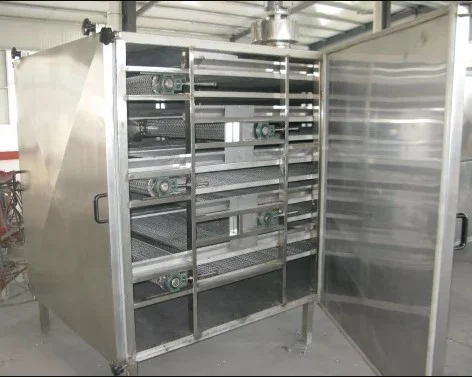
- Continuous Multi-Layer Belt / Conveyor Dryers
- Best For: Large-scale commercial food processing plants handling high daily tonnage of sliced ginger, turmeric, onions, or chillies.
- Features: Automated material feed, multi-stage temperature zone management, high fuel efficiency.
- Industrial Multi-Tray / Cabinet Dryers
- Best For: Medium enterprises, regional cooperatives (Koperasi Tani), or facilities running varied batch runs.
- Features: Stainless steel food-contact zones (SS304/SS316), uniform cross-flow air distribution, compact footprint.
Both Continuous Multi-Layer Belt Dryers and Batch Tray Dryers play distinct roles in Indonesian spice and agro-processing facilities. Choosing between them depends primarily on your processing scale, seasonal variety, and labor strategy.
Comparison Matrix
| Feature / Metric | Continuous Multi-Layer Belt Dryer | Batch Tray Dryer |
| Operational Mode | Continuous, automated feed & discharge | Batch loading, holding, and unloading |
| Typical Throughput | High: 500 kg/hr to 5,000+ kg/hr wet feed | Low–Medium: 50 kg to 500 kg per batch |
| Physical Footprint | Linear Horizontal: Longer length, compact height | Vertical/Compact: Small horizontal footprint |
| Specific Footprint Yield | Very High: Multi-pass cascading multiplies belt area per $m^2$ ground area | Medium: Stacked trays maximize vertical room height |
| Energy Efficiency | High ($2,800–3,600 \text{ kJ/kg } H_2O$ evaporated): Integrated heat recovery & zone circulation | Moderate ($3,800–4,800 \text{ kJ/kg } H_2O$ evaporated): Heat lost during door opening & purge cycles |
| Labor Requirement | Low (Automated loading/conveying) | High (Manual tray loading, flipping, and unloading) |
| Initial Capital Investment (CAPEX) | High | Low |
Key Performance Factors
1. Throughput & Scalability
- Continuous Multi-Layer Belt Dryer: Designed for high-tonnage processing facilities. Raw wet slices of ginger, turmeric, or shallots are loaded continuously onto a top mesh belt and cascade down through 3 to 5 internal decks. This cascading motion tumbles the product, exposing fresh surfaces to airflow and preventing clumping.
- Batch Tray Dryer: Designed for low-volume runs, specialized organic crops, or small R&D facilities. Because every batch requires manual loading, drying time, cooling, and manual unloading, downtime between batches reduces total daily throughput.
2. Physical Footprint & Spatial Efficiency
- Continuous Multi-Layer Belt Dryer: Takes advantage of multi-pass layering (3, 5, or 7 tiers) to multiply effective drying surface area inside a single chamber. While it requires a longer linear footprint (typically $8\text{m}$ to $20\text{m}$), it produces a high yield per square meter of factory floor.
- Batch Tray Dryer: Features a much smaller floor footprint. Trays are stacked vertically on trolleys inside an insulated cabinet. However, as throughput demands increase, adding multiple tray dryers quickly clutters factory floor space and complicates material handling.
3. Energy Efficiency & Thermal Management
- Continuous Multi-Layer Belt Dryer: Highly thermal-efficient in continuous operation. Modern systems use multi-zone temperature controls (e.g., $80^\circ\text{C}$ at the wet entry zone to rapidly evaporate surface moisture, dropping to $55^\circ\text{C}$ in the final finishing zone to protect color, curcumin, or capsaicin). Exhaust air from drier zones is recirculated to wet entry zones, lowering thermal consumption per kilogram of evaporated moisture.
- Batch Tray Dryer: Less energy-efficient overall. Every time the cabinet doors are opened to swap trolleys, ambient tropical humidity enters the chamber, requiring significant energy to reheat the system. Air distribution across upper and lower trays can also cause uneven drying, requiring longer residence times to dry the slowest tray.
Contextual Suitability in Indonesia
Choose a Continuous Multi-Layer Belt Dryer if:
- You process high volumes continuously: Facilities handling large commercial quantities of sliced ginger (jahe), turmeric (kunyit), shallots (bawang merah), or chilli (cabai) in agricultural centers like East Java, Central Java, or Sumatra.
- You operate during the monsoon season: Enclosed continuous systems protect high-moisture produce from ambient humidity without relying on sun drying or manual intervention.
- You supply industrial food manufacturers: Instant noodle seasoning producers, oleoresin extractors, and international spice exporters require consistent moisture levels ($\le 8\%$) and standardized color retention across large production runs.
Choose a Batch Tray Dryer if:
- You operate a multi-product, seasonal facility: Smaller plants processing diverse niche crops (e.g., nutmeg, cloves, vanilla, and small batches of wild ginger) where recipes and cleaning procedures change daily.
- Capital budget (CAPEX) is constrained: Regional cooperatives (Koperasi Tani) seeking an affordable entry point into dehydrated spice processing before scaling up to continuous automation.
- Factory floor space is limited: Facilities in urban industrial zones with constrained linear space where a full conveyor line cannot fit.
Targeting Indonesia’s Industrial & Agro Hubs
Equipment design, energy selection, and service coverage are tailored to regional processing hubs across the Indonesian archipelago:
Java Island (Core Food Manufacturing & Agro Corridor)
- Central & East Java (Semarang, Solo, Brebes, Surabaya, Malang, Nganjuk): Key agricultural zones for shallots, garlic, ginger, and turmeric processing, along with major food industrial estates.
- Target Keywords: Mesin Pengering Rempah Surabaya, Ginger Dryer Semarang, Shallot Dehydrator Brebes, Pengering Kunyit Malang
Sumatra Island (Agricultural Export Corridor)
- North Sumatra (Medan) & Lampung: Major belts for ginger, chilli, and spice cultivation targeting regional and export markets.
- Target Keywords: Mesin Pengering Cabai Medan, Industrial Spice Dryer Lampung, Agro Processing Machinery Sumatra
Sulawesi & Eastern Indonesia
- South Sulawesi (Makassar) & NTB (Bima): Growing centers for chilli, shallot, and spice dehydration facilities.
- Target Keywords: Spice Dryer Machine Makassar, Chilli Dehydrator Bima, Industrial Food Dryer NTB
Engineering Parameters for Project Sizing
To receive a tailored technical offer, heat load calculation, and commercial quotation for your facility in Indonesia, please specify:
- Target Agricultural Crop: (e.g., Ginger, Turmeric, Shallot/Onion, Garlic, Chilli, or Multi-Crop)
- Material Preparation State: (Whole, sliced, diced, chopped, or flaked)
- Slice Thickness / Size: (e.g., 3mm–5mm thickness)
- Input Capacity Requirement: (kg per hour OR tons per day of fresh input)
- Initial Moisture Level: (Approximate % upon loading)
- Desired Final Moisture Level: (Typically 6% to 10% for milling/packaging)
- Preferred Heat Source: (Steam, LPG/Natural Gas, Diesel, Biomass/Palm Shells, Electric, or Hybrid)
- Facility Location: (City / Province in Indonesia)
Why Partner with GTI Dryers?
GTI Dryers delivers thermal dehydration systems engineered specifically for the humid tropical operating environments of Southeast Asia.
- Precision Airflow Engineering: Custom duct designs eliminate dead zones and ensure consistent drying across all product trays or conveyor belts.
- Hygienic Stainless Construction: Full SS304/SS316 food-grade contact surfaces that conform to international food safety standards.
- Energy-Efficient Thermal Design: Advanced heat recirculation systems designed to lower operating costs per kilogram of dried output.
- Comprehensive Project Lifecycle: End-to-end service covering capacity planning, thermal sizing, installation guidance, commissioning, and operational training.
Request a Technical Proposal for Your Facility
Are you planning a new spice processing project or upgrading an existing drying facility in Indonesia?
Contact the GTI Dryers engineering team today with your crop type, daily throughput target, slice dimensions, and heating preferences to receive a process layout, thermal calculation, and commercial proposal.
Layanan Informasi Bahasa Indonesia (Indonesian Project Enquiries):
Untuk merencanakan proyek pengeringan jahe, kunyit, bawang, atau cabai di Indonesia, hubungi tim rekayasa kami untuk mendapatkan konsultasi teknis, perhitungan beban termal, dan penawaran mesin dehidrasi industri yang sesuai dengan kebutuhan pabrik Anda.