
Cameroon’s Agro-Export Transformation: Industrializing Central Africa’s Spice Engine
Often referred to as “Africa in miniature,” Cameroon possesses diverse agro-ecological zones ideal for cultivating high-value spices. Sourced from volcanic soils and tropical rain belts, Cameroonian spices—such as high-pungency gingembre (ginger), world-renowned Poivre de Penja (Penja white/black pepper), curcuma (turmeric), piment (chili), and ail (garlic)—are prized globally for their rich essential oil content and distinct sensory profiles.
Driven by the Ministry of Agriculture and Rural Development (MINADER), the Ministry of Mines, Industry and Technological Development (MINMIDT), and regional trade frameworks within the CEMAC zone and AfCFTA (ZLECAF), Cameroonian agribusinesses are shifting from raw farm-gate exports to manufacturing standardized, value-added dehydrated spices, kibbled flakes, and fine powders.
Cameroon’s core agricultural processing zones feature distinct regional specialties:
- Littoral Zone (Penja, Njombé, Moungo Basin): World-renowned GI-certified Penja pepper hub (Poivre de Penja), along with high-yield ginger and chili cultivation.
- West & North-West Regions (Bafoussam, Bamenda, Foumbot): Core highlands producing ginger, turmeric, garlic, and hot chili peppers (piment).
- South-West & Centre Belt (Buea, Kumba, Yaoundé logistics corridor): Strategic hubs for processing, grinding, packaging, and export via the Port of Douala and Kribi Deep Seaport.
However, operating in West-Central Africa’s equatorial climate brings severe post-harvest risks. High relative humidity ($>85\%$) during the long rainy season leads to rapid moisture reabsorption, mold growth, mycotoxin/aflatoxin contamination (violating EU, US FDA, and ANOR quality standards), discoloration, and loss of volatile aromatic oils.
To secure long-term European and North American off-take contracts and supply domestic food seasoning manufacturers, commercial processors in Cameroon are upgrading from open-air drying to enclosed, multi-stage industrial continuous dehydration plants.
Technical Transformation: Converting Fresh Crops into Export Ingredients
Fresh Cameroonian ginger, turmeric, Penja pepper, chili, and garlic arrive at wash-and-slice facilities with initial moisture levels between 70% and 85%. Uncontrolled open drying degrades heat-sensitive compounds such as gingerol, piperine, curcumin, capsaicin, and allicin.
Precision thermal dehydration converts raw equatorial harvests into shelf-stable, export-grade products:
Fresh Moungo Ginger → Hydro-Washing & Slicing → Multi-Zone Belt Dryer → Dry Ginger Flakes → High-Oil Powder / Extract
Fresh Penja Pepper Berries → Fermentation / Soaking → Controlled Airflow → Premium White Pepper → Whole / Crushed Export Peppercorns
Fresh Highland Turmeric → Boiling & Slicing → Hot-Air Recirculation → Dried Roots → High-Curcumin Powder
Fresh Western Chili Pods → De-stemming & Dicing → Managed Humidity → Dried Chili Strips → Crushed Flakes / Chili Powder
Fresh Local Garlic Cloves → Clove Separation → Low-Temp Dehydration → Garlic Flakes → Industrial Seasoning Powder
Operational Advantages for Cameroonian Processing Facilities
- Continuous Operations in Rainy Basins: Sealed thermal chambers enable 24/7 continuous throughput during the torrential rainy seasons in the Littoral and South-West regions.
- ANOR & HACCP Compliance: Food-grade SS304/SS316 stainless steel contact surfaces eliminate insect, dust, and fungal contamination risks.
- Essential Oil & Aroma Preservation: Multi-zone temperature regulation retains volatile piperine in Penja pepper and gingerol content in native ginger.
- Precise Export Moisture Control: Consistently achieves export-grade target moisture levels ($\le 8\%\text{–}10\%$) required for long-distance maritime container transport.
Application Engineering: Five Core Cameroonian Spice Pillars
GTI Dryers engineers dehydration systems tailored to the physical characteristics and thermal parameters of Central Africa’s primary spice crops.
| Crop Application | Primary Cameroonian Processing Hubs | Dehydration & Quality Standard |
| Gingembre (Ginger) | Moungo (Penja, Njombé), West Region (Foumbot), South-West | Continuous moisture removal preserving high oleoresin/oil content and a clean pale gold export appearance. |
| Poivre de Penja (Pepper) | Moungo Basin (Penja, Manengouba), Loum | Gentle temperature profiles ($\le 50^\circ\text{C}$) to protect volatile piperine and preserve the distinct woody aroma of white pepper. |
| Curcuma (Turmeric) | West Region (Bafoussam), Centre, North-West | Uniform heat distribution ensuring retention of curcumin content ($\ge 5.0\%$) and vibrant yellow-orange color. |
| Piment (Chili) | Littoral, West, Centre, Far North | Controlled humidity extraction to prevent pod collapse, maintaining sharp capsaicin potency and deep red color. |
| Ail (Garlic) | West Region (Bamenda, Bafoussam), North Region | Low-temperature drying ($\le 52^\circ\text{C}$) to avoid sugar scorching and retain active pungent allicin flavor. |
1. Ginger Dryer Machine Manufacturer in Cameroon (Séchoirs à Gingembre)
Cameroon produces highly aromatic ginger with a spicy profile. Designed for commercial plants in the Moungo Basin and West Region, our continuous ginger dehydrators transform fresh ginger rhizomes into export-grade dried slices, flakes, and fine ground powders.
- Processing Line Flow:
Fresh Ginger Washing $\rightarrow$ Mechanical Slicing ($3\text{–}5\text{mm}$) $\rightarrow$ Continuous Belt Dehydrator $\rightarrow$ Counter-Flow Cooling $\rightarrow$ Flaking / Powder Grinding
- Local Search Terms:
Séchoir industriel de gingembre Cameroun | Deshydrateur de gingembre Douala | Machine pour transformation du gingembre
2. Penja White Pepper Dryer Equipment (Séchoirs pour Poivre de Penja)
Protected Geographical Indication (PGI) Penja pepper demands strict drying protocols. Following retting and skin removal, washed white peppercorns must be dried rapidly to prevent mold formation while maintaining a uniform off-white tone and essential oil concentration.
- Primary Advantage: Indirect clean hot-air circulation guarantees zero soot or fuel combustion residue on the peppercorns, fully respecting premium PGI export purity standards.
- Local Search Terms:
Séchoir pour poivre de Penja | Machine de séchage poivre blanc Cameroun | Déshydrateur industriel poivre de Penja
3. Turmeric Dryer Machine Manufacturer in Cameroon (Séchoirs à Curcuma)
Cameroonian turmeric is valued for its natural purity and curcumin content. Controlled indirect hot-air circulation dries sliced turmeric roots evenly without surface darkening or thermal degradation.
- Quality Assurance: Precision temperature zoning preserves active curcumin and prevents root skin browning for downstream pulverizing.
- Local Search Terms:
Séchoir de curcuma Cameroun | Machine pour sécher le curcuma Bafoussam | Processeur industriel de curcuma
4. Chili Dryer Machine Manufacturer in Cameroon (Séchoirs à Piment)
Cultivated across the Littoral, West, and Northern zones, fresh African bird’s eye and cayenne chilies are processed into dried whole pods, crushed flakes, and hot chili powder for regional culinary use and export.
- Key Feature: Managed exhaust humidity prevents pod shriveling, locking in natural red pigments and capsaicin heat levels.
- Local Search Terms:
Séchoir de piment au Cameroun | Déshydrateur industriel de piment Douala | Machine pour sécher le piment frais
5. Garlic Dryer Machine Manufacturer in Cameroon (Séchoirs à Ail)
Garlic grown in the western highlands and northern regions is dehydrated into shelf-stable garlic flakes, granules, and powders for commercial food blenders, bouillon manufacturers, and export markets.
- Engineering Requirement: Features specialized food-grade mesh belting and air velocity controls to handle sticky, high-sugar garlic slices smoothly without belt buildup.
- Local Search Terms:
Séchoir d’ail au Cameroun | Déshydrateur d’ail Bafoussam | Machine de séchage pour ail et oignon
Dehydration Equipment Selection for Cameroonian Facilities
Selecting the ideal dehydration system depends on daily raw input tonnage, heating utility availability, and factory space:
Fresh Agricultural Input (Moungo Basin, Western Highlands & Northern Plains)
│
├── High-Volume Continuous Output (Agro-Industrial Exporters) ──► Multi-Layer Continuous Belt Dryers
│
└── Specialized Batch / Multi-Crop Operations (Agro-Coops) ──► Diesel / Biomass Multi-Trolley Cabinet Dryers
- Continuous Multi-Layer Belt Dryers (5-Layer / 7-Layer)
- Best For: Commercial agro-processing plants handling high daily tonnage ($5\text{ to }50+\text{ tons/day}$) of sliced ginger, Penja pepper, turmeric, or chili.
- Features: Automated spreading feed, variable speed belt controls, multi-zone thermal management, high energy efficiency.
- Industrial Multi-Tray / Cabinet Dryers
- Best For: Agricultural cooperatives (coopératives agricoles), regional processors, or facilities managing smaller multi-spice batches.
- Features: Full SS304/SS316 stainless steel contact surfaces, heavy insulation panels, digital PID temperature controllers ($\pm 1^\circ\text{C}$).
Technical Comparison: Continuous Multi-Layer Belt Dryers vs. Batch Tray Dryers
For spice processors across Cameroon’s key agricultural belts—such as the Moungo Basin (Penja pepper and ginger), the Western Highlands (ginger, turmeric, and chili), and Northern agricultural hubs—the choice of dehydration machinery dictates operational yield, fuel overheads, and regulatory compliance.
1. High-Level Comparison Matrix
| Operational Parameter | Continuous Multi-Layer Belt Dryer | Industrial Batch Tray Dryer |
| Primary Suitability | Commercial exporters ($5\text{–}50+\text{ tons/day}$) | Smallholders & cooperatives ($500\text{kg}\text{–}3\text{ tons/day}$) |
| Thermal Efficiency | High ($1.2\text{–}1.5\text{ kWh/kg}$ $H_2O$ evaporated) | Moderate to Low ($1.8\text{–}2.5\text{ kWh/kg}$ $H_2O$ evaporated) |
| Throughput & Capacity | Continuous 24/7 loading ($200\text{–}2,000+\text{ kg/hour}$) | Batch loading ($50\text{–}300\text{ kg/batch}$) |
| Factory Footprint | Linear Horizontal Layout ($12\text{–}25\text{m}$ L $\times 2.5\text{–}4\text{m}$ W) | Vertical Compact Footprint ($2\text{–}4\text{m}$ L $\times 1.5\text{–}2.5\text{m}$ W) |
| Labor Dependency | Low (1–2 operators per shift) | High (3–5 workers for loading, unloading, tray washing) |
| ANOR & HACCP Compliance | Automated closed-loop process (Zero cross-contact) | Manual handling risks during tray rotation |
| Capital Investment (CAPEX) | High ($\$35,000\text{–}\$150,000+$) | Low to Medium ($\$5,000\text{–}\$22,000$) |
2. Fuel Efficiency & Operational Costs in Cameroon
Energy management directly affects processing margins in Cameroon, where operations rely on diesel, biomass, or dual-fuel systems due to seasonal energy fluctuations.
Continuous Multi-Layer Belt Dryer
- Heat Recirculation: Utilizes internal exhaust air recovery loops, retaining up to $60\%$ of thermal energy within the chamber rather than losing it in high-humidity zones like the Moungo or South-West regions.
- Continuous Thermal Balance: Operates uninterrupted at thermal equilibrium without opening doors, preventing recurring fuel spikes.
- Biomass Integration: Integrates easily with indirect heat exchangers burning local agricultural waste (e.g., palm kernel shells, coffee husks, or wood waste), cutting diesel fuel overheads by up to $75\%$.
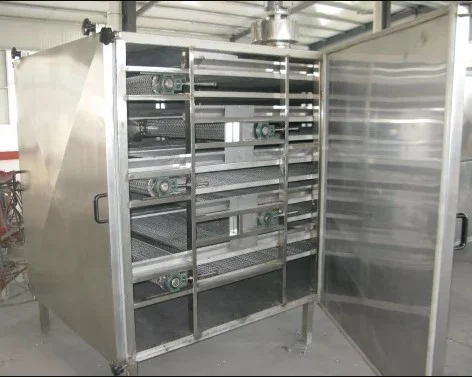
Batch Tray Dryer
- Thermal Shock Losses: Every reload cycle requires opening cabinet doors, causing heat to escape and requiring extra fuel to bring the chamber back to target temperatures.
- Air Resistance Losses: Static trays create air-flow resistance. Operators often raise burner temperatures to force heat through dense lower trays, wasting fuel and risking product scorching.
3. Factory Footprint & Civil Layout Requirements
[Continuous Multi-Layer Belt Layout]
┌──────────────┐ ┌──────────────────────────────────────────────┐ ┌──────────────┐
│ Feed Hopper │►│ 5-Layer Chamber (15m – 20m Length x 3m Width)│►│ Cooling Belt │
└──────────────┘ └──────────────────────────────────────────────┘ └──────────────┘
[Batch Tray Dryer Layout]
┌───────────────────────┐
│ Multi-Trolley Cabinet │ ◄ Compact: 3m x 2m (Requires 6m x 6m room
└───────────────────────┘ for tray washing, staging, and sanitation)
- Continuous Belt Dryers: Require a long, horizontal floor plan ($12\text{ to }25\text{ meters}$) with high ceilings ($\ge 4\text{ meters}$) to accommodate multi-tier incline feeds and exhaust ducting. This setup suits purpose-built processing sheds in industrial corridors near Douala, Bafoussam, or Yaoundé.
- Batch Tray Dryers: Occupy a compact primary footprint, allowing them to fit into smaller rural sheds. However, adequate staging areas are required for tray washing, sanitization, and manual trolley handling.
4. ANOR Compliance, HACCP, and Export Quality Standards
The Agence des Normes et de la Qualité (ANOR) enforces food hygiene, moisture thresholds, and safety standards (aligning with NC 39: Code of Hygienic Practice for Spices and Dried Aromatic Herbs and ISO 22000/HACCP principles):
Raw Crop Infeed ──► Sealed SS304 Multi-Layer Tunnel ──► Counter-Flow Cooling ──► ANOR-Compliant Packaging
(Zero Human Contact)
- Penja Pepper (Poivre de Penja): Protected Geographical Indication (PGI) Penja pepper requires gentle drying temperatures ($\le 50^\circ\text{C}$) to protect volatile piperine and preserve its distinct aroma. Continuous belt dryers ensure uniform moisture reduction ($\le 11\%$) without smoke or fuel soot contamination.
- Ginger (Gingembre): Multi-zone belt dryers maintain controlled heat profiles to prevent browning, retaining high gingerol content and pale gold appearance required for international markets.
- Chili (Piment): Automated relative humidity exhaust prevents pod shriveling and retains natural capsaicin heat while reducing moisture below $9\%$ to prevent aflatoxin development during humid rainy seasons.
- Cross-Contamination Prevention: Food-grade SS304/SS316 stainless steel contact surfaces in continuous dryers meet strict ANOR inspection criteria, removing the hygiene risks associated with manual tray handling and open-air drying.
Strategic Selection Guidelines for Cameroonian Facilities
- Select a Batch Tray Dryer if: Your plant processes under $2.5\text{ metric tons/day}$ of raw harvest, handles varied seasonal specialty crops in small lots, or operates with limited capital ($\le \$25,000$).
- Select a Continuous Multi-Layer Belt Dryer if: You export bulk shipments (EU, North America, CEMAC region) under ANOR/HACCP certification, process over $5\text{ metric tons/day}$ of ginger, Penja pepper, or chili, and need uninterrupted 24/7 operation through heavy rainy seasons.
Regional GEO Strategy: Targeting Cameroon’s Agro-Industrial Corridors
Equipment configurations, heat sources, and technical support align with Cameroon’s main processing zones:
Littoral & Moungo Processing Corridor (Douala, Penja, Njombé, Loum)
- Primary Focus: High-capacity processing for ginger, Penja white/black pepper, chili, and export logistics via Douala Port.
- Target Keywords: Séchoir poivre de Penja, Gingembre industriel Douala, Usine agroalimentaire Moungo, Séchoir piment Littoral
Western Highlands Agricultural Hub (Bafoussam, Foumbot, Dschang, Bamenda)
- Primary Focus: High-yield production centers for ginger, turmeric, garlic, and hot peppers.
- Target Keywords: Séchoir de gingembre Bafoussam, Curcuma industriel Foumbot, Séchoir d’ail Bamenda, Déshydrateur Ouest Cameroun
Southern & Central Logistics Belt (Yaoundé, Kribi, Ebolowa)
- Primary Focus: Secondary transformation, industrial food blending, and export maritime dispatch via Kribi Deep Seaport.
- Target Keywords: Séchoir industriel d’épices Yaoundé, Équipements agroalimentaires Kribi, Transformation d’épices Centre Cameroun
Technical Project Sizing Parameters
To receive a heat-balance calculation, CAD plant layout, and commercial proposal for your facility in Cameroon, please provide:
- Target Agricultural Crop: (e.g., Ginger, Penja Pepper, Turmeric, Chili, Garlic, or Multi-Crop)
- Material Preparation State: (Whole peppercorns, sliced $3\text{–}5\text{mm}$, diced, or crushed)
- Daily Processing Input: (kg/hour OR tons/day of fresh raw harvest)
- Initial Moisture Content: (Approximate % upon loading, typically $70\%\text{–}80\%$)
- Target Final Moisture Content: (Typically $8\%$ to $10\%$ for grinding/export packaging)
- Preferred Heating Energy Source: (Diesel, Biomass/Palm Shells/Wood Waste, Dual-Fuel Burner, Steam Coil, or Electric)
- Facility Location: (Town / Region in Cameroon)
Why Partner with GTI Dryers?
GTI Dryers manufactures heavy-duty industrial thermal systems built for high performance in tropical, high-humidity environments across Central Africa.
- Precision Airflow Distribution: Custom air duct geometry eliminates cold spots and ensures uniform drying across all product layers.
- Sanitary Stainless Construction: Complete SS304/SS316 food-grade contact areas that conform to international FDA, EU, ANOR, and HACCP export standards.
- Energy-Efficient Recirculation: Advanced heat recovery designs reduce fuel consumption per kilogram of evaporated moisture by up to $40\%$.
- Turnkey Engineering Service: End-to-end guidance covering capacity planning, thermal calculations, CAD installation layout, commissioning, and operator training.
Request an Engineering Proposal for Your Plant
Are you setting up a new spice processing line or upgrading existing drying equipment in Cameroon?
Contact the GTI Dryers engineering team today with your crop type, daily throughput target, slice thickness, and fuel choice to receive a detailed process flow layout, thermal calculation, and commercial quotation.
Demande de Devis Technique pour Projets au Cameroun:
Vous envisagez d’installer une nouvelle unité de séchage pour le gingembre, le poivre de Penja, le curcuma, le piment ou l’ail au Cameroun ? Contactez notre équipe d’ingénierie dès aujourd’hui pour obtenir une étude personnalisée, des plans d’implantation CAD et une offre commerciale.