
Thailand’s Agricultural Shift: Scaling Up Value-Added Spice Dehydration
Thailand’s agricultural and food processing sector stands as a major driver of Southeast Asian exports. With growing international demand for ready-to-cook Thai curry pastes, instant noodle seasonings, nutraceutical extract concentrates, and standardized botanical ingredients, Thai agri-businesses are shifting from selling unprocessed raw crops toward high-value, shelf-stable dehydrated ingredients.
Primary agricultural belts across Thailand yield massive annual harvests of fresh spices and aromatics:
- Northern Thailand (Chiang Mai, Chiang Rai, Nan, Phrae): Key regional hubs for ginger (khing), turmeric (khamin), and garlic (kratheim).
- Northeastern Isan Region (Chaiyaphum, Nakhon Ratchasima, Ubon Ratchathani): Major cultivation zones for hot chillies (phrik) and red shallots (hom daeng).
- Central & Western Plains (Kanchanaburi, Ratchaburi): Commercial hubs for high-yield aromatics, lemongrass, and food-grade spices.
However, Thailand’s tropical climate—characterized by seasonal monsoon downpours and relative humidity levels exceeding 85%—creates severe post-harvest vulnerabilities. Open sun-drying often leads to mold growth, volatile oil loss, darkening of colors, and contamination levels that fail strict GMP, HACCP, Halal, and FDA export standards.
To ensure year-round production uptime and meet international quality benchmarks, Thai processors are replacing weather-dependent drying with enclosed, automated, multi-zone industrial dehydration systems.
Technical Transformation: Processing Fresh Harvests into High-Value Ingredients
Freshly harvested Thai ginger (khing / ขิง), turmeric (khamin / ขมิ้น), chillies (phrik / พริก), garlic (kratheim / กระเทียม), and shallots (hom daeng / หอมแดง) arrive at processing facilities with initial moisture levels between 75% and 85%. Uncontrolled heat destroys essential aromatic compounds like gingerol, curcumin, capsaicin, and allicin.
Precision thermal dehydration converts raw agricultural crops into consistent, export-ready product forms:
Fresh Northern Khing (Ginger) → Mechanical Slicing → Multi-Zone Belt Dryer → Ginger Flakes → High-Solubility Extract / Powder
Fresh Thai Khamin (Turmeric) → Washing & Slicing → Controlled Hot-Air → Dried Slices → High-Curcumin Powder
Fresh Isan Phrik (Chilli) → Pod De-stemming → Heat-Recirculating → Whole Dried Pods → Crushed Flakes / Chili Powder
Fresh Kratheim (Garlic) → Clove Peeling → Low-Temp Dehydration → Dried Flakes → Industrial Seasoning Granules
Fresh Hom Daeng (Shallot) → Precision Dicing → Gentle Airflow Drying → Kibbled Shallots → Crispy Shallot Powder
Operational Advantages for Thai Food Processors
- Uninterrupted Monsoon Uptime: Completely sealed thermal chambers allow factories to run 24/7 through heavy rainy seasons without production delays.
- Bio-Active Compound Retention: Precise temperature zoning preserves natural pigments, pungent essential oils, and active health nutrients.
- Contamination Control: Closed stainless steel processing channels eliminate exposure to rain, dust, bird drop contamination, and aflatoxins.
- Export-Ready Standards: Achieves low target moisture levels ($\le 6\%-8\%$) required for downstream pulverizing, long-shelf-life packaging, and container shipping.
Application Engineering: Five Core Thai Spice Pillars
GTI Dryers designs specialized drying parameters tailored to the physical characteristics and thermal sensitivities of Thailand’s major spice crops.
| Crop Application | Key Thai Cultivation Hubs | Dehydration & Quality Target |
| Ginger (Khing) | Chiang Mai, Chiang Rai, Nan | Continuous surface moisture removal preserving essential oil yield ($\ge 1.6\text{ ml}/100\text{g}$) and pale yellow aesthetics. |
| Turmeric (Khamin) | Surat Thani, Chiang Rai, Kanchanaburi | Controlled thermal cycles to lock in deep orange pigments and retain curcumin levels for extraction and powder processing. |
| Chilli (Phrik) | Chaiyaphum, Ubon Ratchathani, Nakhon Ratchasima | Managed humidity exhaustion to prevent pod collapse, maintaining vibrant red aesthetics and sharp capsaicin potency. |
| Garlic (Kratheim) | Chiang Mai, Mae Hong Son, Lamphun | Low-temperature drying ($\le 55^\circ\text{C}$) to prevent slice yellowing and preserve active allicin flavor compounds. |
| Shallots (Hom Daeng) | Si Sa Ket, Ubon Ratchathani | Specialized gentle air movement to process high-sugar diced shallots without scorching or surface caramelization. |
1. Ginger Dryer Machine Manufacturer in Thailand
Thailand is a major exporter of fresh and processed ginger products. Designed for commercial plants in Northern Thailand, our ginger dehydration lines turn fresh ginger rhizomes into export-grade ginger flakes, kibble, and ground powders.
- Processing Line Flow:
Raw Ginger Hydro-Washing $\rightarrow$ Mechanical Peeling/Slicing ($3\text{–}5\text{mm}$) $\rightarrow$ Continuous Dehydrator $\rightarrow$ Counter-Flow Cooling $\rightarrow$ Granulation / Pulverizing
- Thai Search Terms:
เครื่องอบขิงแปรรูป | เครื่องอบแห้งขิงแผ่น | เครื่องทำขิงผงอุตสาหกรรม
2. Turmeric Dryer Machine Manufacturer in Thailand
Thai turmeric (khamin) is valued for its rich curcumin content. Controlled indirect hot-air circulation dries sliced turmeric roots evenly without thermal degradation, satisfying industrial extraction and food powder standards.
- Primary Advantage: Clean hot-air distribution guarantees zero soot or fuel combustion residue on the product, meeting strict international export purity requirements.
- Thai Search Terms:
เครื่องอบขมิ้นชัน | เครื่องอบแห้งขมิ้นผง | โรงงานแปรรูปขมิ้นชัน
3. Chilli Dryer Machine Manufacturer in Thailand
The Isan region produces significant yields of hot chillies used in domestic food manufacturing and global exports. Industrial chilli dryers allow processors to produce whole dried chillies, flakes, and chilli powder with consistent heat and uniform color retention.
- Quality Assurance: Locks in natural capsaicin levels while drying whole pods or crushed chillies down to stable moisture levels ($\le 9\%$) for fine grinding mills.
- Thai Search Terms:
เครื่องอบพริกแห้ง | เครื่องอบพริกอุตสาหกรรม | เครื่องวิจลนพริกสด
4. Garlic Dryer Machine Manufacturer in Thailand
Grown extensively across Northern Thailand, fresh garlic cloves are processed into shelf-stable dehydrated garlic flakes and granules used in ready-to-eat seasoning packs, sauces, and instant food products.
- Key Feature: Multi-stage temperature zones prevent sugar blistering, ensuring a clean off-white finish and intense garlic aroma.
- Thai Search Terms:
เครื่องอบกระเทียมแผ่น | เครื่องอบกระเทียมแห้ง | เครื่องแปรรูปกระเทียม
5. Shallot Dryer Machine Manufacturer in Thailand
Red shallots (hom daeng) are a foundational ingredient in Thai cuisine. Dehydrating seasonal shallot surpluses into dried flakes, granules, and powders helps stabilize factory ingredient supplies and reduces seasonal food waste.
- Engineering Requirement: Features specialized food-grade mesh belts and adjustable air velocity control to handle high-sugar sliced shallots smoothly.
- Thai Search Terms:
เครื่องอบหอมแดง | เครื่องอบแห้งหอมแดงแผ่น | เครื่องผลิตหอมแดงผง
Dehydration Equipment Selection for Thai Facilities
Selecting the proper dehydration machinery depends on daily raw input tonnage, heating utility availability, and plant floor layout:
Fresh Agricultural Input (Northern / Isan Harvests)
│
├── High-Volume Continuous Output (Industrial Processing Parks) ──► Multi-Layer Continuous Belt Dryers
│
└── Specialized Batch / Multi-Crop Operations (Agro-Cooperatives) ──► Heat Pump & Multi-Trolley Cabinet Dryers
- Continuous Multi-Layer Belt Dryers (5-Layer / 7-Layer)
- Best For: Commercial food processing plants handling high daily tonnage ($5\text{ to }50+\text{ tons/day}$) of sliced ginger, turmeric, garlic, or chillies.
- Features: Automated spreading feed, adjustable belt speed controls, multi-zone thermal management, high energy efficiency.
- Heat Pump & Multi-Trolley Cabinet Dryers
- Best For: Agricultural cooperatives, specialty herbal producers, or facilities managing smaller multi-product batches.
- Features: Closed-loop energy savings, stainless steel food-contact areas (SS304/SS316), precise digital temperature control ($\pm 1^\circ\text{C}$).
Both Continuous Multi-Layer Belt Dryers and Heat Pump Dehydration Systems offer distinct advantages for Thailand’s growing spice and botanical processing sector—particularly across major agricultural regions like Northern Thailand (Chiang Mai, Chiang Rai) and Northeastern Isan (Chaiyaphum, Ubon Ratchathani).
Evaluating energy efficiency, throughput, and factory footprint helps determine the optimal system for specific processing requirements.
1. Executive Comparison
| Parameter / Metric | Continuous Multi-Layer Belt Dryer (5 to 7 Mesh Belts) | Closed-Loop Heat Pump Dehydration System |
| Primary Suitability | High-tonnage, continuous 24/7 industrial production lines | High-quality, energy-efficient batch or semi-continuous drying |
| Fresh Crop Intake Capacity | High: $500\text{ kg/hr}$ to $5,000+\text{ kg/hr}$ ($12\text{–}120+\text{ Tons/Day}$) | Low-to-Medium: $500\text{ kg}$ to $5,000\text{ kg}$ per batch ($1\text{–}10\text{ Tons/Day}$) |
| Specific Power / Energy Consumption | $\sim 0.9\text{ to } 1.2\text{ kWh equivalent}$ per kg water evaporated (LPG/Steam forced air) | $\sim 0.28\text{ to } 0.38\text{ kWh}$ per kg water evaporated (High COP $3.5\text{–}4.2$) |
| Footprint Requirements | Large Horizontal Floor Space: $15\text{m}\text{–}25\text{m}$ Length $\times$ $3\text{m}\text{–}4\text{m}$ Width | Compact Chamber Footprint: $4\text{m}\text{–}10\text{m}$ Length $\times$ $3\text{m}$ Width |
| Drying Temperature Capabilities | $55^\circ\text{C}$ to $110^\circ\text{C}$ (Multi-zone temperature graduation) | $35^\circ\text{C}$ to $70^\circ\text{C}$ (Low-temperature dehumidification) |
| Labor & Line Automation | Fully Automated: Inline feed hopper, spreading conveyor, and automatic discharge | Semi-Automated: Manual or forklift trolley/tray loading & unloading |
| Thai Utility Integration | Ideal for facilities with LPG gas tanks, Biomass boilers, or Steam networks | Fully electric operation ($380\text{V}/3\text{Ph}/50\text{Hz}$) matching PEA grid tariffs |
2. Deep-Dive Performance Metrics
A. Energy Efficiency & Operational Costs (OPEX in Thailand)
Utility economics in Thailand heavily dictate long-term drying OPEX:
- Industrial Electricity Tariffs (PEA/MEA): Average around $\approx 3.95\text{–}4.15\text{ THB/kWh}$.
- Industrial LPG / Boiler Biomass: Widely used across Thai industrial estates for direct thermal applications.
Moisture Extraction Energy Consumption (per 1,000 kg Water Evaporated)
──────────────────────────────────────────────────────────────────────────────
Heat Pump System : [█████████] ~320 kWh Electric (Cost: ~1,260 THB)
Natural Gas / Belt Dryer: [████████████████████████] ~1,050 kWh Equivalent Thermal + Utility Fans (Cost: ~2,300–2,800 THB)
- Closed-Loop Heat Pump Efficiency:
Heat pumps do not vent moisture-laden air outside. Instead, they condense water out of the air using a refrigeration circuit, recovering latent heat and recirculating warm, dry air back into the drying room. By achieving a Coefficient of Performance (COP) of $3.5\text{ to }4.2$, heat pumps reduce electricity costs by 50% to 65% compared to direct electric heating, making them highly economical under Provincial Electricity Authority (PEA) commercial tariffs.
- Continuous Belt Dryer Thermal Management:
Belt dryers rely on forced hot-air convection powered by LPG burners, steam heat exchangers, or biomass air heaters. While exhaust air recirculation recovers a portion of sensible heat, continuous venting is necessary to exhaust moisture. However, when operating continuously 24/7 during peak harvest seasons, the cost per kilogram of finished product drops substantially due to higher hourly throughput.
B. Fresh Crop Throughput & Seasonal Handling
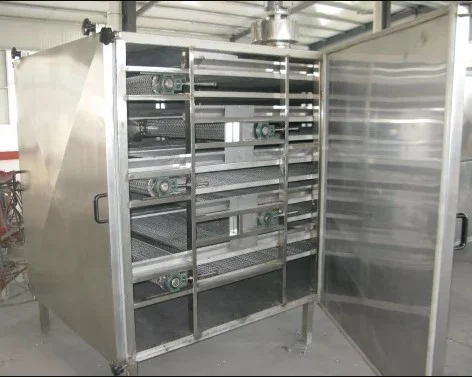
- Multi-Layer Belt Dryers (High Tonnage Processing):
Designed for high seasonal surges in key agricultural hubs (e.g., peak ginger and garlic harvests in Northern Thailand, or hot chillies in Isan).
- Fresh sliced ginger ($3\text{–}5\text{mm}$), sliced turmeric, or peeled garlic cloves are continuously loaded via a spreading belt onto top-tier stainless steel (SS304) mesh belts.
- Product moves horizontally and drops from upper to lower belts, automatically flipping spice layers to ensure uniform drying without manual intervention.
- Heat Pump Drying Systems (Batch / Multi-Crop Versatility):
Processing volume is limited by trolley and chamber dimensions.
- Ideal for high-value, heat-sensitive botanicals where retaining volatile oils, natural aesthetics, and bioactive compounds (e.g., curcumin in khamin, allicin in kratheim, or gingerol in khing) is prioritized over massive volume.
C. Factory Footprint & Civil Integration
- Continuous Belt Dryer Layout:
Requires long, dedicated factory bays ($18\text{m}\text{–}28\text{m}$ clear length including feed hoppers, vibration spreaders, cooling beds, and discharge conveyors). It serves as the primary processing anchor in integrated plants.
- Heat Pump System Layout:
Highly compact and modular. Facilities can start with a single 4-trolley or 8-trolley walk-in chamber ($15\text{–}30\text{ m}^2$) and scale capacity by adding adjacent drying rooms as production demands grow.
3. Technology Selection Framework for Thai Processors
What is your daily raw fresh crop intake target?
│
┌───────────────────────┴───────────────────────┐
▼ ▼
[ Exceeds 10 Tons / Day ] [ Under 10 Tons / Day ]
│ │
Continuous Multi-Layer Belt Dryer Closed-Loop Heat Pump System
│ │
• High-volume export processing (Chiang Mai/Isan) • Premium organic / herbal extracts
• Automated 24/7 continuous production line • Low-temperature aroma & color retention
• Integrated LPG / Steam / Biomass utility • Reduced electrical operating cost (PEA)
- Select a Multi-Layer Belt Dryer if: Your facility processes large daily volumes ($10\text{ to }100+\text{ tons/day}$) of fresh ginger, turmeric, garlic, or chillies, requiring integrated, automated, 24/7 continuous output to supply large seasoning manufacturers or export markets.
- Select a Heat Pump Dehydration System if: You process specialty organic spices, herbal extracts, or ready-to-use ingredients requiring strict color/aroma retention, high energy efficiency, and modular batch flexibility on a compact factory floor.
Targeting Thailand’s Agricultural & Food Hubs
Equipment design, energy integration, and customer support are aligned with Thailand’s main regional food processing centers:
Northern Thailand Agro-Processing Belt (Chiang Mai, Chiang Rai, Lamphun)
- Primary Crops: Ginger, Garlic, Turmeric, Herbal Extracts.
- Target Keywords: Ginger Dryer Chiang Mai, Garlic Dehydrator Lamphun, Herbal Processing Machinery Chiang Rai
Northeastern Isan Spice Region (Chaiyaphum, Si Sa Ket, Ubon Ratchathani)
- Primary Crops: Hot Chillies, Red Shallots, Spices.
- Target Keywords: Chilli Dryer Chaiyaphum, Shallot Dehydrator Si Sa Ket, Agro Dryer Ubon Ratchathani
Central & Eastern Food Manufacturing Hubs (Pathum Thani, Samut Prakan, Chonburi)
- Primary Focus: Export packaging centers, ready-to-eat seasoning manufacturers, and industrial curry paste processing plants.
- Target Keywords: Industrial Food Dryer Pathum Thani, Spice Processing Equipment Samut Prakan, Food Dehydration Plant Chonburi
Technical Project Sizing Parameters
To receive a custom heat load calculation, factory layout drawing, and commercial proposal for your facility in Thailand, please provide:
- Target Agricultural Crop: (e.g., Ginger, Turmeric, Chilli, Garlic, Shallot, or Multi-Crop)
- Material Preparation State: (Whole pods, sliced $3\text{–}5\text{mm}$, diced, or crushed)
- Daily Processing Input: (kg/hour OR tons/day of fresh raw harvest)
- Initial Moisture Content: (Approximate % upon loading, typically $80\%$)
- Target Final Moisture Content: (Typically $6\%$ to $10\%$ for grinding/packaging)
- Preferred Heating Energy Source: (LPG/Natural Gas, Steam Boiler, Biomass, Electric Heat Pump, or Hybrid)
- Facility Location: (Province / Industrial Estate in Thailand)
Why Partner with GTI Dryers?
GTI Dryers manufactures industrial thermal systems built for high performance in humid tropical environments across Southeast Asia.
- Precision Airflow Distribution: Custom air duct layouts eliminate cold spots and ensure uniform drying across all product layers.
- Sanitary Stainless Construction: Complete SS304/SS316 food-grade contact surfaces that conform to international FDA, GMP, and HACCP standards.
- Energy-Efficient Recirculation: Advanced heat recovery designs lower operating fuel costs per kilogram of evaporated moisture.
- Turnkey Engineering Service: End-to-end guidance covering capacity planning, thermal calculations, CAD installation layout, commissioning, and operator training.
Request an Engineering Proposal for Your Plant
Are you setting up a new spice processing line or upgrading existing drying equipment in Thailand?
Contact the GTI Dryers engineering team today with your crop type, daily throughput target, slice thickness, and fuel choice to receive a detailed process flow layout, thermal calculation, and commercial quotation.
สอบถามข้อมูลสำหรับโครงการในประเทศไทย (Thailand Project Inquiries):
หากท่านกำลังวางแผนโครงการแปรรูปและอบแห้งขิง ขมิ้น พริก กระเทียม หรือหอมแดง ในประเทศไทย ติดต่อทีมวิศวกรของ GTI Dryers วันนี้ เพื่อรับคำแนะนำทางเทคนิค การคำนวณประหยัดพลังงาน และข้อเสนอโครงการที่คุ้มค่าที่สุด